| Size | Price | Stock | Qty |
|---|---|---|---|
| 5mg |
|
||
| 10mg |
|
||
| 25mg |
|
||
| 50mg |
|
||
| 100mg |
|
||
| 250mg |
|
||
| 500mg | |||
| 1g | |||
| Other Sizes |


| Targets |
PIM1 (IC50 = 24 μM;(Ki = 0.6 μM); PIM2 (IC50 = 100 μM)
Pim-1 and Pim-2 serine/threonine kinases. For (Z)-SMI-4a, the IC50 values were: Pim-1 = 0.12 μM, Pim-2 = 0.56 μM (measured via radioactive kinase assay). It exhibited high selectivity over other oncogenic kinases (e.g., Src, Akt1, ERK2, JAK2) with IC50 > 10 μM, and no significant inhibition of class I histone deacetylases (HDAC1, HDAC2) at 10 μM [1] |
|---|---|
| ln Vitro |
In intact cells, SMI-4a treatment (0.5 μM; 1 hour; HEK-293T cells) attenuates autophosphorylation of tagged Pim-1 [1].
The present study aimed to explore the mechanism underlying the antitumor effect of SMI‑4a in K562 and imatinib‑resistant K562 (K562/G) cell lines. It was demonstrated that SMI‑4a inhibited the proliferation of K562 and K562/G cells using a WST‑8 assay. The Annexin V‑propidium iodide assay demonstrated that SMI‑4a induced apoptosis of K562 and K562/G cells in a dose‑, and time‑dependent manner. Furthermore, Hoechst 33342 staining was used to verify the apoptosis rate. The clone formation assay revealed that SMI‑4a significantly inhibited the colony formation capacity of K562 and K562/G cells. Western blot analysis demonstrated that SMI‑4a decreased phosphorylated (p)‑Ser9‑glycogen synthase kinase (GSK) 3β/pGSK3β and inhibited the translocation of β‑catenin. In addition, the downstream gene expression of apoptosis regulator Bax and poly(ADP‑ribose) polymerase‑1 was upregulated, and apoptosis regulator Bcl‑2 and Myc proto‑oncogene protein expression levels were downregulated. Immunofluorescence results demonstrated changes in the expression level of β‑catenin in the plasma and nucleus. The results of the present study suggest that SMI‑4a is an effective drug to use in combination with current chemotherapeutics for the treatment of imatinib-resistant CML.Reference: Mol Med Rep. 2017 Oct;16(4):4603-4612. https://pubmed.ncbi.nlm.nih.gov/28849186/ Enzymatic Activity: (Z)-SMI-4a (0.01 μM–10 μM) dose-dependently inhibited recombinant Pim-1 and Pim-2 kinase activity. At 0.12 μM, it reduced Pim-1-mediated phosphorylation of a synthetic peptide substrate (RRRVSYRRR) by 50% (IC50 = 0.12 μM); for Pim-2, 50% inhibition was achieved at 0.56 μM (IC50 = 0.56 μM) [1] - Cellular Proliferation: In human prostate cancer cell lines (DU145, LNCaP) with endogenous Pim kinase expression, (Z)-SMI-4a (1 μM–20 μM) treatment for 72 hours inhibited cell proliferation: IC50 = 3.2 μM (DU145), IC50 = 4.5 μM (LNCaP) via MTT assay. Western blot showed reduced phosphorylation of Pim substrate Bad (Ser112) by 45% at 5 μM in DU145 cells, confirming on-target activity [1] - Kinase Selectivity: At 10 μM, (Z)-SMI-4a showed <10% inhibition of 25 other kinases (including Src, Akt1, ERK2, JAK2, STAT3) and class I HDACs, demonstrating Pim-specific inhibition [1] |
| ln Vivo |
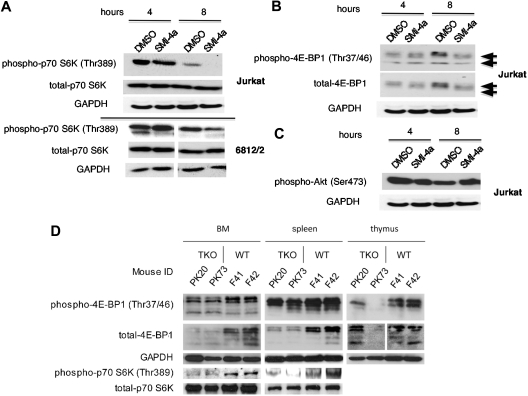
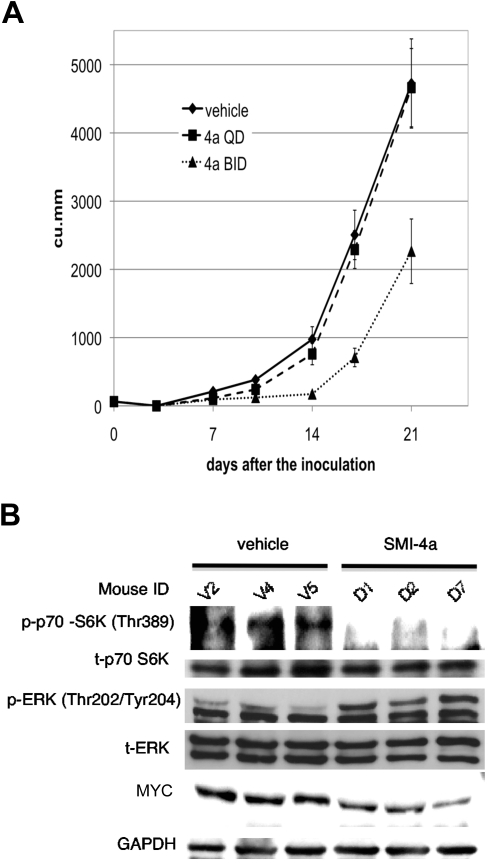
SMI-4a (60 mg/Kg) treatment twice daily significantly reduce tumor size and is well tolerated. Tumors harvested 1 hour after the final oral gavage of SMI-4a demonstrates decreased phosphorylation of p70 S6K compared with tumors from mice treated with vehicle, whereas in comparison total p70 S6K expression isunchanged.
|
| Enzyme Assay |
Pim Kinase Assays[1]
Pim protein kinase assays were conducted using multiple methods to ensure that the effects of the compounds were not due to any experimental artifacts. The primary screen and evaluation of the compounds shown in Table 3 was conducted using an ATP-depletion assay. Briefly, recombinant human Pim-1 was incubated with S6 kinase/Rsk-2 peptide 2 (KKRNRTLTK) as the substrate in the presence 100 µM of compounds from the screening library, 1 µM ATP and 10 mM MgCl2 for 1 h. The Kinase-Glo luciferase kit was used to measure residual ATP levels after the kinase reaction. For experiments that required higher ATP concentrations, Pim-1 kinase activity was monitored spectrophotometrically using a coupled assay in which ADP production is coupled to NADH oxidation catalyzed by pyruvate kinase and lactate dehydrogenase. Assays were carried out in 20 mM MOPS pH 7 containing 100 mM NaCl, 10 mM MgCl2, 2.5 mM phosphoenolpyruvate, 0.2 mM NADH, 30 µg/mL pyruvate kinase, 10 µg/mL lactate dehydrogenase, 2 mM dithiothreitol, 25 nM Pim-1, 100 µM S61 peptide, and varying concentrations of ATP. Activity was measured by monitoring NADH oxidation as the decrease at 340 nm in a VersaMax microplate reader (Molecular Devices) at 25 °C. Reactions were initiated by the addition of ATP (typically 100 µM). Inhibitors (final 1% DMSO) were added just prior to the addition of ATP. In either case, IC50 values were determined using nonlinear regression with the program GraphPad Prism. In some experiments, Pim-1 kinase activity was determined using His-tagged 4E-BP1 as the substrate. The active Pim-1 protein was resuspended in kinase reaction buffer (10 mM MOPS, pH 7.4, 100 µM ATP, 15 mM MgCl2, 1 mM Na3VO4, 1 mM NaF, 1 mM DTT, and protease inhibitor cocktail). In each reaction (30 µL), 3 µg of His-4E-BP1 protein was used as substrate, and 10 μCi of [γ-32P] ATP were then added. Incubation was carried out at 30 °C for 30 min with agitation. The samples were then subjected to SDS-PAGE and 32P labeled 4E-BP1 was visualized by autoradiography. Finally, Pim-1 activity in intact cells was measured in some experiments. HEK-293T cells were transfected with Flag-Pim-1 for 24 h, and then were trypsined and divided into smaller dishes for overnight. Cells were washed once and incubated with phosphate-free media containing 10% phosphate-free FBS for 1 h. Cells were then incubated in medium containing 50 μCi/ml [32P]orthophosphate for 4 h, in which the test compounds were added for the final 1 h. To immunoprecipitate Pim-1, anti-Flag M2 agarose was added to the cell lysate and incubated for 3 h. A portion (10%) of the immunoprecipitates was used for Western blotting with anti-Flag antibodies (input). The other 90% of each sample was subjected to SDS-PAGE, and 32P-labeled Pim-1 was visualized by autoradiography. Radioactive Pim Kinase Inhibition Assay: Recombinant human Pim-1 (residues 44–313) or Pim-2 (residues 38–326) was incubated with a synthetic peptide substrate (RRRVSYRRR for Pim-1; RRRLSYRRR for Pim-2, 20 μM) and [γ-³²P]-ATP (10 μM, 3000 Ci/mmol) in kinase buffer (25 mM Tris-HCl pH 7.5, 10 mM MgCl₂, 1 mM DTT, 0.1 mM Na₃VO₄). Serial dilutions of (Z)-SMI-4a (0.01 μM–10 μM) were added, and the mixture was incubated at 30°C for 45 minutes. The reaction was stopped by adding 30% trichloroacetic acid (TCA), and precipitated peptides were transferred to P81 phosphocellulose filters. Filters were washed 3 times with 1% phosphoric acid, and radioactivity was measured via liquid scintillation counting. IC50 values were calculated using four-parameter logistic regression [1] |
| Cell Assay |
Western Blot Analysis[1]
Cell Types: HEK-293T cells Tested Concentrations: 0.5 µM Incubation Duration: 1 hour Experimental Results: Caused a dose-dependent reduction in Pim-1-induced 4E-BP1 phosphorylation, with an IC50 of approximately 125 nM. MTT-Based Antiproliferation Assay: Human prostate cancer cells (DU145, LNCaP) were seeded in 96-well plates at a density of 5×10³ cells/well and allowed to attach overnight. Serial dilutions of (Z)-SMI-4a (0.5 μM–20 μM) or vehicle (DMSO, 0.1%) were added, and cells were incubated at 37°C with 5% CO₂ for 72 hours. MTT reagent (5 mg/mL) was added to each well (10 μL/well), and incubation continued for 4 hours. The medium was aspirated, and 150 μL DMSO was added to dissolve formazan crystals. Absorbance was measured at 570 nm, and cell viability was calculated relative to vehicle. IC50 values were determined via dose-response curve fitting [1] |
| Animal Protocol |
Dissolved in 65% DMSO, 30% PEG-400, 5% Tween-80; 75, 60 mg/kg; oral administration Nu/nu nude mice injected with pre-T-LBL cells
Antitumor Assay[1]
A syngeneic mouse tumor model that uses a transformed murine mammary adenocarcinoma cell line (JC, ATCC number CRL-2116) and Balb/C mice (Charles River) was performed as previously described. Tumor cells (1 × 10⁶) were implanted subcutaneously, and tumor volume was calculated using the equation: (L × W2)/2. Upon detection of tumors, mice were randomized into treatment groups. Treatment was then administered once per day, five days per week, thereafter consisting of intraperitoneal doses of 0 or 50 mg 16a/kg or vehicle (50% DMSO: 50% phosphate-buffered saline). Whole body weights and tumor volume measurements were performed three times per week. Treatment protocols: Female (NZB × NZW)F1 mice were orally treated with AZD1208 (15 mg/kg) or vehicle control (0.1% Tween 80 and 0.5% methyl cellulose in water) 19, 20 for 12 weeks (n = 10 mice per group), starting at age 22 weeks (at the time of onset of proteinuria). Mice were then placed under anesthesia and killed at age 34 weeks. Twelve-week-old MRL/lpr mice received the selective Pim-1 inhibitor SMI-4a (60 mg/kg) or vehicle control (DMSO/PEG-400/Tween 80) twice daily, as described previously 21. Oral gavage was administered on 5 of 7 days each week for 8 weeks (n = 10 mice per group). In an independent experiment, survival was observed in mice until age 30 weeks, and the survival rates were compared between 2 groups (n = 15 mice per group). Reference: Arthritis Rheumatol. 2019 Aug;71(8):1308-1318. https://onlinelibrary.wiley.com/doi/abs/10.1002/art.40863 |
| References | |
| Additional Infomation |
Pim protein kinase is frequently overexpressed in prostate cancer and certain types of leukemia and lymphoma. Screening revealed that 5-(3-trifluoromethylbenzyl)thiazolidin-2,4-dione (4a) is a Pim-1 inhibitor and attenuates the autophosphorylation of labeled Pim-1 in intact cells. Although 4a is a competitive inhibitor of ATP, screening of approximately 50 different protein kinases showed high selectivity for Pim kinase. Computer docking of 4a with Pim-1 provided a model for lead compound optimization, leading to the synthesis of a series of substituted thiazolidin-2,4-dione analogs. The most active new compound exhibited an IC50 of 13 nM for Pim-1 and 2.3 μM for Pim-2. Other compounds in this series showed selectivity exceeding 2500-fold and 400-fold for Pim-1 and Pim-2, respectively, while other homologues showed substantially similar activity for both isoenzymes. In summary, these compounds are novel Pim kinase inhibitors and may provide lead compounds for the development of novel anticancer drugs. [1] The development of targeted tyrosine kinase inhibitors (TKIs) has successfully altered the course of chronic myeloid leukemia (CML). However, many patients fail to respond to TKI treatment or experience disease relapse. The proviral integration site of Moloney murine leukemia virus-1 (PIM-1) is a serine/threonine kinase involved in regulating apoptosis, cell cycle, signal transduction, and transcriptional pathways that are associated with tumor progression and poor prognosis.
(Z)-SMI-4a is a synthetic small molecule Pim-1 and Pim-2 kinase inhibitor developed to investigate the role of Pim kinase in cancer cell proliferation and as a lead compound for the development of anticancer drugs [1] - Its mechanism of action involves competitive binding to the ATP-binding pocket of Pim kinase, thereby inhibiting its ability to phosphorylate downstream substrates (such as Bad), which regulate cell survival and proliferation [1] - The high selectivity of (Z)-SMI-4a for Pim kinase relative to other signal kinases minimizes off-target effects, making it a valuable chemical probe for studying the biology of Pim kinase [1] |
| Molecular Formula |
C11H6F3NO2S
|
|
|---|---|---|
| Molecular Weight |
273.23
|
|
| Exact Mass |
273.007
|
|
| Elemental Analysis |
C, 48.36; H, 2.21; F, 20.86; N, 5.13; O, 11.71; S, 11.73
|
|
| CAS # |
438190-29-5
|
|
| Related CAS # |
|
|
| PubChem CID |
1361334
|
|
| Appearance |
White to off-white solid powder
|
|
| Density |
1.5±0.1 g/cm3
|
|
| Index of Refraction |
1.602
|
|
| LogP |
2.3
|
|
| Hydrogen Bond Donor Count |
1
|
|
| Hydrogen Bond Acceptor Count |
6
|
|
| Rotatable Bond Count |
1
|
|
| Heavy Atom Count |
18
|
|
| Complexity |
406
|
|
| Defined Atom Stereocenter Count |
0
|
|
| SMILES |
S1C(N([H])C(/C/1=C(\[H])/C1C([H])=C([H])C([H])=C(C(F)(F)F)C=1[H])=O)=O
|
|
| InChi Key |
NGJLOFCOEOHFKQ-VMPITWQZSA-N
|
|
| InChi Code |
InChI=1S/C11H6F3NO2S/c12-11(13,14)7-3-1-2-6(4-7)5-8-9(16)15-10(17)18-8/h1-5H,(H,15,16,17)/b8-5+
|
|
| Chemical Name |
5-(3-(trifluoromethyl)benzylidene)thiazolidine-2,4-dione
|
|
| Synonyms |
TCS PIM-1 4a; SMI-4a; TCS PIM-1 4a; (Z)-SMI-4a; (5Z)-5-[3-(trifluoromethyl)benzylidene]-1,3-thiazolidine-2,4-dione; (Z)-5-(3-(trifluoromethyl)benzylidene)thiazolidine-2,4-dione; CHEMBL183906; SMI4a; SMI 4a
|
|
| HS Tariff Code |
2934.99.9001
|
|
| Storage |
Powder -20°C 3 years 4°C 2 years In solvent -80°C 6 months -20°C 1 month |
|
| Shipping Condition |
Room temperature (This product is stable at ambient temperature for a few days during ordinary shipping and time spent in Customs)
|
| Solubility (In Vitro) |
DMSO: 10 mM in DMSO
Water: 1 mg/mL (Insoluble) Ethanol: N/A |
|---|---|
| Solubility (In Vivo) |
Solubility in Formulation 1: 2 mg/mL (7.32 mM) in 0.5% CMC-Na/saline water (add these co-solvents sequentially from left to right, and one by one), Suspended solution; with ultrasonication.
Preparation of saline: Dissolve 0.9 g of sodium chloride in 100 mL ddH₂ O to obtain a clear solution. Solubility in Formulation 2: 5 mg/mL (18.30 mM) in 20% HP-β-CD in Saline (add these co-solvents sequentially from left to right, and one by one), Suspended solution. Preparation of saline: Dissolve 0.9 g of sodium chloride in 100 mL ddH₂ O to obtain a clear solution. (Please use freshly prepared in vivo formulations for optimal results.) |
| Preparing Stock Solutions | 1 mg | 5 mg | 10 mg | |
| 1 mM | 3.6599 mL | 18.2996 mL | 36.5992 mL | |
| 5 mM | 0.7320 mL | 3.6599 mL | 7.3198 mL | |
| 10 mM | 0.3660 mL | 1.8300 mL | 3.6599 mL |
*Note: Please select an appropriate solvent for the preparation of stock solution based on your experiment needs. For most products, DMSO can be used for preparing stock solutions (e.g. 5 mM, 10 mM, or 20 mM concentration); some products with high aqueous solubility may be dissolved in water directly. Solubility information is available at the above Solubility Data section. Once the stock solution is prepared, aliquot it to routine usage volumes and store at -20°C or -80°C. Avoid repeated freeze and thaw cycles.
Calculation results
Working concentration: mg/mL;
Method for preparing DMSO stock solution: mg drug pre-dissolved in μL DMSO (stock solution concentration mg/mL). Please contact us first if the concentration exceeds the DMSO solubility of the batch of drug.
Method for preparing in vivo formulation::Take μL DMSO stock solution, next add μL PEG300, mix and clarify, next addμL Tween 80, mix and clarify, next add μL ddH2O,mix and clarify.
(1) Please be sure that the solution is clear before the addition of next solvent. Dissolution methods like vortex, ultrasound or warming and heat may be used to aid dissolving.
(2) Be sure to add the solvent(s) in order.
SMI-4a treatment inhibits the phosphorylation of TORC1 substrates.Blood.2010 Jan 28;115(4):824-33. |
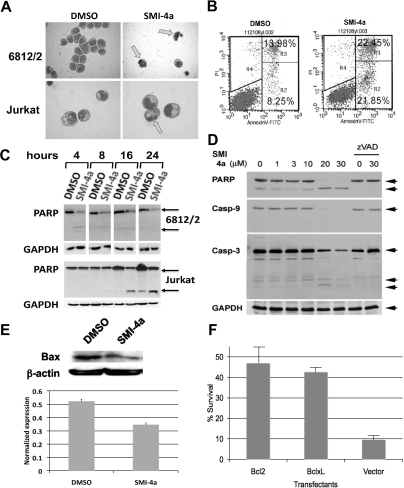
SMI-4a treatment induces apoptosis in pre–T-LBL.Blood.2010 Jan 28;115(4):824-33. |
ERK1/2 phosphorylation is increased by SMI-4a treatment.Blood.2010 Jan 28;115(4):824-33. |
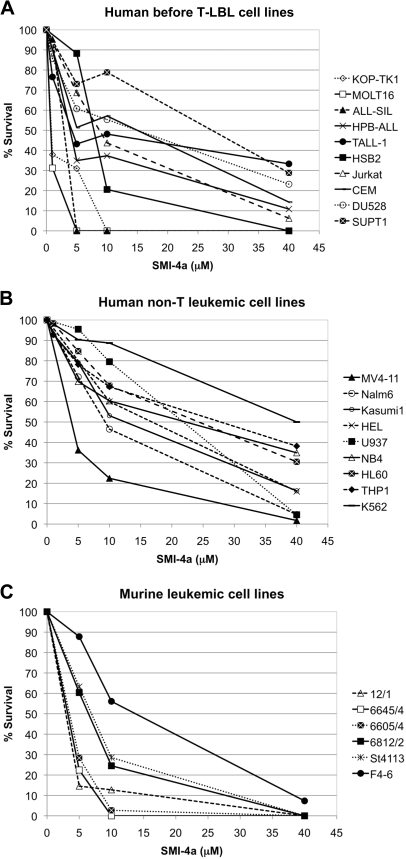
The sensitivity of leukemic cell lines to Pim kinase inhibitor SMI-4a.Blood.2010 Jan 28;115(4):824-33. |
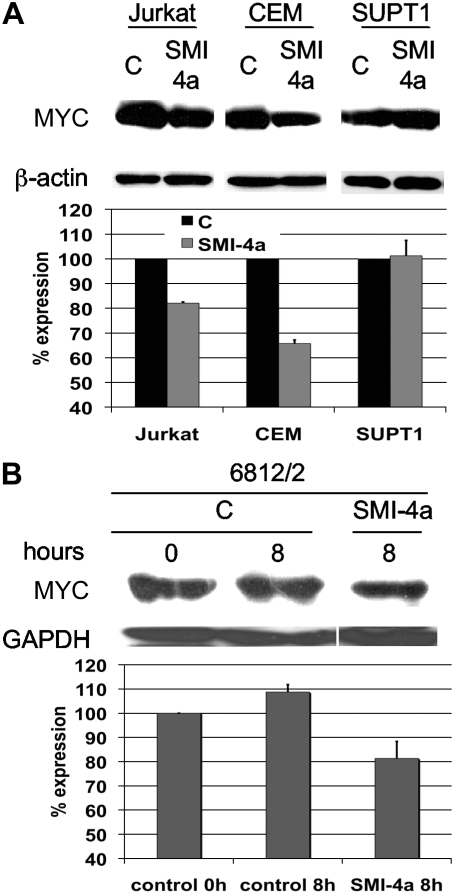
SMI-4a treatment of pre–T-LBL down-regulates the level of MYC protein.Blood.2010 Jan 28;115(4):824-33. |
The in vivo sensitivity of 6812/2 to SMI-4a treatment.Blood.2010 Jan 28;115(4):824-33. |
Products are for research use only; We do not sell to patients
Copyright 2020 InvivoChem LLC | All Rights Reserved