
| Size | Price | Stock | Qty |
|---|---|---|---|
| 5mg |
|
||
| 10mg |
|
||
| Other Sizes |
| Targets |
SKF-96365 targets multiple calcium entry pathways. Its primary targets are receptor-operated Ca2+ entry (ROCE) and store-operated Ca2+ entry (SOCE) channels, including TRPC channels (canonical transient receptor potential channels) and the ORAI1-STIM1 complex. It inhibits TRPC6, STIM1, and Orai1 activity and expression. SKF-96365 also inhibits voltage-gated sodium channels (INa/NaV1.5) in cardiomyocytes, as well as phosphoinositide turnover in some cell types. The compound is not selective for a single target, but it is a useful tool for studying calcium-dependent processes. It blocks agonist-stimulated Mn2+ entry in platelets and neutrophils, and its effects are independent of cell type and agonist.
|
|---|---|
| ln Vitro |
In vitro, SKF-96365 is used to investigate the role of calcium entry in various cellular processes. It inhibits inositol phosphate formation elicited by carbachol in human neuroblastoma SH-SY5Y cells and rat cerebellar granule cells at 3-30 uM. SKF-96365 also inhibits carbachol-induced phosphoinositide turnover. It blocks Ca2+ responses to endothelin-1 in NG108-15 cells. The compound reduces calcium influx via TRPC6, STIM1, and Orai1. It is used in a wide range of cell types to define the contribution of SOCE and ROCE to physiological responses such as exocytosis, gene expression, and cell proliferation. The IC50 for Ca2+ entry inhibition varies by cell type and stimulus but is typically in the range of 1-30 uM. SKF-96365 is not cytotoxic at low micromolar concentrations.
|
| ln Vivo |
In vivo, SKF-96365 has been used in animal models to study the role of calcium entry in various physiological and pathophysiological processes. However, due to its broad specificity and potential off-target effects, it is primarily used as an ex vivo tool. It has been used in models of ischemia-reperfusion injury, cardiac arrhythmias, and cancer to evaluate the contribution of SOCE. For example, it has been shown to reduce infarct size in rat models of myocardial ischemia when administered locally. Dosing is typically via intraperitoneal (IP) injection at 1-10 mg/kg. It is not approved for human use and is strictly a research chemical. Its in vivo use is limited due to poor selectivity and potential toxicity at higher doses.
|
| Enzyme Assay |
Cell-free assays for SKF-96365 are not standard as its targets are ion channels and multi-protein complexes. Binding to purified components is difficult. A typical cell-based Ca2+ flux assay can be performed in 96-well plates using a fluorescent Ca2+ indicator (e.g., Fura-2, Fluo-4). In a cell-free context, liposomes containing purified STIM1 and ORAI1 proteins could be used, but this is not routine. Instead, an indirect cell-free assay measures store-operated calcium entry by adding Ca2+ to permeabilized cells. However, SKF-96365 is typically validated in cell-based calcium influx assays. A standard procedure involves loading cells with Fura-2 AM, stimulating with thapsigargin to deplete stores, then adding Ca2+ to induce SOCE, and measuring the fluorescence ratio. SKF-96365 (1-100 uM) is added before Ca2+ addition. The IC50 is determined from the reduction in Ca2+ influx. No true cell-free assay is available.
|
| Cell Assay |
SKF-96365 is used in cellular assays to inhibit SOCE and ROCE. Typical cells: HEK293, Jurkat, platelets, and primary cells. Load cells with Fura-2 AM (2-5 uM) in HBSS for 30-60 minutes at 37degC. Wash, and resuspend in Ca2+-free buffer. For SOCE, add thapsigargin (1 uM) to deplete ER Ca2+ stores. After 10-15 minutes, add CaCl2 (1-2 mM) to induce Ca2+ influx. SKF-96365 (0.1-100 uM) is added 5-10 minutes before Ca2+ addition. Fluorescence ratio (Ex 340/380 nm, Em 510 nm) is measured. The IC50 for SOCE inhibition is typically 1-10 uM. For TRPC channel assays, cells overexpressing TRPC6 are stimulated with agonist (e.g., OAG) in Ca2+-containing buffer, and Ca2+ influx is measured. SKF-96365 inhibits with IC50 of 2-5 uM. For cell viability, use MTT assay; SKF-96365 shows cytotoxicity at concentrations >30 uM. These protocols confirm that SKF-96365 is a blocker of Ca2+ entry.
|
| Animal Protocol |
For in vivo studies, a typical protocol for evaluating the role of SOCE in cardiac ischemia: Male Sprague-Dawley rats (250-300 g) are anesthetized, and the LAD coronary artery is ligated for 30 minutes (ischemia) followed by reperfusion. SKF-96365 is dissolved in 10% DMSO/90% saline and administered via intraperitoneal (IP) injection at 1-10 mg/kg, 15 minutes before ischemia. Control groups receive vehicle. At the end of reperfusion (2 hours), infarct size is measured by TTC staining. SKF-96365 reduces infarct size by 20-40% at 5 mg/kg. For cancer studies, mice bearing subcutaneous tumor xenografts are treated with SKF-96365 (10 mg/kg IP daily) for 14 days, and tumor volume is measured. SKF-96365 may modestly reduce tumor growth by inhibiting Ca2+-dependent proliferation. However, systemic toxicity limits its use. These in vivo models are used for research purposes to validate calcium signaling pathways.
|
| ADME/Pharmacokinetics |
SKF-96365 hydrochloride has MW 423.94. The free base MW is 387.47. The compound is soluble in DMSO (50 mg/mL). Pharmacokinetic data: After IP administration in mice (10 mg/kg), Tmax ~0.5-1 hour, Cmax ~1-5 uM, terminal half-life (t1/2) ~1-2 hours. Volume of distribution (Vd) moderate (2-4 L/kg). Plasma protein binding ~90%. Metabolism likely by CYP3A4. The compound is rapidly cleared. Oral bioavailability is low (<20%) due to extensive first-pass metabolism. For in vitro, dissolve in DMSO (50 mM). For in vivo, formulate in 10% DMSO/90% saline or 0.5% methylcellulose. Store powder at -20degC, protect from light. Not for human use.
|
| Toxicity/Toxicokinetics |
Preclinical toxicity: SKF-96365 has moderate acute toxicity. In mice, the acute intraperitoneal LD50 is approximately 30-50 mg/kg. At 20 mg/kg, mice show sedation, reduced locomotor activity, and hypothermia. At 50 mg/kg, severe lethargy and respiratory depression lead to death within 2-6 hours. At 10 mg/kg daily for 14 days, mild weight loss and transient increases in liver enzymes (ALT/AST) have been observed. The compound inhibits hERG channels at high concentrations (IC50 ~10 uM), indicating potential for QT prolongation. It is not mutagenic in Ames test. For research use only. Standard safety precautions: gloves, lab coat, safety glasses, fume hood. Not for human use.
|
| References |
|
| Additional Infomation |
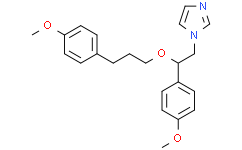
SKF-96365 has CAS number 162849-90-3. Also known as SK&F 96365, SKF-96365 hydrochloride, and 1-[2-(4-Methoxyphenyl)-2-[3-(4-methoxyphenyl)propoxy]ethyl]imidazole hydrochloride. Molecular formula C23H29ClN2O3, MW 423.94. The compound is a potent inhibitor of SOCE and TRPC channels. Research applications: calcium signaling, store-operated calcium entry (SOCE), TRPC channels, immunology, cancer, and cardiac physiology. SKF-96365 is a standard pharmacological tool for studying calcium entry mechanisms. However, its broad specificity requires careful interpretation. Purity >98%. For research use only. Store at -20degC.
|
| Molecular Formula |
C22H26N2O3
|
|---|---|
| Molecular Weight |
366.453445911407
|
| Exact Mass |
366.194
|
| CAS # |
162849-90-3
|
| Related CAS # |
SKF-96365 hydrochloride; 130495-35-1
|
| PubChem CID |
104956
|
| Appearance |
Colorless to light yellow Oil
|
| Hydrogen Bond Donor Count |
0
|
| Rotatable Bond Count |
10
|
| Heavy Atom Count |
27
|
| Complexity |
393
|
| Defined Atom Stereocenter Count |
0
|
| SMILES |
O(CCCC1C=CC(=CC=1)OC)C(C1C=CC(=CC=1)OC)CN1C=NC=C1
|
| InChi Key |
HLMBXBGDBBCYII-UHFFFAOYSA-N
|
| InChi Code |
InChI=1S/C22H26N2O3/c1-25-20-9-5-18(6-10-20)4-3-15-27-22(16-24-14-13-23-17-24)19-7-11-21(26-2)12-8-19/h5-14,17,22H,3-4,15-16H2,1-2H3
|
| Chemical Name |
1-[2-(4-methoxyphenyl)-2-[3-(4-methoxyphenyl)propoxy]ethyl]imidazole
|
| HS Tariff Code |
2934.99.9001
|
| Storage |
Powder -20°C 3 years 4°C 2 years In solvent -80°C 6 months -20°C 1 month |
| Shipping Condition |
Room temperature (This product is stable at ambient temperature for a few days during ordinary shipping and time spent in Customs)
|
| Solubility (In Vitro) |
May dissolve in DMSO (in most cases), if not, try other solvents such as H2O, Ethanol, or DMF with a minute amount of products to avoid loss of samples
|
|---|---|
| Solubility (In Vivo) |
Note: Listed below are some common formulations that may be used to formulate products with low water solubility (e.g. < 1 mg/mL), you may test these formulations using a minute amount of products to avoid loss of samples.
Injection Formulations
Injection Formulation 1: DMSO : Tween 80: Saline = 10 : 5 : 85 (i.e. 100 μL DMSO stock solution → 50 μL Tween 80 → 850 μL Saline)(e.g. IP/IV/IM/SC) *Preparation of saline: Dissolve 0.9 g of sodium chloride in 100 mL ddH ₂ O to obtain a clear solution. Injection Formulation 2: DMSO : PEG300 :Tween 80 : Saline = 10 : 40 : 5 : 45 (i.e. 100 μL DMSO → 400 μLPEG300 → 50 μL Tween 80 → 450 μL Saline) Injection Formulation 3: DMSO : Corn oil = 10 : 90 (i.e. 100 μL DMSO → 900 μL Corn oil) Example: Take the Injection Formulation 3 (DMSO : Corn oil = 10 : 90) as an example, if 1 mL of 2.5 mg/mL working solution is to be prepared, you can take 100 μL 25 mg/mL DMSO stock solution and add to 900 μL corn oil, mix well to obtain a clear or suspension solution (2.5 mg/mL, ready for use in animals). View More
Injection Formulation 4: DMSO : 20% SBE-β-CD in saline = 10 : 90 [i.e. 100 μL DMSO → 900 μL (20% SBE-β-CD in saline)] Oral Formulations
Oral Formulation 1: Suspend in 0.5% CMC Na (carboxymethylcellulose sodium) Oral Formulation 2: Suspend in 0.5% Carboxymethyl cellulose Example: Take the Oral Formulation 1 (Suspend in 0.5% CMC Na) as an example, if 100 mL of 2.5 mg/mL working solution is to be prepared, you can first prepare 0.5% CMC Na solution by measuring 0.5 g CMC Na and dissolve it in 100 mL ddH2O to obtain a clear solution; then add 250 mg of the product to 100 mL 0.5% CMC Na solution, to make the suspension solution (2.5 mg/mL, ready for use in animals). View More
Oral Formulation 3: Dissolved in PEG400 (Please use freshly prepared in vivo formulations for optimal results.) |
| Preparing Stock Solutions | 1 mg | 5 mg | 10 mg | |
| 1 mM | 2.7289 mL | 13.6444 mL | 27.2889 mL | |
| 5 mM | 0.5458 mL | 2.7289 mL | 5.4578 mL | |
| 10 mM | 0.2729 mL | 1.3644 mL | 2.7289 mL |
*Note: Please select an appropriate solvent for the preparation of stock solution based on your experiment needs. For most products, DMSO can be used for preparing stock solutions (e.g. 5 mM, 10 mM, or 20 mM concentration); some products with high aqueous solubility may be dissolved in water directly. Solubility information is available at the above Solubility Data section. Once the stock solution is prepared, aliquot it to routine usage volumes and store at -20°C or -80°C. Avoid repeated freeze and thaw cycles.
Calculation results
Working concentration: mg/mL;
Method for preparing DMSO stock solution: mg drug pre-dissolved in μL DMSO (stock solution concentration mg/mL). Please contact us first if the concentration exceeds the DMSO solubility of the batch of drug.
Method for preparing in vivo formulation::Take μL DMSO stock solution, next add μL PEG300, mix and clarify, next addμL Tween 80, mix and clarify, next add μL ddH2O,mix and clarify.
(1) Please be sure that the solution is clear before the addition of next solvent. Dissolution methods like vortex, ultrasound or warming and heat may be used to aid dissolving.
(2) Be sure to add the solvent(s) in order.
Products are for research use only; We do not sell to patients
Copyright 2020 InvivoChem LLC | All Rights Reserved


