| Size | Price | Stock | Qty |
|---|---|---|---|
| 5mg |
|
||
| 10mg |
|
||
| 25mg |
|
||
| 50mg |
|
||
| 100mg |
|
||
| Other Sizes |
Purity: ≥98%
| Targets |
TRPC4/TRPC5
ML204 hydrochloride shows 19-fold selectivity against muscarinic receptor-coupled TRPC6 channel activation and inhibits TRPC4β-mediated intracellular Ca2+ increase with an IC50 value of 0.96 μM (HEK293 cells)[1]. ML204 hydrochloride inhibits TRPC4β activity that is triggered by endogenous M3-like muscarinic receptors stimulating Gq/11 or Gi/o activation by μ-opioid, 5HT1A serotonin, and M2 muscarinic receptors[1]. LPS-induced TRPC5 channel activity is inhibited by ML204 hydrochloride[3]. |
|---|---|
| ln Vitro |
ML204 hydrochloride shows 19-fold selectivity against muscarinic receptor-coupled TRPC6 channel activation and inhibits TRPC4β-mediated intracellular Ca2+ increase with an IC50 value of 0.96 μM (HEK293 cells)[1]. ML204 hydrochloride inhibits TRPC4β activity that is triggered by endogenous M3-like muscarinic receptors stimulating Gq/11 or Gi/o activation by μ-opioid, 5HT1A serotonin, and M2 muscarinic receptors[1]. LPS-induced TRPC5 channel activity is inhibited by ML204 hydrochloride[3].
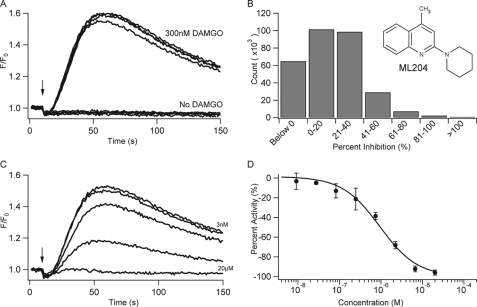
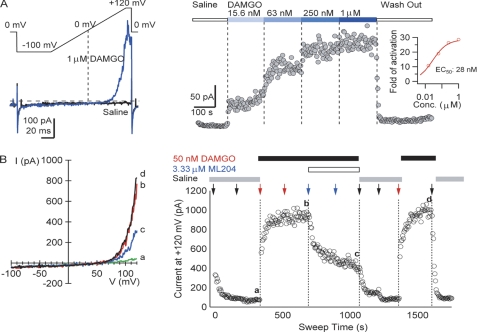
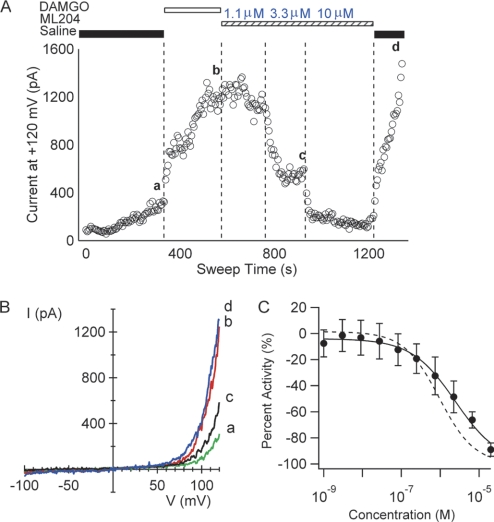
In a fluorescence-based Ca²⁺ assay using HEK293 cells co-expressing mouse TRPC4β and μ-opioid receptors, ML204 inhibited DAMGO-induced intracellular Ca²⁺ rise with an IC₅₀ of 0.96 ± 0.26 µM. Complete inhibition was achieved at 20 µM. [1] In automated whole-cell patch clamp (QPatch16) recordings, ML204 blocked TRPC4β currents activated by 50 nM DAMGO with an IC₅₀ of ≈2.9–3.55 µM. [1] ML204 (3.33 µM) also blocked TRPC4β currents activated by intracellular dialysis of GTPγS (IC₅₀ ≈ 2.85 µM), indicating a direct effect on the channel independent of GPCR signaling. [1] In manual patch clamp recordings, 10 µM ML204 nearly completely blocked currents through guinea pig TRPC4β channels activated by 10 µM carbachol. [1] ML204 (10 µM) exhibited modest inhibition (≈38%) of TRPC6 currents activated via M₅ muscarinic receptors but showed no appreciable block of TRPC6 currents activated directly by 10 µM OAG. [1] In a membrane potential assay, ML204 blocked acetylcholine-induced TRPC6-mediated depolarization with an IC₅₀ of 18.4 µM. [1] ML204 (10 µM) significantly blocked native muscarinic receptor-activated cation currents (mIₐₐₜ) in freshly isolated guinea pig ileal smooth muscle cells, inhibiting carbachol (100 µM)-evoked currents by 86 ± 2% and GTPγS (200 µM)-induced currents by 65 ± 4%. [1] In broad profiling studies (Ricerca Lead Profiling Screen of 68 targets at 10 µM), ML204 showed >50% inhibition in only 7 out of 68 binding assays. [1] |
| ln Vivo |
In LPS-injected mice, ML204 hydrochloride (1 mg/kg; sc; twice a day; for 5 days) reduces peritoneal leukocyte counts and cytokines and causes mortality linked to worsened hypothermia[4]. Dual TRPC4/TRPC5 blockade by ML204 increased mortality and hypothermia in thioredoxin-treated LPS mice but preserved macrophage's ability to phagocytose. TRPC5 deletion did not alter body temperature but promoted additional accumulation of peritoneal leukocytes and inflammatory mediator release in thioredoxin-administered LPS mice. Thioredoxin diminished macrophage-mediated phagocytosis in wild-type but not TRPC5 knockout animals. TRPC5 ablation did not affect LPS-induced responses. However, ML204 caused mortality associated with exacerbated hypothermia and decreased peritoneal leukocyte numbers and cytokines in LPS-injected mice. These results suggest that bacterial thioredoxin effects under LPS stimuli are mediated by TRPC4 and TRPC5, shedding light on the additional mechanisms of bacterial virulence and on the pathophysiological roles of these receptors.
Notably, ML204-perfused mice were protected from PS-induced FPE (Figure 7A). These results were quantified in a blinded fashion by counting the number of FPs over a measured length of GBM in TEM images (n = 90–105 images per group). By this analysis, ML204-perfused mice showed significant protection from the effects of PS (Figure 7B). These results are in line with our observations in Trpc5-KO mice.[3] Next, we tested the effect of ML204 in the LPS model. ML204 was injected (20 mg/kg/d i.p.) twice at 12-hour intervals after injection of LPS. Control PBS-injected mice had no observable structural changes and no albuminuria (Figure 7, C–E). LPS injection resulted in FPE (Figure 7D), although this was milder than the PS-induced FPE. Importantly, the ML204-treated mice were protected from LPS-induced FPE and albuminuria[3]. In a vascular perfusion model, co-perfusion of ML204 (10 µM) with protamine sulfate (PS) in wild-type mice preserved foot processes (FPs) and protected from PS-induced foot process effacement (FPE), similar to HBSS controls.[3] In an LPS-induced albuminuria model, treatment of wild-type mice with ML204 (20 mg/kg/day, intraperitoneal injection) mitigated LPS-induced foot process effacement (FPE).[3] Treatment with ML204 (20 mg/kg/day, i.p.) significantly reduced LPS-induced albuminuria in wild-type mice.[3] |
| Enzyme Assay |
ML204 has a 19-fold coupling to muscarinic receptor-coupled TRPC6 channel activation and inhibits TRPC4β-mediated intracellular Ca2+ rise with an IC50 value of 0.96 μM (HEK293 cells) [1]. The activation of Gq/11 by the M2 muscarinic receptor or endogenous M3-like muscarinic receptor, u-opioid, 5HT1A hematin, Gi/o, and TRPC4β is blocked by ML204[1]. ML204 inhibits TRPC5 channel activity that is triggered by LPS [3].
ML204 was identified as a novel TRPC4 channel inhibitor following a high throughput fluorescent screen of the MLSMR library and SAR analysis of active compounds. ML204 inhibited calcium influx through TRPC4 channels activated by μ-opioid receptor stimulation with an IC50 value of 0.96 μM and exhibited 19-fold selectivity against TRPC6 channels in similar fluorescent assays. ML204 blocked TRPC4 channels in an electrophysiological assay with an IC value of 2.6 μM and was also active in fluorescent and electrophysiological assays in which TRPC4 channels were activated by different mechanisms, indicating direct block of TRPC4 channels. Selectivity for block of TRPC4 channels was examined in fluorescent and electrophysiological experiments against closely related TRPC channels and more distantly related TRPV, TRPA and TRPM channels, and against non-TRP ion channels. ML204 afforded good selectivity (19-fold) against TRPC6 channels and more modest selectivity against TRPC3 and TRPC5 (9-fold) channels. Little or no block of TRPV, TRPA, TRPM or voltage-gated ion channels was observed. ML204 exhibited properties useful for a variety of in vitro investigations[2]. Rac1 activation assay.[3] Rac1 activation assays were done as previously described, with some modifications. Podocytes were treated with 300 μg/ml PS for 1 hour, followed by harvest and Rac1 pulldown experiments. In the ML204 experiments, cells were pretreated with 30 μM ML204 for 20 minutes before PS was applied. Activated Rac1 was analyzed with a commercial Rac1 activation assay kit using a GST-tagged fusion protein corresponding to the p21-binding domain (PBD; residues 67–150) of human PAK-1, according to the manufacturer’s instructions. After pulldown, the eluted active Rac1 was detected by immunoblotting using a mouse monoclonal Rac1 antibody. Total Rac1 and GADPH were measured in the cell lysates used for the pulldown studies and served as loading controls. Electrophysiology.[3] Patch-clamp electrophysiology was performed in the whole-cell configuration or on outside-out patches. Patch pipettes with resistances of 3–4 MΩ were pulled from borosilicate glass with a P-97 puller and filled with a solution containing 135 mM CH3SO3Cs, 10 mM CsCl, 3 mM MgATP, 0.2 mM NaGTP, 0.2 mM EGTA, 0.13 mM CaCl2, and 10 mM HEPES (pH 7.3) with CsOH. The bath solution contained 135 mM CH3SO3Na, 5 mM CsCl, 2 mM CaCl2, 1 mM MgCl2, 10 mM HEPES, and 10 mM glucose (pH 7.4) with NaOH. Angiotensin II (500 nM), LPS (100 μg/ml), and ML204 (10 μM) were applied to the bath solution. Whole-cell currents were recorded from –100 mV to +100 mV voltage ramps over 400 ms and a holding potential of –60 mV. For single-channel recordings in the outside-out configuration, we used a voltage step protocol from –100 mV to +100 mV delivered at 20-mV intervals and a holding potential of 0 mV. Average pipette resistance filled with pipette solution was 3–5 MΩ. Data were sampled at 10 kHz and filtered at 5 kHz. Single-channel data were further off-line filtered at 500 Hz before analysis. In single-channel traces, currents were idealized using a manually defined amplitude criterion to assign ion channel opening and closing transitions. Ensemble averages were expressed as Po (average current divided by unitary current amplitude and number of channels per patch) and plotted as histograms. All data were acquired at room temperature and analyzed using pClamp 10. |
| Cell Assay |
PS, LPS, and Cch treatment of cultured podocytes.[3]
Differentiated cultured podocytes grown at >90% confluence were incubated with 1–30 μM ML204 for 20 minutes, and then exposed to 300 μg/ml PS, 100 μg/ml LPS, or 100 μM Cch as appropriate. For PS experiments, as soon as changes in cell morphology could be seen by light microscopy (70–90 min), cells were fixed with 4% paraformaldehyde in PBS for 15 minutes before permeabilization with 0.1% Triton X-100 for 10 minutes. For LPS and Cch experiments, cells were fixed as above at 24 hours after treatment. For immunostaining, podocytes were incubated with synaptopodin “NT” antibody and detected with Alexa Fluor 488–conjugated secondary antibody. Actin structures were labeled with Alexa Fluor 594–conjugated phalloidin as described previously. 3 independent trials were analyzed, with 3 dishes per condition in each trial and 10 images per dish with comparable cell density. A total of 1,600–2,000 cells was analyzed for the PS/ML204 experiment and 1,400–1,600 cells for the PS/KD experiments. A total of 1,000 cells was analyzed for the LPS experiment and 1,400 cells for the Cch experiment. The number of cells was counted by DAPI staining and analysis with an automated script in ImageJ, which was subsequently corrected manually. Affected cells were defined as either collapsed with a very bright, condensed actin staining (for PS experiments), or cells without clearly visible stress fibers (for LPS and Cch experiments), as previously described. Images were acquired with a Zeiss LSM510 upright confocal microscope. Images from an optical slice of 3–4 μm were acquired using Zeiss Pascal software. Statistical significance was evaluated by ANOVA and Dunnett’s multiple-comparison test. Primary High-Throughput Fluorescence Ca²⁺ Screen: A stable HEK293 cell line co-expressing mouse TRPC4β and μ-opioid receptors was used. Cells were seeded in 384-well plates, loaded with Fluo4-AM, and stimulated with DAMGO. Test compounds were added before agonist addition. Intracellular Ca²⁺ changes were monitored using a fluorescence plate reader. [1] Selectivity Screening via Fluorescence Ca²⁺ Assay: HEK293 cells stably expressing various TRP channels (TRPV1, TRPV3, TRPM8, TRPA1) were seeded in 96-well plates, loaded with Fluo4-AM, and exposed to respective channel agonists. Ca²⁺ influx was measured to assess compound effects. [1] Membrane Potential Assay for TRPC6: HEK293 cells stably expressing TRPC6 (with endogenous muscarinic receptors) were loaded with a membrane potential-sensitive dye. Cells were stimulated with acetylcholine, and membrane depolarization was measured in the presence or absence of test compounds. [1] Automated Patch Clamp (QPatch16): HEK293 cells stably expressing TRPC4β and μ-OR were prepared as a single-cell suspension. Whole-cell currents were recorded using a voltage ramp protocol. Agonists (DAMGO) and compounds were applied via perfusion. [1] Manual Whole-Cell Patch Clamp for TRPC Channels: HEK293 cells heterologously expressing specific TRPC channels (with or without co-expressed GPCRs) were voltage-clamped. Currents were elicited by voltage ramps. Drugs were applied via a gravity-driven perfusion system. [1] Electrophysiology on Native Neurons: Dorsal root ganglion neurons from mice were cultured. Voltage-gated Na⁺, K⁺, and Ca²⁺ channel currents were recorded using specific voltage step protocols in the presence or absence of ML204. [1] Electrophysiology on Native Smooth Muscle Cells: Ileal smooth muscle myocytes were freshly isolated from guinea pigs. Whole-cell recordings were performed to measure mIₐₐₜ induced by bath-applied carbachol or intracellular GTPγS infusion. ML204 was applied via perfusion. [1] |
| Animal Protocol |
Animal/Disease Models: Nonfasted male C57BL/6 (2 -3 months)[4]
Doses: 1 mg/kg Route of Administration: subcutaneous (sc) injection, twice a day, for 5 days (prior to LPS injection) Experimental Results: Induces mortality associated with increased hypothermia in mice with LPS-induced systemic inflammatory response. LPS-induced albuminuria.[3] Induction of albuminuria in male WT and Trpc5-KO mice (20–25 g BW) by LPS injection was done as previously described, with some modifications. At 48 hours prior to injection, baseline urine was collected for 24 hours in metabolic cages. LPS (15 μg/g i.p., 1 mg/ml) was injected twice, at the 0- and 24-hour time points. PBS was injected i.p. twice, at 12 and 36 hours, to avoid dehydration. ML204 (20 mg/kg/d i.p.) was injected at 12 and 24 hours. Urine was collected for a 24-hour period beginning 24 hours after initial LPS injection using metabolic cages. To quantify the levels of albuminuria, 10 μl urine was analyzed by SDS-PAGE. Bovine serum albumin standards (0.25, 0.5, 1.0, 2.5, and 5.0 μg) were run on the same gel and used to identify and quantify urinary albumin bands. Coomassie signals were quantified using ImageJ. The resulting values — the product of area size and mean gray value of each albumin standard band — were used for construction of a standard curve and its associated mathematical function. Subsequently, the values of the sample bands were translated into albumin concentrations, which were extrapolated to the 24-hour total urine volume. Results were assessed by ANOVA and Bonferroni’s multiple-comparison test. For preparation of glomerular lysates for Western blotting, mice were treated as above and killed 36 hours after initial LPS injection. Mouse kidneys were perfused through the renal artery with Dynabeads for magnetic isolation of highly purified glomeruli. Protein extraction from isolated glomeruli, SDS-PAGE, and Western blotting was done as described previously, and proteins were detected with appropriate primary and secondary antibodies. PS model.[3] Adult WT (n = 15) and Trpc5-KO (n = 7) littermate mice were anesthetized with pentobarbital and placed on a heat pad set at 37°C, and their kidneys were perfused in situ through the renal artery at a pressure of approximately 240 mm Hg and an infusion rate of 9 ml/min as previously described (58), with some modifications. First, kidneys were flushed with HBSS or with HBSS plus 10 μM ML204 at 37°C for 2 minutes, followed by perfusion with 2 mg/ml PS in HBSS or with PS plus ML204 at 37°C for 15 minutes. All vascular perfusion solutions were kept at 37°C throughout the duration of the experiment. Pharmacological Treatments[4] C57BL/6, TRPC5+/+, and TRPC5−/− mice received a subcutaneous (s.c.) injection of phosphate-buffered saline (PBS) containing bacterial Trx (20 μg/150 μl/animal, twice a day; from E. coli) for 3 days prior to the induction of SIRS. In order to assess the role of TRPC4 and TRPC5 complexes in LPS-induced responses, C57BL/6 mice received ML204 [16, 21] (1 mg/kg, 150 μl/animal, twice a day) for 5 days and then LPS. In a separate set of experiments, C57BL/6 animals received ML204 (1 mg/kg, twice a day; in 6% dimethyl sulfoxide (DMSO) in PBS) for 2 days alone, and then, this drug was coinjected with bacterial Trx (20 μg/animal, twice a day) for another 3 days prior to LPS challenge. Vehicle-treated mice were used as controls. In the protamine sulfate (PS) perfusion model, adult wild-type mice were anesthetized, and kidneys were perfused in situ through the renal artery. Kidneys were first flushed with HBSS or HBSS containing 10 µM ML204 for 2 minutes, followed by perfusion with 2 mg/ml PS in HBSS or PS plus ML204 for 15 minutes. All solutions were kept at 37°C. Kidneys were then fixed for TEM analysis.[3] In the LPS-induced albuminuria model, male wild-type mice were injected intraperitoneally with LPS (15 µg/g) twice at 0 and 24 hours. ML204 (20 mg/kg/day, i.p.) was administered at 12 and 24 hours after the initial LPS injection. Control groups received PBS. Urine was collected in metabolic cages starting 24 hours post-LPS for albumin quantification. Kidneys were harvested 36 hours post-LPS for glomerular isolation and analysis.[3] |
| References |
|
| Additional Infomation |
Transient receptor potential (TRPC) channels are non-selective cation channels permeable to calcium ions (Ca²⁺) and involved in various physiological functions, including smooth muscle contraction and synaptic transmission. However, the lack of highly effective selective TRPC channel inhibitors has limited in-depth research into the roles of these channels in physiological systems. This article reports the identification and characterization of a novel, highly effective selective TRPC4 channel inhibitor, ML204. We performed high-throughput fluorescence screening on 305,000 compounds in a small molecular library to identify inhibitors that could block the increase in intracellular Ca²⁺ following stimulation of mouse TRPC4β channels by μ-opioid receptors. ML204 inhibited the increase in intracellular Ca²⁺ mediated by TRPC4β with an IC₅₀ value of 0.96 μM and exhibited 19-fold selectivity for activation of muscarinic receptor-coupled TRPC6 channels. In whole-cell patch-clamp recordings, ML204 blocked TRPC4β currents activated by μ-opioid receptor stimulation or intracellular dialysis with guanosine 5'-3-O-(thio)triphosphate (GTPγS), indicating that ML204 interacts directly with TRPC4 channels rather than interfering with signal transduction pathways. Selective studies showed that 10–20 μM ML204 had no significant blocking effect on TRPV1, TRPV3, TRPA1, and TRPM8 in mouse dorsal root ganglion neurons, as well as on KCNQ2 and native voltage-gated sodium, potassium, and calcium channels. In isolated guinea pig ileal muscle cells, ML204 blocked muscarinic cation currents activated by perfusion of carbachol or intracellular perfusion of GTPγS, demonstrating its effectiveness against native TRPC4 currents. Therefore, ML204 is an excellent novel tool for studying TRPC4 channel function and may facilitate the development of therapeutics targeting TRPC4. [1] ML204 is a novel TRPC4 channel inhibitor identified through high-throughput fluorescence screening and structure-activity relationship analysis of active compounds in an MLSMR compound library. ML204 inhibits calcium ion influx into the μ-opioid receptor-activated TRPC4 channel with an IC50 of 0.96 μM and exhibits 19-fold selectivity for the TRPC6 channel in similar fluorescence assays. ML204 blocks the TRPC4 channel in electrophysiological assays with an IC50 of 2.6 μM and is also active in fluorescence and electrophysiological assays of TRPC4 channels activated by different mechanisms, indicating that it can directly block the TRPC4 channel. We tested the selectivity of ML204 for blocking the TRPC4 channel through fluorescence and electrophysiological experiments and compared it with closely related TRPC channels, more distantly related TRPV, TRPA, and TRPM channels, and non-TRP ion channels. ML204 showed good selectivity for TRPC6 channels (19-fold) and slightly lower selectivity for TRPC3 and TRPC5 channels (9-fold). No blocking effect on TRPV, TRPA, TRPM, or voltage-gated ion channels was observed. ML204 is suitable for a variety of in vitro studies. [2]
Intact renal filtration function is essential for the retention of essential proteins in the blood and the removal of waste products from the body. Damage to the filtration barrier leads to the loss of albumin in urine, a hallmark of cardiovascular disease and renal failure. We found that the ion channel TRPC5 mediates damage to the filtration barrier. Using Trpc5 knockout mice, small molecule inhibitors of TRPC5, imaging of isolated Ca2+ in the glomeruli, and in vivo imaging of podocyte actin dynamics, we determined that the loss or inhibition of TRPC5 blocks the remodeling of the podocyte cytoskeleton. Inhibition or loss of TRPC5 prevents the activation of the small GTP-binding protein Rac1 and stabilizes synaptic proteins. Importantly, deletion or pharmacological inhibition of TRPC5 protected mice from proteinuria. These data suggest that the calcium permeability channel TRPC5 is a key determinant of proteinuria and identify TRPC5 inhibition as a potential therapeutic strategy for the prevention or treatment of proteinuric nephropathy. [3] Thioredoxins play a crucial role in bacterial antioxidant mechanisms and virulence; however, their regulatory role in the host is not fully understood. Reduction of human thioredoxin (Trx) activates transient receptor potential classical 5 (TRPC5) in inflammation, but there is no evidence that these receptors mediate the role of bacterial thioredoxins in the host. Importantly, TRPC5 can form functional complexes with other subunits, such as TRPC4. In this study, thioredoxins from E. coli induced death in mice injected with lipopolysaccharide (LPS) with reduced leukocyte aggregation, regulation of cytokine release into the peritoneum, and impaired peritoneal macrophage-mediated phagocytosis. [4] ML204 was discovered from a high-throughput screening of 305,000 compounds in the Small Molecule Library of Molecular Libraries (MLSMR). [1] It is reported to be the first highly efficient and selective small molecule blocker of the TRPC4 channel. [1] The compound acts as a direct channel blocker rather than interfering with the upstream GPCR signaling pathway. [1] Structure-activity relationship (SAR) studies have shown that the small alkylamine substituents on the left (e.g., piperidine, pyrrolidine) and limited modifications on the quinoline ring on the right are crucial to the activity. [1] ML204 is considered an excellent pharmacological tool for studying the function of TRPC4/C5 channels in natural tissues and may facilitate the development of therapeutics targeting these channels. [1] |
| Molecular Formula |
C15H19CLN2
|
|
|---|---|---|
| Molecular Weight |
262.777762651443
|
|
| Exact Mass |
262.123
|
|
| CAS # |
2070015-10-8
|
|
| Related CAS # |
5465-86-1;2070015-10-8 (HCl);
|
|
| PubChem CID |
49786978
|
|
| Appearance |
White to off-white solid powder
|
|
| Hydrogen Bond Donor Count |
1
|
|
| Hydrogen Bond Acceptor Count |
2
|
|
| Rotatable Bond Count |
1
|
|
| Heavy Atom Count |
18
|
|
| Complexity |
247
|
|
| Defined Atom Stereocenter Count |
0
|
|
| SMILES |
Cl.N1(C2C=C(C)C3C=CC=CC=3N=2)CCCCC1
|
|
| InChi Key |
QCABWRXQHZUBPW-UHFFFAOYSA-N
|
|
| InChi Code |
InChI=1S/C15H18N2.ClH/c1-12-11-15(17-9-5-2-6-10-17)16-14-8-4-3-7-13(12)14;/h3-4,7-8,11H,2,5-6,9-10H2,1H3;1H
|
|
| Chemical Name |
|
|
| Synonyms |
|
|
| HS Tariff Code |
2934.99.9001
|
|
| Storage |
Powder -20°C 3 years 4°C 2 years In solvent -80°C 6 months -20°C 1 month Note: Please store this product in a sealed and protected environment, avoid exposure to moisture. |
|
| Shipping Condition |
Room temperature (This product is stable at ambient temperature for a few days during ordinary shipping and time spent in Customs)
|
| Solubility (In Vitro) |
|
|||
|---|---|---|---|---|
| Solubility (In Vivo) |
Note: Listed below are some common formulations that may be used to formulate products with low water solubility (e.g. < 1 mg/mL), you may test these formulations using a minute amount of products to avoid loss of samples.
Injection Formulations
Injection Formulation 1: DMSO : Tween 80: Saline = 10 : 5 : 85 (i.e. 100 μL DMSO stock solution → 50 μL Tween 80 → 850 μL Saline)(e.g. IP/IV/IM/SC) *Preparation of saline: Dissolve 0.9 g of sodium chloride in 100 mL ddH ₂ O to obtain a clear solution. Injection Formulation 2: DMSO : PEG300 :Tween 80 : Saline = 10 : 40 : 5 : 45 (i.e. 100 μL DMSO → 400 μLPEG300 → 50 μL Tween 80 → 450 μL Saline) Injection Formulation 3: DMSO : Corn oil = 10 : 90 (i.e. 100 μL DMSO → 900 μL Corn oil) Example: Take the Injection Formulation 3 (DMSO : Corn oil = 10 : 90) as an example, if 1 mL of 2.5 mg/mL working solution is to be prepared, you can take 100 μL 25 mg/mL DMSO stock solution and add to 900 μL corn oil, mix well to obtain a clear or suspension solution (2.5 mg/mL, ready for use in animals). View More
Injection Formulation 4: DMSO : 20% SBE-β-CD in saline = 10 : 90 [i.e. 100 μL DMSO → 900 μL (20% SBE-β-CD in saline)] Oral Formulations
Oral Formulation 1: Suspend in 0.5% CMC Na (carboxymethylcellulose sodium) Oral Formulation 2: Suspend in 0.5% Carboxymethyl cellulose Example: Take the Oral Formulation 1 (Suspend in 0.5% CMC Na) as an example, if 100 mL of 2.5 mg/mL working solution is to be prepared, you can first prepare 0.5% CMC Na solution by measuring 0.5 g CMC Na and dissolve it in 100 mL ddH2O to obtain a clear solution; then add 250 mg of the product to 100 mL 0.5% CMC Na solution, to make the suspension solution (2.5 mg/mL, ready for use in animals). View More
Oral Formulation 3: Dissolved in PEG400 (Please use freshly prepared in vivo formulations for optimal results.) |
| Preparing Stock Solutions | 1 mg | 5 mg | 10 mg | |
| 1 mM | 3.8055 mL | 19.0273 mL | 38.0546 mL | |
| 5 mM | 0.7611 mL | 3.8055 mL | 7.6109 mL | |
| 10 mM | 0.3805 mL | 1.9027 mL | 3.8055 mL |
*Note: Please select an appropriate solvent for the preparation of stock solution based on your experiment needs. For most products, DMSO can be used for preparing stock solutions (e.g. 5 mM, 10 mM, or 20 mM concentration); some products with high aqueous solubility may be dissolved in water directly. Solubility information is available at the above Solubility Data section. Once the stock solution is prepared, aliquot it to routine usage volumes and store at -20°C or -80°C. Avoid repeated freeze and thaw cycles.
Calculation results
Working concentration: mg/mL;
Method for preparing DMSO stock solution: mg drug pre-dissolved in μL DMSO (stock solution concentration mg/mL). Please contact us first if the concentration exceeds the DMSO solubility of the batch of drug.
Method for preparing in vivo formulation::Take μL DMSO stock solution, next add μL PEG300, mix and clarify, next addμL Tween 80, mix and clarify, next add μL ddH2O,mix and clarify.
(1) Please be sure that the solution is clear before the addition of next solvent. Dissolution methods like vortex, ultrasound or warming and heat may be used to aid dissolving.
(2) Be sure to add the solvent(s) in order.
Fluorescent assay for TRPC4β channels used to identify and characterize ML204.J Biol Chem.2011 Sep 23;286(38):33436-46. |
Activation of heterologously expressed TRPC4 channels and its inhibition by ML204.J Biol Chem.2011 Sep 23;286(38):33436-46. |
ML204 blocks TRPC4 current elicited by different activation mechanisms. |
Products are for research use only; We do not sell to patients
Copyright 2020 InvivoChem LLC | All Rights Reserved


 COA
COA