| Size | Price | Stock | Qty |
|---|---|---|---|
| 25mg |
|
||
| 50mg |
|
||
| 100mg |
|
||
| 250mg |
|
||
| 500mg |
|
||
| Other Sizes |


Purity: ≥98%
| Targets |
IC50: 300 nM (MLCK)[1]
ML-7 targets myosin light chain kinase (MLCK), a calcium/calmodulin-dependent kinase that phosphorylates the regulatory light chain of myosin II. It has a Ki value of 0.3 µM and an IC₅₀ of 300 nM. It shows >10 µM IC₅₀ for the TRPC6 channel. By inhibiting MLCK, it prevents myosin light chain phosphorylation, reducing smooth muscle contraction and cell migration. |
|---|---|
| ln Vitro |
ML-7 hydrochloride inhibits rabbit portal vein α1-adrenoceptor NSCC with IC50 of 0.8 μM[1]. The myosin light chain kinase (MLCK) inhibitor ML-7 hydrochloride (3 μ M and 10 μM) also attenuates the Dexmedetomidine (DMT)-induced contraction (p<0.05 versus control)[2].
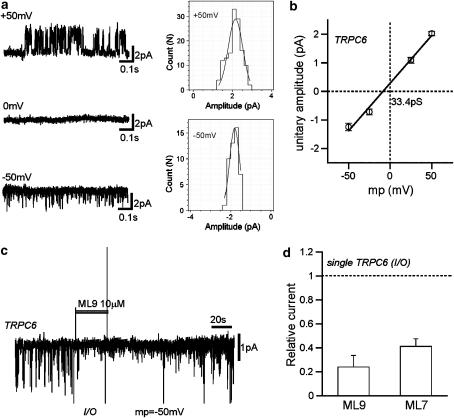
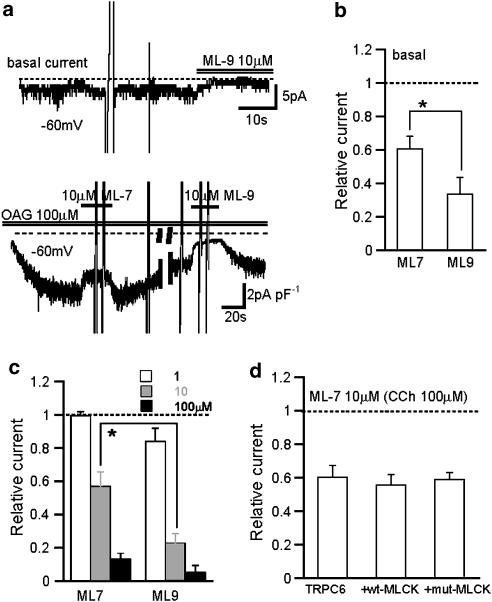
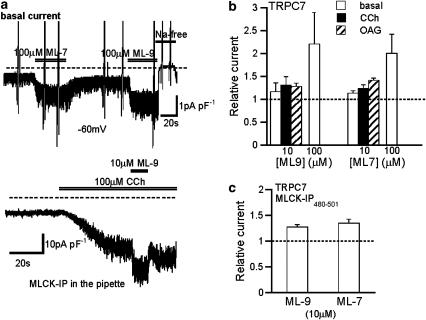
ML-7 (10 μM) applied externally to HEK293 cells expressing TRPC6 rapidly and reversibly inhibited the TRPC6 current, with a slightly weaker efficacy compared to ML-9. [1] In inside-out patch configuration, bath application of ML-7 (10 μM) rapidly diminished single TRPC6 channel activity (~35 pS). [1] On TRPC7 channels expressed in HEK293 cells, external application of ML-7 (10 and 100 μM) caused a rapid and reversible enhancement of both basal and CCh-induced currents, rather than inhibition. This enhancing effect was not prevented by intracellular application of MLCK inhibitory peptide MLCK-IP480-501 (1 μM). [1] In vitro, ML-7 is a potent MLCK inhibitor with a Ki of 0.3 µM and an IC₅₀ of 300 nM. It inhibits superoxide anion release in human neutrophils. It can affect the activity of neutrophils independently of myosin light chain kinase. It has been shown to protect cardiac function from ischemia/reperfusion injury. |
| ln Vivo |
In sham operated animals Evans Blue extravasation is not different between ML-7 hydrochloride and vehicle group (sham+vehicle: 0.26±0.02 OD/g; sham+ML-7: 0.26±0.02 OD/g). After CCI inhibition of MLCK with ML-7 results in a significant lower amount of intracerebral Evans Blue compared to vehicle treated animals (CCI+vehicle: 0.42±0.04 OD/g; CCI+ML-7: 0.35±0.05 OD/g, p=0.048)[3].
In vivo, ML-7 has been shown to protect cardiac function from ischemia/reperfusion injury. By inhibiting MLCK, it may reduce smooth muscle contraction and modulate cellular functions. However, specific in vivo efficacy data in animal models are not extensively detailed in the available literature. |
| Enzyme Assay |
In vitro MLCK kinase assays for ML-7 are performed using purified recombinant MLCK enzyme. The kinase is incubated with myosin light chain protein and ATP in the presence of varying concentrations of ML-7. Phosphorylation is detected using a luminescence-based or fluorescence-based assay. IC₅₀ or Ki values are calculated from dose-response curves.
|
| Cell Assay |
For whole-cell recording of TRPC6/TRPC7 currents: HEK293 cells were transfected with TRPC6 or TRPC7 cDNA and CD8 marker. Nystatin-perforated or conventional whole-cell patch-clamp was used at a holding potential of -60 mV. ML-7 was dissolved in DMSO and diluted to final concentrations (1, 10, 100 μM) in external solution. Rapid drug application was achieved using a Y-tube solution changer. Currents were activated by carbachol (CCh, 100 μM) or 1-oleoyl-2-acetyl-sn-glycerol (OAG, 100 μM). The extent of inhibition or enhancement was calculated as the ratio of current amplitude 5 s after drug application to that just before application. [1]
For single-channel recording: Inside-out patch configuration was used. Pipette solution contained CCh (100 μM) to activate TRPC6 channels. Bath solution was a Cs-aspartate based solution. ML-7 (10 μM) was applied to the bath via Y-tube. Single-channel currents were low-pass filtered at 1 kHz and digitized at 10 kHz. Unitary conductance was ~33.4 pS. The mean current over 2 s was measured 5 s after drug application and compared to that before application. [1] In vitro cell-based assays for ML-7 are performed using smooth muscle cells or other cell types expressing MLCK. Cells are cultured in appropriate media and treated with ML-7 at various concentrations. Myosin light chain phosphorylation is assessed by Western blot. Cell contraction is measured using collagen gel contraction assays. Cell migration is assessed using scratch wound healing or transwell migration assays. |
| Animal Protocol |
In vivo animal studies for ML-7 would typically involve rodent models of ischemia/reperfusion injury. The compound is administered intraperitoneally or intravenously. Cardiac function is assessed by echocardiography or hemodynamic measurements. Infarct size is measured by TTC staining.
|
| ADME/Pharmacokinetics |
Specific pharmacokinetic properties of ML-7, such as half-life and oral bioavailability, are not extensively detailed in the available literature. It is soluble in DMSO and is typically formulated for in vivo administration.
|
| Toxicity/Toxicokinetics |
Comprehensive toxicological data for ML-7 are not widely available in public literature. As a research compound, it is intended for laboratory use only and is not for human therapeutic use. Standard safety precautions should be followed when handling this compound. The compound is supplied with a purity of ≥98%.
|
| References |
Br J Pharmacol.2007 Sep;152(1):122-31.
|
| Additional Infomation |
ML-7 is an N-sulfonyldiazacycloheptane formed by the condensation of 5-iodo-1-naphthalenesulfonic acid with one nitrogen atom of 1,4-diazacycloheptane. It is a selective inhibitor of myosin light chain kinase (EC 2.7.11.18). It is an organoiodine compound and also an N-sulfonyldiazacycloheptane.
ML-7 is a naphthalene sulphonamide derivative (1-(5-iodonaphthalene-1-sulphonyl)homopiperazine, HCl) structurally related to ML-9. It is known as an inhibitor of myosin light chain kinase (MLCK) with an in vitro IC50 of 300 nM (cited from Saitoh et al., 1987, not from this study). However, the present study demonstrates that ML-7 exerts rapid, MLCK-independent effects on TRPC6 (inhibition) and TRPC7 (enhancement) channels, indicating that its actions on ion channels may be nonspecific and not solely due to MLCK inhibition. [1] ML-7 is a potent and selective MLCK inhibitor. It is also known as ML7. It has a Ki of 0.3 µM. It protects cardiac function from ischemia/reperfusion injury. This product is for research use only. |
| Molecular Formula |
C15H17IN2O2S
|
|
|---|---|---|
| Molecular Weight |
416.28
|
|
| Exact Mass |
416.006
|
|
| CAS # |
109376-83-2
|
|
| Related CAS # |
|
|
| PubChem CID |
4216
|
|
| Appearance |
Typically exists as solid at room temperature
|
|
| Density |
1.634g/cm3
|
|
| Boiling Point |
542.7ºC at 760mmHg
|
|
| Flash Point |
282ºC
|
|
| Vapour Pressure |
7.71E-12mmHg at 25°C
|
|
| Index of Refraction |
1.665
|
|
| LogP |
3.775
|
|
| Hydrogen Bond Donor Count |
1
|
|
| Hydrogen Bond Acceptor Count |
4
|
|
| Rotatable Bond Count |
2
|
|
| Heavy Atom Count |
21
|
|
| Complexity |
451
|
|
| Defined Atom Stereocenter Count |
0
|
|
| SMILES |
C1NCCN(S(C2=CC=CC3C(=CC=CC2=3)I)(=O)=O)CC1
|
|
| InChi Key |
GEHJIACZUFWBTK-UHFFFAOYSA-N
|
|
| InChi Code |
InChI=1S/C15H17IN2O2S/c16-14-6-1-5-13-12(14)4-2-7-15(13)21(19,20)18-10-3-8-17-9-11-18/h1-2,4-7,17H,3,8-11H2
|
|
| Chemical Name |
|
|
| Synonyms |
|
|
| HS Tariff Code |
2934.99.9001
|
|
| Storage |
Powder -20°C 3 years 4°C 2 years In solvent -80°C 6 months -20°C 1 month |
|
| Shipping Condition |
Room temperature (This product is stable at ambient temperature for a few days during ordinary shipping and time spent in Customs)
|
| Solubility (In Vitro) |
|
|||
|---|---|---|---|---|
| Solubility (In Vivo) |
Note: Listed below are some common formulations that may be used to formulate products with low water solubility (e.g. < 1 mg/mL), you may test these formulations using a minute amount of products to avoid loss of samples.
Injection Formulations
Injection Formulation 1: DMSO : Tween 80: Saline = 10 : 5 : 85 (i.e. 100 μL DMSO stock solution → 50 μL Tween 80 → 850 μL Saline)(e.g. IP/IV/IM/SC) *Preparation of saline: Dissolve 0.9 g of sodium chloride in 100 mL ddH ₂ O to obtain a clear solution. Injection Formulation 2: DMSO : PEG300 :Tween 80 : Saline = 10 : 40 : 5 : 45 (i.e. 100 μL DMSO → 400 μLPEG300 → 50 μL Tween 80 → 450 μL Saline) Injection Formulation 3: DMSO : Corn oil = 10 : 90 (i.e. 100 μL DMSO → 900 μL Corn oil) Example: Take the Injection Formulation 3 (DMSO : Corn oil = 10 : 90) as an example, if 1 mL of 2.5 mg/mL working solution is to be prepared, you can take 100 μL 25 mg/mL DMSO stock solution and add to 900 μL corn oil, mix well to obtain a clear or suspension solution (2.5 mg/mL, ready for use in animals). View More
Injection Formulation 4: DMSO : 20% SBE-β-CD in saline = 10 : 90 [i.e. 100 μL DMSO → 900 μL (20% SBE-β-CD in saline)] Oral Formulations
Oral Formulation 1: Suspend in 0.5% CMC Na (carboxymethylcellulose sodium) Oral Formulation 2: Suspend in 0.5% Carboxymethyl cellulose Example: Take the Oral Formulation 1 (Suspend in 0.5% CMC Na) as an example, if 100 mL of 2.5 mg/mL working solution is to be prepared, you can first prepare 0.5% CMC Na solution by measuring 0.5 g CMC Na and dissolve it in 100 mL ddH2O to obtain a clear solution; then add 250 mg of the product to 100 mL 0.5% CMC Na solution, to make the suspension solution (2.5 mg/mL, ready for use in animals). View More
Oral Formulation 3: Dissolved in PEG400 (Please use freshly prepared in vivo formulations for optimal results.) |
| Preparing Stock Solutions | 1 mg | 5 mg | 10 mg | |
| 1 mM | 2.4022 mL | 12.0111 mL | 24.0223 mL | |
| 5 mM | 0.4804 mL | 2.4022 mL | 4.8045 mL | |
| 10 mM | 0.2402 mL | 1.2011 mL | 2.4022 mL |
*Note: Please select an appropriate solvent for the preparation of stock solution based on your experiment needs. For most products, DMSO can be used for preparing stock solutions (e.g. 5 mM, 10 mM, or 20 mM concentration); some products with high aqueous solubility may be dissolved in water directly. Solubility information is available at the above Solubility Data section. Once the stock solution is prepared, aliquot it to routine usage volumes and store at -20°C or -80°C. Avoid repeated freeze and thaw cycles.
Calculation results
Working concentration: mg/mL;
Method for preparing DMSO stock solution: mg drug pre-dissolved in μL DMSO (stock solution concentration mg/mL). Please contact us first if the concentration exceeds the DMSO solubility of the batch of drug.
Method for preparing in vivo formulation::Take μL DMSO stock solution, next add μL PEG300, mix and clarify, next addμL Tween 80, mix and clarify, next add μL ddH2O,mix and clarify.
(1) Please be sure that the solution is clear before the addition of next solvent. Dissolution methods like vortex, ultrasound or warming and heat may be used to aid dissolving.
(2) Be sure to add the solvent(s) in order.
Effects of ML-9 and ML-7 on single TRPC6 channels.Br J Pharmacol.2007 Sep;152(1):122-31. |
Activation mode of TRPC6 did not affect the efficacy of ML-9 and ML-7. |
Enhancing actions of ML-compounds on macroscopic TRPC7 current (ITRPC7). Conventional whole-cell recording at −60 mV with Ca2+-free external solution.Br J Pharmacol.2007 Sep;152(1):122-31. |
Products are for research use only; We do not sell to patients
Copyright 2020 InvivoChem LLC | All Rights Reserved


 COA
COA