| Size | Price | Stock | Qty |
|---|---|---|---|
| 5mg |
|
||
| 10mg |
|
||
| 25mg |
|
||
| 50mg |
|
||
| 100mg |
|
||
| 250mg |
|
||
| 500mg | |||
| Other Sizes |


Purity: ≥98%
| Targets |
Heat Shock Factor 1 (HSF1) (IC50 = 0.6 μM for inhibiting HSP70 protein expression in HeLa cells) [1]
|
|---|---|
| ln Vitro |
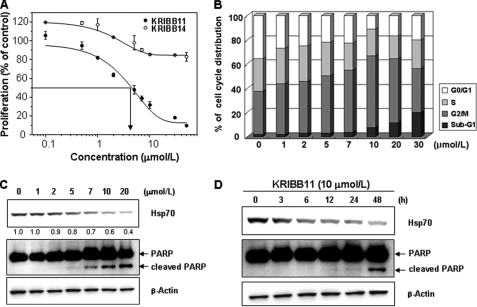
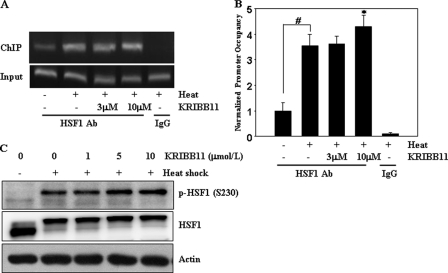
KRIBB11 prevents downstream target proteins of HSF1, including HSP27 and HSP70, from being induced. In HCT-116 cells, KRIBB11 causes apoptosis and growth arrest. KRIBB11 prevents p-TEFb (positive transcription elongation factor b) from being recruited to the hsp70 promoter in an HSF1-dependent manner [1]. After KRIBB11 treatment, PARP and caspase-3 cleavage increased in the cells. KRIBB11 incubation on RKO results in an IC50 of 20–30 μM and a toxicity threshold of about 10 μM [2].
KRIBB11 (0.1-5 μM) dose-dependently inhibited HSP70 protein synthesis in HeLa, A549, and MCF-7 cells, with 80% inhibition at 2 μM in HeLa cells as detected by Western blot [1] - KRIBB11 (1 μM) impaired the recruitment of positive transcription elongation factor b (P-TEFb) to the hsp70 promoter in heat-shocked HeLa cells, reducing P-TEFb binding by 65% as measured by chromatin immunoprecipitation (ChIP) assay [1] - KRIBB11 (0.5-4 μM) suppressed HSF1 transcriptional activity in HeLa cells transfected with hsp70-luciferase reporter plasmid, with 50% inhibition of luciferase activity at 1.2 μM [1] - KRIBB11 (2 μM) reversed Hsp90 inhibitor resistance in HCT116 cells overexpressing HSF1, enhancing the anti-proliferative effect of geldanamycin (IC50 of geldanamycin decreased from 80 nM to 25 nM) [2] - KRIBB11 (1-4 μM) reduced p62/SQSTM1 protein expression and LC3-II/LC3-I ratio in HSF1-overexpressing HCT116 cells, inhibiting autophagic flux by 48% at 2 μM as detected by Western blot and autophagy flux assay [2] |
| ln Vivo |
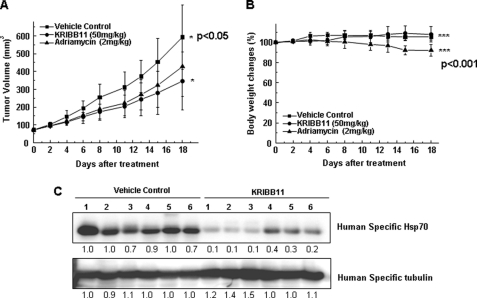
In nude mice without weight loss, KRIBB11 (50 mg/kg, intraperitoneal injection) inhibited 47.4% of tumor growth [1].
Nude mice (BALB/c-nu) bearing HCT116 cell xenografts overexpressing HSF1 were administered KRIBB11 (10 mg/kg, intraperitoneal injection, once daily for 14 days) in combination with geldanamycin (2 mg/kg, ip). The combination group showed a 62% reduction in tumor volume, compared to 28% reduction with geldanamycin alone and 15% reduction with KRIBB11 alone [2] - KRIBB11 (10 mg/kg, ip) treatment in xenograft mice reduced HSP70 and p62/SQSTM1 protein expression in tumor tissues by 55% and 42% respectively, as measured by immunohistochemistry and Western blot [2] |
| Enzyme Assay |
Luciferase reporter assay: HeLa cells were transfected with hsp70-luciferase reporter plasmid and β-actin-renilla plasmid. After 24 hours, cells were pretreated with KRIBB11 (0.1-5 μM) for 1 hour, then heat-shocked at 43°C for 1 hour. Luciferase activity was measured using a dual-luciferase assay system to assess HSF1 transcriptional activity [1]
- Chromatin immunoprecipitation (ChIP) assay: Heat-shocked HeLa cells treated with KRIBB11 (1 μM) were cross-linked with formaldehyde, and chromatin was sheared into fragments. Anti-CDK9 antibody (targeting P-TEFb) was used for immunoprecipitation; DNA fragments bound to P-TEFb were amplified by PCR using primers specific to the hsp70 promoter region to quantify recruitment efficiency [1] |
| Cell Assay |
HeLa cells were cultured in DMEM medium supplemented with fetal bovine serum and treated with KRIBB11 (0.1-5 μM) for 24 hours, with or without heat shock (43°C for 1 hour). Western blot was performed to detect HSP70, HSF1, and β-actin (loading control) protein levels [1]
- HCT116 cells overexpressing HSF1 were cultured in RPMI 1640 medium and treated with KRIBB11 (1-4 μM) alone or in combination with geldanamycin (25-100 nM) for 72 hours. Cell proliferation was assessed by MTT assay; Western blot detected p62/SQSTM1, LC3-I/LC3-II, and HSP70 expression [2] - Autophagy flux assay: HSF1-overexpressing HCT116 cells were transfected with mRFP-GFP-LC3 plasmid, then treated with KRIBB11 (2 μM) for 24 hours. Fluorescence images were captured by confocal microscopy, and the number of red-only (autolysosomes) and yellow (autophagosomes) puncta was counted to evaluate autophagic flux [2] - RT-PCR: Total RNA was extracted from KRIBB11-treated HeLa cells, and cDNA was synthesized. PCR amplification was performed using primers for hsp70 and GAPDH (internal control) to quantify hsp70 mRNA levels [1] |
| Animal Protocol |
10% dimethylacetamide, 50% PEG300, and 40% distilled water;50 mg/kg/day;i.p.
Pathogen-free Balb/c nude mice BALB/c-nu nude mice (5-6 weeks old) were subcutaneously injected with HSF1-overexpressing HCT116 cells (2×10⁶ cells/mouse) to establish xenograft tumors. When tumors reached 100-120 mm³, mice were randomly divided into four groups: control (vehicle), KRIBB11 alone (10 mg/kg), geldanamycin alone (2 mg/kg), and combination group. KRIBB11 was dissolved in DMSO and diluted with normal saline (final DMSO concentration ≤5%), administered via intraperitoneal injection once daily for 14 days. Geldanamycin was administered intraperitoneally every other day for 14 days. Tumor volume was measured every 3 days; mice were euthanized on day 15, and tumor tissues were collected for protein expression analysis [2] |
| Toxicity/Toxicokinetics |
KRIBB11 (≤5 μM) did not induce significant apoptosis in HeLa or HCT116 cells, and Annexin V-FITC/PI staining showed an apoptosis rate of <12% [1][2]. In nude mice treated with KRIBB11 (10 mg/kg, intraperitoneal injection, for 14 consecutive days), no significant changes in body weight, food intake, or serum ALT, AST, and creatinine levels were observed compared to the control group [2]. Histopathological examination of the liver, kidneys, heart, lungs, and spleen of KRIBB11-treated mice revealed no significant pathological damage [2].
|
| References |
|
| Additional Infomation |
KRIBB11 is an indazole compound with the structure 1H-indazole, where the 5-position is substituted with [6-(methylamino)-3-nitropyridin-2-yl]amino. It is a heat shock factor 1 inhibitor (IC50 = 1.2 μM) and inhibits tumor growth in a mouse xenograft model. It exhibits apoptosis-inducing, antitumor, and heat shock factor 1-inhibiting activities. KRIBB11 is an indazole, aromatic amine, aminopyridine, and C-nitro compound.
KRIBB11 is a small molecule inhibitor of HSF1 that specifically targets the transcriptional activity of HSF1[1] - Its mechanism of action involves inhibiting the recruitment of P-TEFb to the hsp70 promoter, thereby inhibiting HSF1-mediated hsp70 transcription and reducing HSP70 protein synthesis[1] - KRIBB11 reverses the resistance of HSF1-overexpressing cancer cells to Hsp90 inhibitors by inhibiting HSF1-induced p62/SQSTM1 expression and autophagy flux[2] - It is mainly used as a research tool to study the role of the HSF1-HSP70 pathway in cancer progression and drug resistance[1][2] |
| Molecular Formula |
C13H12N6O2
|
|
|---|---|---|
| Molecular Weight |
284.27
|
|
| Exact Mass |
284.102
|
|
| CAS # |
342639-96-7
|
|
| Related CAS # |
|
|
| PubChem CID |
69894253
|
|
| Appearance |
Yellow to orange solid powder
|
|
| Density |
1.5±0.1 g/cm3
|
|
| Boiling Point |
535.0±50.0 °C at 760 mmHg
|
|
| Flash Point |
277.3±30.1 °C
|
|
| Vapour Pressure |
0.0±1.4 mmHg at 25°C
|
|
| Index of Refraction |
1.812
|
|
| LogP |
4.3
|
|
| Hydrogen Bond Donor Count |
3
|
|
| Hydrogen Bond Acceptor Count |
6
|
|
| Rotatable Bond Count |
3
|
|
| Heavy Atom Count |
21
|
|
| Complexity |
376
|
|
| Defined Atom Stereocenter Count |
0
|
|
| SMILES |
CNC1=NC(=C(C=C1)[N+](=O)[O-])NC2=CC3=C(C=C2)NN=C3
|
|
| InChi Key |
NDJJEQIMIJJCLL-UHFFFAOYSA-N
|
|
| InChi Code |
InChI=1S/C13H12N6O2/c1-14-12-5-4-11(19(20)21)13(17-12)16-9-2-3-10-8(6-9)7-15-18-10/h2-7H,1H3,(H,15,18)(H2,14,16,17)
|
|
| Chemical Name |
2-N-(1H-indazol-5-yl)-6-N-methyl-3-nitropyridine-2,6-diamine
|
|
| Synonyms |
|
|
| HS Tariff Code |
2934.99.9001
|
|
| Storage |
Powder -20°C 3 years 4°C 2 years In solvent -80°C 6 months -20°C 1 month |
|
| Shipping Condition |
Room temperature (This product is stable at ambient temperature for a few days during ordinary shipping and time spent in Customs)
|
| Solubility (In Vitro) |
|
|||
|---|---|---|---|---|
| Solubility (In Vivo) |
Note: Listed below are some common formulations that may be used to formulate products with low water solubility (e.g. < 1 mg/mL), you may test these formulations using a minute amount of products to avoid loss of samples.
Injection Formulations
Injection Formulation 1: DMSO : Tween 80: Saline = 10 : 5 : 85 (i.e. 100 μL DMSO stock solution → 50 μL Tween 80 → 850 μL Saline)(e.g. IP/IV/IM/SC) *Preparation of saline: Dissolve 0.9 g of sodium chloride in 100 mL ddH ₂ O to obtain a clear solution. Injection Formulation 2: DMSO : PEG300 :Tween 80 : Saline = 10 : 40 : 5 : 45 (i.e. 100 μL DMSO → 400 μLPEG300 → 50 μL Tween 80 → 450 μL Saline) Injection Formulation 3: DMSO : Corn oil = 10 : 90 (i.e. 100 μL DMSO → 900 μL Corn oil) Example: Take the Injection Formulation 3 (DMSO : Corn oil = 10 : 90) as an example, if 1 mL of 2.5 mg/mL working solution is to be prepared, you can take 100 μL 25 mg/mL DMSO stock solution and add to 900 μL corn oil, mix well to obtain a clear or suspension solution (2.5 mg/mL, ready for use in animals). View More
Injection Formulation 4: DMSO : 20% SBE-β-CD in saline = 10 : 90 [i.e. 100 μL DMSO → 900 μL (20% SBE-β-CD in saline)] Oral Formulations
Oral Formulation 1: Suspend in 0.5% CMC Na (carboxymethylcellulose sodium) Oral Formulation 2: Suspend in 0.5% Carboxymethyl cellulose Example: Take the Oral Formulation 1 (Suspend in 0.5% CMC Na) as an example, if 100 mL of 2.5 mg/mL working solution is to be prepared, you can first prepare 0.5% CMC Na solution by measuring 0.5 g CMC Na and dissolve it in 100 mL ddH2O to obtain a clear solution; then add 250 mg of the product to 100 mL 0.5% CMC Na solution, to make the suspension solution (2.5 mg/mL, ready for use in animals). View More
Oral Formulation 3: Dissolved in PEG400 (Please use freshly prepared in vivo formulations for optimal results.) |
| Preparing Stock Solutions | 1 mg | 5 mg | 10 mg | |
| 1 mM | 3.5178 mL | 17.5889 mL | 35.1778 mL | |
| 5 mM | 0.7036 mL | 3.5178 mL | 7.0356 mL | |
| 10 mM | 0.3518 mL | 1.7589 mL | 3.5178 mL |
*Note: Please select an appropriate solvent for the preparation of stock solution based on your experiment needs. For most products, DMSO can be used for preparing stock solutions (e.g. 5 mM, 10 mM, or 20 mM concentration); some products with high aqueous solubility may be dissolved in water directly. Solubility information is available at the above Solubility Data section. Once the stock solution is prepared, aliquot it to routine usage volumes and store at -20°C or -80°C. Avoid repeated freeze and thaw cycles.
Calculation results
Working concentration: mg/mL;
Method for preparing DMSO stock solution: mg drug pre-dissolved in μL DMSO (stock solution concentration mg/mL). Please contact us first if the concentration exceeds the DMSO solubility of the batch of drug.
Method for preparing in vivo formulation::Take μL DMSO stock solution, next add μL PEG300, mix and clarify, next addμL Tween 80, mix and clarify, next add μL ddH2O,mix and clarify.
(1) Please be sure that the solution is clear before the addition of next solvent. Dissolution methods like vortex, ultrasound or warming and heat may be used to aid dissolving.
(2) Be sure to add the solvent(s) in order.
 |
|---|
 |
|
Products are for research use only; We do not sell to patients
Copyright 2020 InvivoChem LLC | All Rights Reserved


 COA
COA