| Size | Price | Stock | Qty |
|---|---|---|---|
| 5mg |
|
||
| 10mg |
|
||
| 25mg |
|
||
| 50mg |
|
||
| 100mg |
|
||
| 250mg |
|
||
| 500mg | |||
| Other Sizes |


Purity: ≥98%
| Targets |
IWP-L6 specifically targets Porcupine (PORCN), a membrane-bound O-acyltransferase involved in Wnt ligand palmitoylation (PORCN IC50 = 1.3 nM) [1]
IWP-L6 shows no significant inhibition of other acyltransferases or kinases (IC50 > 10 μM for 30+ tested targets) [1] |
|---|---|
| ln Vitro |
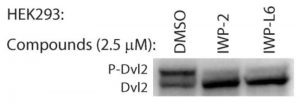
The phosphorylation of dishevelled 2 (Dvl2) in HEK293 cells, a biochemical event linked to numerous Wnt-dependent cellular responses, was efficiently reduced by IWP-L6 (Porcn Inhibitor III). In cultured embryonic kidneys, Wnt-mediated branching morphogenesis is inhibited by IWP-L6 [1].
In recombinant PORCN enzyme assays, IWP-L6 dose-dependently inhibits PORCN-mediated palmitoylation of Wnt3a, with 92% inhibition at 10 nM. It blocks the lipid modification of Wnt ligands, which is essential for Wnt signaling activation [1] - In HEK293 cells transfected with Wnt-responsive luciferase reporter plasmid, IWP-L6 (0.5 μM) reduces Wnt3a-induced luciferase activity by 85% after 24 hours. It downregulates mRNA expression of Wnt target genes (AXIN2, MYC) by 70% and 65% respectively [1] - In human colorectal cancer cells (HCT116) with constitutive Wnt signaling, IWP-L6 (1 μM) inhibits cell proliferation by 58% after 72 hours (MTT assay). It also reduces the proportion of S-phase cells from 32% to 18% (flow cytometry analysis) [1] - In normal HEK293 cells, IWP-L6 shows low toxicity at concentrations up to 20 μM (cell viability > 88% vs. control) [1] |
| ln Vivo |
Porcn Inhibitor III, or IWP-L6, is rapidly metabolized in rat plasma (t1/2 = 190 min), murine plasma (t1/2 = 2 min), and the murine liver S9 fractions (t1/2 = 26 min). It remains stable in human plasma for a period of twenty-four hours. The products of amide cleavage are the main metabolites. Other medication candidates have been shown to exhibit similar species-dependent metabolitic profiles because of the involvement of carboxylesterase (CES). In mouse-derived plasma, IWP-L6 had a limited metabolic stability, while in zebrafish, it was quite active. Potent activity was demonstrated by IWP-L6 [1].
|
| Enzyme Assay |
PORCN palmitoylation activity assay: Purified recombinant human PORCN was incubated with Wnt3a-derived peptide substrate, palmitoyl-CoA (acyl donor), and IWP-L6 (0.01 nM-10 nM) in assay buffer (25 mM Tris-HCl, pH 7.4, 10 mM MgCl₂, 1 mM DTT) at 37°C for 90 minutes. Palmitoylated substrate was detected by liquid chromatography-tandem mass spectrometry (LC-MS/MS), and IC50 values were calculated from dose-response curves [1]
- Acyltransferase selectivity assay: IWP-L6 (10 μM) was screened against a panel of 15+ acyltransferases (including DHHC family members) using respective peptide substrates and acyl donors. Palmitoylation activity was quantified by LC-MS/MS, with no significant inhibition (>50% activity reduction) observed for off-target acyltransferases [1] |
| Cell Assay |
Wnt reporter gene assay: HEK293 cells were seeded in 96-well plates at 5×10³ cells/well and transfected with β-catenin-responsive luciferase plasmid and Renilla luciferase plasmid (internal control). After 24 hours, cells were pretreated with IWP-L6 (0.01-5 μM) for 1 hour, then stimulated with Wnt3a (50 ng/mL) for 24 hours. Dual-luciferase assay system was used to measure luciferase activity [1]
- Cancer cell proliferation assay: HCT116 cells were seeded in 96-well plates at 3×10³ cells/well and treated with IWP-L6 (0.1-20 μM) for 72 hours. Cell viability was assessed by MTT assay, and cell cycle distribution was analyzed by flow cytometry after propidium iodide staining [1] - Wnt target gene expression assay: HCT116 cells were seeded in 6-well plates at 2×10⁵ cells/well and treated with IWP-L6 (1 μM) for 24 hours. Total RNA was extracted, and AXIN2/MYC mRNA levels were detected by quantitative real-time PCR (qPCR) with GAPDH as the housekeeping gene [1] |
| Animal Protocol |
Rats
|
| References | |
| Additional Infomation |
IWP-L6 is a potent and selective small-molecule Porcupine (PORCN) inhibitor, PORCN being a key enzyme in the classical Wnt signaling pathway [1] - its mechanism of action involves binding to the active site of PORCN to inhibit palmitoylation of Wnt ligands. This blocks the secretion of Wnt ligands and the subsequent activation of downstream β-catenin-dependent signaling pathways [1] - IWP-L6 has shown efficacy in inhibiting Wnt-driven colorectal cancer cell proliferation in vitro, supporting its utility as a tool compound for studying the Wnt signaling pathway [1] - it has been widely used to elucidate the role of PORCN-mediated Wnt lipidation in development, tissue homeostasis, and cancer progression [1] - IWP-L6's high selectivity for PORCN minimizes off-target effects, making it a valuable reagent for studying Wnt ligand biosynthesis and signal transduction [1]
|
| Molecular Formula |
C25H20N4O2S2
|
|
|---|---|---|
| Molecular Weight |
472.58
|
|
| Exact Mass |
472.102
|
|
| Elemental Analysis |
C, 63.54; H, 4.27; N, 11.86; O, 6.77; S, 13.57
|
|
| CAS # |
1427782-89-5
|
|
| Related CAS # |
|
|
| PubChem CID |
71601111
|
|
| Appearance |
White to off-white solid powder
|
|
| Density |
1.4±0.1 g/cm3
|
|
| Index of Refraction |
1.727
|
|
| LogP |
5.64
|
|
| Hydrogen Bond Donor Count |
1
|
|
| Hydrogen Bond Acceptor Count |
6
|
|
| Rotatable Bond Count |
6
|
|
| Heavy Atom Count |
33
|
|
| Complexity |
802
|
|
| Defined Atom Stereocenter Count |
0
|
|
| SMILES |
S1C([H])([H])C([H])([H])C2=C1C(N(C1C([H])=C([H])C([H])=C([H])C=1[H])C(=N2)SC([H])([H])C(N([H])C1C([H])=C([H])C(=C([H])N=1)C1C([H])=C([H])C([H])=C([H])C=1[H])=O)=O
|
|
| InChi Key |
QESQGTFWEQMCMH-UHFFFAOYSA-N
|
|
| InChi Code |
InChI=1S/C25H20N4O2S2/c30-22(28-21-12-11-18(15-26-21)17-7-3-1-4-8-17)16-33-25-27-20-13-14-32-23(20)24(31)29(25)19-9-5-2-6-10-19/h1-12,15H,13-14,16H2,(H,26,28,30)
|
|
| Chemical Name |
N-(5-phenyl-2-pyridinyl)-2-[(3,4,6,7-tetrahydro-4-oxo-3-phenylthieno[3,2-d]pyrimidin-2-yl)thio]-acetamide
|
|
| Synonyms |
|
|
| HS Tariff Code |
2934.99.9001
|
|
| Storage |
Powder -20°C 3 years 4°C 2 years In solvent -80°C 6 months -20°C 1 month |
|
| Shipping Condition |
Room temperature (This product is stable at ambient temperature for a few days during ordinary shipping and time spent in Customs)
|
| Solubility (In Vitro) |
DMSO: 25 mg/mL (52.9 mM)
Water: 1 mg/mL (Insoluble) Ethanol: 1 mg/mL |
|---|---|
| Solubility (In Vivo) |
Note: Listed below are some common formulations that may be used to formulate products with low water solubility (e.g. < 1 mg/mL), you may test these formulations using a minute amount of products to avoid loss of samples.
Injection Formulations
Injection Formulation 1: DMSO : Tween 80: Saline = 10 : 5 : 85 (i.e. 100 μL DMSO stock solution → 50 μL Tween 80 → 850 μL Saline)(e.g. IP/IV/IM/SC) *Preparation of saline: Dissolve 0.9 g of sodium chloride in 100 mL ddH ₂ O to obtain a clear solution. Injection Formulation 2: DMSO : PEG300 :Tween 80 : Saline = 10 : 40 : 5 : 45 (i.e. 100 μL DMSO → 400 μLPEG300 → 50 μL Tween 80 → 450 μL Saline) Injection Formulation 3: DMSO : Corn oil = 10 : 90 (i.e. 100 μL DMSO → 900 μL Corn oil) Example: Take the Injection Formulation 3 (DMSO : Corn oil = 10 : 90) as an example, if 1 mL of 2.5 mg/mL working solution is to be prepared, you can take 100 μL 25 mg/mL DMSO stock solution and add to 900 μL corn oil, mix well to obtain a clear or suspension solution (2.5 mg/mL, ready for use in animals). View More
Injection Formulation 4: DMSO : 20% SBE-β-CD in saline = 10 : 90 [i.e. 100 μL DMSO → 900 μL (20% SBE-β-CD in saline)] Oral Formulations
Oral Formulation 1: Suspend in 0.5% CMC Na (carboxymethylcellulose sodium) Oral Formulation 2: Suspend in 0.5% Carboxymethyl cellulose Example: Take the Oral Formulation 1 (Suspend in 0.5% CMC Na) as an example, if 100 mL of 2.5 mg/mL working solution is to be prepared, you can first prepare 0.5% CMC Na solution by measuring 0.5 g CMC Na and dissolve it in 100 mL ddH2O to obtain a clear solution; then add 250 mg of the product to 100 mL 0.5% CMC Na solution, to make the suspension solution (2.5 mg/mL, ready for use in animals). View More
Oral Formulation 3: Dissolved in PEG400 (Please use freshly prepared in vivo formulations for optimal results.) |
| Preparing Stock Solutions | 1 mg | 5 mg | 10 mg | |
| 1 mM | 2.1160 mL | 10.5802 mL | 21.1604 mL | |
| 5 mM | 0.4232 mL | 2.1160 mL | 4.2321 mL | |
| 10 mM | 0.2116 mL | 1.0580 mL | 2.1160 mL |
*Note: Please select an appropriate solvent for the preparation of stock solution based on your experiment needs. For most products, DMSO can be used for preparing stock solutions (e.g. 5 mM, 10 mM, or 20 mM concentration); some products with high aqueous solubility may be dissolved in water directly. Solubility information is available at the above Solubility Data section. Once the stock solution is prepared, aliquot it to routine usage volumes and store at -20°C or -80°C. Avoid repeated freeze and thaw cycles.
Calculation results
Working concentration: mg/mL;
Method for preparing DMSO stock solution: mg drug pre-dissolved in μL DMSO (stock solution concentration mg/mL). Please contact us first if the concentration exceeds the DMSO solubility of the batch of drug.
Method for preparing in vivo formulation::Take μL DMSO stock solution, next add μL PEG300, mix and clarify, next addμL Tween 80, mix and clarify, next add μL ddH2O,mix and clarify.
(1) Please be sure that the solution is clear before the addition of next solvent. Dissolution methods like vortex, ultrasound or warming and heat may be used to aid dissolving.
(2) Be sure to add the solvent(s) in order.
Products are for research use only; We do not sell to patients
Copyright 2020 InvivoChem LLC | All Rights Reserved


 COA
COA