| Size | Price | Stock | Qty |
|---|---|---|---|
| 5mg |
|
||
| 10mg |
|
||
| 25mg |
|
||
| 50mg |
|
||
| 100mg |
|
||
| 250mg | |||
| Other Sizes |


| Targets |
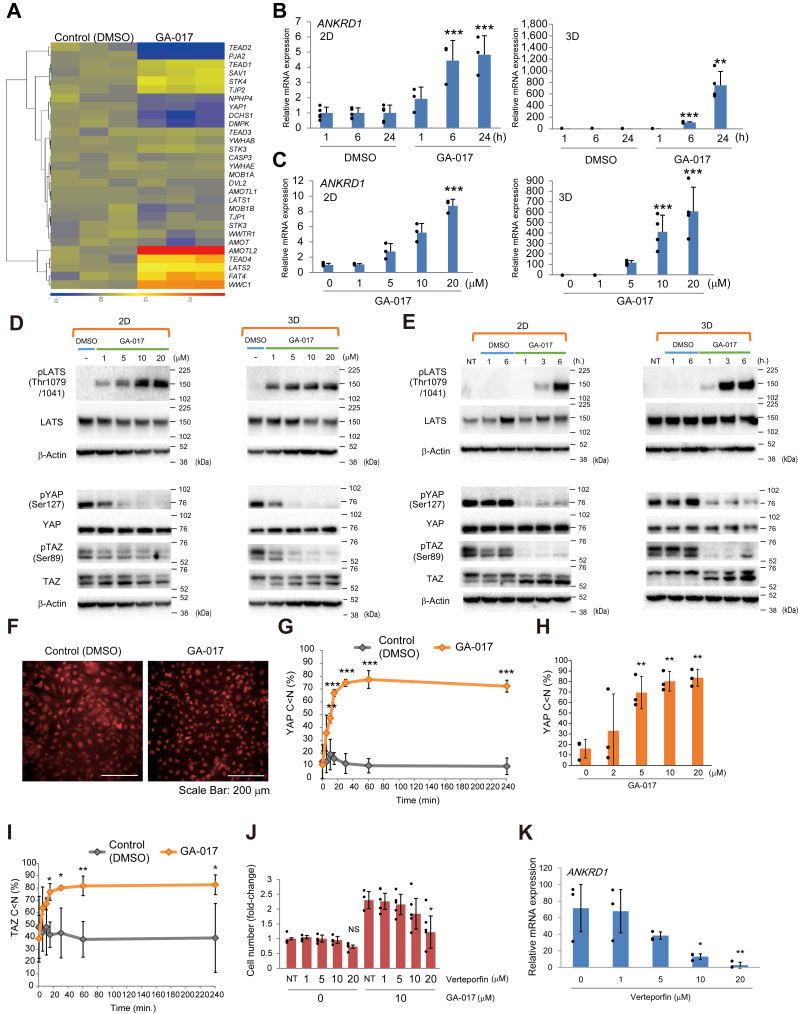
GA-017 targets LATS1 and LATS2, key components of the Hippo signaling pathway. LATS1/2 are serine/threonine protein kinases that phosphorylate and inhibit YAP and TAZ, transcriptional coactivators that promote cell proliferation and survival. By inhibiting LATS1/2, GA-017 promotes YAP/TAZ activation and nuclear translocation. It competitively inhibits LATS1 and 2 against ATP, with Ki values of 0.58 ± 0.11 and 0.25 ± 0.03 nM, respectively.
|
|---|---|
| ln Vitro |
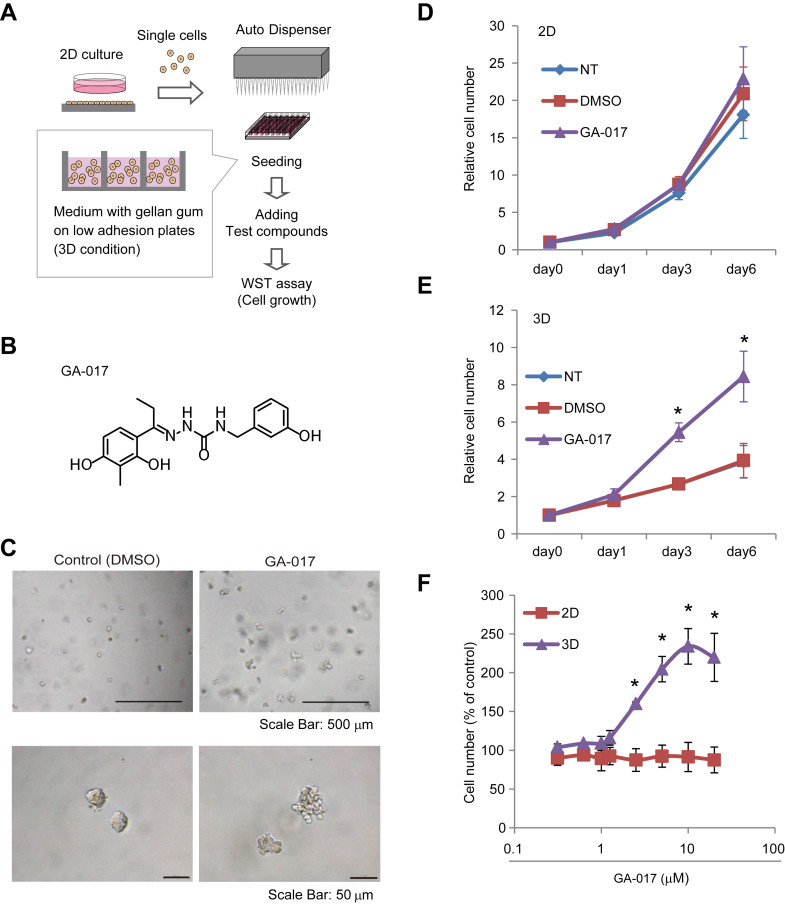
GA-017 stimulates cell proliferation and prevents HUVEC cell death[1]. SKOV3, EC50 3.51 ± 0.26 μM, grows more rapidly when GA-017 is present[1]. At Ki (factor distribution) values of 0.58±0.11 and 0.25±0.03 nM, respectively, GA-017 competitively inhibits LATS1 and 2 ATP [1].
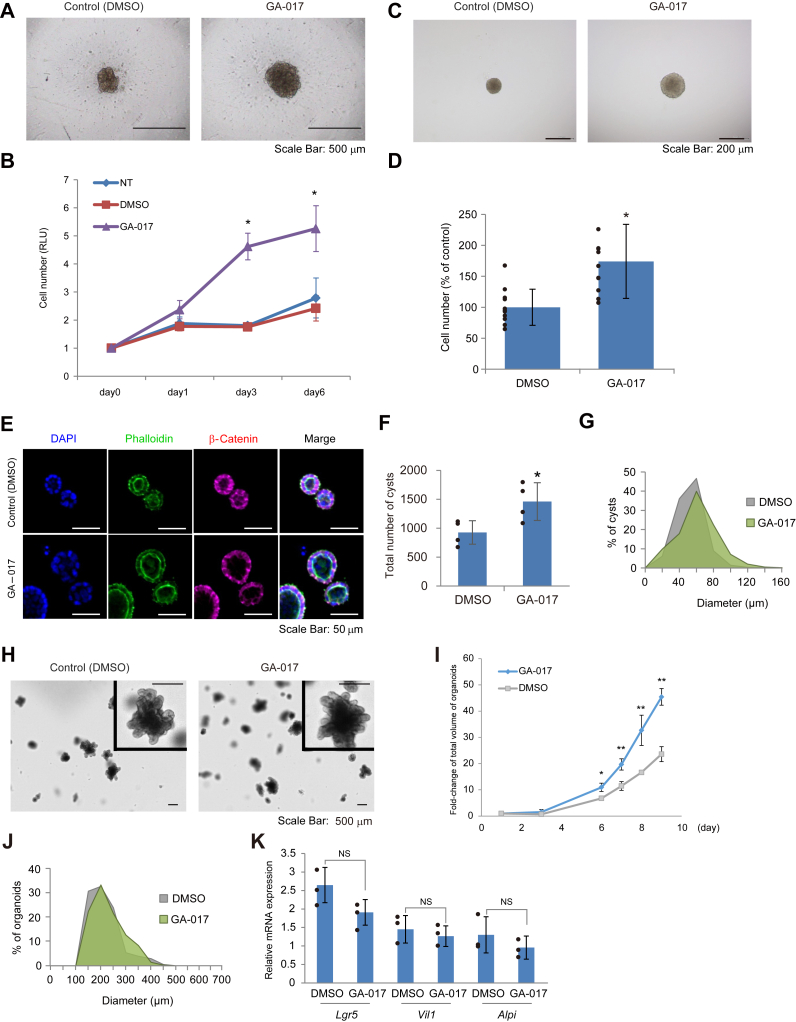
In vitro, GA-017 promotes cell growth under 3D culture conditions. It enhances cell proliferation through the activation and nuclear translocation of YAP/TAZ. It enhances the formation of mouse intestinal organoids ex vivo. The compound's ability to activate YAP/TAZ makes it a valuable tool for studying Hippo signaling and tissue regeneration. |
| ln Vivo |
Specific in vivo data for GA-017 are not detailed in the available literature. However, as a potent activator of YAP/TAZ, it could be used to study tissue regeneration, wound healing, and organ growth in vivo. Its effects on organoid formation ex vivo suggest it may have applications in regenerative medicine.
|
| Enzyme Assay |
The enzymatic activity of GA-017 can be assessed using kinase assays with recombinant LATS1 and LATS2. The kinase is incubated with its substrate, YAP or TAZ, and ATP in the presence of varying concentrations of the inhibitor. The extent of phosphorylation is measured using techniques such as radioactive labeling or immunoassay. The IC50 and Ki values for LATS inhibition are determined from dose-response curves.
|
| Cell Assay |
To evaluate the cellular effects of GA-017, cells are treated with the compound, and the phosphorylation of YAP/TAZ is measured by Western blotting using phospho-specific antibodies. The nuclear translocation of YAP/TAZ is assessed by immunofluorescence. Cell proliferation and growth are measured using standard assays. The formation of organoids can be assessed in 3D culture systems.
|
| Animal Protocol |
In vivo studies with GA-017 would typically involve administration to animals via oral or parenteral routes. Models of tissue injury, regeneration, or organ growth could be used to evaluate the compound's effects. Biomarkers of YAP/TAZ activity would be measured in tissues.
|
| ADME/Pharmacokinetics |
GA-017 has a molecular formula of C18H21N3O4 and a molecular weight of 343.38. Its CAS number is 2351906-74-4. The compound is a potent and selective LATS1/2 inhibitor. It is soluble in DMSO and other organic solvents. The purity is typically >98%.
|
| Toxicity/Toxicokinetics |
Specific toxicology data for GA-017 are not detailed in the available literature. However, as a potent activator of YAP/TAZ, which promotes cell proliferation, it may have tumor-promoting effects. As with all research compounds, standard safety precautions should be taken during handling.
|
| References | |
| Additional Infomation |
GA-017 is a potent and selective LATS1/2 inhibitor used as a research tool to study the Hippo signaling pathway. It promotes YAP/TAZ activation and cell proliferation. It is a valuable tool for studying tissue regeneration, organ growth, and cancer biology. It is not a clinically approved drug.
|
| Molecular Formula |
C18H21N3O4
|
|---|---|
| Molecular Weight |
343.377044439316
|
| Exact Mass |
343.15
|
| Elemental Analysis |
C, 62.96; H, 6.16; N, 12.24; O, 18.64
|
| CAS # |
2351906-74-4
|
| PubChem CID |
147467531
|
| Appearance |
Off-white to light yellow solid powder
|
| LogP |
2.5
|
| Hydrogen Bond Donor Count |
5
|
| Hydrogen Bond Acceptor Count |
5
|
| Rotatable Bond Count |
5
|
| Heavy Atom Count |
25
|
| Complexity |
471
|
| Defined Atom Stereocenter Count |
0
|
| SMILES |
OC1C(C)=C(C=CC=1C(CC)=NNC(NCC1C=CC=C(C=1)O)=O)O
|
| InChi Key |
FBCPIOAXERAOIA-HKWRFOASSA-N
|
| InChi Code |
InChI=1S/C18H21N3O4/c1-3-15(14-7-8-16(23)11(2)17(14)24)20-21-18(25)19-10-12-5-4-6-13(22)9-12/h4-9,22-24H,3,10H2,1-2H3,(H2,19,21,25)/b20-15-
|
| Chemical Name |
1-[(Z)-1-(2,4-dihydroxy-3-methylphenyl)propylideneamino]-3-[(3-hydroxyphenyl)methyl]urea
|
| Synonyms |
GA 017; GA-017; GA017;
|
| HS Tariff Code |
2934.99.9001
|
| Storage |
Powder -20°C 3 years 4°C 2 years In solvent -80°C 6 months -20°C 1 month |
| Shipping Condition |
Room temperature (This product is stable at ambient temperature for a few days during ordinary shipping and time spent in Customs)
|
| Solubility (In Vitro) |
DMSO : ~20.83 mg/mL (~60.66 mM)
|
|---|---|
| Solubility (In Vivo) |
Note: Listed below are some common formulations that may be used to formulate products with low water solubility (e.g. < 1 mg/mL), you may test these formulations using a minute amount of products to avoid loss of samples.
Injection Formulations
Injection Formulation 1: DMSO : Tween 80: Saline = 10 : 5 : 85 (i.e. 100 μL DMSO stock solution → 50 μL Tween 80 → 850 μL Saline)(e.g. IP/IV/IM/SC) *Preparation of saline: Dissolve 0.9 g of sodium chloride in 100 mL ddH ₂ O to obtain a clear solution. Injection Formulation 2: DMSO : PEG300 :Tween 80 : Saline = 10 : 40 : 5 : 45 (i.e. 100 μL DMSO → 400 μLPEG300 → 50 μL Tween 80 → 450 μL Saline) Injection Formulation 3: DMSO : Corn oil = 10 : 90 (i.e. 100 μL DMSO → 900 μL Corn oil) Example: Take the Injection Formulation 3 (DMSO : Corn oil = 10 : 90) as an example, if 1 mL of 2.5 mg/mL working solution is to be prepared, you can take 100 μL 25 mg/mL DMSO stock solution and add to 900 μL corn oil, mix well to obtain a clear or suspension solution (2.5 mg/mL, ready for use in animals). View More
Injection Formulation 4: DMSO : 20% SBE-β-CD in saline = 10 : 90 [i.e. 100 μL DMSO → 900 μL (20% SBE-β-CD in saline)] Oral Formulations
Oral Formulation 1: Suspend in 0.5% CMC Na (carboxymethylcellulose sodium) Oral Formulation 2: Suspend in 0.5% Carboxymethyl cellulose Example: Take the Oral Formulation 1 (Suspend in 0.5% CMC Na) as an example, if 100 mL of 2.5 mg/mL working solution is to be prepared, you can first prepare 0.5% CMC Na solution by measuring 0.5 g CMC Na and dissolve it in 100 mL ddH2O to obtain a clear solution; then add 250 mg of the product to 100 mL 0.5% CMC Na solution, to make the suspension solution (2.5 mg/mL, ready for use in animals). View More
Oral Formulation 3: Dissolved in PEG400 (Please use freshly prepared in vivo formulations for optimal results.) |
| Preparing Stock Solutions | 1 mg | 5 mg | 10 mg | |
| 1 mM | 2.9122 mL | 14.5611 mL | 29.1223 mL | |
| 5 mM | 0.5824 mL | 2.9122 mL | 5.8245 mL | |
| 10 mM | 0.2912 mL | 1.4561 mL | 2.9122 mL |
*Note: Please select an appropriate solvent for the preparation of stock solution based on your experiment needs. For most products, DMSO can be used for preparing stock solutions (e.g. 5 mM, 10 mM, or 20 mM concentration); some products with high aqueous solubility may be dissolved in water directly. Solubility information is available at the above Solubility Data section. Once the stock solution is prepared, aliquot it to routine usage volumes and store at -20°C or -80°C. Avoid repeated freeze and thaw cycles.
Calculation results
Working concentration: mg/mL;
Method for preparing DMSO stock solution: mg drug pre-dissolved in μL DMSO (stock solution concentration mg/mL). Please contact us first if the concentration exceeds the DMSO solubility of the batch of drug.
Method for preparing in vivo formulation::Take μL DMSO stock solution, next add μL PEG300, mix and clarify, next addμL Tween 80, mix and clarify, next add μL ddH2O,mix and clarify.
(1) Please be sure that the solution is clear before the addition of next solvent. Dissolution methods like vortex, ultrasound or warming and heat may be used to aid dissolving.
(2) Be sure to add the solvent(s) in order.
|
|
|
Products are for research use only; We do not sell to patients
Copyright 2020 InvivoChem LLC | All Rights Reserved