| Size | Price | Stock | Qty |
|---|---|---|---|
| 5mg |
|
||
| 10mg |
|
||
| 25mg |
|
||
| 50mg |
|
||
| 100mg |
|
||
| 250mg | |||
| 500mg | |||
| Other Sizes |


Purity: ≥98%
| ln Vivo |
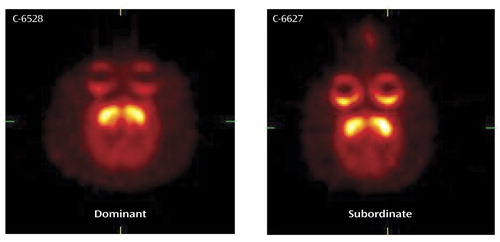
In a study of cynomolgus monkeys, [¹⁸F]fluoroclebopride was used with positron emission tomography (PET) to measure D₂-like receptor availability (distribution volume ratio) in the striatum. The tracer showed excellent uptake into D₂-rich regions of the basal ganglia, allowing clear visualization of the caudate and putamen. [1]
In individually housed monkeys, the distribution volume ratio for [¹⁸F]fluoroclebopride was 2.49 ± 0.08 (SEM) in a group that later became dominant, and 2.40 ± 0.06 (SEM) in a group that later became subordinate. After 3 months of social housing, the distribution volume ratio increased by 22.0% in dominant monkeys (to 3.04 ± 0.23, SEM), while subordinate monkeys showed only a 3.9% increase (to 2.49 ± 0.10, SEM). [1] In a cocaine-experienced monkey with over 3 years of self-administration history (lifetime intake ~20 g), [¹⁸F]fluoroclebopride binding was more than 20% lower compared to a cocaine-naïve monkey, and this reduction persisted for at least 7 months of abstinence. [1] |
|---|---|
| Animal Protocol |
PET Imaging Procedure:** Positron emission tomography (PET) scanning was performed in cynomolgus monkeys using [¹⁸F]fluoroclebopride as the radiotracer. The primary dependent variable was the distribution volume ratio, which is the ratio of radioligand distribution in the region of interest (e.g., striatum) compared to its distribution in a region devoid of receptors. This ratio provides a unitless number representing the ratio of receptor density (Bmax) to receptor affinity (Kd). PET images were coregistered with magnetic resonance imaging (MRI) from the same monkeys to localize brain regions. [1]
PET Imaging Procedure: Positron emission tomography (PET) scanning was performed in cynomolgus monkeys using [¹⁸F]fluoroclebopride as the radiotracer. The primary dependent variable was the distribution volume ratio, which is the ratio of radioligand distribution in the region of interest (e.g., striatum) compared to its distribution in a region devoid of receptors. This ratio provides a unitless number representing the ratio of receptor density (Bmax) to receptor affinity (Kd). PET images were coregistered with magnetic resonance imaging (MRI) from the same monkeys to localize brain regions. [1] |
| References |
|
| Additional Infomation |
[¹⁸F]Fluoroclebopride is a positron-emitting radioligand used in PET imaging studies to measure dopamine D₂-like receptor availability in vivo. It is described as having similar affinity to [¹¹C]raclopride for D₂-like receptors. The tracer has been used in nonhuman primate models to investigate the effects of social environment and chronic cocaine exposure on D₂ receptor function. Changes in [¹⁸F]fluoroclebopride binding can reflect alterations in either receptor density (Bmax) or extracellular dopamine levels, as the binding of these radioligands is influenced by competition with endogenous dopamine. [1]
|
| Molecular Formula |
C20H23CLFN3O2
|
|---|---|
| Molecular Weight |
391.86700
|
| Exact Mass |
391.146
|
| Elemental Analysis |
C, 61.30; H, 5.92; Cl, 9.05; F, 4.85; N, 10.72; O, 8.17
|
| CAS # |
154540-49-5
|
| Related CAS # |
154540-49-5
|
| PubChem CID |
127887
|
| Appearance |
Solid powder
|
| Density |
1.3±0.1 g/cm3
|
| Boiling Point |
518.2±50.0 °C at 760 mmHg
|
| Flash Point |
267.2±30.1 °C
|
| Vapour Pressure |
0.0±1.3 mmHg at 25°C
|
| Index of Refraction |
1.618
|
| LogP |
2.69
|
| Hydrogen Bond Donor Count |
2
|
| Hydrogen Bond Acceptor Count |
5
|
| Rotatable Bond Count |
5
|
| Heavy Atom Count |
27
|
| Complexity |
482
|
| Defined Atom Stereocenter Count |
0
|
| SMILES |
FC1=CC=C(CN2CCC(NC(C3=CC(Cl)=C(N)C=C3OC)=O)CC2)C=C1
|
| InChi Key |
HKDIGEWWDHALIS-UHFFFAOYSA-N
|
| InChi Code |
InChI=1S/C20H23ClFN3O2/c1-27-19-11-18(23)17(21)10-16(19)20(26)24-15-6-8-25(9-7-15)12-13-2-4-14(22)5-3-13/h2-5,10-11,15H,6-9,12,23H2,1H3,(H,24,26)
|
| Chemical Name |
4-amino-5-chloro-N-[1-[(4-fluorophenyl)methyl]piperidin-4-yl]-2-methoxybenzamide
|
| Synonyms |
Fluoroclebopride
|
| HS Tariff Code |
2934.99.9001
|
| Storage |
Powder -20°C 3 years 4°C 2 years In solvent -80°C 6 months -20°C 1 month |
| Shipping Condition |
Room temperature (This product is stable at ambient temperature for a few days during ordinary shipping and time spent in Customs)
|
| Solubility (In Vitro) |
DMSO: ≥ 125 mg/mL (~319.0 mM)
|
|---|---|
| Solubility (In Vivo) |
Note: Listed below are some common formulations that may be used to formulate products with low water solubility (e.g. < 1 mg/mL), you may test these formulations using a minute amount of products to avoid loss of samples.
Injection Formulations
Injection Formulation 1: DMSO : Tween 80: Saline = 10 : 5 : 85 (i.e. 100 μL DMSO stock solution → 50 μL Tween 80 → 850 μL Saline)(e.g. IP/IV/IM/SC) *Preparation of saline: Dissolve 0.9 g of sodium chloride in 100 mL ddH ₂ O to obtain a clear solution. Injection Formulation 2: DMSO : PEG300 :Tween 80 : Saline = 10 : 40 : 5 : 45 (i.e. 100 μL DMSO → 400 μLPEG300 → 50 μL Tween 80 → 450 μL Saline) Injection Formulation 3: DMSO : Corn oil = 10 : 90 (i.e. 100 μL DMSO → 900 μL Corn oil) Example: Take the Injection Formulation 3 (DMSO : Corn oil = 10 : 90) as an example, if 1 mL of 2.5 mg/mL working solution is to be prepared, you can take 100 μL 25 mg/mL DMSO stock solution and add to 900 μL corn oil, mix well to obtain a clear or suspension solution (2.5 mg/mL, ready for use in animals). View More
Injection Formulation 4: DMSO : 20% SBE-β-CD in saline = 10 : 90 [i.e. 100 μL DMSO → 900 μL (20% SBE-β-CD in saline)] Oral Formulations
Oral Formulation 1: Suspend in 0.5% CMC Na (carboxymethylcellulose sodium) Oral Formulation 2: Suspend in 0.5% Carboxymethyl cellulose Example: Take the Oral Formulation 1 (Suspend in 0.5% CMC Na) as an example, if 100 mL of 2.5 mg/mL working solution is to be prepared, you can first prepare 0.5% CMC Na solution by measuring 0.5 g CMC Na and dissolve it in 100 mL ddH2O to obtain a clear solution; then add 250 mg of the product to 100 mL 0.5% CMC Na solution, to make the suspension solution (2.5 mg/mL, ready for use in animals). View More
Oral Formulation 3: Dissolved in PEG400 (Please use freshly prepared in vivo formulations for optimal results.) |
| Preparing Stock Solutions | 1 mg | 5 mg | 10 mg | |
| 1 mM | 2.5519 mL | 12.7593 mL | 25.5187 mL | |
| 5 mM | 0.5104 mL | 2.5519 mL | 5.1037 mL | |
| 10 mM | 0.2552 mL | 1.2759 mL | 2.5519 mL |
*Note: Please select an appropriate solvent for the preparation of stock solution based on your experiment needs. For most products, DMSO can be used for preparing stock solutions (e.g. 5 mM, 10 mM, or 20 mM concentration); some products with high aqueous solubility may be dissolved in water directly. Solubility information is available at the above Solubility Data section. Once the stock solution is prepared, aliquot it to routine usage volumes and store at -20°C or -80°C. Avoid repeated freeze and thaw cycles.
Calculation results
Working concentration: mg/mL;
Method for preparing DMSO stock solution: mg drug pre-dissolved in μL DMSO (stock solution concentration mg/mL). Please contact us first if the concentration exceeds the DMSO solubility of the batch of drug.
Method for preparing in vivo formulation::Take μL DMSO stock solution, next add μL PEG300, mix and clarify, next addμL Tween 80, mix and clarify, next add μL ddH2O,mix and clarify.
(1) Please be sure that the solution is clear before the addition of next solvent. Dissolution methods like vortex, ultrasound or warming and heat may be used to aid dissolving.
(2) Be sure to add the solvent(s) in order.
|
Products are for research use only; We do not sell to patients
Copyright 2020 InvivoChem LLC | All Rights Reserved


 COA
COA