| Size | Price | Stock | Qty |
|---|---|---|---|
| 10mg |
|
||
| 25mg |
|
||
| 50mg |
|
||
| 100mg |
|
||
| 250mg |
|
||
| Other Sizes |
| Targets |
This compound primarily targets and inhibits PRMT6 with an IC50 value of 10 nM. It also exhibits inhibitory activity against PRMT1 (IC50=119 nM) and PRMT8 (IC50=223 nM), demonstrating >10-fold selectivity for PRMT6.
EPZ020411 selectively targets PRMT6, an enzyme that catalyzes the methylation of arginine residues on histone H3 (H3R2) and other proteins. It inhibits PRMT6 with an IC₅₀ of 10 nM. The compound displays 10-fold and 20-fold selectivity over PRMT1 and PRMT8, respectively, and >100-fold selectivity over other histone methyltransferases (PRMT3/4/5/7). This high selectivity makes EPZ020411 a valuable tool for studying PRMT6-specific functions. |
|---|---|
| ln Vitro |
Treatment
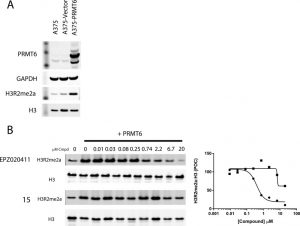
with EPZ020411 results in a dose-dependent decrease in H3R2 methylation
in A375 human melanoma cells exogenously overexpressing
PRMT6(IC50=0.637±0.241 μM). In biochemical assays EPZ020411 is over
100-fold selective for PRMT6/8/1 compared to other histone
methyltransferases including four arginine methyltransferases (PRMT3,
PRMT4, PRMT5, and PRMT7). The compound shows poor permeability in the
parallel artificial membrane permeation assay.
Kinase Assay: EPZ020411 is a potent and selective inhibitor of PRMT6 with IC50 of 10 nM, has >10 fold selectivity for PRMT6 over PRMT1 and PRMT8. Cell Assay: A375 (CRL-1619) cells are cultured in DMEM plus 10% (vol/vol) FBS. PRMT6 is cloned into BamHI and EcoRI sites of a pcDNA4 HisMAX_A plasmid. Transfection of his-tagged PRMT6 or vector control is carried out using Lipofectamine LTX and Plus reagent according to procedures recommended by the manufacturer. Cells are seeded at 200,000 cells/well in 6-well plates. The following day, the cells are concurrently transfected and treated with compound in 0.25% DMSO. Cells are incubated in the presence of increasing concentrations of compound up to 20 μM. Cell pellets are collected after 48 hours of compound treatment. In A375 human melanoma cells exogenously overexpressing PRMT6, treatment with EPZ020411 results in a dose-dependent decrease in H3R2 methylation, with an IC50 of 0.637 μM. Biochemical assays show it is over 100-fold selective for PRMT6/8/1 compared to other histone methyltransferases such as PRMT3, PRMT4, PRMT5, and PRMT7. In vitro, EPZ020411 potently inhibits PRMT6 with an IC₅₀ of 10 nM. In biochemical assays, it displays 10-fold and 20-fold selectivity over PRMT1 and PRMT8, respectively, and >100-fold selectivity over other HMTs. In cellular assays, EPZ020411 treatment leads to a dose-dependent decrease in H3R2 methylation in A375 human melanoma cells overexpressing PRMT6 (IC₅₀ = 0.637 ± 0.241 µM). The compound blocks PRMT6-mediated methylation of histone H3 at arginine 2, which enhances cellular oxidative stress responses by reducing reactive oxygen species (ROS) production and inhibiting apoptosis. |
| ln Vivo |
EPZ020411
shows good bioavailability following subcutaneous dosing in rats making
it a suitable tool for in vivo studies. Male Sprague-Dawley rats
administered a single dose of EPZ020411 at 1 mg/kg by i.v. bolus show a
moderate clearance (CL) of 19.7±1.0 mL/min/kg, with a volume of
distribution at steady state (Vss) of 11.1±1.6 L/kg, translating to a
mean terminal half-life (t1/2) of 8.54±1.43 h. Following 5 mg/kg s.c.
dosing, a good bioavailability of 65.6 ± 4.3% is observed, leading to
EPZ020411 unbound blood concentration remaining above the PRMT6
biochemical IC50 value for more than 12 h.
Pharmacokinetic studies in rats demonstrate that EPZ020411 possesses good bioavailability. Following subcutaneous dosing (5 mg/kg) in male Sprague-Dawley rats, a bioavailability of 65.6% is observed, maintaining unbound blood concentrations above the PRMT6 biochemical IC50 for over 12 hours. In vivo, EPZ020411 shows good bioavailability following subcutaneous dosing in rats, making it a suitable tool for in vivo studies. In male Sprague-Dawley rats, a single 1 mg/kg intravenous dose shows moderate clearance (CL) of 19.7±1.0 mL/min/kg and a steady-state distribution volume (Vss) of 11.1±1.6 L/kg, with a mean terminal half-life (t1/2) of 8.54±1.43 hours. Following subcutaneous administration at 5 mg/kg, a good bioavailability of 65.6±4.3% is observed, with unbound blood concentrations remaining above the PRMT6 biochemical IC₅₀ for over 12 hours. |
| Enzyme Assay |
In biochemical assays, inhibition is assessed using recombinant PRMT6 enzyme and a radiolabeled cofactor, S-adenosylmethionine. The compound's direct inhibitory potency against PRMT6 is determined by measuring the reduction in substrate methylation to calculate the IC50 value.
Non-cellular enzyme assays for EPZ020411 involve assessing its inhibition of PRMT6 methyltransferase activity using purified recombinant PRMT6 enzyme. The enzyme is incubated with a peptide substrate (e.g., histone H3) and the methyl donor S-adenosylmethionine (SAM) in the presence of varying concentrations of EPZ020411. The incorporation of methyl groups into the substrate is measured using a radiometric assay with [³H]-SAM or using a luminescence-based assay (e.g., MTase-Glo™). IC₅₀ values are determined from dose-response curves. |
| Cell Assay |
A375 cells are seeded in 6-well plates and cultured in DMEM supplemented with 10% FBS. After overnight adherence, cells are transfected with a his-tagged PRMT6 plasmid and simultaneously treated with increasing concentrations (0-20 μM) of EPZ020411 for 48 hours. Cell pellets are then collected for analysis of H3R2 methylation levels.
In vitro cellular assays for EPZ020411 involve treating A375 human melanoma cells overexpressing PRMT6 with the compound and assessing H3R2 methylation and cell viability. Cells are seeded at 200,000 cells/well in 6-well plates and transfected with his-tagged PRMT6 or vector control. Cells are treated with increasing concentrations of compound (up to 20 µM) in 0.25% DMSO for 48 hours. H3R2 methylation is assessed by Western blotting using a methylation-specific antibody. Cell viability is measured using MTT or CellTiter-Glo® assays. |
| Animal Protocol |
Dissolved in saline, pH 6.5; 1 mg/kg; i.v. injection
Sprague-Dawley rats Male Sprague-Dawley rats are used for pharmacokinetic studies. The protocol includes an intravenous bolus group (1 mg/kg in saline, pH 6.5) and a subcutaneous group (5 mg/kg). Blood samples are collected at specific time points to assess clearance, volume of distribution, half-life, and bioavailability. In vivo animal experiments with EPZ020411 are conducted in male Sprague-Dawley rats to assess pharmacokinetic properties. Rats are administered a single 1 mg/kg intravenous dose or 5 mg/kg subcutaneous dose of EPZ020411. Blood samples are collected at various time points, and plasma concentrations are measured by LC-MS/MS. Pharmacokinetic parameters such as clearance (CL), volume of distribution (Vss), terminal half-life (t1/2), and bioavailability are calculated. |
| ADME/Pharmacokinetics |
In rats, EPZ020411 exhibits moderate clearance (CL) of 19.7 mL/min/kg, a steady-state volume of distribution (Vss) of 11.1 L/kg, and a mean terminal half-life (t1/2) of 8.54 hours. An absolute bioavailability of 65.6% is observed following subcutaneous administration.
EPZ020411 2HCl has a molecular weight of 515.52 and a molecular formula of C₂₅H₄₀Cl₂N₄O₃. It is a solid powder with a purity of ≥98%. The compound is soluble in DMSO and other organic solvents. It is typically stored at -20°C, protected from light and moisture. The compound is stable under recommended storage conditions. |
| Toxicity/Toxicokinetics |
According to the available Safety Data Sheet (SDS), EPZ020411 dihydrochloride is classified as a non-hazardous substance or mixture at research-use doses. Regarding carcinogenicity, it is not listed as hazardous by NTP, IARC, OSHA, or ACGIH. However, detailed toxicological effects of this product have not been thoroughly studied, and its complete toxicity profile requires further validation.
EPZ020411 2HCl is a research compound for laboratory use only and is not approved for human therapeutic use. In preclinical studies, it has been generally well-tolerated at therapeutic doses. Standard laboratory safety precautions should be followed when handling the compound. It may cause skin, eye, and respiratory irritation. Appropriate personal protective equipment should be used. |
| References |
[1]. ACS Med Chem Lett.2015Apr 6;6(6):655-9.
|
| Additional Infomation |
EPZ020411 2HCl (CAS 2095432-47-4) is a potent and selective PRMT6 inhibitor with an IC₅₀ of 10 nM. It displays 10-fold and 20-fold selectivity over PRMT1 and PRMT8, respectively, and >100-fold selectivity over other HMTs. The compound shows good bioavailability following subcutaneous dosing in rats and is used as a chemical probe to study PRMT6 function in cancer research.
|
| Molecular Formula |
C25H40CL2N4O3
|
|---|---|
| Molecular Weight |
515.516104698181
|
| Exact Mass |
514.247
|
| CAS # |
2095432-47-4
|
| Related CAS # |
2095432-47-4 (2HCl);1700663-41-7;2070015-25-5 (HCl);
|
| PubChem CID |
129896715
|
| Appearance |
Typically exists as solid at room temperature
|
| Hydrogen Bond Donor Count |
4
|
| Hydrogen Bond Acceptor Count |
6
|
| Rotatable Bond Count |
12
|
| Heavy Atom Count |
34
|
| Complexity |
519
|
| Defined Atom Stereocenter Count |
0
|
| SMILES |
Cl.Cl.O(CCC1CCOCC1)C1CC(C1)OC1C=CC(C2=C(C=NN2)CN(C)CCNC)=CC=1
|
| InChi Key |
QCHZLIPYCYHFLI-UHFFFAOYSA-N
|
| InChi Code |
InChI=1S/C25H38N4O3.2ClH/c1-26-10-11-29(2)18-21-17-27-28-25(21)20-3-5-22(6-4-20)32-24-15-23(16-24)31-14-9-19-7-12-30-13-8-19;;/h3-6,17,19,23-24,26H,7-16,18H2,1-2H3,(H,27,28);2*1H
|
| Chemical Name |
N,N'-dimethyl-N'-[[5-[4-[3-[2-(oxan-4-yl)ethoxy]cyclobutyl]oxyphenyl]-1H-pyrazol-4-yl]methyl]ethane-1,2-diamine;dihydrochloride
|
| Synonyms |
EPZ020411 2HCl; 2095432-47-4; EPZ-020411 2HCl; EPZ020411 Dihydrochloride; 1,2-Ethanediamine, N1,N2-dimethyl-N1-[[3-[4-[[trans-3-[2-(tetrahydro-2H-pyran-4-yl)ethoxy]cyclobutyl]oxy]phenyl]-1H-pyrazol-4-yl]methyl]-, hydrochloride (1:2); orb1690001;
|
| HS Tariff Code |
2934.99.9001
|
| Storage |
Powder -20°C 3 years 4°C 2 years In solvent -80°C 6 months -20°C 1 month |
| Shipping Condition |
Room temperature (This product is stable at ambient temperature for a few days during ordinary shipping and time spent in Customs)
|
| Solubility (In Vitro) |
May dissolve in DMSO (in most cases), if not, try other solvents such as H2O, Ethanol, or DMF with a minute amount of products to avoid loss of samples
|
|---|---|
| Solubility (In Vivo) |
Note: Listed below are some common formulations that may be used to formulate products with low water solubility (e.g. < 1 mg/mL), you may test these formulations using a minute amount of products to avoid loss of samples.
Injection Formulations
Injection Formulation 1: DMSO : Tween 80: Saline = 10 : 5 : 85 (i.e. 100 μL DMSO stock solution → 50 μL Tween 80 → 850 μL Saline)(e.g. IP/IV/IM/SC) *Preparation of saline: Dissolve 0.9 g of sodium chloride in 100 mL ddH ₂ O to obtain a clear solution. Injection Formulation 2: DMSO : PEG300 :Tween 80 : Saline = 10 : 40 : 5 : 45 (i.e. 100 μL DMSO → 400 μLPEG300 → 50 μL Tween 80 → 450 μL Saline) Injection Formulation 3: DMSO : Corn oil = 10 : 90 (i.e. 100 μL DMSO → 900 μL Corn oil) Example: Take the Injection Formulation 3 (DMSO : Corn oil = 10 : 90) as an example, if 1 mL of 2.5 mg/mL working solution is to be prepared, you can take 100 μL 25 mg/mL DMSO stock solution and add to 900 μL corn oil, mix well to obtain a clear or suspension solution (2.5 mg/mL, ready for use in animals). View More
Injection Formulation 4: DMSO : 20% SBE-β-CD in saline = 10 : 90 [i.e. 100 μL DMSO → 900 μL (20% SBE-β-CD in saline)] Oral Formulations
Oral Formulation 1: Suspend in 0.5% CMC Na (carboxymethylcellulose sodium) Oral Formulation 2: Suspend in 0.5% Carboxymethyl cellulose Example: Take the Oral Formulation 1 (Suspend in 0.5% CMC Na) as an example, if 100 mL of 2.5 mg/mL working solution is to be prepared, you can first prepare 0.5% CMC Na solution by measuring 0.5 g CMC Na and dissolve it in 100 mL ddH2O to obtain a clear solution; then add 250 mg of the product to 100 mL 0.5% CMC Na solution, to make the suspension solution (2.5 mg/mL, ready for use in animals). View More
Oral Formulation 3: Dissolved in PEG400 (Please use freshly prepared in vivo formulations for optimal results.) |
| Preparing Stock Solutions | 1 mg | 5 mg | 10 mg | |
| 1 mM | 1.9398 mL | 9.6989 mL | 19.3979 mL | |
| 5 mM | 0.3880 mL | 1.9398 mL | 3.8796 mL | |
| 10 mM | 0.1940 mL | 0.9699 mL | 1.9398 mL |
*Note: Please select an appropriate solvent for the preparation of stock solution based on your experiment needs. For most products, DMSO can be used for preparing stock solutions (e.g. 5 mM, 10 mM, or 20 mM concentration); some products with high aqueous solubility may be dissolved in water directly. Solubility information is available at the above Solubility Data section. Once the stock solution is prepared, aliquot it to routine usage volumes and store at -20°C or -80°C. Avoid repeated freeze and thaw cycles.
Calculation results
Working concentration: mg/mL;
Method for preparing DMSO stock solution: mg drug pre-dissolved in μL DMSO (stock solution concentration mg/mL). Please contact us first if the concentration exceeds the DMSO solubility of the batch of drug.
Method for preparing in vivo formulation::Take μL DMSO stock solution, next add μL PEG300, mix and clarify, next addμL Tween 80, mix and clarify, next add μL ddH2O,mix and clarify.
(1) Please be sure that the solution is clear before the addition of next solvent. Dissolution methods like vortex, ultrasound or warming and heat may be used to aid dissolving.
(2) Be sure to add the solvent(s) in order.
|
|---|
|
Products are for research use only; We do not sell to patients
Copyright 2020 InvivoChem LLC | All Rights Reserved