| Size | Price | Stock | Qty |
|---|---|---|---|
| 5mg |
|
||
| 10mg |
|
||
| 25mg |
|
||
| 50mg |
|
||
| 100mg |
|
||
| 250mg | |||
| Other Sizes |
| Targets |
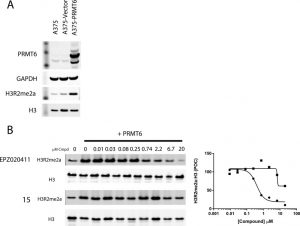
- EPZ020411 hydrochloride targets protein arginine methyltransferase 6 (PRMT6), with an IC₅₀ value of 0.637 ± 0.241 μM for inhibiting PRMT6-induced H3R2 methylation [1]
|
|---|---|
| ln Vitro |
In A375 cells, EPZ020411 hydrochloride (0–20 μM; 24 h) reduces H3R2 methylation[1]. Hair cell survival is increased and neomycin- and cisplatin-induced cell apoptosis is reduced by EPZ020411 hydrochloride (20–40 μM; 6 h)[2].
- In A375 cells overexpressing PRMT6 for 48 hours, PRMT6-induced H3R2 methylation was significantly inhibited by 48-hour exposure to EPZ020411 hydrochloride (IC₅₀ = 0.637 ± 0.241 μM), while the control compound 15 showed no inhibitory effect (IC₅₀ > 20 μM) [1] - In neonatal mouse cochlear explants, pretreatment with EPZ020411 hydrochloride significantly attenuated neomycin- and cisplatin-induced hair cell loss. Immunofluorescence staining for myosin 7a (a hair cell marker) showed increased survival of hair cells in the apical, middle, and basal turns of the cochlea compared to the ototoxin-only groups. Additionally, the number of cleaved caspase-3-positive and TUNEL-positive apoptotic hair cells was drastically reduced. Staining with MitoSox-Red indicated that EPZ020411 hydrochloride inhibited neomycin- and cisplatin-induced reactive oxygen species (ROS) production in hair cells [2] - In HEI-OC1 cells with PRMT6 knockdown, cisplatin-induced ROS accumulation was decreased (detected by DCFH-DA and cellROX green staining). Mitochondrial membrane potential (ΔΨm) was stabilized (assessed by JC-1, TMRM, and rhodamine 123 staining), and cytochrome c translocation was reversed, leading to reduced cell apoptosis [2] |
| ln Vivo |
In C57BL/6J wild-type mice with acute ototoxicity model, EPZ020411 hydrochloride (10 mg/kg; ip once) decreases neomycin- and cisplatin-induced hearing loss[2]. 1.19 Rats' pharmacokinetic parameters for hydrochloride EPZ020411[1]. Rats IV 1 mg/kg Rats SC 5 mg/kg CL (mL/min/kg) 19.7±1.0 Vss (L/kg) 11.1±1.6 t1/2 (h) 8.54±1.43 9.19±1.60 tmax (h) 0.444 Cmax (ng /mL) 844±306 AUC0-τ (h·ng/mL) 745±34 2456±135 AUC0-inf (h·ng/mL) 846±45 2775±181 F (%) 65.6±4.3
- In C57BL/6 mice with neomycin-induced chronic ototoxicity: Intraperitoneal pretreatment with EPZ020411 hydrochloride reduced auditory brainstem response (ABR) and distortion product otoacoustic emission (DPOAE) thresholds, indicating improved hearing function. Immunofluorescence staining showed increased survival of myosin 7a-positive hair cells in all cochlear turns, with decreased apoptotic cells and ROS production compared to the neomycin-only group [2] - In C57BL/6 mice with neomycin + furosemide-induced acute ototoxicity: EPZ020411 hydrochloride intraperitoneal pretreatment alleviated hearing loss (lower ABR/DPOAE thresholds) and increased hair cell survival. Caspase 3/7-positive apoptotic cells and MitoSox-Red-positive ROS-producing cells in the cochlea were significantly reduced [2] - In C57BL/6 mice with cisplatin-induced ototoxicity: Intraperitoneal administration of EPZ020411 hydrochloride improved hearing function (reduced ABR/DPOAE thresholds) and enhanced hair cell survival. The number of apoptotic cells and ROS levels in the cochlea were decreased, confirming the protective effect against cisplatin-induced hair cell damage [2] |
| Enzyme Assay |
- PRMT6 methyltransferase activity inhibition assay: A375 cells were transfected with PRMT6-overexpressing vectors (or empty vectors as controls) to induce H3R2 methylation. The cells were then treated with different concentrations of EPZ020411 hydrochloride for 48 hours. The level of H3R2 methylation was detected to evaluate the inhibitory effect of EPZ020411 hydrochloride on PRMT6 activity, and the IC₅₀ value was calculated as 0.637 ± 0.241 μM [1]
|
| Cell Assay |
Western Blot Analysis[1]
Cell Types: A375 cells Tested Concentrations: 0-20 μM Incubation Duration: 24 hrs (hours) Experimental Results: Dose-dependently diminished H3R2 methylation in A375 cells with an IC50 of 0.634 μM. Cell Viability Assay[2] Cell Types: Cultured cochleae cells Tested Concentrations: 20 and 40 μM Incubation Duration: 6 hrs (hours) Experimental Results: Suppressed the apoptotic cascade induced by aminoglycosides and also inhibited cisplatin-induced apoptosis in the hair cells of the cochlear explants after pretreatment deposed. decreased hair cell loss caused by cisplatin treatment. - H3R2 methylation inhibition assay in A375 cells: A375 cells were seeded and transfected with PRMT6-overexpressing plasmids. After 48 hours of transfection, the cells were treated with EPZ020411 hydrochloride (or compound 15 as a negative control) for another 48 hours. The cells were then processed to detect H3R2 methylation levels using relevant immunological methods, and the inhibitory efficiency was quantified to determine the IC₅₀ [1] - Cochlear explant hair cell protection assay: Cochlear explants were isolated from neonatal mice and divided into control, EPZ020411 hydrochloride-only, ototoxin-only (neomycin or cisplatin), and EPZ020411 hydrochloride + ototoxin groups. The explants were pretreated with EPZ020411 hydrochloride before ototoxin exposure. After incubation, immunofluorescence staining for myosin 7a (hair cell marker) and DAPI (nuclear marker) was performed to count surviving hair cells. Cleaved caspase-3 and TUNEL staining were used to detect apoptotic cells, and MitoSox-Red staining was employed to measure ROS production [2] - HEI-OC1 cell apoptosis and mitochondrial function assay: HEI-OC1 cells were transfected with PRMT6 knockdown vectors or control vectors. After transfection, the cells were treated with cisplatin. DCFH-DA and cellROX green staining were used to detect intracellular ROS levels. JC-1, TMRM, and rhodamine 123 staining were performed to assess mitochondrial membrane potential. Immunofluorescence staining for cytochrome c (Cyt-c) was used to evaluate mitochondrial dysfunction [2] |
| Animal Protocol |
Animal/Disease Models: C57BL/ 6J wild-type mice at P28 with acute ototoxicity model[2]
Doses: 10 mg/kg Route of Administration: intraperitoneal (ip)injection; 10 mg/kg once Experimental Results: Dramatically decreased neomycin- and cisplatin-induced HC loss and demonstrated no effect without neomycin injection with mice. - Neomycin-induced chronic ototoxicity model in C57BL/6 mice: Mice were randomly divided into control (sterile saline), EPZ020411 hydrochloride-only, neomycin-only, and EPZ020411 hydrochloride + neomycin groups. EPZ020411 hydrochloride was administered intraperitoneally as pretreatment, followed by neomycin administration. After the treatment period, ABR and DPOAE thresholds were measured to assess hearing function. Cochleae were harvested for immunofluorescence staining with myosin 7a and phalloidin to count hair cells [2] - Neomycin + furosemide-induced acute ototoxicity model in C57BL/6 mice: Mice were grouped as control, EPZ020411 hydrochloride-only, neomycin + furosemide-only, and EPZ020411 hydrochloride + neomycin + furosemide groups. EPZ020411 hydrochloride was given intraperitoneally before the combined administration of neomycin and furosemide. Hearing function was evaluated by ABR and DPOAE. Cochlear tissues were processed for hair cell counting, and Caspase 3/7 and MitoSox-Red staining to detect apoptosis and ROS [2] - Cisplatin-induced ototoxicity model in C57BL/6 mice: Mice were divided into control (sterile saline), EPZ020411 hydrochloride-only, cisplatin-only, and EPZ020411 hydrochloride + cisplatin groups. EPZ020411 hydrochloride was administered intraperitoneally prior to cisplatin treatment. ABR and DPOAE were measured to assess hearing. Cochleae were collected for myosin 7a and phalloidin staining to count hair cells, and Caspase 3/7 and MitoSox-Red staining to analyze apoptosis and ROS production [2] |
| ADME/Pharmacokinetics |
Subcutaneous injection of EPZ020411 hydrochloride (EPZ020411) showed good bioavailability in rats, making it suitable for in vivo studies [1].
|
| References |
|
| Additional Infomation |
EPZ020411 hydrochloride (EPZ020411) is the first highly efficient and selective small molecule tool compound for PRMT6. PRMT6 has been reported to be expressed in various cancers, suggesting that PRMT6 inhibitors have potential therapeutic value [1]. EPZ020411 hydrochloride exerts a protective effect against ototoxicity induced by aminoglycosides and cisplatin by inhibiting PRMT6. The mechanism includes reducing the production of reactive oxygen species (ROS), alleviating mitochondrial dysfunction, and inhibiting mitochondrial-related apoptosis signaling pathways [2]. The inhibitory effect of EPZ020411 hydrochloride on PRMT6 antagonizes PRMT6-mediated H3R2 methylation, which is involved in regulating gene transcription and cellular processes related to cancer and ototoxicity [1][2].
|
| Molecular Formula |
C25H39CLN4O3
|
|---|---|
| Molecular Weight |
479.055165529251
|
| Exact Mass |
478.271
|
| CAS # |
2070015-25-5
|
| Related CAS # |
EPZ020411;1700663-41-7
|
| PubChem CID |
119081410
|
| Appearance |
Off-white to light yellow solid powder
|
| Hydrogen Bond Donor Count |
3
|
| Hydrogen Bond Acceptor Count |
6
|
| Rotatable Bond Count |
12
|
| Heavy Atom Count |
33
|
| Complexity |
519
|
| Defined Atom Stereocenter Count |
0
|
| SMILES |
Cl.O(CCC1CCOCC1)C1CC(C1)OC1C=CC(C2=C(C=NN2)CN(C)CCNC)=CC=1
|
| InChi Key |
LIDZHJMYAKPGOJ-UHFFFAOYSA-N
|
| InChi Code |
InChI=1S/C25H38N4O3.ClH/c1-26-10-11-29(2)18-21-17-27-28-25(21)20-3-5-22(6-4-20)32-24-15-23(16-24)31-14-9-19-7-12-30-13-8-19;/h3-6,17,19,23-24,26H,7-16,18H2,1-2H3,(H,27,28);1H
|
| Chemical Name |
N,N'-dimethyl-N'-[[5-[4-[3-[2-(oxan-4-yl)ethoxy]cyclobutyl]oxyphenyl]-1H-pyrazol-4-yl]methyl]ethane-1,2-diamine;hydrochloride
|
| Synonyms |
EPZ020411 EPZ020411 HCl EPZ-020411 EPZ 020411EPZ020411 hydrochloride
|
| HS Tariff Code |
2934.99.9001
|
| Storage |
Powder -20°C 3 years 4°C 2 years In solvent -80°C 6 months -20°C 1 month Note: Please store this product in a sealed and protected environment (e.g. under nitrogen), avoid exposure to moisture. |
| Shipping Condition |
Room temperature (This product is stable at ambient temperature for a few days during ordinary shipping and time spent in Customs)
|
| Solubility (In Vitro) |
0.1 M HCL : 50 mg/mL (~104.37 mM)
DMSO : ~50 mg/mL (~104.37 mM) H2O : ~20 mg/mL (~41.75 mM) |
|---|---|
| Solubility (In Vivo) |
Solubility in Formulation 1: ≥ 2.5 mg/mL (5.22 mM) (saturation unknown) in 10% DMSO + 40% PEG300 + 5% Tween80 + 45% Saline (add these co-solvents sequentially from left to right, and one by one), clear solution.
For example, if 1 mL of working solution is to be prepared, you can add 100 μL of 25.0 mg/mL clear DMSO stock solution to 400 μL PEG300 and mix evenly; then add 50 μL Tween-80 to the above solution and mix evenly; then add 450 μL normal saline to adjust the volume to 1 mL. Preparation of saline: Dissolve 0.9 g of sodium chloride in 100 mL ddH₂ O to obtain a clear solution. Solubility in Formulation 2: ≥ 2.5 mg/mL (5.22 mM) (saturation unknown) in 10% DMSO + 90% (20% SBE-β-CD in Saline) (add these co-solvents sequentially from left to right, and one by one), clear solution. For example, if 1 mL of working solution is to be prepared, you can add 100 μL of 25.0 mg/mL clear DMSO stock solution to 900 μL of 20% SBE-β-CD physiological saline solution and mix evenly. Preparation of 20% SBE-β-CD in Saline (4°C,1 week): Dissolve 2 g SBE-β-CD in 10 mL saline to obtain a clear solution. View More
Solubility in Formulation 3: ≥ 2.5 mg/mL (5.22 mM) (saturation unknown) in 10% DMSO + 90% Corn Oil (add these co-solvents sequentially from left to right, and one by one), clear solution. Solubility in Formulation 4: 25 mg/mL (52.19 mM) in PBS (add these co-solvents sequentially from left to right, and one by one), clear solution; with ultrasonication (<60°C). |
| Preparing Stock Solutions | 1 mg | 5 mg | 10 mg | |
| 1 mM | 2.0874 mL | 10.4371 mL | 20.8742 mL | |
| 5 mM | 0.4175 mL | 2.0874 mL | 4.1748 mL | |
| 10 mM | 0.2087 mL | 1.0437 mL | 2.0874 mL |
*Note: Please select an appropriate solvent for the preparation of stock solution based on your experiment needs. For most products, DMSO can be used for preparing stock solutions (e.g. 5 mM, 10 mM, or 20 mM concentration); some products with high aqueous solubility may be dissolved in water directly. Solubility information is available at the above Solubility Data section. Once the stock solution is prepared, aliquot it to routine usage volumes and store at -20°C or -80°C. Avoid repeated freeze and thaw cycles.
Calculation results
Working concentration: mg/mL;
Method for preparing DMSO stock solution: mg drug pre-dissolved in μL DMSO (stock solution concentration mg/mL). Please contact us first if the concentration exceeds the DMSO solubility of the batch of drug.
Method for preparing in vivo formulation::Take μL DMSO stock solution, next add μL PEG300, mix and clarify, next addμL Tween 80, mix and clarify, next add μL ddH2O,mix and clarify.
(1) Please be sure that the solution is clear before the addition of next solvent. Dissolution methods like vortex, ultrasound or warming and heat may be used to aid dissolving.
(2) Be sure to add the solvent(s) in order.
|
|---|
|
Products are for research use only; We do not sell to patients
Copyright 2020 InvivoChem LLC | All Rights Reserved