| Size | Price | Stock | Qty |
|---|---|---|---|
| 1mg |
|
||
| 5mg |
|
||
| 10mg |
|
||
| 25mg |
|
||
| 50mg |
|
||
| 100mg |
|
||
| 250mg |
|
||
| 500mg |
|
||
| Other Sizes |


Purity: ≥98%
| Targets |
V2 vasopressin receptor (selective agonist) [1]
Desmopressin acetate targets the vasopressin V2 receptor (V2R), a G protein-coupled receptor in the renal collecting ducts. By binding to V2R, it activates cAMP-dependent signaling, leading to increased water reabsorption. It also stimulates release of von Willebrand factor from endothelial cells. |
|---|---|
| ln Vitro |
Desmopressin (also known as DDAVP) is a synthetic octapeptide and an analogue of the human antidiuretic hormone arginine vasopressin. Vasopressin is a hormone that reduces the production of urine and desmopressin is a synthetic version for vasopressin. The antidiuretic properties of desmopressin have led to its use in polyuric conditions including primary nocturnal enuresis, nocturia, and diabetes insipidus. Desmopressin works by limiting the amount of water eliminated in the urine. Desmopressin binds to V2 receptors in renal collecting ducts, increasing water reabsorption. It also stimulates release of von Willebrand factor from endothelial cells by acting on the V2 receptor. Desmopressin is most frequently prescribed for treatment of diabetes insipidus or nocturnal enuresis.
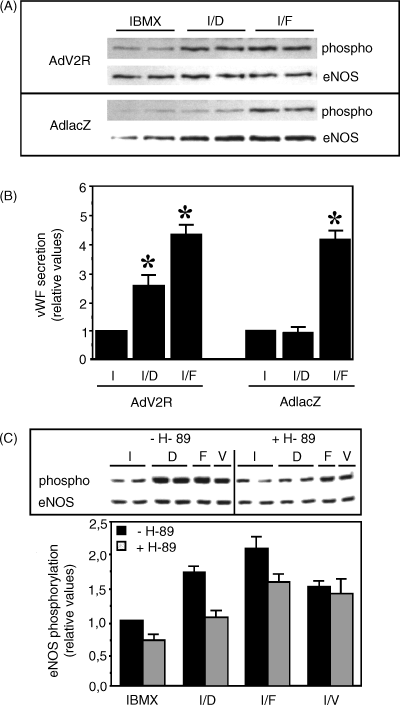
Kinase Assay: Cell Assay: HUVECs are transduced with recombinant adenoviruses AdV2R.EGFP (AdV2R) or AdlacZ. 3 days later cells are incubated for 25 min with 1 μM DDAVP or 10 μM forskolin, both in presence of IBMX. Cell extracts are analyzed for eNOS Ser1177 phosphorylation and eNOS expression. Desmopressin acetate exhibited modest but significant antiproliferative effects on MCF-7 and Skbr3 human breast carcinoma cell lines that express V2 receptors. This effect is mediated through V2 receptor signaling, involving adenylate cyclase activation and intracellular cAMP elevation, and can be blocked by the selective V2 receptor antagonist SR121463. [1] Treatment of MCF-7 cell monolayers with Desmopressin acetate in the presence of plasminogen induced the formation of angiostatin, a natural inhibitor of angiogenesis, likely via V2 receptor-dependent proteolytic processing. [1] In cultures of mouse mammary tumor cells, Desmopressin acetate modulated cell growth and secretion of the serine protease urokinase. [1] Desmopressin acetate is a selective agonist for the vasopressin V2 receptor coupled to cAMP-dependent signaling. It induces cAMP-dependent eNOS activation via Ser1177 phosphorylation. In human endothelial cells, it induces NO production via V2 receptor- and cAMP-mediated signaling. It has selective affinity for the V2 receptor. |
| ln Vivo |
DDAVP (2 μg/kg) reduces accumulation of ascites and formation of intestinal tumor nodules in mice intraperitoneally inoculated with CT-26 cells. Perioperative administration of DDAVP significantly inhibits tumor progression in animals surgically implanted in the spleen with CT-26 cells, and causes some reduction in liver metastasis. DDAVP is able to inhibit lung colonization by blood-borne breast cancer cells in an experimental murine model. It dramatically reduces lymph node and lung metastasis in a model of mammary tumor manipulation and surgical excision in mice when administered perioperatively, and also exerts antitumor effects in combination with chemotherapy. DDAVP increases the plasma levels of coagulation factor VIII, von Willebrand factor (VWF) and tissue-type plasminogen activator, and also enhances platelet adhesion to the vessel wall. The plasma half-life of desmopressin acetate followed a monoexponential time course with t1/2 values of 1.5 to 2.5 hours which was independent of dose.
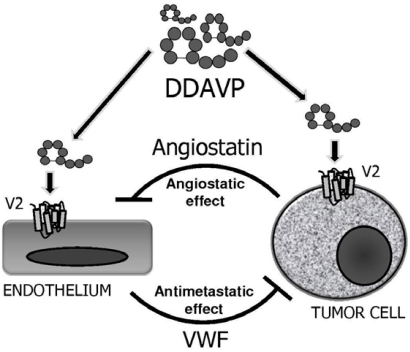
Intravenous administration of Desmopressin acetate at doses of 1-2 μg/kg inhibited by 70% the experimental lung colonization of aggressive mammary cancer cells and dramatically decreased lymph node and distant metastasis in a mouse model of breast tumor manipulation and surgical excision. No direct cytotoxicity on tumor cells was observed, and antimetastatic resistance was achieved without overt toxic effects. [1] In a pilot veterinary clinical trial in surgically treated bitches with locally advanced mammary cancer, perioperative Desmopressin acetate (1 μg/kg, administered 30 minutes before surgery and 24 hours after surgery) significantly prolonged survival, had beneficial effects on both disease-free interval and overall survival, decreased intraoperative bleeding, and was safe. An extended veterinary trial confirmed these results, showing particular survival benefit in patients with more aggressive carcinoma. [1] Desmopressin acetate prevented aggregation of mammary carcinoma cells in mice, reducing the efficiency of the metastatic process. It induces rapid release of von Willebrand factor (VWF) from microvascular endothelial cells; VWF plays a protective role against tumor cell dissemination, induces apoptosis of tumor cells in vitro, and causes death of metastatic cells arrested in the lungs. [1] In vivo, Desmopressin acetate works by limiting water elimination in urine. It binds to V2 receptors in renal collecting ducts, increasing water reabsorption. It also stimulates release of von Willebrand factor from endothelial cells. It is used clinically for diabetes insipidus, nocturia, von Willebrand disease, and hemophilia A. |
| Enzyme Assay |
Cell-free assays for Desmopressin acetate utilize membrane preparations expressing V2 receptors. Radiolabeled vasopressin binding is measured in the presence of increasing compound concentrations. Alternatively, cAMP accumulation assays using membranes or purified receptor preparations can be performed to assess receptor activation.
|
| Cell Assay |
Cell proliferation assays: MCF-7 and Skbr3 human breast carcinoma cell lines (expressing V2 receptors) were treated with Desmopressin acetate, and antiproliferative effects were measured. The involvement of V2 receptor signaling was confirmed using the selective antagonist SR121463, and intracellular cAMP elevation was assessed. [1]
Angiostatin formation assay: MCF-7 cell monolayers were treated with Desmopressin acetate in the presence of appropriate concentrations of plasminogen, and the formation of angiostatin was detected. [1] Mouse mammary tumor cell cultures were treated with Desmopressin acetate to assess modulation of cell growth and urokinase secretion. [1] Cells expressing V2 receptors (renal collecting duct cells, endothelial cells) are treated with Desmopressin acetate at various concentrations. cAMP levels are measured by ELISA. eNOS activation is assessed by Western blot for Ser1177 phosphorylation. von Willebrand factor release from endothelial cells is measured by ELISA. |
| Animal Protocol |
Dissolved in saline; 2 μg/kg; i.v. Syngeneic adult male Balb/c mice inoculated with CT-26 colon cancer cells
Mouse models: For experimental lung colonization, mice were injected intravenously with aggressive mammary cancer cells and treated with Desmopressin acetate at 1-2 μg/kg (intravenous). The number of lung metastases was evaluated. In a breast tumor manipulation and surgical excision model, mice received perioperative Desmopressin acetate (doses not specified in this review but previously reported as 1-2 μg/kg). Survival and metastatic burden were assessed. [1] Veterinary clinical trial: Bitches with locally advanced mammary cancer were treated perioperatively with Desmopressin acetate at 1 μg/kg (intravenous), administered 30 minutes before surgery and 24 hours after surgery. Disease-free interval, overall survival, and intraoperative bleeding were monitored. [1] In vivo animal studies for Desmopressin acetate are conducted in rodent models of diabetes insipidus or bleeding disorders. The compound is administered via oral, intranasal, or intravenous routes. Urine output and osmolality are measured. von Willebrand factor levels in plasma are measured. Bleeding time is assessed. |
| ADME/Pharmacokinetics |
After intravenous injection of Desmopressin acetate, plasma levels of von Willebrand factor (VWF) reach peak levels at about 60 minutes, and VWF has a plasma half-life of 8-10 hours. [1]
Desmopressin acetate is administered via oral, intranasal, or intravenous routes. As a peptide acetate salt (MW 1129.2, formula C46H64N14O12S2·C2H4O2), it has limited oral bioavailability and is typically given intranasally or intravenously. PK parameters including Tmax, half-life, and bioavailability have been characterized. |
| Toxicity/Toxicokinetics |
No overt toxic effects were observed in mice treated with Desmopressin acetate at antimetastatic doses (1-2 μg/kg). In the veterinary trial, Desmopressin acetate appeared safe at 1 μg/kg in canine cancer patients. [1]
The prothrombotic risk should be carefully monitored when Desmopressin acetate is administered perioperatively, as thrombosis is a recognized complication in cancer patients. However, DDAVP is generally considered a safe hemostatic agent. [1] Desmopressin acetate is generally well-tolerated. Common adverse effects include headache, nausea, and hyponatremia. As a V2 receptor agonist, it has potential for fluid overload and electrolyte disturbances. Standard toxicological assessments have been conducted to support clinical use. |
| References |
Thromb Haemost.2010 Nov;104(5):984-9;Curr Pharm Biotechnol.2011 Nov;12(11):1974-80.
|
| Additional Infomation |
Desmopressin acetate is an analogue of vasopressin, possessing antidiuretic and hemostatic effects. Desmopressin acetate has a selective affinity for V2 receptors, acting on the distal renal tubules and stimulating water reabsorption by increasing cell permeability. This antidiuretic is used to treat central diabetes insipidus. Another effect of desmopressin acetate is increasing circulating factor VIII levels, used to treat hemophilia and von Willebrand disease. Arginine vasopressin is a synthetic analogue of a pituitary hormone. Its action is mediated by the vasopressin receptor V2. It has sustained antidiuretic activity but a small pressor effect. It can also regulate circulating factor VIII and von Willebrand factor levels.
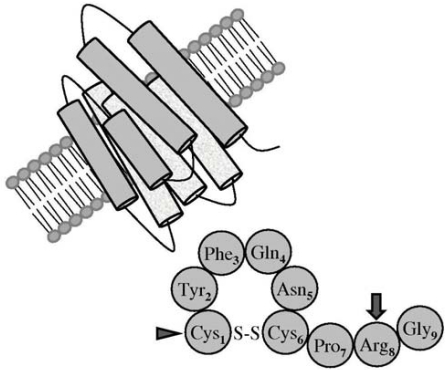
Desmopressin acetate (1-deamino-8-D-arginine vasopressin) is a synthetic analog of vasopressin. Its peptide sequence differs from natural vasopressin by deamination of cysteine at position 1 (prolonging half-life) and substitution of D-arginine for L-arginine at position 8 (reducing pressor effect and conferring V2 receptor selectivity). [1] The compound is initially used for antidiuretic replacement therapy in diabetes insipidus and enuresis, and as a hemostatic agent in bleeding disorders such as mild hemophilia and von Willebrand disease. It causes release of von Willebrand factor (VWF), coagulation factor VIII, and tissue-type plasminogen activator (tPA) from microvascular endothelial stores via V2 receptor-mediated, cAMP-dependent exocytosis. [1] Perioperative use of Desmopressin acetate has been reported in human cancer patients with hemostatic disorders (ovarian tumor, breast fibroadenoma, lung cancer, hepatic metastasis from colon cancer, skin cancer), showing satisfactory bleeding control. [1] The peptide is considered a lead compound for developing novel synthetic analogs with enhanced cytostatic, antimetastatic, and antiangiogenic effects. [1] Desmopressin acetate (molecular formula C46H64N14O12S2·C2H4O2, MW 1129.2) is the acetate salt of desmopressin (dDAVP). It is a synthetic octapeptide analog of arginine vasopressin used clinically for diabetes insipidus, nocturia, von Willebrand disease, and hemophilia A. It is a selective V2 receptor agonist. |
| Molecular Formula |
C48H68N14O14S2
|
|
|---|---|---|
| Molecular Weight |
1129.27
|
|
| Exact Mass |
1128.448
|
|
| CAS # |
62288-83-9
|
|
| Related CAS # |
62357-86-2 (acetate trihydrate);69-25-0;62288-83-9 (acetate);16679-58-6; 16679-58-6;
|
|
| PubChem CID |
16051969
|
|
| Appearance |
Typically exists as solid at room temperature
|
|
| Density |
1.56 g/cm3
|
|
| Boiling Point |
1667.7ºC at 760 mmHg
|
|
| Melting Point |
170-172ºC
|
|
| Flash Point |
962.4ºC
|
|
| LogP |
1.614
|
|
| Hydrogen Bond Donor Count |
14
|
|
| Hydrogen Bond Acceptor Count |
17
|
|
| Rotatable Bond Count |
19
|
|
| Heavy Atom Count |
78
|
|
| Complexity |
2070
|
|
| Defined Atom Stereocenter Count |
7
|
|
| SMILES |
S1C([H])([H])[C@@]([H])(C(N2C([H])([H])C([H])([H])C([H])([H])[C@]2([H])C(N([H])[C@]([H])(C(N([H])C([H])([H])C(N([H])[H])=O)=O)C([H])([H])C([H])([H])C([H])([H])/N=C(\N([H])[H])/N([H])[H])=O)=O)N([H])C([C@@]([H])(C([H])([H])C(N([H])[H])=O)N([H])C([C@@]([H])(C([H])([H])C([H])([H])C(N([H])[H])=O)N([H])C([C@@]([H])(C([H])([H])C2C([H])=C([H])C([H])=C([H])C=2[H])N([H])C([C@@]([H])(C([H])([H])C2C([H])=C([H])C(=C([H])C=2[H])O[H])N([H])C(C([H])([H])C([H])([H])S1)=O)=O)=O)=O)=O.O([H])C(C([H])([H])[H])=O
|
|
| InChi Key |
MLSVJHOYXJGGTR-IFHOVBQLSA-N
|
|
| InChi Code |
InChI=1S/C46H64N14O12S2.C2H4O2/c47-35(62)15-14-29-40(67)58-32(22-36(48)63)43(70)59-33(45(72)60-18-5-9-34(60)44(71)56-28(8-4-17-52-46(50)51)39(66)53-23-37(49)64)24-74-73-19-16-38(65)54-30(21-26-10-12-27(61)13-11-26)41(68)57-31(42(69)55-29)20-25-6-2-1-3-7-25;1-2(3)4/h1-3,6-7,10-13,28-34,61H,4-5,8-9,14-24H2,(H2,47,62)(H2,48,63)(H2,49,64)(H,53,66)(H,54,65)(H,55,69)(H,56,71)(H,57,68)(H,58,67)(H,59,70)(H4,50,51,52);1H3,(H,3,4)/t28-,29+,30+,31+,32+,33+,34+;/m1./s1
|
|
| Chemical Name |
|
|
| Synonyms |
|
|
| HS Tariff Code |
2934.99.9001
|
|
| Storage |
Powder -20°C 3 years 4°C 2 years In solvent -80°C 6 months -20°C 1 month |
|
| Shipping Condition |
Room temperature (This product is stable at ambient temperature for a few days during ordinary shipping and time spent in Customs)
|
| Solubility (In Vitro) |
|
|||
|---|---|---|---|---|
| Solubility (In Vivo) |
Note: Listed below are some common formulations that may be used to formulate products with low water solubility (e.g. < 1 mg/mL), you may test these formulations using a minute amount of products to avoid loss of samples.
Injection Formulations
Injection Formulation 1: DMSO : Tween 80: Saline = 10 : 5 : 85 (i.e. 100 μL DMSO stock solution → 50 μL Tween 80 → 850 μL Saline)(e.g. IP/IV/IM/SC) *Preparation of saline: Dissolve 0.9 g of sodium chloride in 100 mL ddH ₂ O to obtain a clear solution. Injection Formulation 2: DMSO : PEG300 :Tween 80 : Saline = 10 : 40 : 5 : 45 (i.e. 100 μL DMSO → 400 μLPEG300 → 50 μL Tween 80 → 450 μL Saline) Injection Formulation 3: DMSO : Corn oil = 10 : 90 (i.e. 100 μL DMSO → 900 μL Corn oil) Example: Take the Injection Formulation 3 (DMSO : Corn oil = 10 : 90) as an example, if 1 mL of 2.5 mg/mL working solution is to be prepared, you can take 100 μL 25 mg/mL DMSO stock solution and add to 900 μL corn oil, mix well to obtain a clear or suspension solution (2.5 mg/mL, ready for use in animals). View More
Injection Formulation 4: DMSO : 20% SBE-β-CD in saline = 10 : 90 [i.e. 100 μL DMSO → 900 μL (20% SBE-β-CD in saline)] Oral Formulations
Oral Formulation 1: Suspend in 0.5% CMC Na (carboxymethylcellulose sodium) Oral Formulation 2: Suspend in 0.5% Carboxymethyl cellulose Example: Take the Oral Formulation 1 (Suspend in 0.5% CMC Na) as an example, if 100 mL of 2.5 mg/mL working solution is to be prepared, you can first prepare 0.5% CMC Na solution by measuring 0.5 g CMC Na and dissolve it in 100 mL ddH2O to obtain a clear solution; then add 250 mg of the product to 100 mL 0.5% CMC Na solution, to make the suspension solution (2.5 mg/mL, ready for use in animals). View More
Oral Formulation 3: Dissolved in PEG400 (Please use freshly prepared in vivo formulations for optimal results.) |
| Preparing Stock Solutions | 1 mg | 5 mg | 10 mg | |
| 1 mM | 0.8855 mL | 4.4276 mL | 8.8553 mL | |
| 5 mM | 0.1771 mL | 0.8855 mL | 1.7711 mL | |
| 10 mM | 0.0886 mL | 0.4428 mL | 0.8855 mL |
*Note: Please select an appropriate solvent for the preparation of stock solution based on your experiment needs. For most products, DMSO can be used for preparing stock solutions (e.g. 5 mM, 10 mM, or 20 mM concentration); some products with high aqueous solubility may be dissolved in water directly. Solubility information is available at the above Solubility Data section. Once the stock solution is prepared, aliquot it to routine usage volumes and store at -20°C or -80°C. Avoid repeated freeze and thaw cycles.
Calculation results
Working concentration: mg/mL;
Method for preparing DMSO stock solution: mg drug pre-dissolved in μL DMSO (stock solution concentration mg/mL). Please contact us first if the concentration exceeds the DMSO solubility of the batch of drug.
Method for preparing in vivo formulation::Take μL DMSO stock solution, next add μL PEG300, mix and clarify, next addμL Tween 80, mix and clarify, next add μL ddH2O,mix and clarify.
(1) Please be sure that the solution is clear before the addition of next solvent. Dissolution methods like vortex, ultrasound or warming and heat may be used to aid dissolving.
(2) Be sure to add the solvent(s) in order.
DDAVP induces eNOS Ser1177 phosphorylation and VWF secretion via cAMP‐dependent signaling.J Thromb Haemost.2003 Apr;1(4):821-8. |
|---|
Peptide sequence of vasopressin. The synthetic analog DDAVP differs from the natural peptide by deamination of cystein in position 1 (arrowhead), which prolongs its half-life, and Darginine substitution in position 8 (arrow), which reduces the pressor effect and confers selectivity for the V2 membrane receptor.Curr Pharm Biotechnol.2011 Nov;12(11):1974-80. |
Dual and reciprocal effects of perioperative DDAVP on endothelial and tumor cells.Curr Pharm Biotechnol.2011 Nov;12(11):1974-80. |
Products are for research use only; We do not sell to patients
Copyright 2020 InvivoChem LLC | All Rights Reserved


 COA
COA