| Size | Price | Stock | Qty |
|---|---|---|---|
| 10mg |
|
||
| 25mg |
|
||
| 50mg |
|
||
| 100mg |
|
||
| 250mg | |||
| 500mg | |||
| Other Sizes |


Purity: ≥98%
| Targets |
Desmopressin acts as a selective agonist at the vasopressin V2 receptor. By binding to V2 receptors on the distal renal tubules, it stimulates water reabsorption by increasing cell permeability. This antidiuretic effect reduces urine production and increases urine concentration. Additionally, it increases circulating factor VIII levels, which is used to treat hemophilia and von Willebrand disease.
|
|---|---|
| ln Vitro |
In vitro activity: Desmopressin (also known as DDAVP) is a synthetic octapeptide and an analogue of the human antidiuretic hormone arginine vasopressin. Vasopressin is a hormone that reduces the production of urine and desmopressin is a synthetic version for vasopressin. The antidiuretic properties of desmopressin have led to its use in polyuric conditions including primary nocturnal enuresis, nocturia, and diabetes insipidus. Desmopressin works by limiting the amount of water eliminated in the urine. Desmopressin binds to V2 receptors in renal collecting ducts, increasing water reabsorption. It also stimulates release of von Willebrand factor from endothelial cells by acting on the V2 receptor. Desmopressin is most frequently prescribed for treatment of diabetes insipidus or nocturnal enuresis.
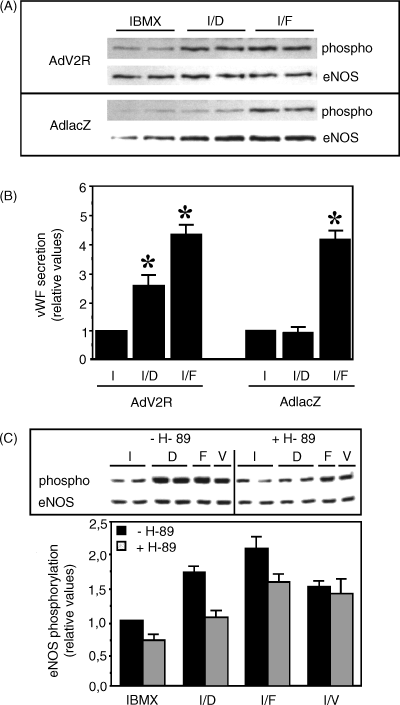
Kinase Assay: Cell Assay: HUVECs are transduced with recombinant adenoviruses AdV2R.EGFP (AdV2R) or AdlacZ. 3 days later cells are incubated for 25 min with 1 μM DDAVP or 10 μM forskolin, both in presence of IBMX. Cell extracts are analyzed for eNOS Ser1177 phosphorylation and eNOS expression. In vitro, desmopressin shows selective affinity for V2 receptors. Its activity is mediated through V2 receptor binding and subsequent cAMP signaling, leading to aquaporin-2 channel insertion in renal collecting duct cells. Detailed in vitro activity data in cell-based systems are not provided in the available references. |
| ln Vivo |
DDAVP (2 μg/kg) reduces accumulation of ascites and formation of intestinal tumor nodules in mice intraperitoneally inoculated with CT-26 cells. Perioperative administration of DDAVP significantly inhibits tumor progression in animals surgically implanted in the spleen with CT-26 cells, and causes some reduction in liver metastasis. DDAVP is able to inhibit lung colonization by blood-borne breast cancer cells in an experimental murine model. It dramatically reduces lymph node and lung metastasis in a model of mammary tumor manipulation and surgical excision in mice when administered perioperatively, and also exerts antitumor effects in combination with chemotherapy. DDAVP increases the plasma levels of coagulation factor VIII, von Willebrand factor (VWF) and tissue-type plasminogen activator, and also enhances platelet adhesion to the vessel wall.
In vivo, desmopressin acts on the distal renal tubules to stimulate water reabsorption by increasing cell permeability, thereby reducing urine production and increasing urine concentration. It is used to treat central diabetes insipidus. It also increases circulating factor VIII levels, used in the management of hemophilia and von Willebrand disease. |
| Enzyme Assay |
V2 receptor binding affinity is determined using radioligand binding assays with membrane preparations from cells expressing the human V2 receptor. Competitive displacement of a labeled V2-specific ligand is measured, and binding parameters are calculated. Functional activity can be assessed by measuring cAMP accumulation in response to receptor activation.
|
| Cell Assay |
Cellular assays for desmopressin use cells expressing the V2 receptor, such as renal collecting duct cell lines. Cells are treated with varying concentrations of desmopressin, and cAMP production is measured as a readout of receptor activation. Aquaporin-2 translocation to the plasma membrane can also be assessed by immunofluorescence.
|
| Animal Protocol |
Dissolved in saline; 2 μg/kg; i.v.
Syngeneic adult male Balb/c mice inoculated with CT-26 colon cancer cells In vivo animal studies for desmopressin are conducted in rodent models of diabetes insipidus. The compound is administered via various routes (oral, intranasal, or subcutaneous), and urine output and urine osmolality are measured to assess antidiuretic efficacy. Factor VIII levels are measured in plasma to evaluate hemostatic effects. |
| ADME/Pharmacokinetics |
Desmopressin acetate trihydrate has the molecular formula C₄₆H₆₄N₁₄O₁₂S₂·C₂H₄O₂·3H₂O with a molecular weight of 1183.31. It is available in multiple formulations including intranasal, oral, and injectable forms. It is rapidly absorbed and has a duration of action of 6-12 hours depending on the route of administration.
|
| Toxicity/Toxicokinetics |
Desmopressin has an established safety profile from clinical use. Common side effects include headache, nausea, hyponatremia, and water intoxication if fluid intake is not restricted. It is contraindicated in patients with hyponatremia or renal impairment. Long-term safety is well documented in the medical literature.
|
| References |
Thromb Haemost.2010 Nov;104(5):984-9;Curr Pharm Biotechnol.2011 Nov;12(11):1974-80.
|
| Additional Infomation |
Desmopressin acetate trihydrate is the trihydrate of desmopressin acetate. It is an antidiuretic that increases urine concentration and reduces urine production, used to prevent and control thirst, polyuria, and dehydration caused by injury, surgery, and certain diseases. It is also used for the diagnosis and treatment of central diabetes insipidus and for renal function testing. It contains anhydrous desmopressin acetate. Desmopressin acetate is an analogue of the hormone vasopressin, which has antidiuretic and hemostatic properties. Desmopressin acetate has a selective affinity for V2 receptors and stimulates water reabsorption by increasing cell permeability in the distal renal tubules. This antidiuretic is used to treat central diabetes insipidus. Another effect of desmopressin acetate is to increase circulating factor VIII levels, used to treat patients with hemophilia and von Willebrand disease. It is a synthetic analogue of the pituitary hormone arginine vasopressin. Its action is mediated by V2 vasopressin receptors. It has a long-lasting antidiuretic effect, but a very small pressor effect. It also regulates circulating levels of factor VIII and von Willebrand factor.
See also: Desmopressin acetate (note moved here). Desmopressin acetate trihydrate is an approved drug for multiple indications including central diabetes insipidus, nocturnal enuresis, and bleeding disorders. It is a synthetic analog of vasopressin with selective V2 receptor agonist activity. Its antidiuretic and hemostatic properties make it a valuable therapeutic agent in endocrinology and hematology. |
| Molecular Formula |
C46H64N14O12S2.C2H4O2.3[H2O]
|
|---|---|
| Molecular Weight |
1183.31476
|
| Exact Mass |
1182.48
|
| CAS # |
62357-86-2
|
| Related CAS # |
62357-86-2 (acetate trihydrate);69-25-0;62288-83-9 (acetate);16679-58-6; 16679-58-6;16789-98-3;Desmopressin Acetate
|
| PubChem CID |
46783812
|
| Appearance |
Typically exists as solid at room temperature
|
| LogP |
1.421
|
| Hydrogen Bond Donor Count |
17
|
| Hydrogen Bond Acceptor Count |
20
|
| Rotatable Bond Count |
19
|
| Heavy Atom Count |
81
|
| Complexity |
2070
|
| Defined Atom Stereocenter Count |
7
|
| SMILES |
N/C(=N/CCCC(NC(C1CCCN1C(C1CSSCCC(=O)NC(CC2C=CC(O)=CC=2)C(=O)NC(CC2C=CC=CC=2)C(=O)NC(CCC(=O)N)C(=O)NC(CC(=O)N)C(=O)N1)=O)=O)C(NCC(=O)N)=O)/N
|
| InChi Key |
YNKFCNRZZPFMEX-XHPDKPNGSA-N
|
| InChi Code |
InChI=1S/C46H64N14O12S2.C2H4O2.3H2O/c47-35(62)15-14-29-40(67)58-32(22-36(48)63)43(70)59-33(45(72)60-18-5-9-34(60)44(71)56-28(8-4-17-52-46(50)51)39(66)53-23-37(49)64)24-74-73-19-16-38(65)54-30(21-26-10-12-27(61)13-11-26)41(68)57-31(42(69)55-29)20-25-6-2-1-3-7-25;1-2(3)4;;;/h1-3,6-7,10-13,28-34,61H,4-5,8-9,14-24H2,(H2,47,62)(H2,48,63)(H2,49,64)(H,53,66)(H,54,65)(H,55,69)(H,56,71)(H,57,68)(H,58,67)(H,59,70)(H4,50,51,52);1H3,(H,3,4);3*1H2/t28-,29+,30+,31+,32+,33+,34+;;;;/m1..../s1
|
| Chemical Name |
acetic acid;(2S)-N-[(2R)-1-[(2-amino-2-oxoethyl)amino]-5-(diaminomethylideneamino)-1-oxopentan-2-yl]-1-[(4R,7S,10S,13S,16S)-7-(2-amino-2-oxoethyl)-10-(3-amino-3-oxopropyl)-13-benzyl-16-[(4-hydroxyphenyl)methyl]-6,9,12,15,18-pentaoxo-1,2-dithia-5,8,11,14,17-pentazacycloicosane-4-carbonyl]pyrrolidine-2-carboxamide;trihydrate
|
| Synonyms |
DDAVP; Adiuretin; Deamino Arginine Vasopressin; Desmogalen; Vasopressin 1-Desamino-8-arginine
|
| HS Tariff Code |
2934.99.9001
|
| Storage |
Powder -20°C 3 years 4°C 2 years In solvent -80°C 6 months -20°C 1 month |
| Shipping Condition |
Room temperature (This product is stable at ambient temperature for a few days during ordinary shipping and time spent in Customs)
|
| Solubility (In Vitro) |
|
|||
|---|---|---|---|---|
| Solubility (In Vivo) |
Note: Listed below are some common formulations that may be used to formulate products with low water solubility (e.g. < 1 mg/mL), you may test these formulations using a minute amount of products to avoid loss of samples.
Injection Formulations
Injection Formulation 1: DMSO : Tween 80: Saline = 10 : 5 : 85 (i.e. 100 μL DMSO stock solution → 50 μL Tween 80 → 850 μL Saline)(e.g. IP/IV/IM/SC) *Preparation of saline: Dissolve 0.9 g of sodium chloride in 100 mL ddH ₂ O to obtain a clear solution. Injection Formulation 2: DMSO : PEG300 :Tween 80 : Saline = 10 : 40 : 5 : 45 (i.e. 100 μL DMSO → 400 μLPEG300 → 50 μL Tween 80 → 450 μL Saline) Injection Formulation 3: DMSO : Corn oil = 10 : 90 (i.e. 100 μL DMSO → 900 μL Corn oil) Example: Take the Injection Formulation 3 (DMSO : Corn oil = 10 : 90) as an example, if 1 mL of 2.5 mg/mL working solution is to be prepared, you can take 100 μL 25 mg/mL DMSO stock solution and add to 900 μL corn oil, mix well to obtain a clear or suspension solution (2.5 mg/mL, ready for use in animals). View More
Injection Formulation 4: DMSO : 20% SBE-β-CD in saline = 10 : 90 [i.e. 100 μL DMSO → 900 μL (20% SBE-β-CD in saline)] Oral Formulations
Oral Formulation 1: Suspend in 0.5% CMC Na (carboxymethylcellulose sodium) Oral Formulation 2: Suspend in 0.5% Carboxymethyl cellulose Example: Take the Oral Formulation 1 (Suspend in 0.5% CMC Na) as an example, if 100 mL of 2.5 mg/mL working solution is to be prepared, you can first prepare 0.5% CMC Na solution by measuring 0.5 g CMC Na and dissolve it in 100 mL ddH2O to obtain a clear solution; then add 250 mg of the product to 100 mL 0.5% CMC Na solution, to make the suspension solution (2.5 mg/mL, ready for use in animals). View More
Oral Formulation 3: Dissolved in PEG400 (Please use freshly prepared in vivo formulations for optimal results.) |
| Preparing Stock Solutions | 1 mg | 5 mg | 10 mg | |
| 1 mM | 0.8451 mL | 4.2254 mL | 8.4508 mL | |
| 5 mM | 0.1690 mL | 0.8451 mL | 1.6902 mL | |
| 10 mM | 0.0845 mL | 0.4225 mL | 0.8451 mL |
*Note: Please select an appropriate solvent for the preparation of stock solution based on your experiment needs. For most products, DMSO can be used for preparing stock solutions (e.g. 5 mM, 10 mM, or 20 mM concentration); some products with high aqueous solubility may be dissolved in water directly. Solubility information is available at the above Solubility Data section. Once the stock solution is prepared, aliquot it to routine usage volumes and store at -20°C or -80°C. Avoid repeated freeze and thaw cycles.
Calculation results
Working concentration: mg/mL;
Method for preparing DMSO stock solution: mg drug pre-dissolved in μL DMSO (stock solution concentration mg/mL). Please contact us first if the concentration exceeds the DMSO solubility of the batch of drug.
Method for preparing in vivo formulation::Take μL DMSO stock solution, next add μL PEG300, mix and clarify, next addμL Tween 80, mix and clarify, next add μL ddH2O,mix and clarify.
(1) Please be sure that the solution is clear before the addition of next solvent. Dissolution methods like vortex, ultrasound or warming and heat may be used to aid dissolving.
(2) Be sure to add the solvent(s) in order.
DDAVP induces eNOS Ser1177 phosphorylation and VWF secretion via cAMP‐dependent signaling.J Thromb Haemost.2003 Apr;1(4):821-8. |
|---|
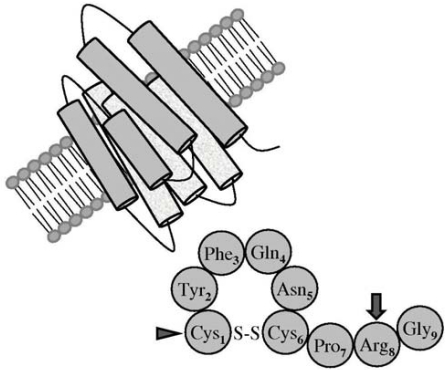
Peptide sequence of vasopressin. The synthetic analog DDAVP differs from the natural peptide by deamination of cystein in position 1 (arrowhead), which prolongs its half-life, and Darginine substitution in position 8 (arrow), which reduces the pressor effect and confers selectivity for the V2 membrane receptor.Curr Pharm Biotechnol.2011 Nov;12(11):1974-80. |
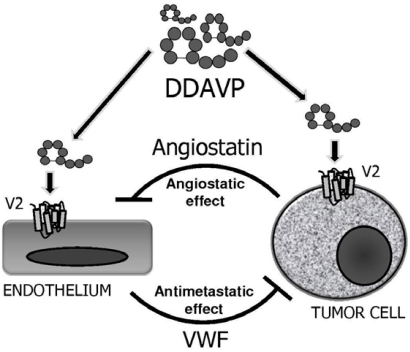
Dual and reciprocal effects of perioperative DDAVP on endothelial and tumor cells.Curr Pharm Biotechnol.2011 Nov;12(11):1974-80. |
Products are for research use only; We do not sell to patients
Copyright 2020 InvivoChem LLC | All Rights Reserved


 COA
COA