| Size | Price | Stock | Qty |
|---|---|---|---|
| 10mg |
|
||
| 25mg |
|
||
| 50mg |
|
||
| 100mg |
|
||
| 250mg |
|
||
| 500mg | |||
| Other Sizes |


Purity: ≥98%
| Targets |
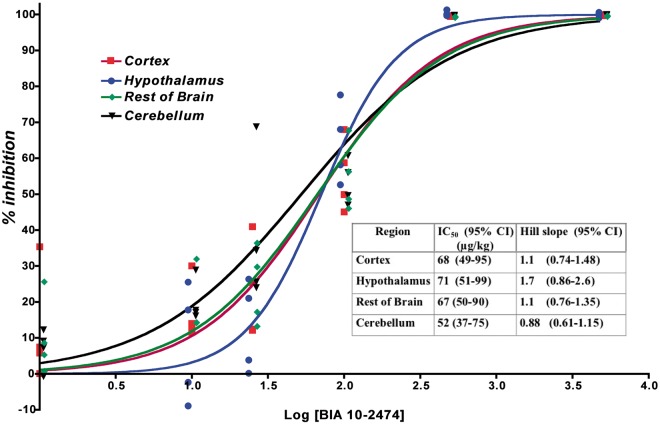
ExVivo: It was demonstrated that BIA 10-2474 is a strong FAAH inhibitor in several brain areas, with an IC50 of 50–70 mg/kg (ip). The corresponding IC50 values for the cerebellum, cortex, remainder of the brain, and hypothalamus are 52, 67, and 68 mg/kg, respectively [1].
|
|---|---|
| ln Vitro |
ExVivo: It was demonstrated that BIA 10-2474 is a strong FAAH inhibitor in several brain areas, with an IC50 of 50–70 mg/kg (ip). The corresponding IC50 values for the cerebellum, cortex, remainder of the brain, and hypothalamus are 52, 67, and 68 mg/kg, respectively [1].
|
| ln Vivo |
A Phase I clinical trial involving the medication BIA 10-2474 experienced a major adverse event (SAE) in January 2016, which resulted in one death. We'll look for potential reasons why a trial can fail, like off-target effects, dose estimations, unforeseen immunological reactions, species variance, and cumulative dose toxicity [2].
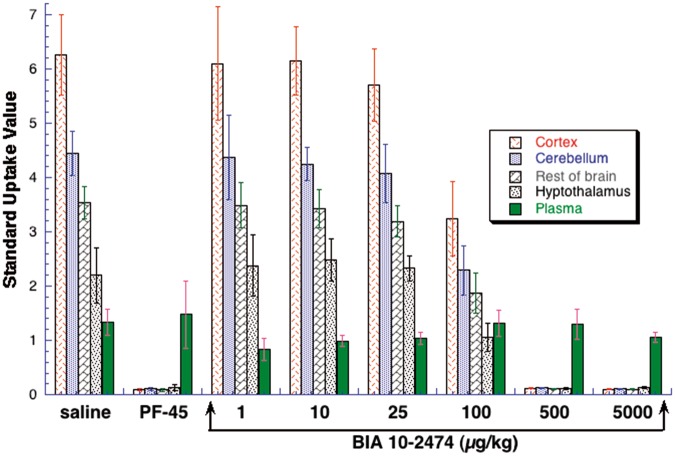
In rats, BIA 10-2474 administered intraperitoneally (i.p.) at doses of 0.5 mg/kg or 5 mg/kg, 40 minutes before radiotracer injection, completely abolished the binding of the FAAH-selective radiotracer [¹⁸F]-DOPP in all brain regions, indicating complete inhibition of FAAH activity in the rat brain at these doses [1] A lower dose range (1-500 µg/kg, i.p.) was used to characterize the in vivo potency of BIA 10-2474. The drug dose-dependently inhibited [¹⁸F]-DOPP binding to FAAH in various brain regions (cortex, hypothalamus, cerebellum, rest of brain). The IC₅₀ values for FAAH inhibition in rat brain were determined to be between 52 and 71 µg/kg [1] |
| Enzyme Assay |
The literature states that BIA 10-2474 inhibits FAAH, likely through an irreversible mechanism involving the formation of a covalent bond between the drug's electrophilic carbamate or urea carbon and the serine 241 residue of the hydrolase
In vitro, the concentration required to inhibit other enzymes was reported to be about 50 to 100 times higher than that needed for FAAH inhibition, suggesting relatively low specificity for FAAH over other serine hydrolases. |
| Animal Protocol |
Groups of male Sprague-Dawley rats (n=4 per group) were pre-treated with solutions of BIA 10-2474 (dissolved in 5% Tween 80 in saline) or vehicle via intraperitoneal injection, 40 minutes prior to the intravenous injection of the radiotracer [¹⁸F]-DOPP [1]
The drug doses used in the study ranged from 1 to 5000 µg/kg (i.p.) [1] Rats were sacrificed by decapitation 40 minutes after radiotracer administration. Brains were removed, dissected into regions (cortex, hypothalamus, cerebellum, rest of brain), and the radioactivity was measured to calculate the standard uptake value [1] |
| ADME/Pharmacokinetics |
At sacrifice (40 minutes after administration), plasma concentrations of BIA 10-2474 were determined in rats in the three highest dose groups (100, 500, and 5000 µg/kg) [1]
The corresponding plasma concentrations were 25 ± 3 ng/mL, 116 ± 22 ng/mL, and 1380 ± 71 ng/mL, which are equivalent to approximately 83 nM, 386 nM, and 4595 nM, respectively [1] Plasma concentrations in the groups receiving lower doses of BIA 10-2474 (below 100 µg/kg) were below the detection limit (<15 ng/mL) [1] |
| Toxicity/Toxicokinetics |
In a Phase I clinical trial, a 10-day, continuously increasing dose (MAD) regimen up to 50 mg resulted in severe neurotoxicity in multiple participants. Clinical symptoms included headache, cerebellar syndrome, loss of consciousness, memory impairment, diplopia, and hemiplegia. Magnetic resonance imaging (MRI) revealed deep brain hemorrhage, necrosis, and bilateral symmetrical lesions involving the hippocampus, pons, thalamus, and cerebral cortex. One volunteer died (brain death), and four others suffered irreversible brain damage. The toxicity appeared to be cumulative, occurring on days 5 and 6 of multiple 50 mg doses, but not observed with a single 100 mg dose. In animal studies, cynomolgus monkeys receiving 100 mg/kg/24 h doses developed medullary damage, a form of axonal dystrophy.
|
| References | |
| Additional Infomation |
BIA 10-2474 is a putative fatty acid amide hydrolase (FAAH) inhibitor[1]
This compound was involved in a Phase I clinical trial that resulted in serious adverse events (SAEs), including one death[1] This study aimed to determine the in vivo efficacy of BIA 10-2474 in inhibiting FAAH in the rat central nervous system, as information on this was lacking prior to the clinical trial[1] Results showed that BIA 10-2474 is an effective FAAH inhibitor in the rat brain, with an IC₅₀ (50-70 µg/kg) comparable to other known FAAH inhibitors[1] The authors believe that very high levels of FAAH inhibition may have been achieved in the central nervous system of the subjects in the Phase I trial, and that assessing target binding in the central nervous system using techniques such as PET imaging before dose escalation may help improve the inhibitory effect. [1] |
| Molecular Formula |
C16H20N4O2
|
|
|---|---|---|
| Molecular Weight |
300.36
|
|
| Exact Mass |
300.158
|
|
| CAS # |
1233855-46-3
|
|
| Related CAS # |
|
|
| PubChem CID |
46831476
|
|
| Appearance |
White to off-white solid powder
|
|
| Density |
1.3±0.1 g/cm3
|
|
| Boiling Point |
568.3±52.0 °C at 760 mmHg
|
|
| Flash Point |
297.5±30.7 °C
|
|
| Vapour Pressure |
0.0±1.6 mmHg at 25°C
|
|
| Index of Refraction |
1.642
|
|
| LogP |
-0.41
|
|
| Hydrogen Bond Donor Count |
0
|
|
| Hydrogen Bond Acceptor Count |
3
|
|
| Rotatable Bond Count |
2
|
|
| Heavy Atom Count |
22
|
|
| Complexity |
386
|
|
| Defined Atom Stereocenter Count |
0
|
|
| SMILES |
O=C(N1C=C(C2=C[N+]([O-])=CC=C2)N=C1)N(C3CCCCC3)C
|
|
| InChi Key |
DOWVMJFBDGWVML-UHFFFAOYSA-N
|
|
| InChi Code |
InChI=1S/C16H20N4O2/c1-18(14-7-3-2-4-8-14)16(21)19-11-15(17-12-19)13-6-5-9-20(22)10-13/h5-6,9-12,14H,2-4,7-8H2,1H3
|
|
| Chemical Name |
|
|
| Synonyms |
|
|
| HS Tariff Code |
2934.99.9001
|
|
| Storage |
Powder -20°C 3 years 4°C 2 years In solvent -80°C 6 months -20°C 1 month |
|
| Shipping Condition |
Room temperature (This product is stable at ambient temperature for a few days during ordinary shipping and time spent in Customs)
|
| Solubility (In Vitro) |
DMSO: ≥ 4 mg/mL
Water: 1mg/mL (Insoluble) Ethanol: N/A |
|---|---|
| Solubility (In Vivo) |
Note: Listed below are some common formulations that may be used to formulate products with low water solubility (e.g. < 1 mg/mL), you may test these formulations using a minute amount of products to avoid loss of samples.
Injection Formulations
Injection Formulation 1: DMSO : Tween 80: Saline = 10 : 5 : 85 (i.e. 100 μL DMSO stock solution → 50 μL Tween 80 → 850 μL Saline)(e.g. IP/IV/IM/SC) *Preparation of saline: Dissolve 0.9 g of sodium chloride in 100 mL ddH ₂ O to obtain a clear solution. Injection Formulation 2: DMSO : PEG300 :Tween 80 : Saline = 10 : 40 : 5 : 45 (i.e. 100 μL DMSO → 400 μLPEG300 → 50 μL Tween 80 → 450 μL Saline) Injection Formulation 3: DMSO : Corn oil = 10 : 90 (i.e. 100 μL DMSO → 900 μL Corn oil) Example: Take the Injection Formulation 3 (DMSO : Corn oil = 10 : 90) as an example, if 1 mL of 2.5 mg/mL working solution is to be prepared, you can take 100 μL 25 mg/mL DMSO stock solution and add to 900 μL corn oil, mix well to obtain a clear or suspension solution (2.5 mg/mL, ready for use in animals). View More
Injection Formulation 4: DMSO : 20% SBE-β-CD in saline = 10 : 90 [i.e. 100 μL DMSO → 900 μL (20% SBE-β-CD in saline)] Oral Formulations
Oral Formulation 1: Suspend in 0.5% CMC Na (carboxymethylcellulose sodium) Oral Formulation 2: Suspend in 0.5% Carboxymethyl cellulose Example: Take the Oral Formulation 1 (Suspend in 0.5% CMC Na) as an example, if 100 mL of 2.5 mg/mL working solution is to be prepared, you can first prepare 0.5% CMC Na solution by measuring 0.5 g CMC Na and dissolve it in 100 mL ddH2O to obtain a clear solution; then add 250 mg of the product to 100 mL 0.5% CMC Na solution, to make the suspension solution (2.5 mg/mL, ready for use in animals). View More
Oral Formulation 3: Dissolved in PEG400 (Please use freshly prepared in vivo formulations for optimal results.) |
| Preparing Stock Solutions | 1 mg | 5 mg | 10 mg | |
| 1 mM | 3.3293 mL | 16.6467 mL | 33.2934 mL | |
| 5 mM | 0.6659 mL | 3.3293 mL | 6.6587 mL | |
| 10 mM | 0.3329 mL | 1.6647 mL | 3.3293 mL |
*Note: Please select an appropriate solvent for the preparation of stock solution based on your experiment needs. For most products, DMSO can be used for preparing stock solutions (e.g. 5 mM, 10 mM, or 20 mM concentration); some products with high aqueous solubility may be dissolved in water directly. Solubility information is available at the above Solubility Data section. Once the stock solution is prepared, aliquot it to routine usage volumes and store at -20°C or -80°C. Avoid repeated freeze and thaw cycles.
Calculation results
Working concentration: mg/mL;
Method for preparing DMSO stock solution: mg drug pre-dissolved in μL DMSO (stock solution concentration mg/mL). Please contact us first if the concentration exceeds the DMSO solubility of the batch of drug.
Method for preparing in vivo formulation::Take μL DMSO stock solution, next add μL PEG300, mix and clarify, next addμL Tween 80, mix and clarify, next add μL ddH2O,mix and clarify.
(1) Please be sure that the solution is clear before the addition of next solvent. Dissolution methods like vortex, ultrasound or warming and heat may be used to aid dissolving.
(2) Be sure to add the solvent(s) in order.
Inhibition of [18F]-DOPP binding to FAAH in rat brain regions by pre-treatment with PF-04457845 (0.1 mg/kg) or BIA 10-2474.J Cereb Blood Flow Metab.2017 Nov;37(11):3635-3639. |
Brain regional inhibition of FAAH by doses of BIA 10-2474 as measured by inhibition of [18F]-DOPP.J Cereb Blood Flow Metab.2017 Nov;37(11):3635-3639. |
Products are for research use only; We do not sell to patients
Copyright 2020 InvivoChem LLC | All Rights Reserved


 COA
COA