| Size | Price | Stock | Qty |
|---|---|---|---|
| 5mg |
|
||
| 10mg | |||
| Other Sizes |


Purity: ≥98%
| Targets |
Akt
API-1 targets Akt (also known as protein kinase B), a key serine/threonine kinase in the PI3K/Akt signaling pathway that promotes cell survival and proliferation. It binds to the pleckstrin homology (PH) domain of Akt, which is critical for its membrane translocation and activation. This binding inhibits the EGF-induced kinase activity of Akt1, Akt2, and Akt3. |
|---|---|
| ln Vitro |
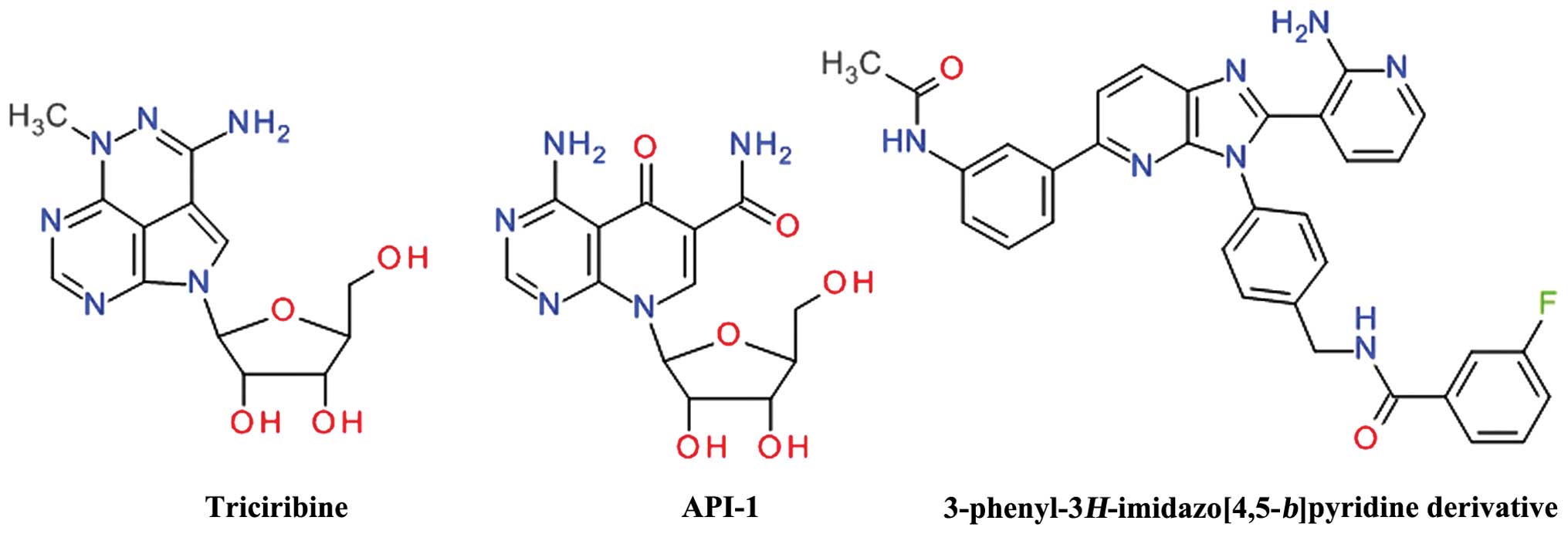
An isosteric scaffold of adenosine, the 4-aminopyrido[2,3-d]pyrimidine derivative API-1 was discovered to inhibit Akt by screening the DTP/NCI compound library in a cell-based assay. API-1 binds to the PH domain and inhibits Akt membrane translocation, leading to the inhibition of the growth of tumors with hyperactivated Akt. API-1 was shown to induce apoptosis in tested cancer cell lines by synergizing with TNF-related apoptosis-inducing ligand (TRAIL). A series of 4-amino-pyrrolo[2,3-d]pyrimidine derivatives, closely related to API-1, were discovered in a high-throughput screening based on a newly developed fluorescence-based assay as allosteric Akt inhibitors [1].
In vitro, API-1 inhibits EGF-induced kinase activity of Akt1, Akt2, and Akt3. With an IC50 of about 0.8 μM, it effectively reduces the levels of Akt phosphorylation. It induces cell growth arrest and apoptosis in human cancer cells expressing constitutively active Akt. In API-1-sensitive lung cancer cell lines, it quickly and effectively decreases Mcl-1 levels. |
| ln Vivo |
In vivo, API-1 has demonstrated antitumor activity. It inhibits the growth of tumors with hyperactivated Akt. Its ability to induce apoptosis and inhibit tumor growth has been observed in preclinical models. However, specific details of in vivo studies are not extensively detailed in the available literature.
|
| Enzyme Assay |
The in vitro binding assay for API-1 involves studying its interaction with the PH domain of Akt. Techniques such as surface plasmon resonance (SPR) or nuclear magnetic resonance (NMR) can be used to confirm binding. Competitive binding assays with fluorescently labeled PH domain ligands can also be used to determine the compound's affinity for the PH domain.
|
| Cell Assay |
In vitro cellular assays for API-1 assess its functional activity as an Akt inhibitor. Cancer cell lines are treated with API-1, and the phosphorylation of Akt and its downstream targets (e.g., GSK3β, PRAS40) is measured by Western blot. Cell proliferation, apoptosis, and Mcl-1 levels are also assessed. These assays demonstrate the compound's ability to inhibit Akt signaling and induce cell death.
|
| Animal Protocol |
In vivo animal studies for API-1 have been conducted in xenograft models to evaluate its antitumor efficacy. Tumor-bearing mice are treated with API-1, and tumor growth is monitored. Markers of apoptosis and Akt signaling are assessed in tumor tissues. However, specific details of these studies are not extensively detailed in the available literature.
|
| ADME/Pharmacokinetics |
API-1 is a cell-permeable small molecule that is typically administered via injection in in vivo studies. Its pharmacokinetic properties are characteristic of small molecule kinase inhibitors. However, detailed parameters such as half-life, volume of distribution, and bioavailability are not extensively detailed in the available literature. It is intended for research use only.
|
| Toxicity/Toxicokinetics |
Specific toxicity data for API-1 are not extensively detailed in the available literature. As an Akt inhibitor, its toxicity profile is likely related to its mechanism of action. However, its ability to induce apoptosis in cancer cells suggests potential for therapeutic use. It is intended for research purposes only and is not for human use.
|
| References | |
| Additional Infomation |
Screening of the National Cancer Institute (NCI) Diverse Compound Library revealed API-2 [(Tricilidine (TCN), NSC 154020)], which effectively inhibits the Akt signaling pathway in human cancer cells, thereby suppressing cell growth and inducing apoptosis. TCN is a tricyclic purine nucleoside derivative (Figure 9), which is activated intracellularly by adenosine kinase metabolism to the monophosphate-active analog TCN-P. Surface plasmon resonance and nuclear magnetic resonance spectroscopy analysis showed that TCN-P (not TCN) binds to the region near the PIP3 binding pocket in the PH domain of Akt, thereby preventing Akt phosphorylation and subsequent activation. The mechanism by which TCN-P inhibits Akt may be by preventing PIP3 from recruiting Akt to the plasma membrane. This mechanism may involve competing with PIP3 for binding to the PH domain, or by binding to regions that induce conformational changes, thereby hindering PIP3 activation. Studies have shown that 10 μM TCN can inhibit the phosphorylation of Akt and its downstream signaling pathways in T cell acute lymphoblastic leukemia cells, leading to cell cycle arrest and caspase-dependent apoptosis. In prostate cancer cells, TCN can enhance apoptosis induced by the death receptor pathway (124). TCN and TCN-P have been used in several clinical trials for various solid tumors and hematological malignancies, but their efficacy is limited due to their toxicity. TCN combined with other anticancer drugs is more effective than TCN alone [1].
API-1 is a potent and selective Akt inhibitor that binds to the PH domain, a unique mechanism of action compared to ATP-competitive inhibitors. It is a valuable research tool for studying the PI3K/Akt pathway and its role in cancer cell survival and proliferation. It is not approved for clinical use and is intended for research purposes only. |
| Molecular Formula |
C13H15N5O6
|
|---|---|
| Molecular Weight |
337.2881
|
| Exact Mass |
337.102
|
| Elemental Analysis |
C, 46.29; H, 4.48; N, 20.76; O, 28.46
|
| CAS # |
36707-00-3
|
| Related CAS # |
36707-00-3
|
| PubChem CID |
24773090
|
| Appearance |
white solid powder
|
| Density |
1.792g/cm3
|
| Boiling Point |
795.8ºC at 760 mmHg
|
| Flash Point |
435.1ºC
|
| Index of Refraction |
1.764
|
| LogP |
-1.9
|
| Hydrogen Bond Donor Count |
5
|
| Hydrogen Bond Acceptor Count |
10
|
| Rotatable Bond Count |
3
|
| Heavy Atom Count |
24
|
| Complexity |
571
|
| Defined Atom Stereocenter Count |
4
|
| SMILES |
NC(C1C(=O)C2=C(N=CN=C2N)N(C2C(O)C(O)C(CO)O2)C=1)=O
|
| InChi Key |
SPBWHPXCWJLQRU-FITJORAGSA-N
|
| InChi Code |
InChI=1S/C13H15N5O6/c14-10-6-7(20)4(11(15)23)1-18(12(6)17-3-16-10)13-9(22)8(21)5(2-19)24-13/h1,3,5,8-9,13,19,21-22H,2H2,(H2,15,23)(H2,14,16,17)/t5-,8-,9-,13-/m1/s1
|
| Chemical Name |
4-amino-8-[(2R,3R,4S,5R)-3,4-dihydroxy-5-(hydroxymethyl)oxolan-2-yl]-5-oxopyrido[2,3-d]pyrimidine-6-carboxamide
|
| Synonyms |
API1; NSC 177233;API-1; NSC-177233; api-1; 36707-00-3; NSC 177223; 4-Amino-5,6,7,8-tetrahydro-5-oxo-8-(beta-D-ribofuranosyl)pyrido[2,3-d]pyrimidine-6-carboxamide; W3UEK36Q7X; NSC177223; 4-amino-5,8-dihydro-5-oxo-8-beta-d-ribofuranosyl-pyrido[2,3-d]pyrimidine-6-carboxamide; ld-101; API 1; NSC177233
|
| HS Tariff Code |
2934.99.9001
|
| Storage |
Powder -20°C 3 years 4°C 2 years In solvent -80°C 6 months -20°C 1 month |
| Shipping Condition |
Room temperature (This product is stable at ambient temperature for a few days during ordinary shipping and time spent in Customs)
|
| Solubility (In Vitro) |
DMSO: ~50 mg/mL (~148.2 mM; with ultrasonication and warming by heating to 60°C)
|
|---|---|
| Solubility (In Vivo) |
Solubility in Formulation 1: ≥ 2.5 mg/mL (7.41 mM) (saturation unknown) in 10% DMSO + 40% PEG300 + 5% Tween-80 + 45% Saline (add these co-solvents sequentially from left to right, and one by one), Clear solution.
For example, if 1 mL of working solution is to be prepared, you can add 100 μL of DMSO stock solution (25.0 mg/mL) to 400 μL of PEG300 and mix well; then add 50 μL of Tween-80 and mix well; finally add 450 μL of physiological saline and adjust the volume to 1 mL. Preparation of saline: Dissolve 0.9 g of sodium chloride in 100 mL ddH₂ O to obtain a clear solution. Solubility in Formulation 2: ≥ 2.5 mg/mL (7.41 mM) (saturation unknown) in 10% DMSO + 90% (20% SBE-β-CD in Saline) (add these co-solvents sequentially from left to right, and one by one), Clear solution. For example, if 1 mL of working solution is to be prepared, you can add 100 μL of DMSO stock solution (25.0 mg/mL) to 900 μL of 20% SBE-β-CD saline and mix well. Preparation of 20% SBE-β-CD in Saline (4°C,1 week): Dissolve 2 g SBE-β-CD in 10 mL saline to obtain a clear solution. Solubility in Formulation 3: ≥ 2.5 mg/mL (7.41 mM) (saturation unknown) in 10% DMSO + 90% Corn Oil (add these co-solvents sequentially from left to right, and one by one), Clear solution. For example, if 1 mL of working solution is to be prepared, you can add 100 μL of DMSO stock solution (25.0 mg/mL) to 900 μL of corn oil and mix well. (Please use freshly prepared in vivo formulations for optimal results.) |
| Preparing Stock Solutions | 1 mg | 5 mg | 10 mg | |
| 1 mM | 2.9648 mL | 14.8240 mL | 29.6481 mL | |
| 5 mM | 0.5930 mL | 2.9648 mL | 5.9296 mL | |
| 10 mM | 0.2965 mL | 1.4824 mL | 2.9648 mL |
*Note: Please select an appropriate solvent for the preparation of stock solution based on your experiment needs. For most products, DMSO can be used for preparing stock solutions (e.g. 5 mM, 10 mM, or 20 mM concentration); some products with high aqueous solubility may be dissolved in water directly. Solubility information is available at the above Solubility Data section. Once the stock solution is prepared, aliquot it to routine usage volumes and store at -20°C or -80°C. Avoid repeated freeze and thaw cycles.
Calculation results
Working concentration: mg/mL;
Method for preparing DMSO stock solution: mg drug pre-dissolved in μL DMSO (stock solution concentration mg/mL). Please contact us first if the concentration exceeds the DMSO solubility of the batch of drug.
Method for preparing in vivo formulation::Take μL DMSO stock solution, next add μL PEG300, mix and clarify, next addμL Tween 80, mix and clarify, next add μL ddH2O,mix and clarify.
(1) Please be sure that the solution is clear before the addition of next solvent. Dissolution methods like vortex, ultrasound or warming and heat may be used to aid dissolving.
(2) Be sure to add the solvent(s) in order.
|
|
Products are for research use only; We do not sell to patients
Copyright 2020 InvivoChem LLC | All Rights Reserved


 COA
COA