| Size | Price | Stock | Qty |
|---|---|---|---|
| 5g |
|
||
| 50g |
|
||
| Other Sizes |


| ln Vitro |
1,4-Dihydroxyanthraquinone (1,4-DHAQ, a fluorophore) doped cellulose (CL) microporous nanofiber film, also known as 1,4-DHAQ@CL, is utilized for very sensitive and selective fluorescence detection of Cu(2+) in aqueous solution. It is created by easy electrospinning and subsequent deacetylating[1].
Quinizarin (1,4-Dihydroxyanthraquinone) binds to negatively supercoiled and linear DNA by intercalating mode, as demonstrated by unwinding of negatively supercoiled DNA and lengthening of linear DNA. In the presence of Quinizarin (1,4-Dihydroxyanthraquinone) (8x10^-5 M), distribution of DNA topoisomers with lower superhelicity and reduced electrophoretic mobility was detected by agarose gel electrophoresis, while the band corresponding to highly supercoiled DNA diminished. [1] At concentrations of Quinizarin (1,4-Dihydroxyanthraquinone) (5x10^-5 M), appearance of DNA topoisomers with low superhelicity was observed. [1] In TGGE experiments, at 25x10^-6 M, Quinizarin (1,4-Dihydroxyanthraquinone) caused detection of DNA topoisomers with lower superhelicity across the whole temperature range, and cruciform extrusion was observed. [1] AFM imaging showed that in the presence of 10^-3 M Quinizarin (1,4-Dihydroxyanthraquinone), negatively supercoiled DNA molecules appeared more relaxed with few crossings. [1] Linear plasmid pRES3 contour length increased from 1489±20 nm to 1647±35 nm in the presence of 10^-3 M Quinizarin (1,4-Dihydroxyanthraquinone), corresponding to approximately a 10% increase. [1] Fluorescence spectrophotometry revealed fluorescence quenching and a small blue shift upon interaction with DNA, indicating intercalation into a lower polarity DNA-stacking region. The binding constant (Kb) for Quinizarin (1,4-Dihydroxyanthraquinone) with calf thymus DNA was 1.16 x 10^4 M^-1, with a binding stoichiometry (n) of 1.04 ± 0.05 and dissociation constant (Kd) of 8.61 ± 0.05 x 10^-5 M. [1] |
|---|---|
| Enzyme Assay |
For fluorescence binding experiments, Quinizarin (1,4-Dihydroxyanthraquinone) fluorescence spectra (490-750 nm) were obtained upon excitation at 475 nm. Emitted fluorescence was analyzed at 540 nm. Various Quinizarin (1,4-Dihydroxyanthraquinone)/DNA complexes were researched by changing the concentration of calf thymus DNA in the range 10^-7 to 10^-3 M at a constant concentration (10^-6 M) of Quinizarin (1,4-Dihydroxyanthraquinone). [1]
The binding constant (Kb) and binding stoichiometry (n) for Quinizarin (1,4-Dihydroxyanthraquinone)/DNA complex formation were estimated using the equation (F0 - F)/F0 = -Kd[(F0 - F)/F0[DNA]] + n, where F0 and F are fluorescence intensities in the absence and presence of DNA. The slope in the Scatchard plot represents the dissociation constant -Kd, and n (number of specific binding sites) is obtained from the y-intercept. [1] |
| References | |
| Additional Infomation |
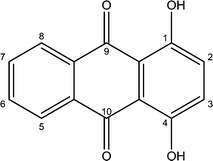
Quinacrine is a dihydroxyanthraquinone with two hydroxyl substituents located at positions 1 and 4, respectively; formally, it is derived by replacing two hydrogen atoms of anthraquinone with hydroxyl groups. It is a dye. 1,4-Dihydroxyanthraquinone has been reported in senna (Senna obtusifolia) and madder (Rubia tinctorum), and relevant data are available. See also: madder root (partial). Mechanism of Action: The laxative effect of the six anthraquinones is related to their ability to uncouple and phosphorylate in the mitochondria of plants (bean) and animals (guinea pig intestines). The structural requirements are: a rigid planar structure with at least one OH group, preferably located at positions 1, 1 and 8, 2, 3, 6 and 7.
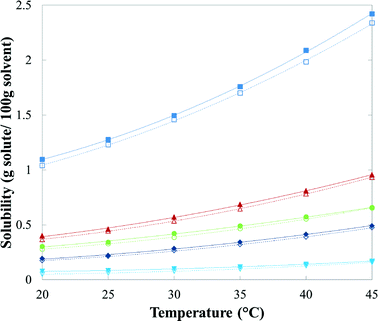
Quinizarin (1,4-Dihydroxyanthraquinone) (1,4-dihydroxyanthraquinone) is a dihydroxyanthraquinone used as a fungicide and pesticide chemical and has shown the ability to inhibit tumour cell growth. [2] Two polymorphs of Quinizarin (1,4-Dihydroxyanthraquinone) (FI and FII) are known. The commercially available FI is a metastable polymorph under ambient conditions, but is kinetically stable for many days in the absence of FII. FI and FII have an enantiotropic relationship with a transition temperature between 50°C and 60°C. A high-temperature form (FIII) exists above ~185°C. [2] The solubility of Quinizarin (1,4-Dihydroxyanthraquinone) FI and FII in organic solvents (acetic acid, acetone, acetonitrile, n-butanol, toluene) from 20°C to 45°C is below 2.5% by weight and decreases in the order: toluene, acetone, acetic acid, acetonitrile, n-butanol. Solubility data (g per 100g solvent) for FI in toluene at 20°C is 1.0968 and at 45°C is 2.4204; in acetone at 20°C is 0.3986 and at 45°C is 0.9555; in acetic acid at 20°C is 0.3036 and at 45°C is 0.6573; in acetonitrile at 20°C is 0.1924 and at 45°C is 0.4915; in n-butanol at 20°C is 0.0768 and at 45°C is 0.1702. [2] Quinizarin (1,4-Dihydroxyanthraquinone) forms intra- and intermolecular hydrogen bonds leading to ribbons arranged in slipped π-stacks. The crystal structure of FI is monoclinic, space group P2/n, with unit cell dimensions a=10.2390(8) Å, b=6.0429(4) Å, c=16.454(2) Å, β=95.999(8)°, V=1012.51(17) ų, Z=4, density 1.576 Mg m⁻³. The crystal structure of FII is monoclinic, space group Cc, with unit cell dimensions a=20.0099(12) Å, b=24.6219(9) Å, c=18.3201(11) Å, β=116.274(8)°, V=8093.4(9) ų, Z=32, density 1.577 Mg m⁻³. [2] Quinizarin (1,4-Dihydroxyanthraquinone) has been used to fabricate a microporous nanofiber film (1,4-DHAQ@CL) via electrospinning and deacetylation for fluorescence detection of Cu²⁺ in aqueous solution, with a linear detection range of 2.5×10⁻⁹ to 3.75×10⁻⁸ M and a detection limit of 3 nM. The sensing mechanism is ascribed to the formation of phenolate between Quinizarin (1,4-Dihydroxyanthraquinone) and Cu²⁺, causing fluorescence quenching. The Stern-Volmer constant (Ksv) for the 1,4-DHAQ@CL nanofiber film was 4.2×10⁷ M⁻¹. The film is reusable after treatment with high concentrations of chromium nitrate and rinsing. [3] After complexation with Cu²⁺, the (1,4-DHAQ)-Cu²⁺@CL nanofiber film can be used to detect Cr³⁺, with a linear detection range of 2.5×10⁻⁹ to 2.5×10⁻⁸ M and a detection limit of 3.75×10⁻⁹ M. The binding constant (K) between Quinizarin (1,4-Dihydroxyanthraquinone) and Cr³⁺ was evaluated as 3.67×10⁵ M⁻¹. [3] |
| Molecular Formula |
C14H8O4
|
|---|---|
| Molecular Weight |
240.21
|
| Exact Mass |
240.042
|
| CAS # |
81-64-1
|
| PubChem CID |
6688
|
| Appearance |
Orange to red solid powder
|
| Density |
1.5±0.1 g/cm3
|
| Boiling Point |
465.3±40.0 °C at 760 mmHg
|
| Melting Point |
198-199 °C(lit.)
|
| Flash Point |
249.3±23.8 °C
|
| Vapour Pressure |
0.0±1.2 mmHg at 25°C
|
| Index of Refraction |
1.733
|
| Source |
Originated from plants: Solanaceae Rhizophora mucronata Lam
|
| LogP |
4.47
|
| Hydrogen Bond Donor Count |
2
|
| Hydrogen Bond Acceptor Count |
4
|
| Rotatable Bond Count |
0
|
| Heavy Atom Count |
18
|
| Complexity |
342
|
| Defined Atom Stereocenter Count |
0
|
| SMILES |
O=C1C2=C(C=CC=C2)C(C3=C(O)C=CC(O)=C13)=O
|
| InChi Key |
GUEIZVNYDFNHJU-UHFFFAOYSA-N
|
| InChi Code |
InChI=1S/C14H8O4/c15-9-5-6-10(16)12-11(9)13(17)7-3-1-2-4-8(7)14(12)18/h1-6,15-16H
|
| Chemical Name |
1,4-dihydroxyanthracene-9,10-dione
|
| Synonyms |
Quinizarin; 1,4-Dihydroxyanthraquinone
|
| HS Tariff Code |
2934.99.9001
|
| Storage |
Powder -20°C 3 years 4°C 2 years In solvent -80°C 6 months -20°C 1 month Note: This product requires protection from light (avoid light exposure) during transportation and storage. |
| Shipping Condition |
Room temperature (This product is stable at ambient temperature for a few days during ordinary shipping and time spent in Customs)
|
| Solubility (In Vitro) |
DMSO : ~3.33 mg/mL (~13.9 mM)
|
|---|---|
| Solubility (In Vivo) |
Note: Listed below are some common formulations that may be used to formulate products with low water solubility (e.g. < 1 mg/mL), you may test these formulations using a minute amount of products to avoid loss of samples.
Injection Formulations
Injection Formulation 1: DMSO : Tween 80: Saline = 10 : 5 : 85 (i.e. 100 μL DMSO stock solution → 50 μL Tween 80 → 850 μL Saline)(e.g. IP/IV/IM/SC) *Preparation of saline: Dissolve 0.9 g of sodium chloride in 100 mL ddH ₂ O to obtain a clear solution. Injection Formulation 2: DMSO : PEG300 :Tween 80 : Saline = 10 : 40 : 5 : 45 (i.e. 100 μL DMSO → 400 μLPEG300 → 50 μL Tween 80 → 450 μL Saline) Injection Formulation 3: DMSO : Corn oil = 10 : 90 (i.e. 100 μL DMSO → 900 μL Corn oil) Example: Take the Injection Formulation 3 (DMSO : Corn oil = 10 : 90) as an example, if 1 mL of 2.5 mg/mL working solution is to be prepared, you can take 100 μL 25 mg/mL DMSO stock solution and add to 900 μL corn oil, mix well to obtain a clear or suspension solution (2.5 mg/mL, ready for use in animals). View More
Injection Formulation 4: DMSO : 20% SBE-β-CD in saline = 10 : 90 [i.e. 100 μL DMSO → 900 μL (20% SBE-β-CD in saline)] Oral Formulations
Oral Formulation 1: Suspend in 0.5% CMC Na (carboxymethylcellulose sodium) Oral Formulation 2: Suspend in 0.5% Carboxymethyl cellulose Example: Take the Oral Formulation 1 (Suspend in 0.5% CMC Na) as an example, if 100 mL of 2.5 mg/mL working solution is to be prepared, you can first prepare 0.5% CMC Na solution by measuring 0.5 g CMC Na and dissolve it in 100 mL ddH2O to obtain a clear solution; then add 250 mg of the product to 100 mL 0.5% CMC Na solution, to make the suspension solution (2.5 mg/mL, ready for use in animals). View More
Oral Formulation 3: Dissolved in PEG400 (Please use freshly prepared in vivo formulations for optimal results.) |
| Preparing Stock Solutions | 1 mg | 5 mg | 10 mg | |
| 1 mM | 4.1630 mL | 20.8151 mL | 41.6302 mL | |
| 5 mM | 0.8326 mL | 4.1630 mL | 8.3260 mL | |
| 10 mM | 0.4163 mL | 2.0815 mL | 4.1630 mL |
*Note: Please select an appropriate solvent for the preparation of stock solution based on your experiment needs. For most products, DMSO can be used for preparing stock solutions (e.g. 5 mM, 10 mM, or 20 mM concentration); some products with high aqueous solubility may be dissolved in water directly. Solubility information is available at the above Solubility Data section. Once the stock solution is prepared, aliquot it to routine usage volumes and store at -20°C or -80°C. Avoid repeated freeze and thaw cycles.
Calculation results
Working concentration: mg/mL;
Method for preparing DMSO stock solution: mg drug pre-dissolved in μL DMSO (stock solution concentration mg/mL). Please contact us first if the concentration exceeds the DMSO solubility of the batch of drug.
Method for preparing in vivo formulation::Take μL DMSO stock solution, next add μL PEG300, mix and clarify, next addμL Tween 80, mix and clarify, next add μL ddH2O,mix and clarify.
(1) Please be sure that the solution is clear before the addition of next solvent. Dissolution methods like vortex, ultrasound or warming and heat may be used to aid dissolving.
(2) Be sure to add the solvent(s) in order.
|
|
Products are for research use only; We do not sell to patients
Copyright 2020 InvivoChem LLC | All Rights Reserved