| Size | Price | Stock | Qty |
|---|---|---|---|
| 5mg |
|
||
| 10mg |
|
||
| 25mg |
|
||
| 50mg |
|
||
| 100mg |
|
||
| 250mg | |||
| Other Sizes |
Purity: ≥98%
| Targets |
K-Ras(G12C)
Target: K-Ras(G12C) (mutant)[2] 6H05 TFA targets the oncogenic K-Ras (G12C) mutant. It acts as a covalent, selective, and allosteric inhibitor. The compound gives the greatest degree of modification, which allosterically modifies the oncogenic G12C mutant of K-Ras. By binding to the mutant protein, it inhibits its activity, thereby blocking downstream signaling pathways that drive tumor growth. This mechanism makes it a promising candidate for the treatment of K-Ras G12C-mutant cancers. |
|---|---|
| ln Vitro |
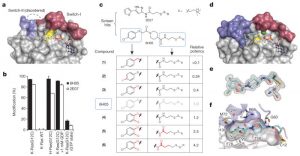
6H05, which allosterically alters the highly homologous protein H-Ras'soncogenicG12C mutant while sparing the wild-type K-Ras, exhibits the highest degree of modification[1]. Moreover, 6H05 can be synthesized into another oncogenic K-Ras(G12C) inhibitor by using it as an intermediate.[2]
In Vitro: The fragment induced the greatest degree of modification of K-Ras(G12C) in the GDP state, as detected by intact protein mass spectrometry, without affecting wild-type K-Ras.[2] In vitro, 6H05 TFA is a potent inhibitor of the K-Ras (G12C) mutant. It functions by allosterically modifying and inhibiting the oncogenic KRAS G12C mutant. Its activity has been characterized in biochemical assays measuring its binding and inhibition of the mutant protein. It is a selective inhibitor, making it a valuable tool for studying K-Ras G12C-driven cancers and for developing new targeted therapies. However, specific IC50 values are not detailed in standard summaries. |
| ln Vivo |
In vivo studies on 6H05 TFA are limited, as it is primarily a research compound. However, as a potent inhibitor of the K-Ras (G12C) mutant, it has the potential for antitumor activity in vivo. Its efficacy would need to be evaluated in animal models of K-Ras G12C-mutant cancers. It is not an approved drug and is available only as a research compound for studying K-Ras biology and cancer.
|
| Enzyme Assay |
Enzyme Assay: A disulfide fragment-based screening (FBS) approach was used to screen a library of 480 disulfide-containing small molecule compounds against K-Ras(G12C) in the GDP state. Intact protein mass spectrometry was employed to detect the formation of disulfide bonds between the compounds and the protein. Among the screened fragments, 6H05 and 2E07 were identified as those that induced the greatest degree of modification of K-Ras(G12C).[2]
Non-cellular binding assays for 6H05 TFA typically involve measuring its binding affinity for the K-Ras (G12C) mutant protein. These assays may use surface plasmon resonance (SPR) or other biophysical techniques to determine the binding affinity and kinetics. The compound's ability to covalently modify the mutant protein can be assessed using mass spectrometry or other methods. These assays are essential for characterizing the compound's interaction with its target. |
| Cell Assay |
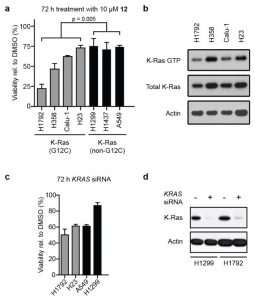
6H05 exhibits allele-specific impairment of K-Ras function, according to preliminary evaluation of 6H05 in lung cancer cell lines, although further chemical optimization of 6H05 is required to be evaluated in vivo[1]. More research is required to determine the specificity and effectiveness of 6H05 in vivo as well as how it affects the subcellular localization of other farnesylated GTPases.
In vitro cell-based assays for 6H05 TFA are conducted using cancer cell lines harboring the K-Ras G12C mutation. Cells are treated with the compound, and its effects on cell viability, proliferation, and downstream signaling pathways (e.g., MAPK pathway) are assessed. These experiments are crucial for confirming its mechanism of action and for evaluating its potential as an anticancer agent. The compound is typically dissolved in DMSO for cell-based studies. |
| Animal Protocol |
In vivo animal studies for 6H05 TFA would typically involve mouse xenograft models of K-Ras G12C-mutant cancers. Tumor-bearing mice would be treated with the compound, and tumor growth would be monitored. However, specific published in vivo data for 6H05 TFA are not extensively documented. As a research compound, its in vivo efficacy would need to be validated in preclinical models.
|
| ADME/Pharmacokinetics |
6H05 TFA has a molecular weight of 590.14 g/mol and a molecular formula of C22H31ClF3N3O4S3. It is a trifluoroacetic acid salt. As a research compound, its pharmacokinetic properties, such as absorption, distribution, metabolism, and excretion, are not extensively documented. It is intended for research use only. Its solubility and stability would be important factors for its use in in vitro and in vivo studies.
|
| Toxicity/Toxicokinetics |
Comprehensive toxicological data for 6H05 TFA are limited, as it is a research compound. It is intended for laboratory use only and is not for human consumption. As with all research chemicals, appropriate safety precautions should be taken when handling 6H05 TFA. Its safety profile in vivo has not been extensively characterized. Standard toxicological assessments would be required for clinical development.
|
| References | |
| Additional Infomation |
Additional Info: Binding of 6H05 to K-Ras(G12C) occurs via a disulfide bond with Cys12, which generates a new allosteric pocket (termed S-IIP) beneath the effector binding switch-II region. Subsequent structure-activity relationship optimization of 6H05 led to compound 6 (45), which displayed the greatest potency to inhibit K-Ras(G12C) enzymatic activity. The X-ray cocrystal structure of the K-Ras(G12C)-compound 6 complex (PDB code: 4LUC) confirmed that compound 6 forms a disulfide bond with Cys12.[2]
6H05 TFA is a potent, covalent, selective, and allosteric inhibitor of the oncogenic K-Ras (G12C) mutant. It functions by allosterically modifying and inhibiting the mutant protein. It has the molecular formula C22H31ClF3N3O4S3 and a molecular weight of 590.14 g/mol. 6H05 TFA is not an approved drug and is available as a research compound for studying K-Ras G12C-driven cancers. |
| Molecular Formula |
C20H30CLN3O2S3
|
|
|---|---|---|
| Molecular Weight |
590.14
|
|
| Exact Mass |
589.111
|
|
| Elemental Analysis |
C, 44.78; H, 5.30; Cl, 6.01; F, 9.66; N, 7.12; O, 10.84; S, 16.30
|
|
| CAS # |
2061344-88-3
|
|
| Related CAS # |
6H05;1469338-01-9
|
|
| PubChem CID |
86208069
|
|
| Appearance |
White to off-white solid powder
|
|
| Hydrogen Bond Donor Count |
2
|
|
| Hydrogen Bond Acceptor Count |
11
|
|
| Rotatable Bond Count |
11
|
|
| Heavy Atom Count |
36
|
|
| Complexity |
581
|
|
| Defined Atom Stereocenter Count |
0
|
|
| SMILES |
ClC1C=CC(=CC=1)SCC(N1CCC(C(NCCSSCCN(C)C)=O)CC1)=O.FC(C(=O)O)(F)F
|
|
| InChi Key |
YNMYIJSFFJXIRV-UHFFFAOYSA-N
|
|
| InChi Code |
InChI=1S/C20H30ClN3O2S3.C2HF3O2/c1-23(2)12-14-29-28-13-9-22-20(26)16-7-10-24(11-8-16)19(25)15-27-18-5-3-17(21)4-6-18;3-2(4,5)1(6)7/h3-6,16H,7-15H2,1-2H3,(H,22,26);(H,6,7)
|
|
| Chemical Name |
1-[2-(4-chlorophenyl)sulfanylacetyl]-N-[2-[2-(dimethylamino)ethyldisulfanyl]ethyl]piperidine-4-carboxamide;2,2,2-trifluoroacetic acid
|
|
| Synonyms |
|
|
| HS Tariff Code |
2934.99.9001
|
|
| Storage |
Powder -20°C 3 years 4°C 2 years In solvent -80°C 6 months -20°C 1 month Note: Please store this product in a sealed and protected environment, avoid exposure to moisture. |
|
| Shipping Condition |
Room temperature (This product is stable at ambient temperature for a few days during ordinary shipping and time spent in Customs)
|
| Solubility (In Vitro) |
|
|||
|---|---|---|---|---|
| Solubility (In Vivo) |
Note: Listed below are some common formulations that may be used to formulate products with low water solubility (e.g. < 1 mg/mL), you may test these formulations using a minute amount of products to avoid loss of samples.
Injection Formulations
Injection Formulation 1: DMSO : Tween 80: Saline = 10 : 5 : 85 (i.e. 100 μL DMSO stock solution → 50 μL Tween 80 → 850 μL Saline)(e.g. IP/IV/IM/SC) *Preparation of saline: Dissolve 0.9 g of sodium chloride in 100 mL ddH ₂ O to obtain a clear solution. Injection Formulation 2: DMSO : PEG300 :Tween 80 : Saline = 10 : 40 : 5 : 45 (i.e. 100 μL DMSO → 400 μLPEG300 → 50 μL Tween 80 → 450 μL Saline) Injection Formulation 3: DMSO : Corn oil = 10 : 90 (i.e. 100 μL DMSO → 900 μL Corn oil) Example: Take the Injection Formulation 3 (DMSO : Corn oil = 10 : 90) as an example, if 1 mL of 2.5 mg/mL working solution is to be prepared, you can take 100 μL 25 mg/mL DMSO stock solution and add to 900 μL corn oil, mix well to obtain a clear or suspension solution (2.5 mg/mL, ready for use in animals). View More
Injection Formulation 4: DMSO : 20% SBE-β-CD in saline = 10 : 90 [i.e. 100 μL DMSO → 900 μL (20% SBE-β-CD in saline)] Oral Formulations
Oral Formulation 1: Suspend in 0.5% CMC Na (carboxymethylcellulose sodium) Oral Formulation 2: Suspend in 0.5% Carboxymethyl cellulose Example: Take the Oral Formulation 1 (Suspend in 0.5% CMC Na) as an example, if 100 mL of 2.5 mg/mL working solution is to be prepared, you can first prepare 0.5% CMC Na solution by measuring 0.5 g CMC Na and dissolve it in 100 mL ddH2O to obtain a clear solution; then add 250 mg of the product to 100 mL 0.5% CMC Na solution, to make the suspension solution (2.5 mg/mL, ready for use in animals). View More
Oral Formulation 3: Dissolved in PEG400 (Please use freshly prepared in vivo formulations for optimal results.) |
| Preparing Stock Solutions | 1 mg | 5 mg | 10 mg | |
| 1 mM | 1.6945 mL | 8.4726 mL | 16.9451 mL | |
| 5 mM | 0.3389 mL | 1.6945 mL | 3.3890 mL | |
| 10 mM | 0.1695 mL | 0.8473 mL | 1.6945 mL |
*Note: Please select an appropriate solvent for the preparation of stock solution based on your experiment needs. For most products, DMSO can be used for preparing stock solutions (e.g. 5 mM, 10 mM, or 20 mM concentration); some products with high aqueous solubility may be dissolved in water directly. Solubility information is available at the above Solubility Data section. Once the stock solution is prepared, aliquot it to routine usage volumes and store at -20°C or -80°C. Avoid repeated freeze and thaw cycles.
Calculation results
Working concentration: mg/mL;
Method for preparing DMSO stock solution: mg drug pre-dissolved in μL DMSO (stock solution concentration mg/mL). Please contact us first if the concentration exceeds the DMSO solubility of the batch of drug.
Method for preparing in vivo formulation::Take μL DMSO stock solution, next add μL PEG300, mix and clarify, next addμL Tween 80, mix and clarify, next add μL ddH2O,mix and clarify.
(1) Please be sure that the solution is clear before the addition of next solvent. Dissolution methods like vortex, ultrasound or warming and heat may be used to aid dissolving.
(2) Be sure to add the solvent(s) in order.
|
|---|
|
Products are for research use only; We do not sell to patients
Copyright 2020 InvivoChem LLC | All Rights Reserved


 COA
COA