| Size | Price | Stock | Qty |
|---|---|---|---|
| 5mg |
|
||
| 10mg |
|
||
| 50mg |
|
||
| 100mg |
|
||
| 250mg | |||
| 500mg | |||
| Other Sizes |
| Targets |
WR99210's primary target is dihydrofolate reductase (DHFR), a key enzyme in the folate biosynthesis pathway. By inhibiting DHFR, it disrupts the folate pathway essential for parasite DNA synthesis and cell replication, effectively inhibiting parasite growth. The compound has subnanomolar potency for wild-type, double mutant, and quadruple mutant dihydrofolate reductases, making it effective against pyrimethamine-resistant strains. Its efficacy against DHFR mutants makes it invaluable for studying drug-resistant malaria strains and exploring new antimalarial strategies.
|
|---|---|
| ln Vitro |
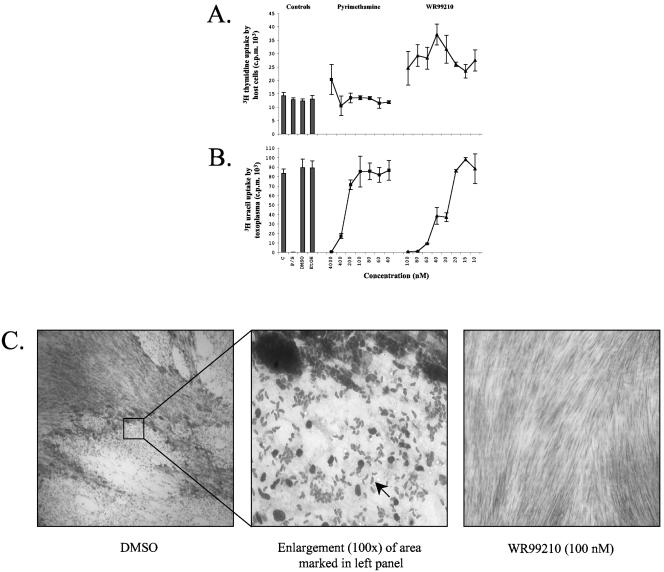
In tissue culture, WR99210 (0-100 nM; 92 h) is very effective against Toxoplasma gondii tachyzoites [1]. Human foreskin fibroblasts are not cytotoxically affected by WR99210 (0-100 nM; 92 h) [1].
In vitro, WR99210 is a potent inhibitor of DHFR with an IC50 of <0.075 nM. It is effective against the most pyrimethamine-resistant Plasmodium falciparum strains. The compound shows good antiparasitic activity against Plasmodium vivax and Plasmodium falciparum (including pyrimethamine-resistant strains) as well as Toxoplasma gondii. Its subnanomolar potency for wild-type, double mutant, and quadruple mutant DHFRs demonstrates its broad efficacy against different parasite strains. |
| ln Vivo |
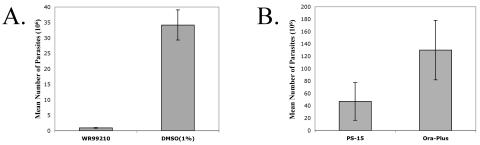
WR99210 (1.25 mg/kg; i.p.; once daily for 5 days) is highly effective against Toxoplasma gondii tachyzoites in a mouse model [1].
In vivo, WR99210 is orally active and has low toxicity. It has been studied for its antimalarial activity in animal models. Its oral bioavailability and low toxicity make it a promising candidate for antimalarial therapy. The compound's efficacy against pyrimethamine-resistant strains suggests that it could be a valuable alternative to existing antimalarial drugs. However, specific in vivo efficacy data is not detailed in the provided search results. |
| Enzyme Assay |
The in vitro activity of WR99210 is assessed using cell-free DHFR enzyme inhibition assays. Recombinant Plasmodium falciparum DHFR (wild-type and mutant forms) is incubated with its substrate (dihydrofolate) and cofactor (NADPH) in the presence of varying concentrations of WR99210. The reduction of dihydrofolate to tetrahydrofolate is measured spectrophotometrically by monitoring the decrease in absorbance at 340 nm. The IC50 is determined from the inhibition curve. For selectivity studies, the compound is tested against mammalian DHFR to assess selectivity.
|
| Cell Assay |
Cell viability assay [1]
Cell Types: human foreskin fibroblasts (Toxoplasma gondii infection) Tested Concentrations: 0-100 nM Incubation Duration: 92 h Experimental Results: It has a significant inhibitory effect on Toxoplasma gondii, with an IC50 value of approximately 50 nM. Cytotoxicity assay[1] Cell Types: Human foreskin fibroblasts Tested Concentrations: 0-100 nM Incubation Duration: 92 hrs (hours) Experimental Results: No toxicity to fibroblasts. For cellular assays, Plasmodium falciparum cultures are used. Parasites are cultured in human erythrocytes in RPMI-1640 medium supplemented with Albumax or serum. Cultures are treated with various concentrations of WR99210 (typically 0.01-100 nM) for 48-72 hours. Parasite growth is assessed by measuring the incorporation of [³H]hypoxanthine or by microscopy using Giemsa-stained smears. The IC50 is determined from dose-response curves. For cytotoxicity studies, mammalian cell lines are treated with WR99210, and cell viability is assessed using MTT or CellTiter-Glo assays. |
| Animal Protocol |
Animal/Disease Models: Male mice (Toxoplasma gondii infection) [1].
Doses: 1.25 mg/kg Route of Administration: intraperitoneal (ip) injection; single dose per day for 5 days. Experimental Results: On day 5, the number of parasites in the abdominal cavity of mice diminished by 2 logs. In vivo, WR99210 is typically administered orally or intraperitoneally to animal models of malaria. Mice are infected with Plasmodium berghei or Plasmodium yoelii, and WR99210 is administered at various doses (typically 1-50 mg/kg) for 4 days. The efficacy is assessed by measuring parasitemia in blood smears on day 4 or by measuring survival over time. The ED50 and ED90 are calculated from dose-response curves. In toxicological studies, the compound is administered at various doses, and body weight, clinical signs, and histopathology are assessed. |
| ADME/Pharmacokinetics |
WR99210 is orally active. It has a molecular weight of 394.68 g/mol and a molecular formula of C14H18Cl3N5O2. The compound is soluble in DMSO. Specific pharmacokinetic data (absorption, distribution, metabolism, excretion) is not available in the provided search results. Its bioavailability and half-life would require further investigation. The compound should be stored under appropriate conditions to maintain stability.
|
| Toxicity/Toxicokinetics |
WR99210 has low toxicity. In animal studies, it is well-tolerated at therapeutic doses. The compound's selectivity for parasite DHFR over mammalian DHFR contributes to its favorable safety profile. However, comprehensive toxicological studies are required to establish its full safety profile. The compound should be handled with standard laboratory safety precautions.
|
| References |
[1]. Mui EJ, et al. Triazine Inhibits Toxoplasma gondii tachyzoites in vitro and in vivo. Antimicrob Agents Chemother. 2005 Aug;49(8):3463-7.
[2]. Hastings MD, et al. Pyrimethamine and WR99210 exert opposing selection on dihydrofolatereductase from Plasmodium vivax. Proc Natl Acad Sci U S A. 2002 Oct 1;99(20):13137-41. [3]. Kiara SM, et al. In vitro activity of antifolate and polymorphism in dihydrofolate reductase of Plasmodium falciparum isolates from the Kenyan coast: emergence of parasites with Ile-164-Leu mutation. Antimicrob Agents Chemother. 2009 Sep;53(9):3793-8. |
| Additional Infomation |
See also: BRL 6231 (Note moved to).
WR99210 is a research compound used in antimalarial research. It is a potent inhibitor of DHFR with subnanomolar potency against wild-type and mutant forms of the enzyme. Its efficacy against pyrimethamine-resistant Plasmodium falciparum strains makes it a valuable tool for studying drug-resistant malaria and for developing new antimalarial strategies. The compound's oral activity and low toxicity profile make it a promising candidate for further development. WR99210 is not approved for clinical use and is intended for research purposes only. It is available from chemical suppliers for research applications. |
| Molecular Formula |
C14H18CL3N5O2
|
|---|---|
| Molecular Weight |
394.681
|
| Exact Mass |
393.053
|
| CAS # |
47326-86-3
|
| Related CAS # |
WR99210 hydrochloride;30711-93-4
|
| PubChem CID |
121750
|
| Appearance |
White to off-white solid powder
|
| LogP |
3.238
|
| Hydrogen Bond Donor Count |
2
|
| Hydrogen Bond Acceptor Count |
3
|
| Rotatable Bond Count |
6
|
| Heavy Atom Count |
24
|
| Complexity |
503
|
| Defined Atom Stereocenter Count |
0
|
| SMILES |
ClC1=C([H])C(=C(C([H])=C1OC([H])([H])C([H])([H])C([H])([H])ON1C(N([H])[H])=NC(N([H])[H])=NC1(C([H])([H])[H])C([H])([H])[H])Cl)Cl
|
| InChi Key |
MJZJYWCQPMNPRM-UHFFFAOYSA-N
|
| InChi Code |
InChI=1S/C14H18Cl3N5O2/c1-14(2)21-12(18)20-13(19)22(14)24-5-3-4-23-11-7-9(16)8(15)6-10(11)17/h6-7H,3-5H2,1-2H3,(H4,18,19,20,21)
|
| Chemical Name |
6,6-dimethyl-1-[3-(2,4,5-trichlorophenoxy)propoxy]-1,3,5-triazine-2,4-diamine
|
| Synonyms |
WR-99210; WR 99210; WR99210
|
| HS Tariff Code |
2934.99.9001
|
| Storage |
Powder -20°C 3 years 4°C 2 years In solvent -80°C 6 months -20°C 1 month Note: This product is not stable in solution, please use freshly prepared working solution for optimal results. |
| Shipping Condition |
Room temperature (This product is stable at ambient temperature for a few days during ordinary shipping and time spent in Customs)
|
| Solubility (In Vitro) |
DMSO : ~5 mg/mL (~12.67 mM)
|
|---|---|
| Solubility (In Vivo) |
Note: Listed below are some common formulations that may be used to formulate products with low water solubility (e.g. < 1 mg/mL), you may test these formulations using a minute amount of products to avoid loss of samples.
Injection Formulations
Injection Formulation 1: DMSO : Tween 80: Saline = 10 : 5 : 85 (i.e. 100 μL DMSO stock solution → 50 μL Tween 80 → 850 μL Saline)(e.g. IP/IV/IM/SC) *Preparation of saline: Dissolve 0.9 g of sodium chloride in 100 mL ddH ₂ O to obtain a clear solution. Injection Formulation 2: DMSO : PEG300 :Tween 80 : Saline = 10 : 40 : 5 : 45 (i.e. 100 μL DMSO → 400 μLPEG300 → 50 μL Tween 80 → 450 μL Saline) Injection Formulation 3: DMSO : Corn oil = 10 : 90 (i.e. 100 μL DMSO → 900 μL Corn oil) Example: Take the Injection Formulation 3 (DMSO : Corn oil = 10 : 90) as an example, if 1 mL of 2.5 mg/mL working solution is to be prepared, you can take 100 μL 25 mg/mL DMSO stock solution and add to 900 μL corn oil, mix well to obtain a clear or suspension solution (2.5 mg/mL, ready for use in animals). View More
Injection Formulation 4: DMSO : 20% SBE-β-CD in saline = 10 : 90 [i.e. 100 μL DMSO → 900 μL (20% SBE-β-CD in saline)] Oral Formulations
Oral Formulation 1: Suspend in 0.5% CMC Na (carboxymethylcellulose sodium) Oral Formulation 2: Suspend in 0.5% Carboxymethyl cellulose Example: Take the Oral Formulation 1 (Suspend in 0.5% CMC Na) as an example, if 100 mL of 2.5 mg/mL working solution is to be prepared, you can first prepare 0.5% CMC Na solution by measuring 0.5 g CMC Na and dissolve it in 100 mL ddH2O to obtain a clear solution; then add 250 mg of the product to 100 mL 0.5% CMC Na solution, to make the suspension solution (2.5 mg/mL, ready for use in animals). View More
Oral Formulation 3: Dissolved in PEG400 (Please use freshly prepared in vivo formulations for optimal results.) |
| Preparing Stock Solutions | 1 mg | 5 mg | 10 mg | |
| 1 mM | 2.5337 mL | 12.6685 mL | 25.3370 mL | |
| 5 mM | 0.5067 mL | 2.5337 mL | 5.0674 mL | |
| 10 mM | 0.2534 mL | 1.2668 mL | 2.5337 mL |
*Note: Please select an appropriate solvent for the preparation of stock solution based on your experiment needs. For most products, DMSO can be used for preparing stock solutions (e.g. 5 mM, 10 mM, or 20 mM concentration); some products with high aqueous solubility may be dissolved in water directly. Solubility information is available at the above Solubility Data section. Once the stock solution is prepared, aliquot it to routine usage volumes and store at -20°C or -80°C. Avoid repeated freeze and thaw cycles.
Calculation results
Working concentration: mg/mL;
Method for preparing DMSO stock solution: mg drug pre-dissolved in μL DMSO (stock solution concentration mg/mL). Please contact us first if the concentration exceeds the DMSO solubility of the batch of drug.
Method for preparing in vivo formulation::Take μL DMSO stock solution, next add μL PEG300, mix and clarify, next addμL Tween 80, mix and clarify, next add μL ddH2O,mix and clarify.
(1) Please be sure that the solution is clear before the addition of next solvent. Dissolution methods like vortex, ultrasound or warming and heat may be used to aid dissolving.
(2) Be sure to add the solvent(s) in order.
|
|
Products are for research use only; We do not sell to patients
Copyright 2020 InvivoChem LLC | All Rights Reserved