| Size | Price | Stock | Qty |
|---|---|---|---|
| 5mg |
|
||
| 10mg |
|
||
| 100mg | |||
| Other Sizes |


| Targets |
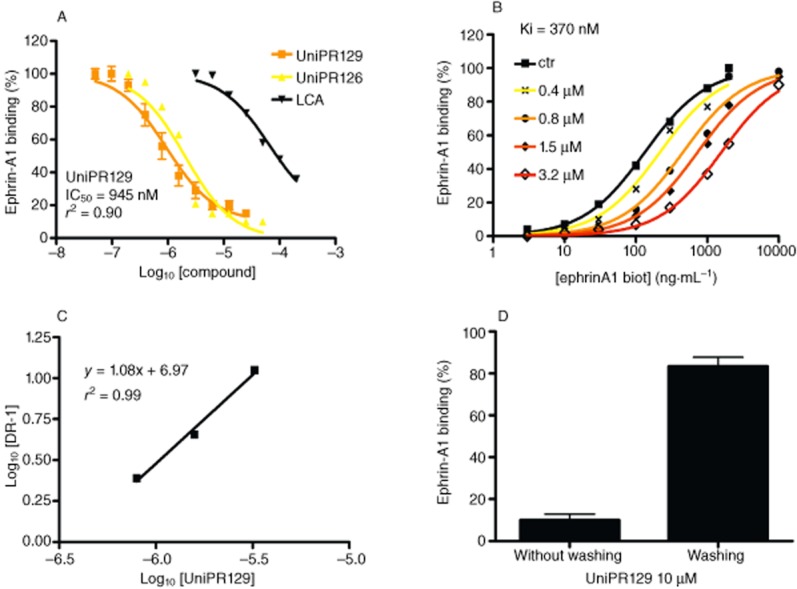
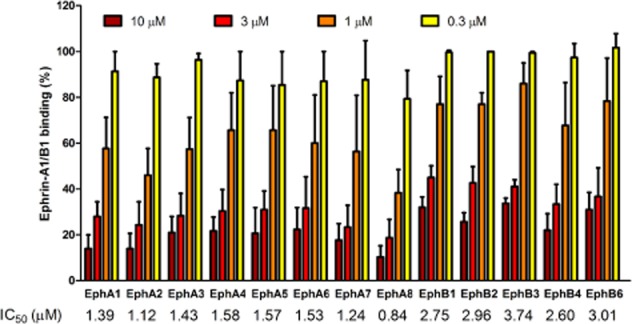
UniPR129 targets Eph receptors, particularly EphA2, and their ephrin ligands. Eph receptors are the largest family of receptor tyrosine kinases and play critical roles in cell migration, adhesion, and angiogenesis. By antagonizing Eph-ephrin interactions, UniPR129 disrupts Eph-mediated signaling pathways involved in tumor progression, angiogenesis, and metastasis. The compound shows potent activity with an IC50 of 945 nM for EphA2-ephrin-A1 interaction.
|
|---|---|
| ln Vitro |
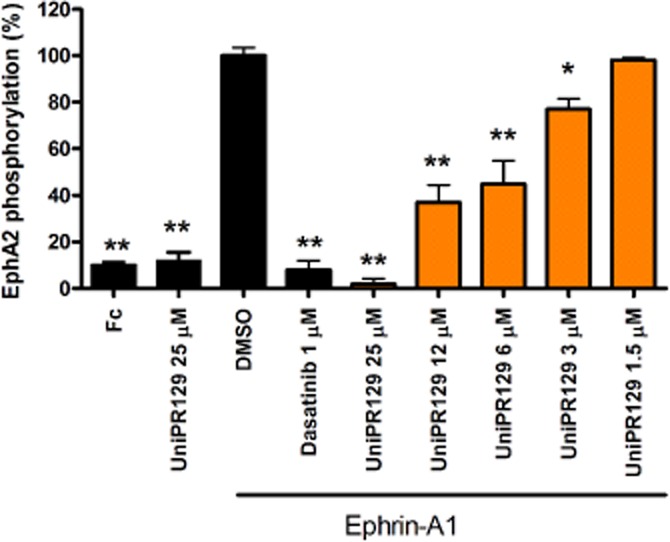
In vitro, UniPR129 blocks EphA2-ephrin-A1 interaction with an IC50 of 945 nM and a Ki of 370 nM. It inhibits in vitro angiogenesis at low micromolar concentrations. The compound impairs cell migration and invasion in cancer cell models. It demonstrates antitumor activity by disrupting tumor vascularization. These effects make UniPR129 a valuable tool for studying Eph receptor biology and oncogenic processes.
|
| ln Vivo |
In vivo, UniPR129 is orally active. It exhibits antitumor effects in preclinical cancer models by impairing tumor growth and vascularization. The compound also shows neuroprotective effects. Its oral bioavailability and in vivo efficacy support its use in cancer and neurological disease research. Specific animal model data and dosing regimens are available in the primary literature.
|
| Enzyme Assay |
Not specifically documented for UniPR129. For Eph/ephrin antagonists, cell-free binding assays typically measure the displacement of labeled ephrin ligands from Eph receptor extracellular domains using surface plasmon resonance (SPR) or ELISA-based competition assays. Binding affinity (Ki = 370 nM) is determined through such competition studies. The IC50 for inhibition of EphA2-ephrin-A1 interaction (945 nM) is measured in cell-free or cell-based formats.
|
| Cell Assay |
In vitro cell-based assays for UniPR129 include angiogenesis assays using endothelial cells to assess inhibition of tube formation. Cell migration and invasion assays are performed using cancer cell lines. EphA2-ephrin-A1 interaction assays may use cells expressing these proteins. Proliferation and survival assays can evaluate antitumor effects. These assays are typically performed at low micromolar concentrations.
|
| Animal Protocol |
In vivo studies with UniPR129 are conducted in mouse models of cancer to evaluate antitumor efficacy. The compound is administered orally due to its oral bioavailability. Endpoints include tumor growth inhibition, assessment of tumor vascularization, and evaluation of metastasis. Neuroprotective effects may be studied in appropriate neurological disease models. Dosing regimens are detailed in the primary literature.
|
| ADME/Pharmacokinetics |
UniPR129 is orally active, indicating favorable oral bioavailability. As a small molecule with molecular weight 576.81 and formula C36H52N2O4, it is suitable for oral administration. Detailed PK parameters such as half-life, Cmax, and AUC are available in the primary literature but are not detailed in the available sources. The compound appears as a solid powder with purity ≥98%.
|
| Toxicity/Toxicokinetics |
Specific toxicity data for UniPR129 are not provided in the available literature. As a research compound, it is not intended for human therapeutic use. Standard laboratory safety precautions should be followed when handling this compound. The compound is supplied for research purposes only.
|
| References |
|
| Additional Infomation |
UniPR129 is a competitive Eph-ephrin antagonist. The molecular formula is C36H52N2O4 with a molecular weight of 576.81. It appears as a solid powder with purity ≥98%. The compound is used in cancer biology research to investigate the role of Eph receptors in oncogenic processes and exhibits both antitumor and neuroprotective effects.
|
| Molecular Formula |
C36H52N2O4
|
|---|---|
| Molecular Weight |
576.809090614319
|
| Exact Mass |
576.392
|
| CAS # |
1639159-47-9
|
| PubChem CID |
91668293
|
| Appearance |
White to off-white solid powder
|
| LogP |
7.7
|
| Hydrogen Bond Donor Count |
4
|
| Hydrogen Bond Acceptor Count |
4
|
| Rotatable Bond Count |
9
|
| Heavy Atom Count |
42
|
| Complexity |
987
|
| Defined Atom Stereocenter Count |
10
|
| SMILES |
O[C@@H]1CC[C@@]2(C)[C@@H](C1)CC[C@@H]1[C@@H]2CC[C@]2(C)[C@@H]([C@H](C)CCC(N[C@H](CC(=O)O)CC3=CNC4C=CC=CC3=4)=O)CC[C@H]21
|
| InChi Key |
JGYYGEYIQBZUCC-ZOOAIUBFSA-N
|
| InChi Code |
InChI=1S/C36H52N2O4/c1-22(8-13-33(40)38-25(20-34(41)42)18-23-21-37-32-7-5-4-6-27(23)32)29-11-12-30-28-10-9-24-19-26(39)14-16-35(24,2)31(28)15-17-36(29,30)3/h4-7,21-22,24-26,28-31,37,39H,8-20H2,1-3H3,(H,38,40)(H,41,42)/t22-,24-,25+,26-,28+,29-,30+,31+,35+,36-/m1/s1
|
| Chemical Name |
(3S)-3-[[(4R)-4-[(3R,5R,8R,9S,10S,13R,14S,17R)-3-hydroxy-10,13-dimethyl-2,3,4,5,6,7,8,9,11,12,14,15,16,17-tetradecahydro-1H-cyclopenta[a]phenanthren-17-yl]pentanoyl]amino]-4-(1H-indol-3-yl)butanoic acid
|
| Synonyms |
Uni PR 129; Uni-PR-129; UniPR129
|
| HS Tariff Code |
2934.99.9001
|
| Storage |
Powder -20°C 3 years 4°C 2 years In solvent -80°C 6 months -20°C 1 month |
| Shipping Condition |
Room temperature (This product is stable at ambient temperature for a few days during ordinary shipping and time spent in Customs)
|
| Solubility (In Vitro) |
DMSO : ~33.33 mg/mL (~57.78 mM)
|
|---|---|
| Solubility (In Vivo) |
Note: Listed below are some common formulations that may be used to formulate products with low water solubility (e.g. < 1 mg/mL), you may test these formulations using a minute amount of products to avoid loss of samples.
Injection Formulations
Injection Formulation 1: DMSO : Tween 80: Saline = 10 : 5 : 85 (i.e. 100 μL DMSO stock solution → 50 μL Tween 80 → 850 μL Saline)(e.g. IP/IV/IM/SC) *Preparation of saline: Dissolve 0.9 g of sodium chloride in 100 mL ddH ₂ O to obtain a clear solution. Injection Formulation 2: DMSO : PEG300 :Tween 80 : Saline = 10 : 40 : 5 : 45 (i.e. 100 μL DMSO → 400 μLPEG300 → 50 μL Tween 80 → 450 μL Saline) Injection Formulation 3: DMSO : Corn oil = 10 : 90 (i.e. 100 μL DMSO → 900 μL Corn oil) Example: Take the Injection Formulation 3 (DMSO : Corn oil = 10 : 90) as an example, if 1 mL of 2.5 mg/mL working solution is to be prepared, you can take 100 μL 25 mg/mL DMSO stock solution and add to 900 μL corn oil, mix well to obtain a clear or suspension solution (2.5 mg/mL, ready for use in animals). View More
Injection Formulation 4: DMSO : 20% SBE-β-CD in saline = 10 : 90 [i.e. 100 μL DMSO → 900 μL (20% SBE-β-CD in saline)] Oral Formulations
Oral Formulation 1: Suspend in 0.5% CMC Na (carboxymethylcellulose sodium) Oral Formulation 2: Suspend in 0.5% Carboxymethyl cellulose Example: Take the Oral Formulation 1 (Suspend in 0.5% CMC Na) as an example, if 100 mL of 2.5 mg/mL working solution is to be prepared, you can first prepare 0.5% CMC Na solution by measuring 0.5 g CMC Na and dissolve it in 100 mL ddH2O to obtain a clear solution; then add 250 mg of the product to 100 mL 0.5% CMC Na solution, to make the suspension solution (2.5 mg/mL, ready for use in animals). View More
Oral Formulation 3: Dissolved in PEG400 (Please use freshly prepared in vivo formulations for optimal results.) |
| Preparing Stock Solutions | 1 mg | 5 mg | 10 mg | |
| 1 mM | 1.7337 mL | 8.6684 mL | 17.3367 mL | |
| 5 mM | 0.3467 mL | 1.7337 mL | 3.4673 mL | |
| 10 mM | 0.1734 mL | 0.8668 mL | 1.7337 mL |
*Note: Please select an appropriate solvent for the preparation of stock solution based on your experiment needs. For most products, DMSO can be used for preparing stock solutions (e.g. 5 mM, 10 mM, or 20 mM concentration); some products with high aqueous solubility may be dissolved in water directly. Solubility information is available at the above Solubility Data section. Once the stock solution is prepared, aliquot it to routine usage volumes and store at -20°C or -80°C. Avoid repeated freeze and thaw cycles.
Calculation results
Working concentration: mg/mL;
Method for preparing DMSO stock solution: mg drug pre-dissolved in μL DMSO (stock solution concentration mg/mL). Please contact us first if the concentration exceeds the DMSO solubility of the batch of drug.
Method for preparing in vivo formulation::Take μL DMSO stock solution, next add μL PEG300, mix and clarify, next addμL Tween 80, mix and clarify, next add μL ddH2O,mix and clarify.
(1) Please be sure that the solution is clear before the addition of next solvent. Dissolution methods like vortex, ultrasound or warming and heat may be used to aid dissolving.
(2) Be sure to add the solvent(s) in order.
|
|
|
Products are for research use only; We do not sell to patients
Copyright 2020 InvivoChem LLC | All Rights Reserved