| Size | Price | Stock | Qty |
|---|---|---|---|
| 5mg |
|
||
| 10mg |
|
||
| 25mg |
|
||
| 50mg |
|
||
| 100mg | |||
| Other Sizes |


| Targets |
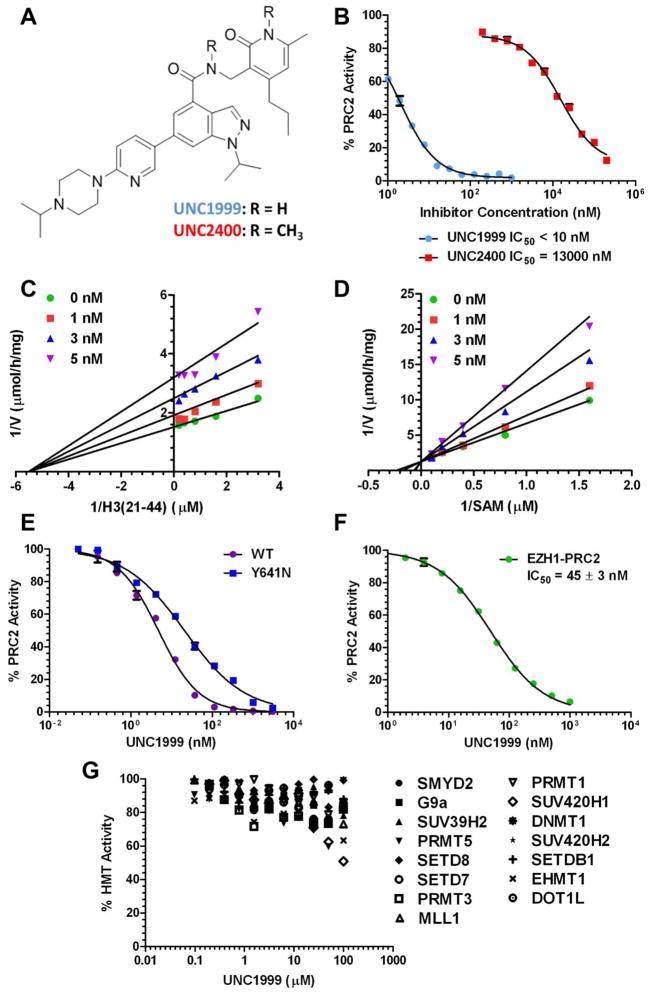
UNC2400 targets the same enzymes as UNC1999, namely the histone methyltransferases EZH1 and EZH2, but with significantly lower potency. It displays IC₅₀ values of 62 μM for EZH1 and >200 μM for EZH2, compared to the potent activity of UNC1999. Because of its greatly reduced activity, UNC2400 serves as a negative control to distinguish specific EZH1/EZH2 inhibition from off-target effects in cell-based studies. The compound's defined selectivity and low potency make it a valuable chemical probe for exploring therapeutic strategies targeting EZH2-driven malignancies.
|
|---|---|
| ln Vitro |
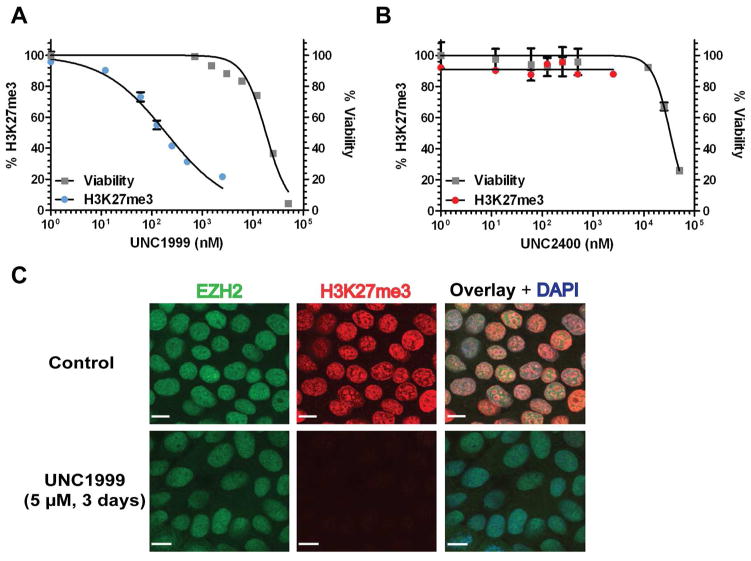
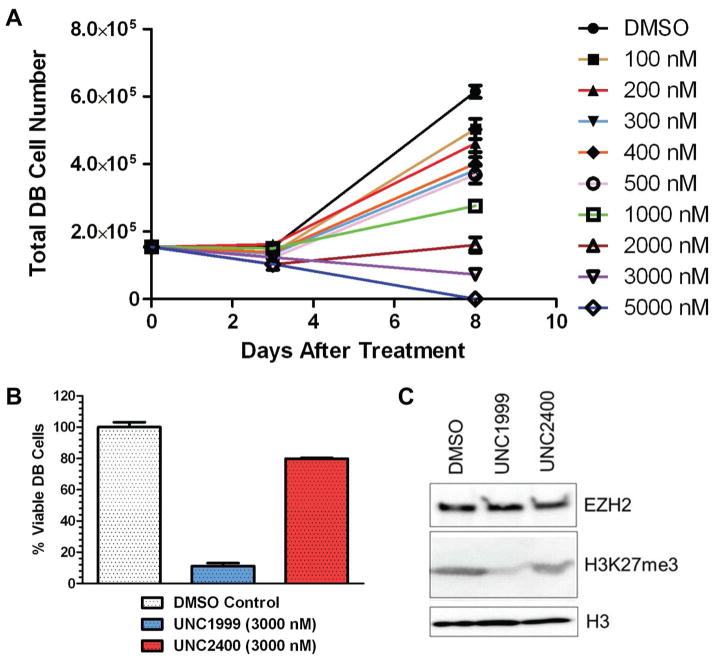
In vitro, UNC2400 is used as a negative control for UNC1999 in cell-based studies. It displays more than 1,000-fold lower potency than the active analog UNC1999. The compound's low activity allows researchers to distinguish specific EZH1/EZH2 inhibition from off-target effects. In cell-based assays, UNC2400 treatment serves as a control to validate that observed phenotypic changes are due to EZH1/EZH2 inhibition rather than non-specific effects of the compound. UNC2400 is a valuable tool for studying chromatin remodeling and epigenetic regulation.
|
| ln Vivo |
In vivo, UNC2400 is not typically used as an active pharmacological agent due to its low potency. It is primarily employed as a negative control in cell-based studies. For in vivo studies, UNC2400 could potentially be used to validate the specificity of UNC1999-mediated effects in animal models, but such applications are not well-documented. The compound is a research tool for studying EZH1/EZH2 function and epigenetic regulation. Comprehensive in vivo studies of UNC2400 alone are limited.
|
| Enzyme Assay |
In vitro enzyme assays for UNC2400 involve measuring its inhibition of the histone methyltransferases EZH1 and EZH2. The assays typically use recombinant EZH1 or EZH2 enzymes incubated with varying concentrations of UNC2400 in the presence of S-adenosylmethionine (SAM) and a histone substrate. The methylation of the substrate is measured using radiometric or fluorescence-based methods. The IC₅₀ values for EZH1 (62 μM) and EZH2 (>200 μM) confirm the compound's greatly reduced potency compared to UNC1999. These assays validate UNC2400's use as a negative control.
|
| Cell Assay |
In vitro cell-based assays for UNC2400 evaluate its effects as a negative control for UNC1999. Cells are cultured and treated with UNC2400 alongside UNC1999 to compare their effects on histone methylation, gene expression, and cell proliferation. The compound's low potency ensures that any observed effects are minimal compared to UNC1999. Histone methylation (H3K27me3) is measured by Western blot using specific antibodies. Gene expression changes are assessed by qPCR or RNA-seq. These assays confirm UNC2400's utility as a negative control.
|
| Animal Protocol |
In vivo animal experiments for UNC2400 are not typically conducted, as the compound is used as a negative control in cell-based studies rather than as an active pharmacological agent. For potential in vivo studies, UNC2400 could be administered to animal models to validate the specificity of UNC1999-mediated effects, but such applications are not well-documented. The compound is a research tool for studying epigenetic regulation. Comprehensive in vivo studies are limited.
|
| ADME/Pharmacokinetics |
Pharmacokinetic (PK) data for UNC2400 are not well-characterized, as the compound is primarily used as a negative control in cell-based studies rather than as a therapeutic agent. The compound has a molecular weight of 597.79 g/mol and a molecular formula of C₃₅H₄₇N₇O₂. It is typically stored as a solid at -20°C. Comprehensive ADME studies are not available in the literature. For research use only, not for human therapeutic use.
|
| Toxicity/Toxicokinetics |
The toxicity profile of UNC2400 has not been extensively characterized, as the compound is used as a negative control in research settings rather than as a therapeutic agent. The compound is for research use only and is not intended for human or veterinary use. Standard safety precautions for handling chemical compounds should be followed, including working in a well-ventilated area and using appropriate personal protective equipment. Comprehensive toxicological studies are needed to fully characterize the safety profile of UNC2400.
|
| References | |
| Additional Infomation |
UNC2400 is a close analog of UNC1999 that displays more than 1,000-fold lower potency than the active analog. It has IC₅₀ values of 62 μM for EZH1 and >200 μM for EZH2. UNC2400 is used as a negative control for cell-based studies of UNC1999, a potent inhibitor of EZH1 and EZH2. The compound is a valuable tool for studying chromatin remodeling, cancer progression, and epigenetic regulation. It is a research-grade compound used to validate the specificity of UNC1999-mediated effects. UNC2400 has not progressed to clinical trials.
|
| Molecular Formula |
C35H47N7O2
|
|---|---|
| Molecular Weight |
597.793387651443
|
| Exact Mass |
597.379
|
| CAS # |
1433200-49-7
|
| PubChem CID |
91691116
|
| Appearance |
White to off-white solid powder
|
| Density |
1.2±0.1 g/cm3
|
| Boiling Point |
798.3±60.0 °C at 760 mmHg
|
| Flash Point |
436.6±32.9 °C
|
| Vapour Pressure |
0.0±2.8 mmHg at 25°C
|
| Index of Refraction |
1.622
|
| LogP |
4.57
|
| Hydrogen Bond Donor Count |
0
|
| Hydrogen Bond Acceptor Count |
6
|
| Rotatable Bond Count |
9
|
| Heavy Atom Count |
44
|
| Complexity |
1090
|
| Defined Atom Stereocenter Count |
0
|
| SMILES |
CCCC1=C(C(=O)N(C(=C1)C)C)CN(C)C(=O)C2=C3C=NN(C3=CC(=C2)C4=CN=C(C=C4)N5CCN(CC5)C(C)C)C(C)C
|
| InChi Key |
IFSQHIRDVVFJSQ-UHFFFAOYSA-N
|
| InChi Code |
InChI=1S/C35H47N7O2/c1-9-10-26-17-25(6)39(8)35(44)31(26)22-38(7)34(43)29-18-28(19-32-30(29)21-37-42(32)24(4)5)27-11-12-33(36-20-27)41-15-13-40(14-16-41)23(2)3/h11-12,17-21,23-24H,9-10,13-16,22H2,1-8H3
|
| Chemical Name |
N-[(1,6-dimethyl-2-oxo-4-propylpyridin-3-yl)methyl]-N-methyl-1-propan-2-yl-6-[6-(4-propan-2-ylpiperazin-1-yl)pyridin-3-yl]indazole-4-carboxamide
|
| HS Tariff Code |
2934.99.9001
|
| Storage |
Powder -20°C 3 years 4°C 2 years In solvent -80°C 6 months -20°C 1 month |
| Shipping Condition |
Room temperature (This product is stable at ambient temperature for a few days during ordinary shipping and time spent in Customs)
|
| Solubility (In Vitro) |
DMSO: ~65 mg/mL (~108.7 mM; with ultrasonication and warming by heating to 60°C)
|
|---|---|
| Solubility (In Vivo) |
Solubility in Formulation 1: ≥ 3.25 mg/mL (5.44 mM) (saturation unknown) in 10% DMSO + 90% Corn Oil (add these co-solvents sequentially from left to right, and one by one), Clear solution.
For example, if 1 mL of working solution is to be prepared, you can add 100 μL of DMSO stock solution (32.5 mg/mL) to 900 μL of corn oil and mix well. (Please use freshly prepared in vivo formulations for optimal results.) |
| Preparing Stock Solutions | 1 mg | 5 mg | 10 mg | |
| 1 mM | 1.6728 mL | 8.3641 mL | 16.7283 mL | |
| 5 mM | 0.3346 mL | 1.6728 mL | 3.3457 mL | |
| 10 mM | 0.1673 mL | 0.8364 mL | 1.6728 mL |
*Note: Please select an appropriate solvent for the preparation of stock solution based on your experiment needs. For most products, DMSO can be used for preparing stock solutions (e.g. 5 mM, 10 mM, or 20 mM concentration); some products with high aqueous solubility may be dissolved in water directly. Solubility information is available at the above Solubility Data section. Once the stock solution is prepared, aliquot it to routine usage volumes and store at -20°C or -80°C. Avoid repeated freeze and thaw cycles.
Calculation results
Working concentration: mg/mL;
Method for preparing DMSO stock solution: mg drug pre-dissolved in μL DMSO (stock solution concentration mg/mL). Please contact us first if the concentration exceeds the DMSO solubility of the batch of drug.
Method for preparing in vivo formulation::Take μL DMSO stock solution, next add μL PEG300, mix and clarify, next addμL Tween 80, mix and clarify, next add μL ddH2O,mix and clarify.
(1) Please be sure that the solution is clear before the addition of next solvent. Dissolution methods like vortex, ultrasound or warming and heat may be used to aid dissolving.
(2) Be sure to add the solvent(s) in order.
|
|
|
Products are for research use only; We do not sell to patients
Copyright 2020 InvivoChem LLC | All Rights Reserved