| Size | Price | Stock | Qty |
|---|---|---|---|
| 1mg |
|
||
| 5mg |
|
||
| 100mg | |||
| Other Sizes |


| Targets |
Shu 9119 acts as an antagonist at melanocortin receptors, primarily MC3R and MC4R. By binding to these receptors, it blocks the action of endogenous melanocortin peptides, such as α-MSH. The melanocortin system plays a key role in regulating food intake, energy expenditure, and sexual behavior. Antagonism of MC4R has been shown to increase food intake and body weight in animal models.
|
|---|---|
| ln Vitro |
In vitro, Shu 9119 binds to melanocortin receptors with high affinity, displacing radiolabeled agonists such as [¹²⁵I]-NDP-α-MSH. It shows selectivity for MC3R and MC4R, with lower affinity for MC1R and MC5R. Its antagonistic activity is confirmed by its ability to block agonist-induced cAMP accumulation in cells expressing these receptors.
|
| ln Vivo |
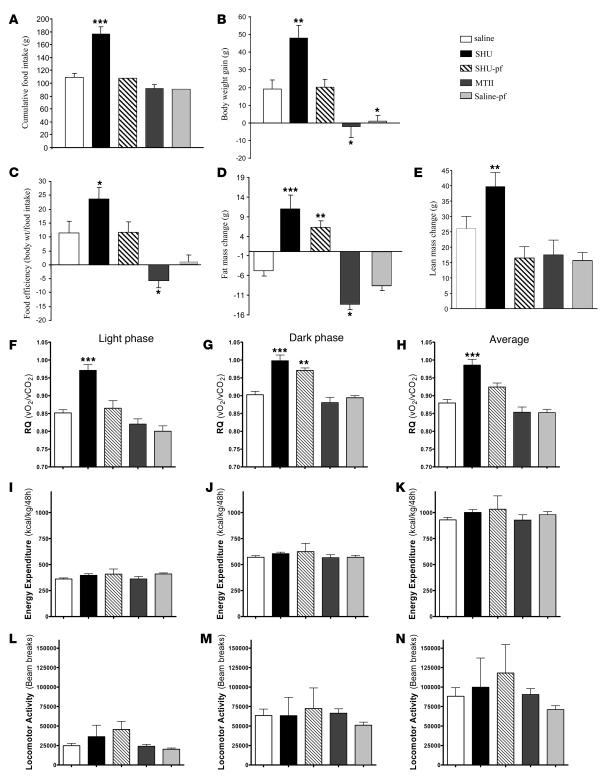
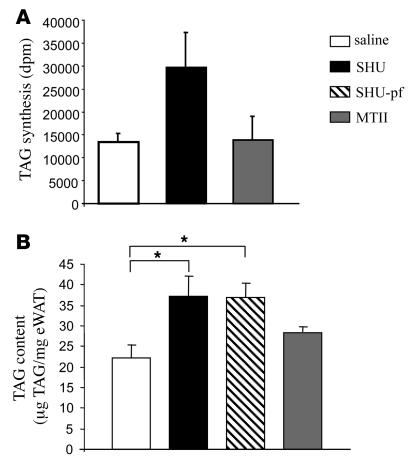
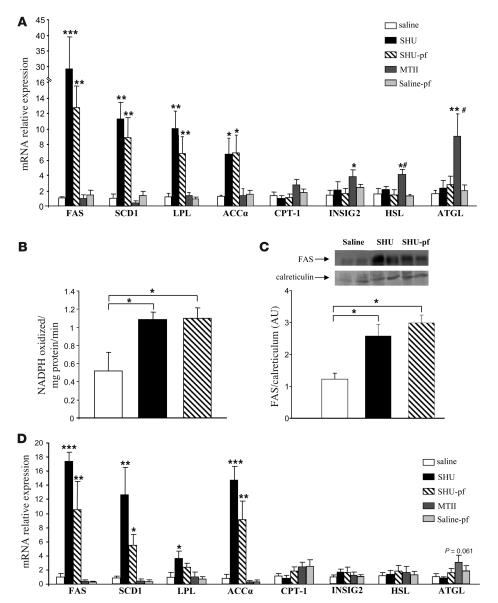
Rats given ad libitum food showed an increase in food intake when CNS-Mcr was blocked by a chronic intracerebroventricular infusion of SHU9119 (24 nmol/d for 7 days) in comparison to controls. Rats treated with SHU9119 showed a noticeably greater weight increase than the control group. Treatment with SHU9119 efficiently raises metabolic efficiency. SHU9119 markedly upregulates the mRNA levels of genes, such as fatty acid synthase, lipoprotein lipase, acetyl-CoA carboxylase α, stearoyl-CoA desaturase-1, and lipogenesis-promoting TAG storage in adipocytes [2]. SHU9119 reduces EE (−42%) via decreasing fat oxidation while increasing food intake (+30%) and body fat (+50%). Furthermore, SHU9119 hinders BAT's absorption of VLDL-TG. In line with this, SHU9119 caused significant disruptions to BAT activity by reducing the amount of uncoupling protein 1 in BAT (−60%) and causing large intracellular lipid droplets [3].
In vivo, Shu 9119 has been used to study the role of melanocortin receptors in feeding behavior and metabolism. Central administration of Shu 9119 into the brain of rodents stimulates food intake and increases body weight, confirming the role of MC4R in appetite regulation. It has also been used to study sexual behavior and other physiological functions mediated by the melanocortin system. |
| Enzyme Assay |
The in vitro receptor binding assay for Shu 9119 involves measuring its affinity for melanocortin receptors (MC1R, MC3R, MC4R, MC5R). This is typically done using a radioligand binding assay with [¹²⁵I]-NDP-α-MSH and membrane preparations from cells expressing the receptors. Competition binding experiments are performed to determine the Ki values of Shu 9119 at each receptor subtype.
|
| Cell Assay |
In vitro cellular assays for Shu 9119 are performed on cells expressing melanocortin receptors. The functional antagonism of Shu 9119 is measured by its ability to block the cAMP accumulation induced by an agonist such as NDP-α-MSH. The IC50 for inhibiting the agonist response is determined to quantify its antagonist potency.
|
| Animal Protocol |
In vivo animal experiments for Shu 9119 are typically conducted in rodents. The compound is administered via intracerebroventricular (ICV) injection to study its central effects on feeding behavior. Food intake and body weight are monitored after administration to assess the hyperphagic effect of MC4R antagonism. Other behaviors, such as sexual behavior, can also be studied.
|
| ADME/Pharmacokinetics |
Specific pharmacokinetic properties of Shu 9119 are not extensively documented in the available literature, as it is a research peptide. As a peptide, it would not be expected to be orally bioavailable and would likely require injection for in vivo studies. Its half-life in the central nervous system would be limited by enzymatic degradation.
|
| Toxicity/Toxicokinetics |
Specific toxicity data for Shu 9119 are not readily available in the public domain, as it is primarily a research compound. As a peptide, its toxicity is likely to be related to its mechanism of action rather than off-target effects. Chronic antagonism of MC4R would be expected to lead to increased food intake and weight gain, which could have metabolic consequences.
|
| References |
|
| Additional Infomation |
Shu 9119 is a research tool used to study the melanocortin system. It is not an FDA-approved drug. It has been instrumental in elucidating the role of MC3R and MC4R in energy homeostasis and appetite regulation. It is one of several peptides used in this field, along with other antagonists like HS014. Its use is confined to basic research laboratories.
|
| Molecular Formula |
C54H71N15O9
|
|---|---|
| Molecular Weight |
1074.23665070534
|
| Exact Mass |
1073.555
|
| CAS # |
168482-23-3
|
| PubChem CID |
9898183
|
| Sequence |
Ac-{Nle}-Asp-His-{d-Nal}-Arg-Trp-Lys-NH2 (Lactam bridge: Asp2-Lys7)Ac-{Nle}-DH-{d-Nal}-RWK-NH2 (Lactam bridge: Asp2-Lys7)
|
| SequenceShortening |
Ac-{Nle}-DH-{d-Nal}-RWK-NH2 (Lactam bridge: Asp2-Lys7)
|
| Appearance |
White to off-white solid powder
|
| Density |
1.4±0.1 g/cm3
|
| Index of Refraction |
1.691
|
| LogP |
-0.04
|
| Hydrogen Bond Donor Count |
13
|
| Hydrogen Bond Acceptor Count |
11
|
| Rotatable Bond Count |
17
|
| Heavy Atom Count |
78
|
| Complexity |
2090
|
| Defined Atom Stereocenter Count |
7
|
| SMILES |
CCCC[C@@H](C(=O)N[C@H]1CC(=O)NCCCC[C@H](NC(=O)[C@@H](NC(=O)[C@@H](NC(=O)[C@H](NC(=O)[C@@H](NC1=O)CC2=CN=CN2)CC3=CC4=CC=CC=C4C=C3)CCCN=C(N)N)CC5=CNC6=CC=CC=C65)C(=O)N)NC(=O)C
|
| InChi Key |
GGYWLZFXFKFWKL-XOJVSUSESA-N
|
| InChi Code |
InChI=1S/C54H71N15O9/c1-3-4-15-40(63-31(2)70)48(73)69-45-27-46(71)59-21-10-9-17-39(47(55)72)64-51(76)43(25-35-28-61-38-16-8-7-14-37(35)38)67-49(74)41(18-11-22-60-54(56)57)65-50(75)42(24-32-19-20-33-12-5-6-13-34(33)23-32)66-52(77)44(68-53(45)78)26-36-29-58-30-62-36/h5-8,12-14,16,19-20,23,28-30,39-45,61H,3-4,9-11,15,17-18,21-22,24-27H2,1-2H3,(H2,55,72)(H,58,62)(H,59,71)(H,63,70)(H,64,76)(H,65,75)(H,66,77)(H,67,74)(H,68,78)(H,69,73)(H4,56,57,60)/t39-,40-,41-,42+,43-,44-,45-/m0/s1
|
| Chemical Name |
(3S,6S,9R,12S,15S,23S)-15-[[(2S)-2-acetamidohexanoyl]amino]-6-[3-(diaminomethylideneamino)propyl]-12-(1H-imidazol-5-ylmethyl)-3-(1H-indol-3-ylmethyl)-9-(naphthalen-2-ylmethyl)-2,5,8,11,14,17-hexaoxo-1,4,7,10,13,18-hexazacyclotricosane-23-carboxamide
|
| HS Tariff Code |
2934.99.9001
|
| Storage |
Powder -20°C 3 years 4°C 2 years In solvent -80°C 6 months -20°C 1 month Note: Please store this product in a sealed and protected environment (e.g. under nitrogen), avoid exposure to moisture and light. |
| Shipping Condition |
Room temperature (This product is stable at ambient temperature for a few days during ordinary shipping and time spent in Customs)
|
| Solubility (In Vitro) |
H2O : ~10 mg/mL (~9.31 mM)
|
|---|---|
| Solubility (In Vivo) |
Note: Listed below are some common formulations that may be used to formulate products with low water solubility (e.g. < 1 mg/mL), you may test these formulations using a minute amount of products to avoid loss of samples.
Injection Formulations
Injection Formulation 1: DMSO : Tween 80: Saline = 10 : 5 : 85 (i.e. 100 μL DMSO stock solution → 50 μL Tween 80 → 850 μL Saline)(e.g. IP/IV/IM/SC) *Preparation of saline: Dissolve 0.9 g of sodium chloride in 100 mL ddH ₂ O to obtain a clear solution. Injection Formulation 2: DMSO : PEG300 :Tween 80 : Saline = 10 : 40 : 5 : 45 (i.e. 100 μL DMSO → 400 μLPEG300 → 50 μL Tween 80 → 450 μL Saline) Injection Formulation 3: DMSO : Corn oil = 10 : 90 (i.e. 100 μL DMSO → 900 μL Corn oil) Example: Take the Injection Formulation 3 (DMSO : Corn oil = 10 : 90) as an example, if 1 mL of 2.5 mg/mL working solution is to be prepared, you can take 100 μL 25 mg/mL DMSO stock solution and add to 900 μL corn oil, mix well to obtain a clear or suspension solution (2.5 mg/mL, ready for use in animals). View More
Injection Formulation 4: DMSO : 20% SBE-β-CD in saline = 10 : 90 [i.e. 100 μL DMSO → 900 μL (20% SBE-β-CD in saline)] Oral Formulations
Oral Formulation 1: Suspend in 0.5% CMC Na (carboxymethylcellulose sodium) Oral Formulation 2: Suspend in 0.5% Carboxymethyl cellulose Example: Take the Oral Formulation 1 (Suspend in 0.5% CMC Na) as an example, if 100 mL of 2.5 mg/mL working solution is to be prepared, you can first prepare 0.5% CMC Na solution by measuring 0.5 g CMC Na and dissolve it in 100 mL ddH2O to obtain a clear solution; then add 250 mg of the product to 100 mL 0.5% CMC Na solution, to make the suspension solution (2.5 mg/mL, ready for use in animals). View More
Oral Formulation 3: Dissolved in PEG400 (Please use freshly prepared in vivo formulations for optimal results.) |
| Preparing Stock Solutions | 1 mg | 5 mg | 10 mg | |
| 1 mM | 0.9309 mL | 4.6545 mL | 9.3089 mL | |
| 5 mM | 0.1862 mL | 0.9309 mL | 1.8618 mL | |
| 10 mM | 0.0931 mL | 0.4654 mL | 0.9309 mL |
*Note: Please select an appropriate solvent for the preparation of stock solution based on your experiment needs. For most products, DMSO can be used for preparing stock solutions (e.g. 5 mM, 10 mM, or 20 mM concentration); some products with high aqueous solubility may be dissolved in water directly. Solubility information is available at the above Solubility Data section. Once the stock solution is prepared, aliquot it to routine usage volumes and store at -20°C or -80°C. Avoid repeated freeze and thaw cycles.
Calculation results
Working concentration: mg/mL;
Method for preparing DMSO stock solution: mg drug pre-dissolved in μL DMSO (stock solution concentration mg/mL). Please contact us first if the concentration exceeds the DMSO solubility of the batch of drug.
Method for preparing in vivo formulation::Take μL DMSO stock solution, next add μL PEG300, mix and clarify, next addμL Tween 80, mix and clarify, next add μL ddH2O,mix and clarify.
(1) Please be sure that the solution is clear before the addition of next solvent. Dissolution methods like vortex, ultrasound or warming and heat may be used to aid dissolving.
(2) Be sure to add the solvent(s) in order.
|
|
|
Products are for research use only; We do not sell to patients
Copyright 2020 InvivoChem LLC | All Rights Reserved