| Size | Price | Stock | Qty |
|---|---|---|---|
| 5mg |
|
||
| 10mg |
|
||
| 25mg |
|
||
| 50mg |
|
||
| 100mg |
|
||
| Other Sizes |
Purity: ≥98%
| Targets |
(S)-4CPG targets group I metabotropic glutamate receptors, specifically mGluR1 and mGluR5. These are G protein-coupled receptors that play important roles in synaptic transmission, plasticity, and neuronal excitability. By activating these receptors, it modulates intracellular signaling pathways.
|
|---|---|
| ln Vitro |
(S)-4-CPG was the most selective compound
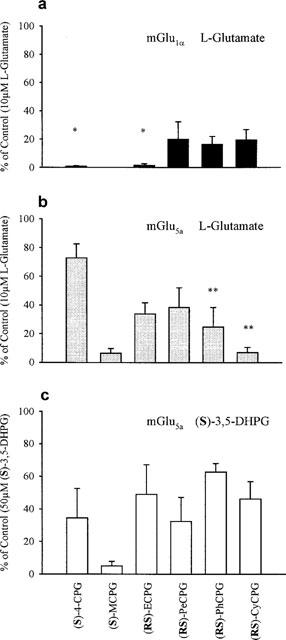
tested, depressing responses to 0.9+0.4 (5) and 73+10% (4) of control (P50.01) in mGlu1a and mGlu5a receptor-expressing cells followed by (RS)-ECPG, which reduced responses to 2+1 (4) and 34+8% (3) of control, respectively (P50.01).[1]
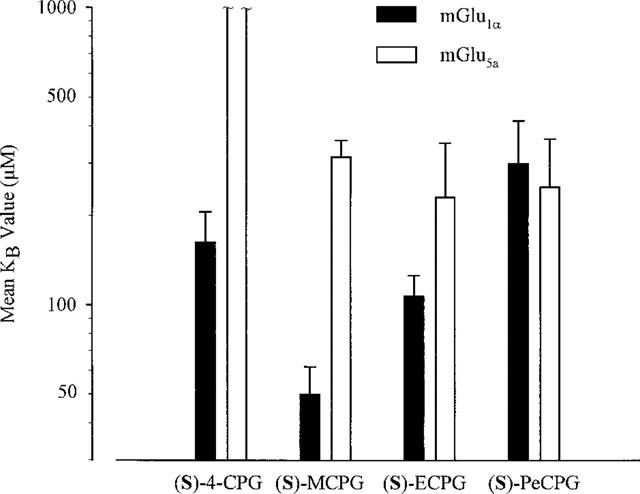
In common with the results for using a single concentration of antagonist, (S)-4-CPG demonstrated selectively for mGlu1a-receptor expressing cells (P50.01), with a KB value of 163+43 mM. In mGlu5a receptor-expressing cells, no shift in the L-glutamate dose response was detected in two out of three preparations. Methylation of (S)-4-CPG to (S)-MCPG induced antagonist activity at mGlu5a receptor-expressing cells (KB=316+43 mM) while maintaining the selectivity for mGlu1a receptors, (KB value of 50+12 mM, P50.05).[1] (S)-4CPG is a selective agonist for group I mGluRs. It activates mGluR1 and mGluR5, leading to activation of phospholipase C, mobilization of intracellular calcium, and activation of protein kinase C. This modulates neuronal excitability and synaptic plasticity. |
| ln Vivo |
In vivo, (S)-4CPG has been used to study the role of group I mGluRs in synaptic plasticity, learning, memory, and various neurological disorders. It has potential utility in animal models of epilepsy, pain, and neurodegenerative diseases.
|
| Enzyme Assay |
Cell-free assays for (S)-4CPG utilize membrane preparations expressing mGluR1 or mGluR5. Radiolabeled glutamate or agonist binding is measured in the presence of increasing concentrations of the compound. GTPγS binding assays can be performed to assess receptor activation.
|
| Cell Assay |
Cells expressing mGluR1 or mGluR5 (e.g., HEK293 cells transfected with the receptors, primary neurons) are loaded with calcium-sensitive dyes. (S)-4CPG-induced calcium mobilization is measured. Inositol phosphate accumulation is measured using radiolabeled myo-inositol. Receptor signaling is assessed by measuring downstream pathway activation.
|
| Animal Protocol |
In vivo animal studies for (S)-4CPG are conducted in rodent models of neurological disorders. The compound is administered via intracerebroventricular or intraperitoneal routes. Behavioral assays (e.g., seizure models, pain tests, learning and memory tests) are performed. Electrophysiological recordings can be performed to assess synaptic plasticity.
|
| ADME/Pharmacokinetics |
Pharmacokinetic properties of (S)-4CPG have not been comprehensively reported. As a small molecule, it is expected to have reasonable membrane permeability. The compound is soluble in DMSO. Detailed PK parameters remain to be determined.
|
| Toxicity/Toxicokinetics |
Toxicity data for (S)-4CPG are limited. As a group I mGluR agonist, standard toxicological assessments would be required for development. Excessive activation of group I mGluRs has been associated with excitotoxicity and seizure activity.
|
| References |
Br J Pharmacol.1999 Jan;126(1):205-10.
|
| Additional Infomation |
(S)-4CPG (CAS#: 134052-73-6) is a selective agonist for group I metabotropic glutamate receptors, specifically mGluR1 and mGluR5. It is used as a research tool for studying glutamate signaling, synaptic plasticity, and neurological disorders. The compound is intended for research use only.
|
| Molecular Formula |
C9H9NO4
|
|
|---|---|---|
| Molecular Weight |
195.172062635422
|
|
| Exact Mass |
195.053
|
|
| CAS # |
134052-73-6
|
|
| Related CAS # |
(R)-4CPG;134052-68-9
|
|
| PubChem CID |
5311459
|
|
| Appearance |
Typically exists as solid at room temperature
|
|
| LogP |
1.169
|
|
| Hydrogen Bond Donor Count |
3
|
|
| Hydrogen Bond Acceptor Count |
5
|
|
| Rotatable Bond Count |
3
|
|
| Heavy Atom Count |
14
|
|
| Complexity |
233
|
|
| Defined Atom Stereocenter Count |
1
|
|
| SMILES |
C1=CC(=CC=C1[C@@H](C(=O)O)N)C(=O)O
|
|
| InChi Key |
VTMJKPGFERYGJF-ZETCQYMHSA-N
|
|
| InChi Code |
InChI=1S/C9H9NO4/c10-7(9(13)14)5-1-3-6(4-2-5)8(11)12/h1-4,7H,10H2,(H,11,12)(H,13,14)/t7-/m0/s1
|
|
| Chemical Name |
|
|
| Synonyms |
|
|
| HS Tariff Code |
2934.99.9001
|
|
| Storage |
Powder -20°C 3 years 4°C 2 years In solvent -80°C 6 months -20°C 1 month |
|
| Shipping Condition |
Room temperature (This product is stable at ambient temperature for a few days during ordinary shipping and time spent in Customs)
|
| Solubility (In Vitro) |
|
|||
|---|---|---|---|---|
| Solubility (In Vivo) |
Note: Listed below are some common formulations that may be used to formulate products with low water solubility (e.g. < 1 mg/mL), you may test these formulations using a minute amount of products to avoid loss of samples.
Injection Formulations
Injection Formulation 1: DMSO : Tween 80: Saline = 10 : 5 : 85 (i.e. 100 μL DMSO stock solution → 50 μL Tween 80 → 850 μL Saline)(e.g. IP/IV/IM/SC) *Preparation of saline: Dissolve 0.9 g of sodium chloride in 100 mL ddH ₂ O to obtain a clear solution. Injection Formulation 2: DMSO : PEG300 :Tween 80 : Saline = 10 : 40 : 5 : 45 (i.e. 100 μL DMSO → 400 μLPEG300 → 50 μL Tween 80 → 450 μL Saline) Injection Formulation 3: DMSO : Corn oil = 10 : 90 (i.e. 100 μL DMSO → 900 μL Corn oil) Example: Take the Injection Formulation 3 (DMSO : Corn oil = 10 : 90) as an example, if 1 mL of 2.5 mg/mL working solution is to be prepared, you can take 100 μL 25 mg/mL DMSO stock solution and add to 900 μL corn oil, mix well to obtain a clear or suspension solution (2.5 mg/mL, ready for use in animals). View More
Injection Formulation 4: DMSO : 20% SBE-β-CD in saline = 10 : 90 [i.e. 100 μL DMSO → 900 μL (20% SBE-β-CD in saline)] Oral Formulations
Oral Formulation 1: Suspend in 0.5% CMC Na (carboxymethylcellulose sodium) Oral Formulation 2: Suspend in 0.5% Carboxymethyl cellulose Example: Take the Oral Formulation 1 (Suspend in 0.5% CMC Na) as an example, if 100 mL of 2.5 mg/mL working solution is to be prepared, you can first prepare 0.5% CMC Na solution by measuring 0.5 g CMC Na and dissolve it in 100 mL ddH2O to obtain a clear solution; then add 250 mg of the product to 100 mL 0.5% CMC Na solution, to make the suspension solution (2.5 mg/mL, ready for use in animals). View More
Oral Formulation 3: Dissolved in PEG400 (Please use freshly prepared in vivo formulations for optimal results.) |
| Preparing Stock Solutions | 1 mg | 5 mg | 10 mg | |
| 1 mM | 5.1237 mL | 25.6187 mL | 51.2374 mL | |
| 5 mM | 1.0247 mL | 5.1237 mL | 10.2475 mL | |
| 10 mM | 0.5124 mL | 2.5619 mL | 5.1237 mL |
*Note: Please select an appropriate solvent for the preparation of stock solution based on your experiment needs. For most products, DMSO can be used for preparing stock solutions (e.g. 5 mM, 10 mM, or 20 mM concentration); some products with high aqueous solubility may be dissolved in water directly. Solubility information is available at the above Solubility Data section. Once the stock solution is prepared, aliquot it to routine usage volumes and store at -20°C or -80°C. Avoid repeated freeze and thaw cycles.
Calculation results
Working concentration: mg/mL;
Method for preparing DMSO stock solution: mg drug pre-dissolved in μL DMSO (stock solution concentration mg/mL). Please contact us first if the concentration exceeds the DMSO solubility of the batch of drug.
Method for preparing in vivo formulation::Take μL DMSO stock solution, next add μL PEG300, mix and clarify, next addμL Tween 80, mix and clarify, next add μL ddH2O,mix and clarify.
(1) Please be sure that the solution is clear before the addition of next solvent. Dissolution methods like vortex, ultrasound or warming and heat may be used to aid dissolving.
(2) Be sure to add the solvent(s) in order.
Graphical representation showing KBvalues derived for the aliphatic series of α-substituted phenylglycine analogues when used with mGlu1αreceptor- and mGlu5areceptor-expressing cells.Br J Pharmacol.1999 Jan;126(1):205-10. |
|---|
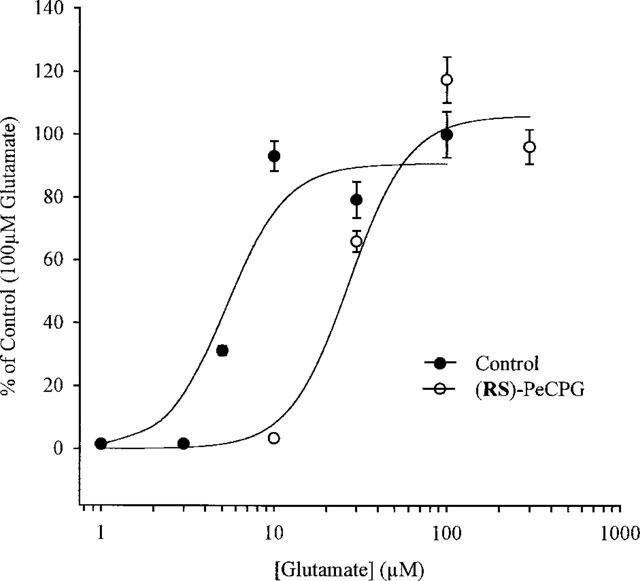
Effect of (RS)-PeCPG onL-glutamate-evoked Ca2+release in CHO cells expressing the mGlu5areceptor.Br J Pharmacol.1999 Jan;126(1):205-10. |
Effects of α-substituted phenylglycine derivatives on agonist-induced Ca2+release in CHO cells expressing either mGlu1αreceptors (a) or mGlu5areceptors (b,c). |
Products are for research use only; We do not sell to patients
Copyright 2020 InvivoChem LLC | All Rights Reserved


 COA
COA