| Size | Price | Stock | Qty |
|---|---|---|---|
| 5mg |
|
||
| 10mg |
|
||
| 50mg | |||
| Other Sizes |


| Targets |
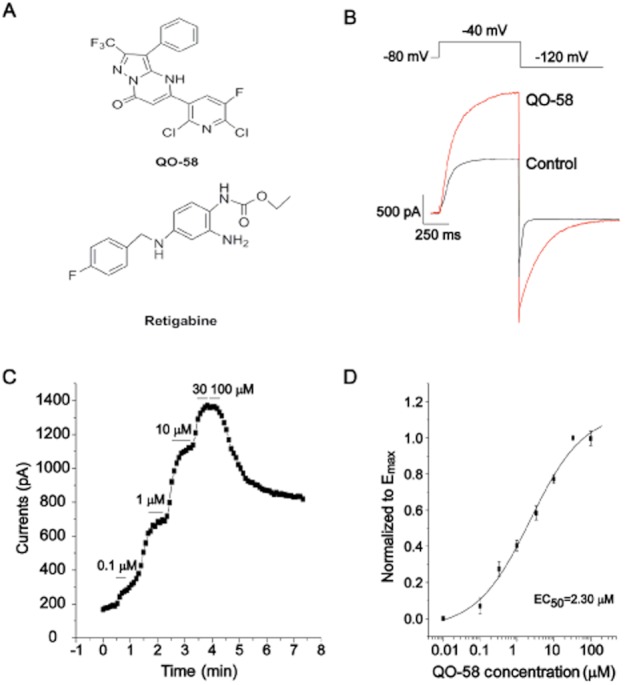
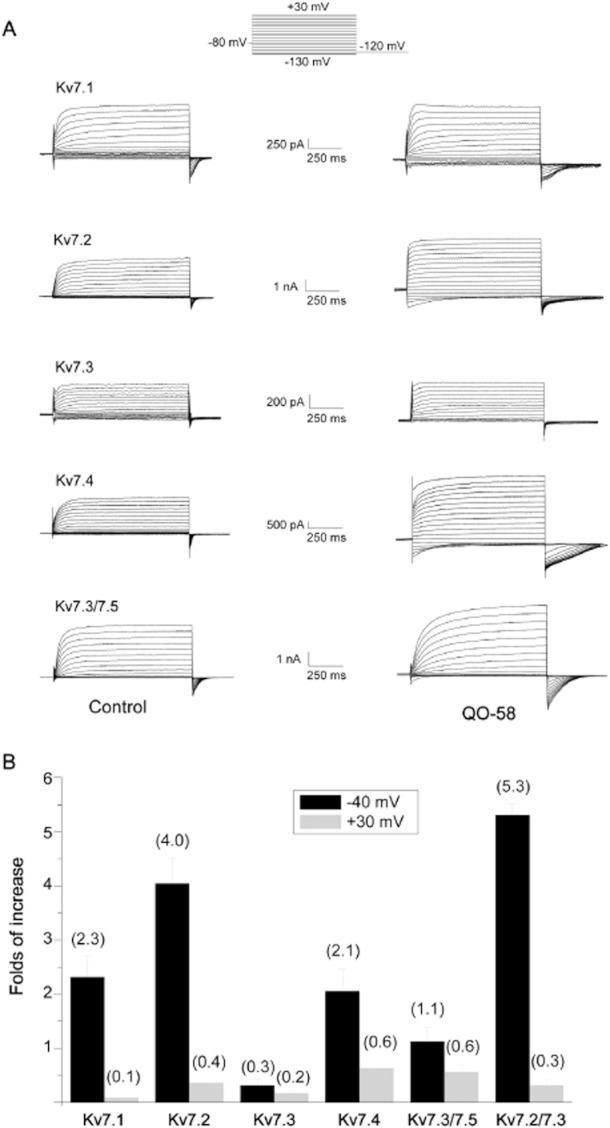
QO-58 targets the Kv7/KCNQ family of voltage-gated potassium channels. It is a potent activator (opener) of these channels, with EC50 values of 0.6 µM for Kv7.4, 1.0 µM for Kv7.2, 5.2 µM for Kv7.3/7.5, and 7.0 µM for Kv7.1. By opening these channels, it enhances the native neuronal M-current, which is a key regulator of neuronal excitability. This leads to a decrease in evoked action potentials.
|
|---|---|
| ln Vitro |
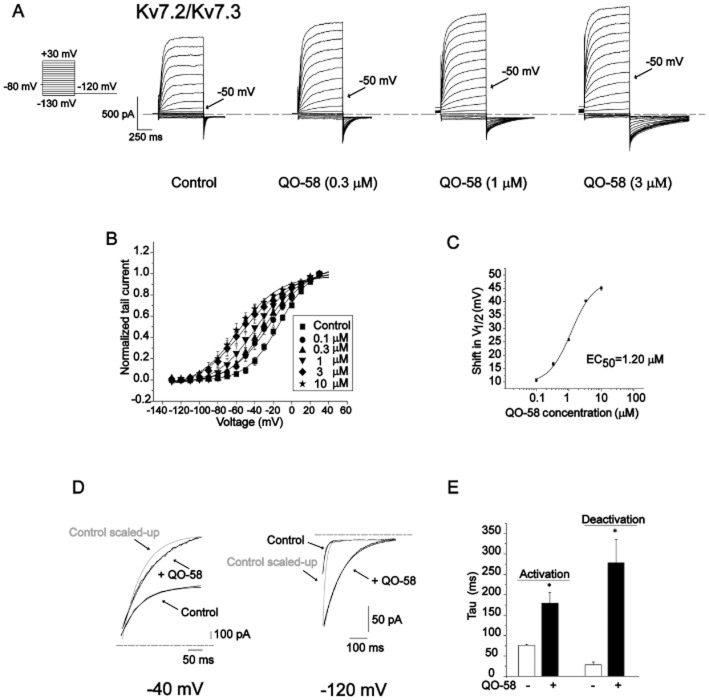
In vitro, QO-58 dose-dependently activates Kv7 currents. It enhances native neuronal M-currents and causes a decrease in evoked action potentials in neurons. Its activity has been characterized using electrophysiological techniques on recombinant Kv7 channels expressed in heterologous systems. The compound's EC50 for different Kv7 subtypes has been determined.
|
| ln Vivo |
In vivo, QO-58 has shown antinociceptive effects for osteoarthritis (OA) pain in the monosodium iodoacetate (MIA) model after pain development. It has also been shown to have antinociceptive effects on inflammatory pain. These findings suggest that QO-58 could be a potential therapeutic agent for the treatment of pain, particularly neuropathic and inflammatory pain. It is also used in neuroscience research to study pain mechanisms and neuroprotective responses.
|
| Enzyme Assay |
Cell-free assays for QO-58 are not the primary method for characterizing its activity, as it is an ion channel opener whose function depends on the channel being in a membrane. However, its binding to the channel could be studied using radioligand binding assays if a suitable radiolabeled ligand is available. Alternatively, its effect on channel activity can be studied using isolated membrane patches in electrophysiological studies.
|
| Cell Assay |
In vitro cell-based assays for QO-58 are performed to measure its effects on Kv7 channel activity. A common method is the patch-clamp electrophysiology technique. Cells expressing recombinant Kv7 channels (e.g., Kv7.2, Kv7.4) are voltage-clamped, and the currents through the channels are measured. The cells are then treated with varying concentrations of QO-58, and the increase in current amplitude is measured. The EC50 for channel activation is calculated from the dose-response curve. This assay directly demonstrates the compound's activity as a channel opener.
|
| Animal Protocol |
In vivo animal experiments for QO-58 are conducted in pain models. One described model is the monosodium iodoacetate (MIA) model of osteoarthritis pain. In this model, MIA is injected into the joint of a rat to induce osteoarthritis-like pain. After pain development, QO-58 is administered, and its antinociceptive effect is measured using behavioral tests, such as the paw withdrawal threshold. The compound has also shown effects on inflammatory pain.
|
| ADME/Pharmacokinetics |
Pharmacokinetic (PK) data for QO-58 is not provided in the available literature. Its properties, such as oral bioavailability and half-life, would be important for its development. The compound is soluble in DMSO. For storage, it is typically kept as a powder.
|
| Toxicity/Toxicokinetics |
Toxicological data for QO-58 is not available in the public literature. As a research compound that modulates neuronal excitability, its safety profile would be a critical factor in its development. However, no specific LD50, organ toxicity, or genotoxicity data are reported. Its use is strictly for research purposes, and it is not intended for human therapeutic use.
|
| References | |
| Additional Infomation |
QO-58 is a research-grade compound developed as a novel and potent activator of Kv7/KCNQ channels. It is a valuable tool for studying the role of these channels in controlling neuronal excitability and for validating them as therapeutic targets for pain and other neurological disorders. Its antinociceptive effects in animal models highlight its therapeutic potential. It has not been approved for clinical use. All information is for research reference and not for diagnostic or clinical use.
|
| Molecular Formula |
C18H8CL2F4N4O
|
|---|---|
| Molecular Weight |
443.18
|
| Exact Mass |
442.001
|
| CAS # |
1259536-62-3
|
| PubChem CID |
51351551
|
| Appearance |
White to off-white solid powder
|
| Density |
1.7±0.1 g/cm3
|
| Boiling Point |
568.5±60.0 °C at 760 mmHg
|
| Flash Point |
297.6±32.9 °C
|
| Vapour Pressure |
0.0±1.6 mmHg at 25°C
|
| Index of Refraction |
1.663
|
| LogP |
4.92
|
| Hydrogen Bond Donor Count |
1
|
| Hydrogen Bond Acceptor Count |
8
|
| Rotatable Bond Count |
2
|
| Heavy Atom Count |
29
|
| Complexity |
791
|
| Defined Atom Stereocenter Count |
0
|
| SMILES |
C1=CC=C(C=C1)C2=C(NN3C2=NC(=CC3=O)C4=CC(=C(N=C4Cl)Cl)F)C(F)(F)F
|
| InChi Key |
ZOLHKPWSDFSDKA-UHFFFAOYSA-N
|
| InChi Code |
InChI=1S/C18H8Cl2F4N4O/c19-15-9(6-10(21)16(20)26-15)11-7-12(29)28-17(25-11)13(8-4-2-1-3-5-8)14(27-28)18(22,23)24/h1-7,27H
|
| Chemical Name |
5-(2,6-dichloro-5-fluoropyridin-3-yl)-3-phenyl-2-(trifluoromethyl)-1H-pyrazolo[1,5-a]pyrimidin-7-one
|
| Synonyms |
QO58 ; QO 58; QO-58
|
| HS Tariff Code |
2934.99.9001
|
| Storage |
Powder -20°C 3 years 4°C 2 years In solvent -80°C 6 months -20°C 1 month |
| Shipping Condition |
Room temperature (This product is stable at ambient temperature for a few days during ordinary shipping and time spent in Customs)
|
| Solubility (In Vitro) |
DMSO : ≥ 62.5 mg/mL (~141.03 mM)
|
|---|---|
| Solubility (In Vivo) |
Note: Listed below are some common formulations that may be used to formulate products with low water solubility (e.g. < 1 mg/mL), you may test these formulations using a minute amount of products to avoid loss of samples.
Injection Formulations
Injection Formulation 1: DMSO : Tween 80: Saline = 10 : 5 : 85 (i.e. 100 μL DMSO stock solution → 50 μL Tween 80 → 850 μL Saline)(e.g. IP/IV/IM/SC) *Preparation of saline: Dissolve 0.9 g of sodium chloride in 100 mL ddH ₂ O to obtain a clear solution. Injection Formulation 2: DMSO : PEG300 :Tween 80 : Saline = 10 : 40 : 5 : 45 (i.e. 100 μL DMSO → 400 μLPEG300 → 50 μL Tween 80 → 450 μL Saline) Injection Formulation 3: DMSO : Corn oil = 10 : 90 (i.e. 100 μL DMSO → 900 μL Corn oil) Example: Take the Injection Formulation 3 (DMSO : Corn oil = 10 : 90) as an example, if 1 mL of 2.5 mg/mL working solution is to be prepared, you can take 100 μL 25 mg/mL DMSO stock solution and add to 900 μL corn oil, mix well to obtain a clear or suspension solution (2.5 mg/mL, ready for use in animals). View More
Injection Formulation 4: DMSO : 20% SBE-β-CD in saline = 10 : 90 [i.e. 100 μL DMSO → 900 μL (20% SBE-β-CD in saline)] Oral Formulations
Oral Formulation 1: Suspend in 0.5% CMC Na (carboxymethylcellulose sodium) Oral Formulation 2: Suspend in 0.5% Carboxymethyl cellulose Example: Take the Oral Formulation 1 (Suspend in 0.5% CMC Na) as an example, if 100 mL of 2.5 mg/mL working solution is to be prepared, you can first prepare 0.5% CMC Na solution by measuring 0.5 g CMC Na and dissolve it in 100 mL ddH2O to obtain a clear solution; then add 250 mg of the product to 100 mL 0.5% CMC Na solution, to make the suspension solution (2.5 mg/mL, ready for use in animals). View More
Oral Formulation 3: Dissolved in PEG400 (Please use freshly prepared in vivo formulations for optimal results.) |
| Preparing Stock Solutions | 1 mg | 5 mg | 10 mg | |
| 1 mM | 2.2564 mL | 11.2821 mL | 22.5642 mL | |
| 5 mM | 0.4513 mL | 2.2564 mL | 4.5128 mL | |
| 10 mM | 0.2256 mL | 1.1282 mL | 2.2564 mL |
*Note: Please select an appropriate solvent for the preparation of stock solution based on your experiment needs. For most products, DMSO can be used for preparing stock solutions (e.g. 5 mM, 10 mM, or 20 mM concentration); some products with high aqueous solubility may be dissolved in water directly. Solubility information is available at the above Solubility Data section. Once the stock solution is prepared, aliquot it to routine usage volumes and store at -20°C or -80°C. Avoid repeated freeze and thaw cycles.
Calculation results
Working concentration: mg/mL;
Method for preparing DMSO stock solution: mg drug pre-dissolved in μL DMSO (stock solution concentration mg/mL). Please contact us first if the concentration exceeds the DMSO solubility of the batch of drug.
Method for preparing in vivo formulation::Take μL DMSO stock solution, next add μL PEG300, mix and clarify, next addμL Tween 80, mix and clarify, next add μL ddH2O,mix and clarify.
(1) Please be sure that the solution is clear before the addition of next solvent. Dissolution methods like vortex, ultrasound or warming and heat may be used to aid dissolving.
(2) Be sure to add the solvent(s) in order.
|
|
|
Products are for research use only; We do not sell to patients
Copyright 2020 InvivoChem LLC | All Rights Reserved