| Size | Price | Stock | Qty |
|---|---|---|---|
| 5mg |
|
||
| 10mg |
|
||
| 50mg | |||
| Other Sizes |


| Targets |
PU141's primary targets are the histone acetyltransferases CBP and p300. It acts as a selective inhibitor of these enzymes, inducing cellular histone hypoacetylation. By inhibiting CBP and p300, it modulates gene expression and suppresses the growth of multiple tumor cell lines.
|
|---|---|
| ln Vitro |
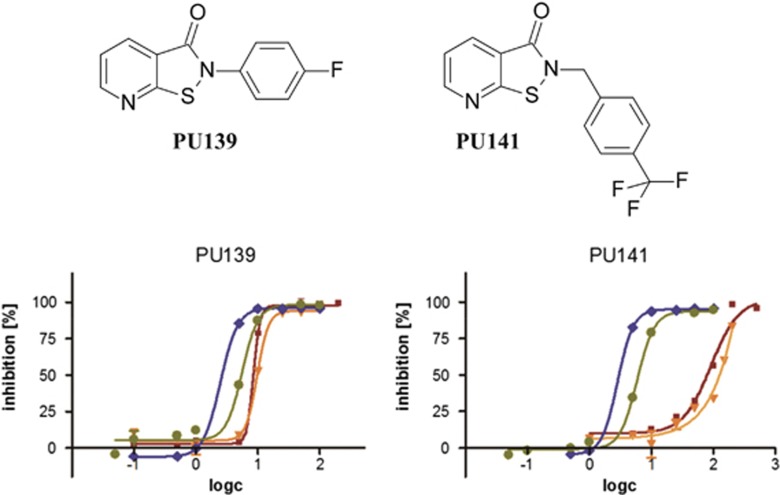
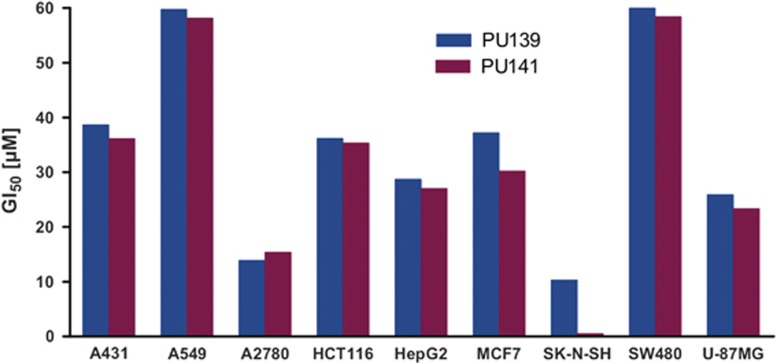
At micromolar concentrations, PU141 inhibits the growth of cells in -N-SH (neuroblastoma), SW480 (colon adenocarcinoma), U-87MG (epitheloid glioblastoma-astrocytoma), A431 (epidermoid carcinoma), A549 (alveolar basal epithelial adenocarcinoma), A2780 (ovarian cancer), HCT116 (epithelial colon cancer), HepG2 (hepatocellular carcinoma), MCF7 (breast cancer), and SK at micromolar concentrations [1]. Growth inhibition and histone hypoacetylation are caused in vitro by PU141. When HDAC and HAT inhibitors were co-treated, PU141 (25 µM) reduced the hyperacetylation of H3K14 and H4K8, but the acetylation levels of H3K9 and H4K16 remained constant. In SK-N-SH and HCT116 cells, the effect on histone acetylation is comparable [1].
In vitro, PU141 inhibits the growth of a variety of cancer cell lines at micromolar concentrations. These include SK-N-SH (neuroblastoma), SW480 (colon adenocarcinoma), U-87MG (glioblastoma), A431 (epidermoid carcinoma), A549 (lung adenocarcinoma), A2780 (ovarian cancer), HCT116 (colon cancer), HepG2 (hepatocellular carcinoma), and MCF7 (breast cancer). The highest antiproliferative activity was observed in the neuroblastoma SK-N-SH cell line. PU141 (25 µM) also reduces the hyperacetylation of H3K14 and H4K8 induced by HDAC inhibitors, while the acetylation levels of H3K9 and H4K16 remain constant. |
| ln Vivo |
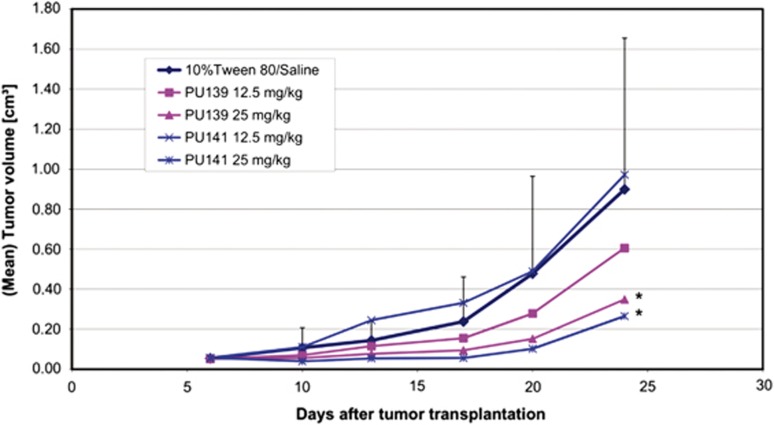
PU141 (25 mg/kg; intraperitoneally injected once for 24 days) exhibits significant antitumor effects on neuroblastoma xenografts in vivo [1].
In vivo, PU141 exhibits significant antitumor effects on neuroblastoma xenografts. In male NMRI:nu/nu nude mice carrying xenograft models, intraperitoneal administration of PU141 at 25 mg/kg once daily for 24 days dramatically diminished tumor volume by 19%. |
| Enzyme Assay |
The in vitro activity of PU141 is assessed using cell-free HAT enzyme activity assays. The specific HAT enzymes (CBP and p300) are incubated with a histone substrate and acetyl-CoA in the presence of varying concentrations of PU141. The inhibition of acetylation is measured to determine the compound's potency and selectivity.
|
| Cell Assay |
Cell viability assay[1]
Cell Types: A431 (epidermoid carcinoma), A549 (alveolar basal epithelial adenocarcinoma), A2780 (ovarian cancer), HCT116 (epithelial colon cancer), HepG2 (hepatocellular carcinoma), MCF7 (breast cancer) ), SK-N-SH (neuroblastoma), SW480 (colon adenocarcinoma) and U-87MG (epithelioid glioblastoma-astrocytoma) Tested Concentrations: 0, 10, 20, 30, 40, Incubation times of 50 and 60 µM: Experimental Results: Inhibition of cell growth at micromolar concentrations in all screened cell lines. The highest cellular antiproliferative activity was detected in the neuroblastoma SK-N-SH cell line. Western Blot Analysis[1] Cell Types: SK-N-SH neuroblastoma and HCT116 colon cancer cells Tested Concentrations: 25 µM Incubation Duration: 3 hrs (hours) Experimental Results: Result in diminished SAHA-induced H3K14 and H4K8 hyperacetylation. For cellular assays, a panel of cancer cell lines is used. Cells are cultured in appropriate media and treated with various concentrations of PU141 (0, 10, 20, 30, 40, 50, and 60 µM). Cell viability is assessed using standard assays. The effect on histone acetylation is analyzed by Western blotting using acetylation-specific antibodies. |
| Animal Protocol |
Animal/Disease Models: Male NMRI: nu/nu (nude) mice carrying xenograft model [1]
Doses: 12.5 and 25 mg/kg Route of Administration: One intraperitonealadministration as a cleanser containing saline microemulsion; continued for 24 Day Experimental Results: Tumor volume was Dramatically diminished (19%) at the 25 mg/kg dose. In vivo, PU141 is administered intraperitoneally to nude mice bearing neuroblastoma xenografts. The compound is formulated as a cleanser containing saline microemulsion and administered at doses of 12.5 and 25 mg/kg once daily for 24 days. Tumor volume is measured over time to assess antitumor efficacy. |
| ADME/Pharmacokinetics |
PU141 has a molecular weight of 310.29 g/mol and a molecular formula of C14H9F3N2OS. Its IUPAC name is 2-[[4-(Trifluoromethyl)phenyl]methyl]isothiazolo[5,4-b]pyridin-3(2H)-one. The compound should be stored under recommended conditions as specified in the Certificate of Analysis.
|
| Toxicity/Toxicokinetics |
Specific toxicity data for PU141 is not detailed in the provided search results. In vitro studies have shown that it inhibits the growth of various cancer cell lines, indicating its potential as an anticancer agent. Comprehensive toxicological studies are required to establish its full safety profile.
|
| References | |
| Additional Infomation |
PU141 is a research compound used to study the specific roles of CBP and p300 in gene regulation and cancer. Its selectivity for CBP and p300 over other HATs makes it a valuable tool for dissecting the functions of these enzymes. It is not approved for clinical use and is intended for research purposes only.
|
| Molecular Formula |
C14H9F3N2OS
|
|---|---|
| Molecular Weight |
310.294272184372
|
| Exact Mass |
310.038
|
| CAS # |
168334-34-7
|
| PubChem CID |
53257845
|
| Appearance |
White to off-white solid powder
|
| LogP |
3.1
|
| Hydrogen Bond Donor Count |
0
|
| Hydrogen Bond Acceptor Count |
6
|
| Rotatable Bond Count |
2
|
| Heavy Atom Count |
21
|
| Complexity |
396
|
| Defined Atom Stereocenter Count |
0
|
| SMILES |
S1C2C(=CC=CN=2)C(N1CC1C=CC(C(F)(F)F)=CC=1)=O
|
| InChi Key |
UQVNCGIZTSUQOC-UHFFFAOYSA-N
|
| InChi Code |
InChI=1S/C14H9F3N2OS/c15-14(16,17)10-5-3-9(4-6-10)8-19-13(20)11-2-1-7-18-12(11)21-19/h1-7H,8H2
|
| Chemical Name |
2-[[4-(trifluoromethyl)phenyl]methyl]-[1,2]thiazolo[5,4-b]pyridin-3-one
|
| Synonyms |
PU141; PU-141; PU 141
|
| HS Tariff Code |
2934.99.9001
|
| Storage |
Powder -20°C 3 years 4°C 2 years In solvent -80°C 6 months -20°C 1 month |
| Shipping Condition |
Room temperature (This product is stable at ambient temperature for a few days during ordinary shipping and time spent in Customs)
|
| Solubility (In Vitro) |
DMSO: ~100 mg/mL (~322.3 mM; with ultrasonication and warming by heating to 80°C)
|
|---|---|
| Solubility (In Vivo) |
Solubility in Formulation 1: 5 mg/mL (16.11 mM) in 10% DMSO + 40% PEG300 + 5% Tween-80 + 45% Saline (add these co-solvents sequentially from left to right, and one by one), Clear solution; with ultrasonication and warming and heat to 80°C.
For example, if 1 mL of working solution is to be prepared, you can add 100 μL of DMSO stock solution (50.0 mg/mL) to 400 μL of PEG300 and mix well; then add 50 μL of Tween-80 and mix well; finally add 450 μL of physiological saline and adjust the volume to 1 mL. Preparation of saline: Dissolve 0.9 g of sodium chloride in 100 mL ddH₂ O to obtain a clear solution. Solubility in Formulation 2: 5 mg/mL (16.11 mM) in 10% DMSO + 90% Corn Oil (add these co-solvents sequentially from left to right, and one by one), Clear solution; with ultrasonication. For example, if 1 mL of working solution is to be prepared, you can add 100 μL of DMSO stock solution (50.0 mg/mL) to 900 μL of corn oil and mix well. (Please use freshly prepared in vivo formulations for optimal results.) |
| Preparing Stock Solutions | 1 mg | 5 mg | 10 mg | |
| 1 mM | 3.2228 mL | 16.1140 mL | 32.2279 mL | |
| 5 mM | 0.6446 mL | 3.2228 mL | 6.4456 mL | |
| 10 mM | 0.3223 mL | 1.6114 mL | 3.2228 mL |
*Note: Please select an appropriate solvent for the preparation of stock solution based on your experiment needs. For most products, DMSO can be used for preparing stock solutions (e.g. 5 mM, 10 mM, or 20 mM concentration); some products with high aqueous solubility may be dissolved in water directly. Solubility information is available at the above Solubility Data section. Once the stock solution is prepared, aliquot it to routine usage volumes and store at -20°C or -80°C. Avoid repeated freeze and thaw cycles.
Calculation results
Working concentration: mg/mL;
Method for preparing DMSO stock solution: mg drug pre-dissolved in μL DMSO (stock solution concentration mg/mL). Please contact us first if the concentration exceeds the DMSO solubility of the batch of drug.
Method for preparing in vivo formulation::Take μL DMSO stock solution, next add μL PEG300, mix and clarify, next addμL Tween 80, mix and clarify, next add μL ddH2O,mix and clarify.
(1) Please be sure that the solution is clear before the addition of next solvent. Dissolution methods like vortex, ultrasound or warming and heat may be used to aid dissolving.
(2) Be sure to add the solvent(s) in order.
|
|
|
Products are for research use only; We do not sell to patients
Copyright 2020 InvivoChem LLC | All Rights Reserved