
| Size | Price | Stock | Qty |
|---|---|---|---|
| 500mg |
|
||
| 1g |
|
||
| 5g |
|
||
| 10g |
|
| Targets |
Endogenous Metabolite; NAD⁺ serves as a substrate for three distinct families of NAD⁺-consuming enzymes:Poly(ADP-ribose) polymerases (PARPs): Hydrolyze NAD⁺ and transfer the ADP-ribose moiety to acceptor amino acids, involved in DNA damage repairADP-ribosyl cyclases (CD38/CD157): Catalyze the cyclization of NAD⁺ to cyclic ADP ribose (cADPR), acting as intracellular calcium-mobilizing agentsSirtuins (SIRT1-7): NAD⁺-dependent deacylases playing key roles in transcription, DNA repair, metabolism, and oxidative stress resistance
NAD Trihydrate targets metabolic enzymes, particularly dehydrogenases. As a coenzyme, it is not a drug with a specific receptor target but rather an essential cofactor for numerous enzymatic reactions involved in cellular metabolism. NAD acts as an electron carrier in redox reactions, being reduced to NADH. |
|---|---|
| ln Vitro |
NAD+ is a coenzyme made up of pyrophosphate bonds connecting adenosine 5'-phosphate and ribosyl nicotinamide 5'-diphosphate. The oxidized form of NADH is called NAD+ [1]. Widespread throughout nature, NAD+ serves as an electron carrier in numerous enzymatic activities by alternating between oxidation (NAD+) and reduction (Nadide) [2].
In vitro studies demonstrate that NAD⁺ acts as a coenzyme serving as an electron carrier in numerous enzymatic reactions by alternating between its oxidized (NAD⁺) and reduced (Nadide) forms. The interaction between NAD⁺-consuming enzymes (such as PARPs, CD38, and sirtuins) and NAD⁺ metabolism can be studied in detail in vitro. NAD⁺-dependent deacetylation activity of sirtuins requires NAD⁺ as a co-substrate. In vitro, NAD is used as a coenzyme in various biochemical assays, including enzymatic reactions and cell-based metabolism studies. It is an essential component for the activity of many dehydrogenases. The compound's role as an electron acceptor makes it critical for studying cellular respiration and metabolic pathways. |
| ln Vivo |
Oral NAD+ supplements have been utilized to treat energy-draining, unexplained diseases like fibromyalgia and chronic fatigue syndrome, as well as simple weariness [3].
Enhancing NAD⁺ availability confers protective effects in multiple models of neurodegeneration and age-related diseases, mediated by increased endogenous sirtuin activity. Oral NAD⁺ supplements have been used to treat energy-draining, unexplained conditions such as chronic fatigue syndrome and fibromyalgia. In kidney disorders, augmentation with NAD⁺ improves Sirt1 deacetylase activity and activates PARP1 for DNA repair. In vivo, NAD is an endogenous metabolite present in all living cells. It is essential for cellular energy metabolism and redox balance. NAD levels decline with age and are associated with various metabolic and age-related diseases. The compound's role as a coenzyme is fundamental to life. |
| Enzyme Assay |
Redox Titrations Using NADH and NAD+. [3]
NADH was repurified in a glovebox (O2 < 2 ppm) by anion exchange chromatography (5-ml HiTrap Q-Sepharose column) to remove contaminating NAD+. After experimentation, the integrity of the NADH stock solution was reevaluated (0.08 ± 0.04% NAD+ formed in 6 h). Typically, redox potentials were set by using 30 μM NADH and a varying amount of NAD+ (Sigma), and the low potential limit was checked by using the NADH regenerating system. EPR.[3] Complex I (10 mg ml−1) was reduced anaerobically by 1 mM purified NADH or by dialysis against purified NADH (≈−0.4 V) or to ≈−0.3 V by using 1 mM NADH and 10 mM NAD+, and frozen immediately. Spectra were recorded on a Bruker EMX X-band spectrometer by using an ER 4119HS high-sensitivity cavity and a ESR900 continuous-flow liquid helium cryostat [3]. Redox Titrations Using NADH and NAD⁺: NADH is repurified in a glovebox (O₂ < 2 ppm) by anion exchange chromatography (5-ml HiTrap Q-Sepharose column) to remove contaminating NAD⁺. Typically, redox potentials are set using 30 μM NADH and varying amounts of NAD⁺ (Sigma), and the low potential limit is checked using an NADH regenerating system. Electron Paramagnetic Resonance (EPR): Complex I (10 mg ml⁻¹) is reduced anaerobically by 1 mM purified NADH or by dialysis against purified NADH (approximately −0.4 V) or to approximately −0.3 V using 1 mM NADH and 10 mM NAD⁺, and frozen immediately. Spectra are recorded on a Bruker EMX X-band spectrometer using an ER 4119HS high-sensitivity cavity and an ESR900 continuous-flow liquid helium cryostat. In vitro enzyme assays for NAD Trihydrate typically involve measuring the activity of NAD-dependent dehydrogenases. The conversion of NAD to NADH is monitored spectrophotometrically at 340 nm. These assays are used to study enzyme kinetics and to screen for modulators of NAD-dependent enzymes. |
| Cell Assay |
Cell culture-tested NAD⁺ is suitable for mammalian cell culture applications. Its applications in in vitro cell systems include studying NAD⁺-dependent metabolic pathways, cell viability assessment, and functional analysis of NAD⁺-consuming enzymes. Specific experimental parameters (such as concentration and treatment duration) are assay-dependent.
In vitro cellular assays for NAD Trihydrate involve treating cells with the compound to assess its effects on cellular metabolism. NAD levels can be measured in cell lysates using enzymatic cycling assays. The compound's role in supporting cellular respiration and energy production is studied in various cell culture models. |
| Animal Protocol |
In vivo animal models can be used for oral administration of NAD⁺ supplements to study pharmacodynamic effects. In kidney injury models, NAD⁺ augmentation strategies have been employed to evaluate effects on Sirt1 activity and PARP1-mediated DNA repair.
In vivo animal studies for NAD Trihydrate typically involve administration of NAD precursors (such as nicotinamide riboside or NMN) rather than NAD itself, due to poor cellular uptake of the intact molecule. However, studies have investigated the effects of NAD supplementation on metabolism, aging, and disease in animal models. |
| ADME/Pharmacokinetics |
Pharmacokinetic data for NAD Trihydrate are limited, as the compound is an endogenous metabolite. When administered exogenously, NAD is rapidly metabolized and has poor bioavailability. NAD precursors are often used instead to boost intracellular NAD levels. The compound's half-life in circulation is short.
|
| Toxicity/Toxicokinetics |
NAD Trihydrate is an endogenous metabolite and is generally considered safe. As a naturally occurring compound, it is not associated with significant toxicity. However, high doses may cause adverse effects. The compound is not a drug but a dietary supplement and research reagent.
|
| References |
|
| Additional Infomation |
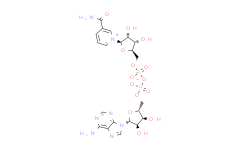
NAD zwitterion is a type of NAD. It has anti-aging effects. Its function is related to the deamidated NAD zwitterion. It is the conjugate base of NAD(+). It is a coenzyme formed by the coupling of ribosylnicotinamide 5'-bisphosphate to adenosine 5'-phosphate via a pyrophosphate bond. It is widely distributed in nature and participates in various enzymatic reactions in which it acts as an electron carrier through alternating oxidation (NAD+) and reduction (NADH). (Dorland, 27th edition) There are reports and data regarding the existence of NAD compounds (Nadide) in the human body. NAD compounds are dinucleotides composed of adenine and nicotinamide. They have coenzyme activity in redox reactions and can also act as donors of the ADP-ribose moiety. It is a coenzyme formed by the coupling of ribosylnicotinamide 5'-bisphosphate to adenosine 5'-phosphate via a pyrophosphate bond. It is widely found in nature and participates in a variety of enzymatic reactions in which it acts as an electron carrier through alternating oxidation (NAD+) and reduction (NADH). (Dorland, 27th edition)
NAD Trihydrate is a naturally occurring coenzyme used in research and as a dietary supplement. It plays an essential role in cellular metabolism and energy production. The compound is also used in various biochemical assays as a cofactor for dehydrogenases. It is not approved as a drug but is available as a research reagent and supplement. |
| Molecular Formula |
C21H27N7O14P2
|
|---|---|
| Molecular Weight |
663.43
|
| Exact Mass |
663.109
|
| CAS # |
53-84-9
|
| Related CAS # |
α-NAD; 7298-93-3; NAD+-13C5 ammonium; NAD+-d4; NAD sodium; 20111-18-6; NAD+ lithium; 64417-72-7; NAD+ (GMP Like); 53-84-9
|
| PubChem CID |
5892
|
| Appearance |
White to off-white solid powder
|
| Melting Point |
140.0 - 142.0 °C
|
| Source |
Endogenously produced metabolite: Human Gut Microbiota Metabolites
Originated from microorganisms |
| LogP |
-5.72
|
| Hydrogen Bond Donor Count |
7
|
| Hydrogen Bond Acceptor Count |
18
|
| Rotatable Bond Count |
11
|
| Heavy Atom Count |
44
|
| Complexity |
1120
|
| Defined Atom Stereocenter Count |
8
|
| SMILES |
P(=O)(O[H])(OP(=O)([O-])OC([H])([H])[C@]1([H])[C@]([H])([C@]([H])([C@]([H])([N+]2=C([H])C([H])=C([H])C(C(N([H])[H])=O)=C2[H])O1)O[H])O[H])OC([H])([H])[C@]1([H])[C@]([H])([C@]([H])([C@]([H])(N2C([H])=NC3=C(N([H])[H])N=C([H])N=C23)O1)O[H])O[H]
|
| InChi Key |
BAWFJGJZGIEFAR-NNYOXOHSSA-N
|
| InChi Code |
InChI=1S/C21H27N7O14P2/c22-17-12-19(25-7-24-17)28(8-26-12)21-16(32)14(30)11(41-21)6-39-44(36,37)42-43(34,35)38-5-10-13(29)15(31)20(40-10)27-3-1-2-9(4-27)18(23)33/h1-4,7-8,10-11,13-16,20-21,29-32H,5-6H2,(H5-,22,23,24,25,33,34,35,36,37)/t10-,11-,13-,14-,15-,16-,20-,21-/m1/s1
|
| Chemical Name |
[[(2R,3S,4R,5R)-5-(6-aminopurin-9-yl)-3,4-dihydroxyoxolan-2-yl]methoxy-hydroxyphosphoryl] [(2R,3S,4R,5R)-5-(3-carbamoylpyridin-1-ium-1-yl)-3,4-dihydroxyoxolan-2-yl]methyl phosphate
|
| Synonyms |
nadide; 53-84-9; coenzyme I; beta-NAD; ...; NAD trihydrate;
|
| HS Tariff Code |
2934.99.9001
|
| Storage |
Powder -20°C 3 years 4°C 2 years In solvent -80°C 6 months -20°C 1 month |
| Shipping Condition |
Room temperature (This product is stable at ambient temperature for a few days during ordinary shipping and time spent in Customs)
|
| Solubility (In Vitro) |
H2O: ~50 mg/mL (~75.4 mM; with ultrasonication)
H2O: ~35 mg/mL (~52.8 mM; with ultrasonication) |
|---|---|
| Solubility (In Vivo) |
Solubility in Formulation 1: 100 mg/mL (150.73 mM) in PBS (add these co-solvents sequentially from left to right, and one by one), Clear solution; with ultrasonication and warming and heat to 60°C.
(Please use freshly prepared in vivo formulations for optimal results.) |
| Preparing Stock Solutions | 1 mg | 5 mg | 10 mg | |
| 1 mM | 1.5073 mL | 7.5366 mL | 15.0732 mL | |
| 5 mM | 0.3015 mL | 1.5073 mL | 3.0146 mL | |
| 10 mM | 0.1507 mL | 0.7537 mL | 1.5073 mL |
*Note: Please select an appropriate solvent for the preparation of stock solution based on your experiment needs. For most products, DMSO can be used for preparing stock solutions (e.g. 5 mM, 10 mM, or 20 mM concentration); some products with high aqueous solubility may be dissolved in water directly. Solubility information is available at the above Solubility Data section. Once the stock solution is prepared, aliquot it to routine usage volumes and store at -20°C or -80°C. Avoid repeated freeze and thaw cycles.
Calculation results
Working concentration: mg/mL;
Method for preparing DMSO stock solution: mg drug pre-dissolved in μL DMSO (stock solution concentration mg/mL). Please contact us first if the concentration exceeds the DMSO solubility of the batch of drug.
Method for preparing in vivo formulation::Take μL DMSO stock solution, next add μL PEG300, mix and clarify, next addμL Tween 80, mix and clarify, next add μL ddH2O,mix and clarify.
(1) Please be sure that the solution is clear before the addition of next solvent. Dissolution methods like vortex, ultrasound or warming and heat may be used to aid dissolving.
(2) Be sure to add the solvent(s) in order.
Products are for research use only; We do not sell to patients
Copyright 2020 InvivoChem LLC | All Rights Reserved


