
| Size | Price | Stock | Qty |
|---|---|---|---|
| 50mg |
|
||
| 100mg |
|
||
| Other Sizes |


| Targets |
Glycosidase Cleavable Linker Cleavable Linker
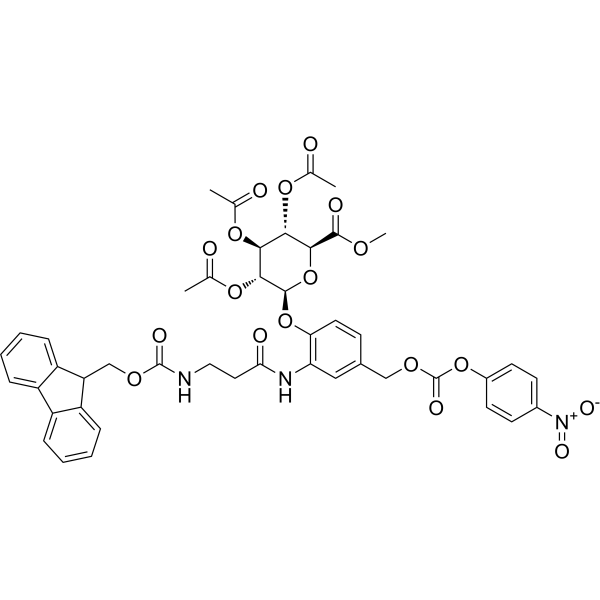
β-D-glucuronide-pNP-carbonate serves as a substrate for β-glucuronidase enzymes, which hydrolyze the glycosidic bond to release pNP-carbonate, subsequently generating p-nitrophenol. As an ADC linker, it is cleavable by β-glucuronidase, an enzyme that is often overexpressed in the tumor microenvironment, enabling targeted drug release. The para-nitrophenyl carbonate provides a reactive handle for conjugation. |
|---|---|
| ln Vitro |
ADCs are comprised of an antibody to which is attached an ADC cytotoxin through an ADC linker[1].
In vitro, β-D-glucuronide-pNP-carbonate is used as a substrate to measure β-glucuronidase activity. Upon enzymatic cleavage, the released p-nitrophenol exhibits a characteristic yellow color under alkaline conditions with an absorbance maximum at approximately 405 nm, allowing for convenient spectrophotometric quantification of enzyme activity. |
| ln Vivo |
In vivo activity data for β-D-glucuronide-pNP-carbonate as a therapeutic agent are limited. As an ADC linker, its in vivo activity would be dependent on the specific antibody and payload conjugated to it. The linker is designed to be cleaved by β-glucuronidase in the tumor microenvironment, releasing the cytotoxic payload specifically at the tumor site.
|
| Enzyme Assay |
For non-cellular in vitro enzyme assays, β-D-glucuronide-pNP-carbonate is incubated with purified β-glucuronidase enzyme in appropriate buffer conditions. The reaction is monitored by measuring the increase in absorbance at 405 nm as p-nitrophenol is released upon enzymatic cleavage of the glycosidic bond. Kinetic parameters such as Km and Vmax can be determined.
|
| Cell Assay |
For in vitro cellular assays, β-D-glucuronide-pNP-carbonate can be used to study β-glucuronidase activity in cell lysates or to evaluate ADC internalization and payload release in cancer cell lines expressing β-glucuronidase. Cells are treated with the compound or ADC construct, and the release of p-nitrophenol or the cytotoxic payload is measured.
|
| Animal Protocol |
In vivo animal studies for β-D-glucuronide-pNP-carbonate as a standalone compound are limited. When used as part of an ADC, in vivo efficacy studies involve administration to tumor-bearing mouse models, where tumor growth inhibition, survival, and biodistribution are assessed to evaluate the therapeutic potential of the ADC construct.
|
| ADME/Pharmacokinetics |
Pharmacokinetic data for β-D-glucuronide-pNP-carbonate are primarily relevant in the context of ADC development. The linker is designed to be stable in circulation and cleaved specifically by β-glucuronidase in the tumor microenvironment. Its hydrophilic glucuronide moiety improves aqueous solubility and reduces aggregation of the ADC.
|
| Toxicity/Toxicokinetics |
Toxicological data for β-D-glucuronide-pNP-carbonate are limited. As an ADC linker, its toxicity profile is determined by the overall ADC construct. The linker itself is designed to be non-toxic and cleavable specifically by β-glucuronidase, an enzyme with limited activity in normal tissues, thereby minimizing off-target toxicity.
|
| References | |
| Additional Infomation |
β-D-glucuronide-pNP-carbonate is a cleavable ADC linker that contains a para-nitrophenyl carbonate reactive handle and a β-D-glucuronide cleavable trigger. It is used in the synthesis of antibody-drug conjugates (ADCs) and as a substrate for β-glucuronidase in enzyme studies. The compound has a molecular weight of 913.83 and a molecular formula of C₄₅H₄₃N₃O₁₈.
|
| Molecular Formula |
C45H43N3O18
|
|---|---|
| Molecular Weight |
913.8322
|
| Exact Mass |
913.254
|
| CAS # |
894095-98-8
|
| PubChem CID |
59816534
|
| Appearance |
White to off-white solid powder
|
| LogP |
4.9
|
| Hydrogen Bond Donor Count |
2
|
| Hydrogen Bond Acceptor Count |
18
|
| Rotatable Bond Count |
22
|
| Heavy Atom Count |
66
|
| Complexity |
1710
|
| Defined Atom Stereocenter Count |
5
|
| SMILES |
O1[C@]([H])([C@@]([H])([C@]([H])([C@@]([H])([C@@]1([H])C(=O)OC([H])([H])[H])OC(C([H])([H])[H])=O)OC(C([H])([H])[H])=O)OC(C([H])([H])[H])=O)OC1C([H])=C([H])C(C([H])([H])OC(=O)OC2C([H])=C([H])C(=C([H])C=2[H])[N+](=O)[O-])=C([H])C=1N([H])C(C([H])([H])C([H])([H])N([H])C(=O)OC([H])([H])C1([H])C2=C([H])C([H])=C([H])C([H])=C2C2=C([H])C([H])=C([H])C([H])=C12)=O
|
| InChi Key |
DMGQNZOORDYDEZ-LELKPENRSA-N
|
| InChi Code |
InChI=1S/C45H43N3O18/c1-24(49)61-38-39(62-25(2)50)41(63-26(3)51)43(66-40(38)42(53)58-4)65-36-18-13-27(22-60-45(55)64-29-16-14-28(15-17-29)48(56)57)21-35(36)47-37(52)19-20-46-44(54)59-23-34-32-11-7-5-9-30(32)31-10-6-8-12-33(31)34/h5-18,21,34,38-41,43H,19-20,22-23H2,1-4H3,(H,46,54)(H,47,52)/t38-,39-,40-,41+,43+/m0/s1
|
| Chemical Name |
methyl (2S,3S,4S,5R,6S)-3,4,5-triacetyloxy-6-[2-[3-(9H-fluoren-9-ylmethoxycarbonylamino)propanoylamino]-4-[(4-nitrophenoxy)carbonyloxymethyl]phenoxy]oxane-2-carboxylate
|
| HS Tariff Code |
2934.99.9001
|
| Storage |
Powder -20°C 3 years 4°C 2 years In solvent -80°C 6 months -20°C 1 month Note: Please store this product in a sealed and protected environment, avoid exposure to moisture. |
| Shipping Condition |
Room temperature (This product is stable at ambient temperature for a few days during ordinary shipping and time spent in Customs)
|
| Solubility (In Vitro) |
DMSO: 250 mg/mL (273.57 mM)
|
|---|---|
| Solubility (In Vivo) |
Note: Listed below are some common formulations that may be used to formulate products with low water solubility (e.g. < 1 mg/mL), you may test these formulations using a minute amount of products to avoid loss of samples.
Injection Formulations
Injection Formulation 1: DMSO : Tween 80: Saline = 10 : 5 : 85 (i.e. 100 μL DMSO stock solution → 50 μL Tween 80 → 850 μL Saline)(e.g. IP/IV/IM/SC) *Preparation of saline: Dissolve 0.9 g of sodium chloride in 100 mL ddH ₂ O to obtain a clear solution. Injection Formulation 2: DMSO : PEG300 :Tween 80 : Saline = 10 : 40 : 5 : 45 (i.e. 100 μL DMSO → 400 μLPEG300 → 50 μL Tween 80 → 450 μL Saline) Injection Formulation 3: DMSO : Corn oil = 10 : 90 (i.e. 100 μL DMSO → 900 μL Corn oil) Example: Take the Injection Formulation 3 (DMSO : Corn oil = 10 : 90) as an example, if 1 mL of 2.5 mg/mL working solution is to be prepared, you can take 100 μL 25 mg/mL DMSO stock solution and add to 900 μL corn oil, mix well to obtain a clear or suspension solution (2.5 mg/mL, ready for use in animals). View More
Injection Formulation 4: DMSO : 20% SBE-β-CD in saline = 10 : 90 [i.e. 100 μL DMSO → 900 μL (20% SBE-β-CD in saline)] Oral Formulations
Oral Formulation 1: Suspend in 0.5% CMC Na (carboxymethylcellulose sodium) Oral Formulation 2: Suspend in 0.5% Carboxymethyl cellulose Example: Take the Oral Formulation 1 (Suspend in 0.5% CMC Na) as an example, if 100 mL of 2.5 mg/mL working solution is to be prepared, you can first prepare 0.5% CMC Na solution by measuring 0.5 g CMC Na and dissolve it in 100 mL ddH2O to obtain a clear solution; then add 250 mg of the product to 100 mL 0.5% CMC Na solution, to make the suspension solution (2.5 mg/mL, ready for use in animals). View More
Oral Formulation 3: Dissolved in PEG400 (Please use freshly prepared in vivo formulations for optimal results.) |
| Preparing Stock Solutions | 1 mg | 5 mg | 10 mg | |
| 1 mM | 1.0943 mL | 5.4715 mL | 10.9430 mL | |
| 5 mM | 0.2189 mL | 1.0943 mL | 2.1886 mL | |
| 10 mM | 0.1094 mL | 0.5471 mL | 1.0943 mL |
*Note: Please select an appropriate solvent for the preparation of stock solution based on your experiment needs. For most products, DMSO can be used for preparing stock solutions (e.g. 5 mM, 10 mM, or 20 mM concentration); some products with high aqueous solubility may be dissolved in water directly. Solubility information is available at the above Solubility Data section. Once the stock solution is prepared, aliquot it to routine usage volumes and store at -20°C or -80°C. Avoid repeated freeze and thaw cycles.
Calculation results
Working concentration: mg/mL;
Method for preparing DMSO stock solution: mg drug pre-dissolved in μL DMSO (stock solution concentration mg/mL). Please contact us first if the concentration exceeds the DMSO solubility of the batch of drug.
Method for preparing in vivo formulation::Take μL DMSO stock solution, next add μL PEG300, mix and clarify, next addμL Tween 80, mix and clarify, next add μL ddH2O,mix and clarify.
(1) Please be sure that the solution is clear before the addition of next solvent. Dissolution methods like vortex, ultrasound or warming and heat may be used to aid dissolving.
(2) Be sure to add the solvent(s) in order.
Products are for research use only; We do not sell to patients
Copyright 2020 InvivoChem LLC | All Rights Reserved


