
| Size | Price | Stock | Qty |
|---|---|---|---|
| 25g |
|
||
| 50g |
|
||
| 100g |
|
||
| Other Sizes |


| Targets |
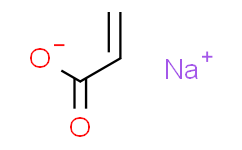
Sodium acrylate does not target a specific receptor or enzyme as a therapeutic agent. Instead, it is an industrial chemical used primarily as a monomer for polymerization. Sodium acrylate polymerizes to form poly(sodium acrylate), a superabsorbent polymer that can absorb many times its weight in water. The compound's effects are physical (water absorption and thickening) rather than pharmacological. It is also used as an antibacterial agent in some applications.
|
|---|---|
| ln Vitro |
In vitro activity of sodium acrylate is assessed by its polymerization behavior and physical properties rather than biological activity. The compound's ability to polymerize under various conditions (bulk, solution, emulsion, suspension) is evaluated. The resulting poly(sodium acrylate) is characterized by its water absorption capacity, swelling ratio, and mechanical properties. The compound's antibacterial properties have been noted, though this is not its primary application.
|
| ln Vivo |
In vivo activity of sodium acrylate has not been characterized as a pharmacological agent, as it is an industrial chemical. The compound is not intended for therapeutic use. Its safety in consumer products is assessed through toxicological studies of the polymer and residual monomer. No pharmacological effects have been reported.
|
| Enzyme Assay |
In vitro enzyme/receptor binding assays are not applicable to sodium acrylate, as it is an industrial chemical and monomer rather than a pharmacological tool. However, biochemical assays may assess its effects on enzymatic activity if relevant. The compound's reactivity with nucleophiles may be studied in the context of its polymerization chemistry.
|
| Cell Assay |
In vitro cellular assays for sodium acrylate are performed to assess cytotoxicity and irritation potential for safety evaluation. Cell lines are exposed to varying concentrations of sodium acrylate, and cell viability is measured by MTT or other assays. The compound may cause irritation to skin, eyes, and the respiratory system. These assays are used for safety assessment of consumer products containing poly(sodium acrylate).
|
| Animal Protocol |
In vivo animal studies with sodium acrylate are conducted for toxicological safety assessment. Acute toxicity studies determine the LD₅₀ in rodents. Dermal and ocular irritation studies assess the compound's potential to cause irritation. Repeated-dose toxicity studies evaluate effects of chronic exposure. The compound is classified as an irritant. These studies support the safe use of sodium acrylate in industrial and consumer applications.
|
| ADME/Pharmacokinetics |
Pharmacokinetic properties of sodium acrylate are not extensively characterized, as it is an industrial chemical rather than a drug. When ingested, the compound may be absorbed to some extent but is primarily metabolized and excreted. The polymerized form (poly(sodium acrylate)) is not absorbed due to its large molecular size. The compound is water-soluble, which facilitates its elimination. Specific PK data are limited.
|
| Toxicity/Toxicokinetics |
Sodium acrylate has low acute toxicity but is an irritant to eyes, skin, and the respiratory system. The compound is classified as a skin irritant (R36/37/38). It is also classified as hazardous to the aquatic environment (Aquatic Acute 1). In case of contact with eyes, rinse immediately with plenty of water and seek medical advice. The compound should be handled with appropriate personal protective equipment.
|
| Additional Infomation |
See other relationships...
The compound is used in the production of superabsorbent polymers for hygiene products, as a flocculating agent in water treatment, as an emulsion stabilizer in cosmetics, and in adhesives and polymers. It is not a therapeutic agent and has no clinical development or regulatory approvals as a drug. Its use is restricted to industrial and consumer product applications. |
| Molecular Formula |
C3H3NAO2
|
|---|---|
| Molecular Weight |
94.04
|
| Exact Mass |
94.003
|
| CAS # |
7446-81-3
|
| Related CAS # |
79-10-7 (Parent)
|
| PubChem CID |
4068533
|
| Appearance |
Typically exists as solids at room temperature
|
| Melting Point |
>300 °C
|
| Hydrogen Bond Donor Count |
0
|
| Rotatable Bond Count |
1
|
| Heavy Atom Count |
6
|
| Complexity |
59.8
|
| Defined Atom Stereocenter Count |
0
|
| SMILES |
C=CC([O-])=O.[Na+]
|
| InChi Key |
NNMHYFLPFNGQFZ-UHFFFAOYSA-M
|
| InChi Code |
InChI=1S/C3H4O2.Na/c1-2-3(4)5;/h2H,1H2,(H,4,5);/q;+1/p-1
|
| Chemical Name |
sodium prop-2-enoate
|
| HS Tariff Code |
2934.99.9001
|
| Storage |
Powder -20°C 3 years 4°C 2 years In solvent -80°C 6 months -20°C 1 month |
| Shipping Condition |
Room temperature (This product is stable at ambient temperature for a few days during ordinary shipping and time spent in Customs)
|
| Solubility (In Vitro) |
May dissolve in DMSO (in most cases), if not, try other solvents such as H2O, Ethanol, or DMF with a minute amount of products to avoid loss of samples
|
|---|---|
| Solubility (In Vivo) |
Note: Listed below are some common formulations that may be used to formulate products with low water solubility (e.g. < 1 mg/mL), you may test these formulations using a minute amount of products to avoid loss of samples.
Injection Formulations
Injection Formulation 1: DMSO : Tween 80: Saline = 10 : 5 : 85 (i.e. 100 μL DMSO stock solution → 50 μL Tween 80 → 850 μL Saline)(e.g. IP/IV/IM/SC) *Preparation of saline: Dissolve 0.9 g of sodium chloride in 100 mL ddH ₂ O to obtain a clear solution. Injection Formulation 2: DMSO : PEG300 :Tween 80 : Saline = 10 : 40 : 5 : 45 (i.e. 100 μL DMSO → 400 μLPEG300 → 50 μL Tween 80 → 450 μL Saline) Injection Formulation 3: DMSO : Corn oil = 10 : 90 (i.e. 100 μL DMSO → 900 μL Corn oil) Example: Take the Injection Formulation 3 (DMSO : Corn oil = 10 : 90) as an example, if 1 mL of 2.5 mg/mL working solution is to be prepared, you can take 100 μL 25 mg/mL DMSO stock solution and add to 900 μL corn oil, mix well to obtain a clear or suspension solution (2.5 mg/mL, ready for use in animals). View More
Injection Formulation 4: DMSO : 20% SBE-β-CD in saline = 10 : 90 [i.e. 100 μL DMSO → 900 μL (20% SBE-β-CD in saline)] Oral Formulations
Oral Formulation 1: Suspend in 0.5% CMC Na (carboxymethylcellulose sodium) Oral Formulation 2: Suspend in 0.5% Carboxymethyl cellulose Example: Take the Oral Formulation 1 (Suspend in 0.5% CMC Na) as an example, if 100 mL of 2.5 mg/mL working solution is to be prepared, you can first prepare 0.5% CMC Na solution by measuring 0.5 g CMC Na and dissolve it in 100 mL ddH2O to obtain a clear solution; then add 250 mg of the product to 100 mL 0.5% CMC Na solution, to make the suspension solution (2.5 mg/mL, ready for use in animals). View More
Oral Formulation 3: Dissolved in PEG400 (Please use freshly prepared in vivo formulations for optimal results.) |
| Preparing Stock Solutions | 1 mg | 5 mg | 10 mg | |
| 1 mM | 10.6338 mL | 53.1689 mL | 106.3377 mL | |
| 5 mM | 2.1268 mL | 10.6338 mL | 21.2675 mL | |
| 10 mM | 1.0634 mL | 5.3169 mL | 10.6338 mL |
*Note: Please select an appropriate solvent for the preparation of stock solution based on your experiment needs. For most products, DMSO can be used for preparing stock solutions (e.g. 5 mM, 10 mM, or 20 mM concentration); some products with high aqueous solubility may be dissolved in water directly. Solubility information is available at the above Solubility Data section. Once the stock solution is prepared, aliquot it to routine usage volumes and store at -20°C or -80°C. Avoid repeated freeze and thaw cycles.
Calculation results
Working concentration: mg/mL;
Method for preparing DMSO stock solution: mg drug pre-dissolved in μL DMSO (stock solution concentration mg/mL). Please contact us first if the concentration exceeds the DMSO solubility of the batch of drug.
Method for preparing in vivo formulation::Take μL DMSO stock solution, next add μL PEG300, mix and clarify, next addμL Tween 80, mix and clarify, next add μL ddH2O,mix and clarify.
(1) Please be sure that the solution is clear before the addition of next solvent. Dissolution methods like vortex, ultrasound or warming and heat may be used to aid dissolving.
(2) Be sure to add the solvent(s) in order.
Products are for research use only; We do not sell to patients
Copyright 2020 InvivoChem LLC | All Rights Reserved


