
| Size | Price | Stock | Qty |
|---|---|---|---|
| 5mg |
|
||
| 10mg |
|
||
| 25mg |
|
||
| Other Sizes |


| Targets |
Tacrolimus Related Compound A does not represent a therapeutic target but is a process-related impurity or degradation product of tacrolimus. As an impurity, it must be controlled in pharmaceutical quality systems. The compound is structurally related to tacrolimus and may have some immunosuppressant activity, though it is not intended for therapeutic use. Its presence in tacrolimus drug products is regulated by pharmacopoeial specifications (USP).
|
|---|---|
| ln Vitro |
In vitro activity of Tacrolimus Related Compound A as a standalone compound is not extensively characterized, as it is an analytical impurity rather than a pharmacologically active drug substance. Based on its structural similarity to tacrolimus, it may exhibit some immunosuppressant activity, though the modifications likely reduce potency compared to the parent drug. The compound reduces peptidyl-prolyl isomerase activity. Its primary relevance is in analytical chemistry.
|
| ln Vivo |
In vivo activity of Tacrolimus Related Compound A has not been characterized, as it is an analytical impurity standard rather than a therapeutic agent. No pharmacological or toxicological studies of this impurity in animal models have been reported. As a related substance of tacrolimus, its systemic exposure in patients would be expected to be minimal due to strict quality control limits.
|
| Enzyme Assay |
In vitro enzyme/receptor binding assays for Tacrolimus Related Compound A are not typically performed, as the compound is used as an analytical reference standard. However, if such assays were conducted, they would likely employ assays for calcineurin inhibition or FKBP12 binding, similar to tacrolimus. Standard protocols would involve measuring the compound's ability to inhibit calcineurin phosphatase activity.
|
| Cell Assay |
In vitro cellular assays for Tacrolimus Related Compound A are not standardly performed, as the compound serves as an analytical reference material. If evaluated, cell-based assays using T-cell lines could measure the compound's ability to inhibit T-cell proliferation or IL-2 production. Such studies would help characterize the pharmacological profile of this impurity, though they are not required for its intended use.
|
| Animal Protocol |
In vivo animal studies with Tacrolimus Related Compound A are not performed, as the compound is not a therapeutic agent but rather an analytical reference standard. Animal studies would not be relevant for an impurity compound that is not intended for pharmacological development. The safety profile is managed through quality control limits.
|
| ADME/Pharmacokinetics |
Pharmacokinetic properties of Tacrolimus Related Compound A have not been studied, as it is an analytical impurity standard rather than a drug candidate. The parent drug tacrolimus is well-characterized: it is orally bioavailable, extensively metabolized in the liver, and has a half-life of approximately 8-12 hours. As a related substance, this impurity would be present at trace levels in tacrolimus products.
|
| Toxicity/Toxicokinetics |
Toxicological data for Tacrolimus Related Compound A are not publicly available, as it is an analytical impurity standard. In pharmaceutical quality control, the toxicological risk of impurities is assessed through the ICH M7 guideline framework. No specific toxicology studies of this impurity have been published. Its safety is managed through strict USP impurity limits.
|
| Additional Infomation |
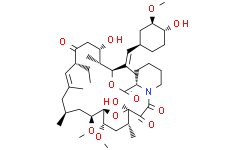
Tacrolimus Related Compound A is an analytical reference standard used for quality control of tacrolimus pharmaceutical products. It has the CAS number 135635-46-0 and is also known as Ascomycin Tacrolimus or Pimecrolimus 4-Hydroxy Analog. The compound reduces peptidyl-prolyl isomerase activity. It is not a therapeutic agent and its use is restricted to laboratory research and pharmaceutical quality control.
|
| Molecular Formula |
C43H69NO12
|
|---|---|
| Molecular Weight |
792.01
|
| CAS # |
135635-46-0
|
| Appearance |
Typically exists as solids at room temperature
|
| SMILES |
O1[C@]2(C(C(N3CCCC[C@H]3C(=O)O[C@H](/C(/C)=C/[C@@H]3CC[C@H]([C@@H](C3)OC)O)[C@H](C)[C@H](CC([C@H](CC)C=C(C)C[C@H](C)C[C@@H]([C@@H]1[C@H](C[C@H]2C)OC)OC)=O)O)=O)=O)O |c:36|
|
| Chemical Name |
(E)-17-ethyl-1,14-dihydroxy-12[(E)-2-(4-hydroxy-3-Methoxycyclohexyl)-1-Methylvinyl]-23,25-diMethoxy-13,19,21,27-tetraMethyl-11,28-dioxa-4-azatricyclo[22.3.1.0(super4,9)]octacos-18-ene-2,3,10,16-tetrone
|
| HS Tariff Code |
2934.99.9001
|
| Storage |
Powder -20°C 3 years 4°C 2 years In solvent -80°C 6 months -20°C 1 month |
| Shipping Condition |
Room temperature (This product is stable at ambient temperature for a few days during ordinary shipping and time spent in Customs)
|
| Solubility (In Vitro) |
May dissolve in DMSO (in most cases), if not, try other solvents such as H2O, Ethanol, or DMF with a minute amount of products to avoid loss of samples
|
|---|---|
| Solubility (In Vivo) |
Note: Listed below are some common formulations that may be used to formulate products with low water solubility (e.g. < 1 mg/mL), you may test these formulations using a minute amount of products to avoid loss of samples.
Injection Formulations
Injection Formulation 1: DMSO : Tween 80: Saline = 10 : 5 : 85 (i.e. 100 μL DMSO stock solution → 50 μL Tween 80 → 850 μL Saline)(e.g. IP/IV/IM/SC) *Preparation of saline: Dissolve 0.9 g of sodium chloride in 100 mL ddH ₂ O to obtain a clear solution. Injection Formulation 2: DMSO : PEG300 :Tween 80 : Saline = 10 : 40 : 5 : 45 (i.e. 100 μL DMSO → 400 μLPEG300 → 50 μL Tween 80 → 450 μL Saline) Injection Formulation 3: DMSO : Corn oil = 10 : 90 (i.e. 100 μL DMSO → 900 μL Corn oil) Example: Take the Injection Formulation 3 (DMSO : Corn oil = 10 : 90) as an example, if 1 mL of 2.5 mg/mL working solution is to be prepared, you can take 100 μL 25 mg/mL DMSO stock solution and add to 900 μL corn oil, mix well to obtain a clear or suspension solution (2.5 mg/mL, ready for use in animals). View More
Injection Formulation 4: DMSO : 20% SBE-β-CD in saline = 10 : 90 [i.e. 100 μL DMSO → 900 μL (20% SBE-β-CD in saline)] Oral Formulations
Oral Formulation 1: Suspend in 0.5% CMC Na (carboxymethylcellulose sodium) Oral Formulation 2: Suspend in 0.5% Carboxymethyl cellulose Example: Take the Oral Formulation 1 (Suspend in 0.5% CMC Na) as an example, if 100 mL of 2.5 mg/mL working solution is to be prepared, you can first prepare 0.5% CMC Na solution by measuring 0.5 g CMC Na and dissolve it in 100 mL ddH2O to obtain a clear solution; then add 250 mg of the product to 100 mL 0.5% CMC Na solution, to make the suspension solution (2.5 mg/mL, ready for use in animals). View More
Oral Formulation 3: Dissolved in PEG400 (Please use freshly prepared in vivo formulations for optimal results.) |
| Preparing Stock Solutions | 1 mg | 5 mg | 10 mg | |
| 1 mM | 1.2626 mL | 6.3131 mL | 12.6261 mL | |
| 5 mM | 0.2525 mL | 1.2626 mL | 2.5252 mL | |
| 10 mM | 0.1263 mL | 0.6313 mL | 1.2626 mL |
*Note: Please select an appropriate solvent for the preparation of stock solution based on your experiment needs. For most products, DMSO can be used for preparing stock solutions (e.g. 5 mM, 10 mM, or 20 mM concentration); some products with high aqueous solubility may be dissolved in water directly. Solubility information is available at the above Solubility Data section. Once the stock solution is prepared, aliquot it to routine usage volumes and store at -20°C or -80°C. Avoid repeated freeze and thaw cycles.
Calculation results
Working concentration: mg/mL;
Method for preparing DMSO stock solution: mg drug pre-dissolved in μL DMSO (stock solution concentration mg/mL). Please contact us first if the concentration exceeds the DMSO solubility of the batch of drug.
Method for preparing in vivo formulation::Take μL DMSO stock solution, next add μL PEG300, mix and clarify, next addμL Tween 80, mix and clarify, next add μL ddH2O,mix and clarify.
(1) Please be sure that the solution is clear before the addition of next solvent. Dissolution methods like vortex, ultrasound or warming and heat may be used to aid dissolving.
(2) Be sure to add the solvent(s) in order.
Products are for research use only; We do not sell to patients
Copyright 2020 InvivoChem LLC | All Rights Reserved


