
| Size | Price | |
|---|---|---|
| 500mg | ||
| 1g | ||
| Other Sizes |


| ADME/Pharmacokinetics |
Metabolism / Metabolites
The first metabolic pathway involves 24-hydroxylase activity in the kidneys; this enzyme is also present in many target tissues containing vitamin D receptors, such as the intestines. The final product of this pathway is a shortened side-chain metabolite—calcitriol. The second metabolic pathway involves stepwise hydroxylation and cyclization of calcitriol at C-26 and C-23, ultimately producing 1α,25R(OH)2-26,23S-lactone D3. This lactone appears to be the main circulating metabolite in the human body. Excretion pathways: Calcitriol is primarily excreted via enterohepatic circulation and bile. Calcitriol metabolites are mainly excreted in feces. On the sixth day after intravenous injection of radiolabeled calcitriol, the cumulative excretion of radioactive material averaged 16% in urine and 49% in feces. Half-life: 5–8 hours |
|---|---|
| Toxicity/Toxicokinetics |
Toxicity Summary
The mechanism of calcitriol in treating psoriasis lies in its anti-proliferative activity against keratinocytes and its stimulatory effect on epidermal cell differentiation. The anticancer activity of the active form of calcitriol appears to be related to intracellular vitamin D receptor (VDR) levels. Vitamin D receptors belong to the zinc finger receptor superfamily of steroid hormones. VDRs selectively bind to 1,25-(OH)₂-D₃ and retinoic acid X receptors (RXRs) to form a heterodimeric complex that interacts with specific DNA sequences known as vitamin D response elements. VDRs are ligand-activated transcription factors. Upon binding to their respective ligands, the receptors activate or inhibit the transcription of target genes. The anticancer effect of calcitriol is thought to be mediated by VDRs in cancer cells. The immunomodulatory activity of calcitriol is also thought to be mediated by vitamin D receptors (VDRs), which are constitutively expressed in monocytes but induced upon activation of T and B cells. 1,25-(OH)₂-D₃ has also been found to enhance the activity of certain vitamin D receptor-positive immune cells and increase the sensitivity of certain target cells to various cytokines secreted by immune cells. Toxicity Data LD50 (oral, rat) = 620 μg/kg; LD50 (intraperitoneal, rat) > 5 mg/kg. |
| References | |
| Additional Infomation |
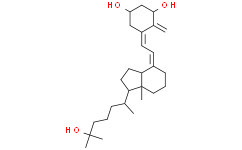
1,25-Dihydroxyvitamin D3 is the active form of vitamin D in the human body (vitamin D₃). Calcitriol is marketed under various brand names, including Roche, Calcijex (Abbott), and Decostriol (Mibe, Jesalis). It is derived from 25-hydroxycholecalciferol (calcidiol) in the kidneys via the enzyme 25-hydroxyvitamin D₁α-hydroxylase. This conversion process is stimulated by decreased serum calcium, phosphate (PO₄³⁻), and parathyroid hormone (PTH) levels. Calcitriol regulates calcium levels by increasing gastrointestinal absorption of calcium and phosphate, increasing renal reabsorption of calcium and phosphate, and inhibiting PTH release. Calcitriol is also commonly used to treat hypocalcemia and osteoporosis.
|
| Molecular Formula |
C27H44O3
|
|---|---|
| Molecular Weight |
416.64
|
| Exact Mass |
416.329
|
| CAS # |
32511-63-0
|
| Related CAS # |
Calcitriol,(1S)-Calcitriol;Calcitriol-13C3;Calcitriol-d3;128723-16-0
|
| PubChem CID |
6437079
|
| Appearance |
Typically exists as solids at room temperature
|
| Density |
1.06g/cm3
|
| Boiling Point |
565ºC at 760 mmHg
|
| Flash Point |
238.4ºC
|
| Index of Refraction |
1.547
|
| LogP |
5.705
|
| Hydrogen Bond Donor Count |
3
|
| Hydrogen Bond Acceptor Count |
3
|
| Rotatable Bond Count |
6
|
| Heavy Atom Count |
30
|
| Complexity |
688
|
| Defined Atom Stereocenter Count |
5
|
| SMILES |
OC1C/C(=C/C=C2\C3CCC(C(C)CCCC(C)(C)O)C3(C)CCC\2)/C(=C)C(O)C1
|
| InChi Key |
GMRQFYUYWCNGIN-MSAPPVOVSA-N
|
| InChi Code |
InChI=1S/C27H44O3/c1-18(8-6-14-26(3,4)30)23-12-13-24-20(9-7-15-27(23,24)5)10-11-21-16-22(28)17-25(29)19(21)2/h10-11,18,22-25,28-30H,2,6-9,12-17H2,1,3-5H3/b20-10+,21-11-/t18-,22-,23-,24+,25?,27-/m1/s1
|
| Chemical Name |
(1R,5Z)-5-[(2E)-2-[(1R,3aS,7aR)-1-[(2R)-6-hydroxy-6-methylheptan-2-yl]-7a-methyl-2,3,3a,5,6,7-hexahydro-1H-inden-4-ylidene]ethylidene]-4-methylidenecyclohexane-1,3-diol
|
| Synonyms |
(1R,5Z)-1,25-Dihydroxyvitamin D3
|
| HS Tariff Code |
2934.99.9001
|
| Storage |
Powder -20°C 3 years 4°C 2 years In solvent -80°C 6 months -20°C 1 month |
| Shipping Condition |
Room temperature (This product is stable at ambient temperature for a few days during ordinary shipping and time spent in Customs)
|
| Solubility (In Vitro) |
May dissolve in DMSO (in most cases), if not, try other solvents such as H2O, Ethanol, or DMF with a minute amount of products to avoid loss of samples
|
|---|---|
| Solubility (In Vivo) |
Note: Listed below are some common formulations that may be used to formulate products with low water solubility (e.g. < 1 mg/mL), you may test these formulations using a minute amount of products to avoid loss of samples.
Injection Formulations
Injection Formulation 1: DMSO : Tween 80: Saline = 10 : 5 : 85 (i.e. 100 μL DMSO stock solution → 50 μL Tween 80 → 850 μL Saline)(e.g. IP/IV/IM/SC) *Preparation of saline: Dissolve 0.9 g of sodium chloride in 100 mL ddH ₂ O to obtain a clear solution. Injection Formulation 2: DMSO : PEG300 :Tween 80 : Saline = 10 : 40 : 5 : 45 (i.e. 100 μL DMSO → 400 μLPEG300 → 50 μL Tween 80 → 450 μL Saline) Injection Formulation 3: DMSO : Corn oil = 10 : 90 (i.e. 100 μL DMSO → 900 μL Corn oil) Example: Take the Injection Formulation 3 (DMSO : Corn oil = 10 : 90) as an example, if 1 mL of 2.5 mg/mL working solution is to be prepared, you can take 100 μL 25 mg/mL DMSO stock solution and add to 900 μL corn oil, mix well to obtain a clear or suspension solution (2.5 mg/mL, ready for use in animals). View More
Injection Formulation 4: DMSO : 20% SBE-β-CD in saline = 10 : 90 [i.e. 100 μL DMSO → 900 μL (20% SBE-β-CD in saline)] Oral Formulations
Oral Formulation 1: Suspend in 0.5% CMC Na (carboxymethylcellulose sodium) Oral Formulation 2: Suspend in 0.5% Carboxymethyl cellulose Example: Take the Oral Formulation 1 (Suspend in 0.5% CMC Na) as an example, if 100 mL of 2.5 mg/mL working solution is to be prepared, you can first prepare 0.5% CMC Na solution by measuring 0.5 g CMC Na and dissolve it in 100 mL ddH2O to obtain a clear solution; then add 250 mg of the product to 100 mL 0.5% CMC Na solution, to make the suspension solution (2.5 mg/mL, ready for use in animals). View More
Oral Formulation 3: Dissolved in PEG400 (Please use freshly prepared in vivo formulations for optimal results.) |
| Preparing Stock Solutions | 1 mg | 5 mg | 10 mg | |
| 1 mM | 2.4002 mL | 12.0008 mL | 24.0015 mL | |
| 5 mM | 0.4800 mL | 2.4002 mL | 4.8003 mL | |
| 10 mM | 0.2400 mL | 1.2001 mL | 2.4002 mL |
*Note: Please select an appropriate solvent for the preparation of stock solution based on your experiment needs. For most products, DMSO can be used for preparing stock solutions (e.g. 5 mM, 10 mM, or 20 mM concentration); some products with high aqueous solubility may be dissolved in water directly. Solubility information is available at the above Solubility Data section. Once the stock solution is prepared, aliquot it to routine usage volumes and store at -20°C or -80°C. Avoid repeated freeze and thaw cycles.
Calculation results
Working concentration: mg/mL;
Method for preparing DMSO stock solution: mg drug pre-dissolved in μL DMSO (stock solution concentration mg/mL). Please contact us first if the concentration exceeds the DMSO solubility of the batch of drug.
Method for preparing in vivo formulation::Take μL DMSO stock solution, next add μL PEG300, mix and clarify, next addμL Tween 80, mix and clarify, next add μL ddH2O,mix and clarify.
(1) Please be sure that the solution is clear before the addition of next solvent. Dissolution methods like vortex, ultrasound or warming and heat may be used to aid dissolving.
(2) Be sure to add the solvent(s) in order.
Products are for research use only; We do not sell to patients
Copyright 2020 InvivoChem LLC | All Rights Reserved


