| Size | Price | Stock | Qty |
|---|---|---|---|
| 25mg |
|
||
| 50mg |
|
||
| 100mg |
|
||
| 250mg |
|
||
| 500mg | |||
| Other Sizes |
Purity: ≥98%
| Targets |
USP2(EC50= 45±4 μM);USP7(EC50= 37±1 μM);SENP2(EC50= 9.8±1.8 μM)
The target of NSC632839 HCl is consistent with NSC632839, which acts as a nonselective isopeptidase inhibitor targeting deubiquitylases (DUBs) including USP2, USP7, and deSUMOylase SENP2. [1] |
||
|---|---|---|---|
| ln Vitro |
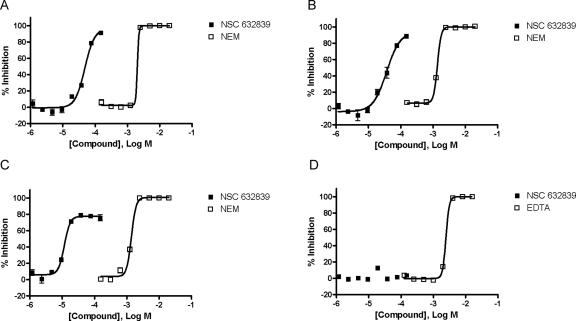
NSC632839 is a nonselective isopeptidase inhibitor that inhibits USP2, USP7, and SENP2 with EC50 values of 45±4 μM, 37±1 μM, and 9.8±1.8 μM, respectively. NSC632839 is not only a DUB (deubiquitylases) inhibitor, but also a deSUMOylase inhibitor. Conjugation or deconjugation of ubiquitin (Ub) or ubiquitin-like proteins (UBLs) to or from cellular proteins is a multifaceted and universal means of regulating cellular physiology, controlling the lifetime, localization, and activity of many critical proteins. Deconjugation of Ub or UBL from proteins is performed by a class of proteases called isopeptidases. The inhibitory activity of the nonselective isopeptidase inhibitor NSC 632839 against deubiquitylases and deSUMOylases was profiled.
1. NSC632839 HCl (the hydrochloride salt form of NSC632839) exhibited inhibitory activity against the isopeptidase activity of USP2 (a DUB) in the Ub-PLA₂ assay. It reduced USP2's cleavage activity toward Ub-PLA₂ in a concentration-dependent manner, yet the exact inhibitory potency (e.g., IC50) was not quantified [1] 2. In the same Ub-PLA₂ assay system, NSC632839 HCl also inhibited the isopeptidase activity of USP7 (another DUB) with a concentration-dependent inhibitory trend similar to that of USP2, and no specific numerical values for the inhibition were provided [1] 3. Using the UBL-PLA₂ assay tailored for deSUMOylase activity, NSC632839 HCl was found to inhibit SENP2 (a deSUMOylase), reducing SENP2-mediated cleavage of SUMO-PLA₂ in a concentration-dependent fashion [1] 4. NSC632839 HCl did not show inhibitory effects on the activity of free phospholipase A₂ (PLA₂) in the PLA₂ substrate cleavage assay, indicating that its inhibitory action is specific to isopeptidases rather than the reporter enzyme PLA₂ [1] |
||
| ln Vivo |
|
||
| Enzyme Assay |
In a 96-well-plate, 40 nM USP2, 40 nM USP7, or 20 nM SENP2 is preincubated with a concentration range of NSC 632839 (NCI/NIH developmental therapeutics program) or control for 30 min before supplementation with an equal volume of 60 nM Ub-PLA2/40 μM NBD C6-HPC (USP2 or 7) or 20 nM SUMO3-PLA2/40 μM NBD C6-HPC (SENP2). Relative activity of the enzymes is determined by measuring the RFU values at single time points within the initial linear range (USP, 50 min; USP7, 50 min; and SENP2, 30 min). The RFU values within the initial linear range are normalized such that isopeptidase+vehicle=0% inhibition and isopeptidase+NEM=100% inhibition. The EC50 values are determined as above. The inhibitory activity of the test compound against the reporter enzyme PLA2 is performed as described above except there is no preincubation step and the data are normalized such that free PLA2+vehicle=0% inhibition and free PLA2+EDTA=100% inhibition. PLA2 activity is determined 8 min after the addition of the reagents.
1. USP2 Inhibitory Assay with Ub-PLA₂ for NSC632839 HCl: A reaction mixture was prepared containing USP2 enzyme, 30 nM Ub-PLA₂ (the reporter substrate), 20 μM NBD C₆-HPC (the fluorescent substrate for PLA₂), and various concentrations of NSC632839 HCl. The mixture was incubated under optimized conditions (room temperature for 45 min in related experiments). The fluorescence signal generated by the cleavage of NBD C₆-HPC by the released PLA₂ was monitored to quantify USP2 isopeptidase activity. The inhibitory effect of NSC632839 HCl was evaluated by comparing the fluorescence intensity in the compound-treated group with that in the control group (without inhibitor) [1] 2. USP7 Inhibitory Assay with Ub-PLA₂ for NSC632839 HCl: The experimental setup was identical to the USP2 assay, with USP7 replacing USP2 as the target enzyme. Different concentrations of NSC632839 HCl were added to the reaction system, and the fluorescence signal was measured after incubation to assess the compound's inhibitory effect on USP7 isopeptidase activity [1] 3. SENP2 Inhibitory Assay with SUMO-PLA₂ for NSC632839 HCl: A deSUMOylase activity assay system was established using SUMO-PLA₂ as the reporter substrate, which contained SENP2 enzyme and different concentrations of NSC632839 HCl. The steps of PLA₂ substrate cleavage and fluorescence signal detection were consistent with the Ub-PLA₂ assay. The reduction in fluorescence signal reflected the inhibitory effect of NSC632839 HCl on SENP2-mediated deSUMOylation activity [1] 4. Free PLA₂ Activity Assay for NSC632839 HCl: A reaction system was prepared with free PLA₂ enzyme, NBD C₆-HPC substrate, and various concentrations of NSC632839 HCl. After incubation, the fluorescence signal was measured to verify whether the compound directly inhibited PLA₂ enzyme activity, ruling out non-specific inhibition of the reporter enzyme [1] |
||
| Cell Assay |
NSC 632839 inhibits ubiquitin isopeptidases as illustrated by its ability to inhibit z-LRGG-AMC cleavage by crude lysates in the mid-micromolar range. To further characterize NSC 632839 against purified enzymes, its inhibitory potential is determined against purified USP2, USP7, and SENP2 and demonstrated that NSC 632839 is not only a DUB inhibitor, but also a deSUMOylase inhibitor. Specifically, NSC 632839 inhibits USP2, USP7, and SENP2 with EC50 values of 45±4 μM, 37±1 μM, and 9.8±1.8 μM, respectively. Importantly, NSC 632839 does not inhibit the reporter enzyme PLA2 over the concentration range tested (1.2-150 μM), indicating that the reported inhibition is selective for isopeptidases. Moreover, the isopeptidase inhibitory activity of NSC 632839 is confirmed by the observation that it does not inhibit free PLA2 over the concentration range tested.
|
||
| Animal Protocol |
|
||
| References | |||
| Additional Infomation |
1. NSC632839 HCl is the hydrochloride form of the nonselective isopeptidase inhibitor NSC632839, retaining the inhibitory activity of the parent compound against a variety of isopeptidases, including USP2, USP7 and SENP2 [1]. 2. The inhibitory activity of NSC632839 HCl was analyzed using the novel UBL-PLA₂ detection platform. This platform has proven to be an effective tool for characterizing isopeptidase activity modulators and provides a basis for assessing the potential of this compound as a tool for studying isopeptidase function [1].
|
| Molecular Formula |
C21H22CLNO
|
|
|---|---|---|
| Molecular Weight |
339.86
|
|
| Elemental Analysis |
C, 74.22; H, 6.52; Cl, 10.43; N, 4.12; O, 4.71
|
|
| CAS # |
157654-67-6
|
|
| Related CAS # |
|
|
| Appearance |
Light yellow to yellow solid powder
|
|
| Boiling Point |
522.7ºC at 760 mmHg
|
|
| Flash Point |
184ºC
|
|
| Vapour Pressure |
5.05E-11mmHg at 25°C
|
|
| LogP |
5.074
|
|
| SMILES |
O=C1/C(CNC/C1=C\C2=CC=C(C)C=C2)=C/C3=CC=C(C)C=C3.[H]Cl
|
|
| InChi Key |
InChI=1S/C21H21NO.ClH/c1-15-3-7-17(8-4-15)11-19-13-22-14-20(21(19)23)12-18-9-5-16(2)6-10-18;/h3-12,22H,13-14H2,1-2H3;1H/b19-11+,20-12+;
|
|
| InChi Code |
O=C1/C(CNC/C1=C\C2=CC=C(C)C=C2)=C/C3=CC=C(C)C=C3.[H]Cl
|
|
| Chemical Name |
,5-Bis[(4-methylphenyl)methylene]-4-piperidone hydrochloride
|
|
| Synonyms |
NSC-632839; NSC 632839; NSC632839; NSC632839 HCL
|
|
| HS Tariff Code |
2934.99.9001
|
|
| Storage |
Powder -20°C 3 years 4°C 2 years In solvent -80°C 6 months -20°C 1 month Note: Please store this product in a sealed and protected environment, avoid exposure to moisture. |
|
| Shipping Condition |
Room temperature (This product is stable at ambient temperature for a few days during ordinary shipping and time spent in Customs)
|
| Solubility (In Vitro) |
DMSO : 6.2~7 mg/mL ( 18.24~20.59 mM )
|
|---|---|
| Solubility (In Vivo) |
Note: Listed below are some common formulations that may be used to formulate products with low water solubility (e.g. < 1 mg/mL), you may test these formulations using a minute amount of products to avoid loss of samples.
Injection Formulations
Injection Formulation 1: DMSO : Tween 80: Saline = 10 : 5 : 85 (i.e. 100 μL DMSO stock solution → 50 μL Tween 80 → 850 μL Saline)(e.g. IP/IV/IM/SC) *Preparation of saline: Dissolve 0.9 g of sodium chloride in 100 mL ddH ₂ O to obtain a clear solution. Injection Formulation 2: DMSO : PEG300 :Tween 80 : Saline = 10 : 40 : 5 : 45 (i.e. 100 μL DMSO → 400 μLPEG300 → 50 μL Tween 80 → 450 μL Saline) Injection Formulation 3: DMSO : Corn oil = 10 : 90 (i.e. 100 μL DMSO → 900 μL Corn oil) Example: Take the Injection Formulation 3 (DMSO : Corn oil = 10 : 90) as an example, if 1 mL of 2.5 mg/mL working solution is to be prepared, you can take 100 μL 25 mg/mL DMSO stock solution and add to 900 μL corn oil, mix well to obtain a clear or suspension solution (2.5 mg/mL, ready for use in animals). View More
Injection Formulation 4: DMSO : 20% SBE-β-CD in saline = 10 : 90 [i.e. 100 μL DMSO → 900 μL (20% SBE-β-CD in saline)] Oral Formulations
Oral Formulation 1: Suspend in 0.5% CMC Na (carboxymethylcellulose sodium) Oral Formulation 2: Suspend in 0.5% Carboxymethyl cellulose Example: Take the Oral Formulation 1 (Suspend in 0.5% CMC Na) as an example, if 100 mL of 2.5 mg/mL working solution is to be prepared, you can first prepare 0.5% CMC Na solution by measuring 0.5 g CMC Na and dissolve it in 100 mL ddH2O to obtain a clear solution; then add 250 mg of the product to 100 mL 0.5% CMC Na solution, to make the suspension solution (2.5 mg/mL, ready for use in animals). View More
Oral Formulation 3: Dissolved in PEG400 (Please use freshly prepared in vivo formulations for optimal results.) |
| Preparing Stock Solutions | 1 mg | 5 mg | 10 mg | |
| 1 mM | 2.9424 mL | 14.7119 mL | 29.4239 mL | |
| 5 mM | 0.5885 mL | 2.9424 mL | 5.8848 mL | |
| 10 mM | 0.2942 mL | 1.4712 mL | 2.9424 mL |
*Note: Please select an appropriate solvent for the preparation of stock solution based on your experiment needs. For most products, DMSO can be used for preparing stock solutions (e.g. 5 mM, 10 mM, or 20 mM concentration); some products with high aqueous solubility may be dissolved in water directly. Solubility information is available at the above Solubility Data section. Once the stock solution is prepared, aliquot it to routine usage volumes and store at -20°C or -80°C. Avoid repeated freeze and thaw cycles.
Calculation results
Working concentration: mg/mL;
Method for preparing DMSO stock solution: mg drug pre-dissolved in μL DMSO (stock solution concentration mg/mL). Please contact us first if the concentration exceeds the DMSO solubility of the batch of drug.
Method for preparing in vivo formulation::Take μL DMSO stock solution, next add μL PEG300, mix and clarify, next addμL Tween 80, mix and clarify, next add μL ddH2O,mix and clarify.
(1) Please be sure that the solution is clear before the addition of next solvent. Dissolution methods like vortex, ultrasound or warming and heat may be used to aid dissolving.
(2) Be sure to add the solvent(s) in order.
Characterization of NSC 632839.Protein Sci.2008 Jun;17(6):1035-43. |
|---|
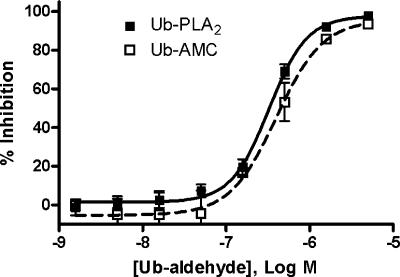
EC50values from Ub-PLA2and Ub-AMC assay are comparable.Protein Sci.2008 Jun;17(6):1035-43. |
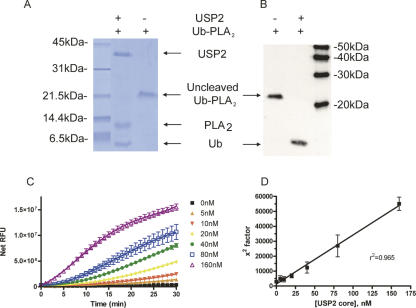
USP2 core cleaves Ub-PLA2resulting in a dose-dependent increase in NBD fluorescence.Protein Sci.2008 Jun;17(6):1035-43. |
Products are for research use only; We do not sell to patients
Copyright 2020 InvivoChem LLC | All Rights Reserved


 COA
COA