| Size | Price | Stock | Qty |
|---|---|---|---|
| 1mg |
|
||
| 5mg |
|
||
| 10mg |
|
||
| 25mg |
|
||
| 50mg |
|
||
| 100mg |
|
||
| 250mg |
|
||
| Other Sizes |


Purity: ≥98%
| Targets |
LCKLSL targets annexin A2 (AnxA2), a protein involved in fibrinolysis and cell membrane organization. It is a competitive inhibitor that potently inhibits the binding of tissue plasminogen activator (tPA) to AnxA2. By blocking this interaction, LCKLSL inhibits the generation of plasmin, which is involved in fibrinolysis and extracellular matrix degradation. LCKLSL's mechanism makes it a valuable tool for studying the role of AnxA2 in fibrinolysis, cell migration, and cancer.
|
|---|---|
| ln Vitro |
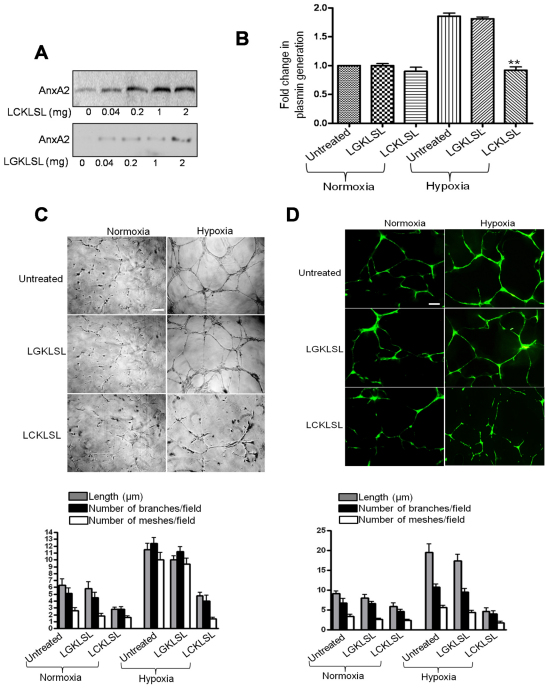
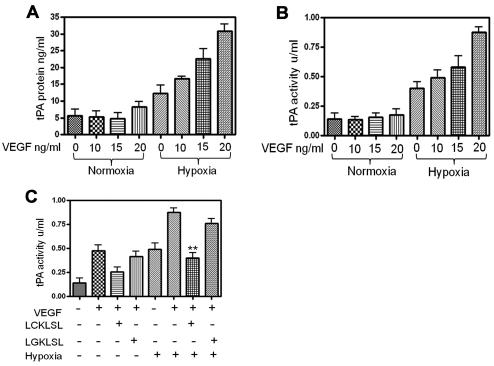
LCKLSL (0–2 mg) therapy reduced plasmin generation and VEGF-induced tPA activity in human retinal microvascular endothelial cells (RMVEC) in hypoxic circumstances [1].
In vitro, LCKLSL is a competitive annexin A2 (AnxA2) inhibitor that potently inhibits the binding of tissue plasminogen activator (tPA) to AnxA2. It inhibits the generation of plasmin. In cell-based assays, LCKLSL treatment results in inhibition of tPA binding to AnxA2, reduced plasmin generation, and modulation of cell migration and invasion. The compound's effects on AnxA2-mediated processes are assessed using binding assays and functional assays. |
| ln Vivo |
The angiogenic response was shown to be inhibited by application of LCKLSL in two in vivo models of angiogenesis (mouse Matrigel plug assay and chicken chorioallantoic membrane). The length of the channel was dramatically reduced by LCKLSL peptide treatment. Vascular branches, junctions, and endpoints were drastically reduced by LCKLSL peptide at a dosage of 5 μg/mL [1].
In vivo, LCKLSL has been studied for its potential in inhibiting fibrinolysis and cancer progression. By inhibiting AnxA2-mediated plasmin generation, LCKLSL may reduce tumor cell invasion and metastasis. However, detailed in vivo efficacy data are limited. The compound is primarily used as a research tool in in vitro studies of AnxA2 function. Comprehensive in vivo studies are needed to fully characterize its therapeutic potential. |
| Enzyme Assay |
In vitro receptor binding assays for LCKLSL involve measuring its inhibition of the binding of tissue plasminogen activator (tPA) to annexin A2 (AnxA2). AnxA2 is immobilized on a solid support, and tPA binding is measured in the presence of varying concentrations of LCKLSL. The displacement of tPA is measured, and the IC₅₀ is calculated. The compound's inhibition of plasmin generation is assessed by measuring plasmin activity using a chromogenic substrate. These assays confirm the compound's mechanism as an AnxA2 inhibitor.
|
| Cell Assay |
In vitro cell-based assays for LCKLSL evaluate its effects on AnxA2-mediated processes. Cells expressing AnxA2 are cultured and treated with LCKLSL, and tPA binding to the cell surface is assessed. Plasmin generation is measured using a chromogenic substrate. Cell migration and invasion are assessed using scratch wound or Boyden chamber assays. These assays confirm the compound's functional activity as an AnxA2 inhibitor.
|
| Animal Protocol |
In vivo animal experiments for LCKLSL have not been extensively reported. The compound is primarily used as a research tool in in vitro studies of AnxA2 function. For potential in vivo studies, LCKLSL can be administered via intraperitoneal injection in animal models of cancer or thrombosis. The compound's effects on tumor growth, metastasis, and fibrinolysis would be assessed. Comprehensive in vivo studies are needed.
|
| ADME/Pharmacokinetics |
Pharmacokinetic (PK) data for LCKLSL are limited. The peptide has a molecular weight of 675.88 g/mol and is soluble in DMSO. It should be stored as a powder at -20°C for 3 years or in solvent at -80°C for 6 months. The compound's metabolic stability, half-life, and bioavailability have not been fully characterized. Comprehensive ADME studies are needed.
|
| Toxicity/Toxicokinetics |
The toxicity profile of LCKLSL has not been extensively characterized. As a research peptide, it should be handled with appropriate safety precautions. The compound is for research use only and is not intended for human or veterinary use. Comprehensive toxicological studies are needed to fully characterize the safety profile of LCKLSL.
|
| References |
[1]. Mallika Valapala, et al. A Competitive Hexapeptide Inhibitor of Annexin A2 Prevents Hypoxia-Induced Angiogenic Events. J Cell Sci. 2011 May 1;124(Pt 9):1453-64.
|
| Additional Infomation |
LCKLSL is an N-terminal hexapeptide and a competitive annexin A2 (AnxA2) inhibitor. It inhibits the binding of tissue plasminogen activator (tPA) to AnxA2 and the generation of plasmin. The peptide is composed of the amino acid sequence Leu-Cys-Lys-Leu-Ser-Leu. LCKLSL is a research tool for studying AnxA2 function and has not progressed to clinical trials.
|
| Molecular Formula |
C30H57N7O8S
|
|---|---|
| Molecular Weight |
675.881
|
| Exact Mass |
675.398
|
| CAS # |
533902-29-3
|
| Related CAS # |
LCKLSL hydrochloride
|
| PubChem CID |
146681222
|
| Sequence |
Leu-Cys-Lys-Leu-Ser-LeuLCKLSL
|
| SequenceShortening |
LCKLSL
|
| Appearance |
White to off-white solid
|
| LogP |
-2.1
|
| Hydrogen Bond Donor Count |
10
|
| Hydrogen Bond Acceptor Count |
11
|
| Rotatable Bond Count |
23
|
| Heavy Atom Count |
46
|
| Complexity |
998
|
| Defined Atom Stereocenter Count |
6
|
| SMILES |
CC(C)C[C@@H](C(=O)N[C@@H](CS)C(=O)N[C@@H](CCCCN)C(=O)N[C@@H](CC(C)C)C(=O)N[C@@H](CO)C(=O)N[C@@H](CC(C)C)C(=O)O)N
|
| InChi Key |
HTBYABHLBWELKC-BTNSXGMBSA-N
|
| InChi Code |
InChI=1S/C30H57N7O8S/c1-16(2)11-19(32)25(39)37-24(15-46)29(43)33-20(9-7-8-10-31)26(40)34-21(12-17(3)4)27(41)36-23(14-38)28(42)35-22(30(44)45)13-18(5)6/h16-24,38,46H,7-15,31-32H2,1-6H3,(H,33,43)(H,34,40)(H,35,42)(H,36,41)(H,37,39)(H,44,45)/t19-,20-,21-,22-,23-,24-/m0/s1
|
| Chemical Name |
(2S)-2-[[(2S)-2-[[(2S)-2-[[(2S)-6-amino-2-[[(2R)-2-[[(2S)-2-amino-4-methylpentanoyl]amino]-3-sulfanylpropanoyl]amino]hexanoyl]amino]-4-methylpentanoyl]amino]-3-hydroxypropanoyl]amino]-4-methylpentanoic acid
|
| HS Tariff Code |
2934.99.9001
|
| Storage |
Powder -20°C 3 years 4°C 2 years In solvent -80°C 6 months -20°C 1 month Note: Please store this product in a sealed and protected environment, avoid exposure to moisture. |
| Shipping Condition |
Room temperature (This product is stable at ambient temperature for a few days during ordinary shipping and time spent in Customs)
|
| Solubility (In Vitro) |
H2O: ≥ 50 mg/mL (~74.0 mM)
DMSO: ~5 mg/mL (~7.4 mM; with ultrasonication) |
|---|---|
| Solubility (In Vivo) |
Note: Listed below are some common formulations that may be used to formulate products with low water solubility (e.g. < 1 mg/mL), you may test these formulations using a minute amount of products to avoid loss of samples.
Injection Formulations
Injection Formulation 1: DMSO : Tween 80: Saline = 10 : 5 : 85 (i.e. 100 μL DMSO stock solution → 50 μL Tween 80 → 850 μL Saline)(e.g. IP/IV/IM/SC) *Preparation of saline: Dissolve 0.9 g of sodium chloride in 100 mL ddH ₂ O to obtain a clear solution. Injection Formulation 2: DMSO : PEG300 :Tween 80 : Saline = 10 : 40 : 5 : 45 (i.e. 100 μL DMSO → 400 μLPEG300 → 50 μL Tween 80 → 450 μL Saline) Injection Formulation 3: DMSO : Corn oil = 10 : 90 (i.e. 100 μL DMSO → 900 μL Corn oil) Example: Take the Injection Formulation 3 (DMSO : Corn oil = 10 : 90) as an example, if 1 mL of 2.5 mg/mL working solution is to be prepared, you can take 100 μL 25 mg/mL DMSO stock solution and add to 900 μL corn oil, mix well to obtain a clear or suspension solution (2.5 mg/mL, ready for use in animals). View More
Injection Formulation 4: DMSO : 20% SBE-β-CD in saline = 10 : 90 [i.e. 100 μL DMSO → 900 μL (20% SBE-β-CD in saline)] Oral Formulations
Oral Formulation 1: Suspend in 0.5% CMC Na (carboxymethylcellulose sodium) Oral Formulation 2: Suspend in 0.5% Carboxymethyl cellulose Example: Take the Oral Formulation 1 (Suspend in 0.5% CMC Na) as an example, if 100 mL of 2.5 mg/mL working solution is to be prepared, you can first prepare 0.5% CMC Na solution by measuring 0.5 g CMC Na and dissolve it in 100 mL ddH2O to obtain a clear solution; then add 250 mg of the product to 100 mL 0.5% CMC Na solution, to make the suspension solution (2.5 mg/mL, ready for use in animals). View More
Oral Formulation 3: Dissolved in PEG400 (Please use freshly prepared in vivo formulations for optimal results.) |
| Preparing Stock Solutions | 1 mg | 5 mg | 10 mg | |
| 1 mM | 1.4796 mL | 7.3978 mL | 14.7955 mL | |
| 5 mM | 0.2959 mL | 1.4796 mL | 2.9591 mL | |
| 10 mM | 0.1480 mL | 0.7398 mL | 1.4796 mL |
*Note: Please select an appropriate solvent for the preparation of stock solution based on your experiment needs. For most products, DMSO can be used for preparing stock solutions (e.g. 5 mM, 10 mM, or 20 mM concentration); some products with high aqueous solubility may be dissolved in water directly. Solubility information is available at the above Solubility Data section. Once the stock solution is prepared, aliquot it to routine usage volumes and store at -20°C or -80°C. Avoid repeated freeze and thaw cycles.
Calculation results
Working concentration: mg/mL;
Method for preparing DMSO stock solution: mg drug pre-dissolved in μL DMSO (stock solution concentration mg/mL). Please contact us first if the concentration exceeds the DMSO solubility of the batch of drug.
Method for preparing in vivo formulation::Take μL DMSO stock solution, next add μL PEG300, mix and clarify, next addμL Tween 80, mix and clarify, next add μL ddH2O,mix and clarify.
(1) Please be sure that the solution is clear before the addition of next solvent. Dissolution methods like vortex, ultrasound or warming and heat may be used to aid dissolving.
(2) Be sure to add the solvent(s) in order.
|
|
Products are for research use only; We do not sell to patients
Copyright 2020 InvivoChem LLC | All Rights Reserved


 COA
COA