| Size | Price | Stock | Qty |
|---|---|---|---|
| 5mg |
|
||
| 10mg |
|
||
| 25mg |
|
||
| 50mg |
|
||
| 100mg |
|
||
| 250mg | |||
| 500mg | |||
| Other Sizes |


Purity: ≥98%
| Targets |
trans-translation tagging reaction(IC50= 0.9 µM)
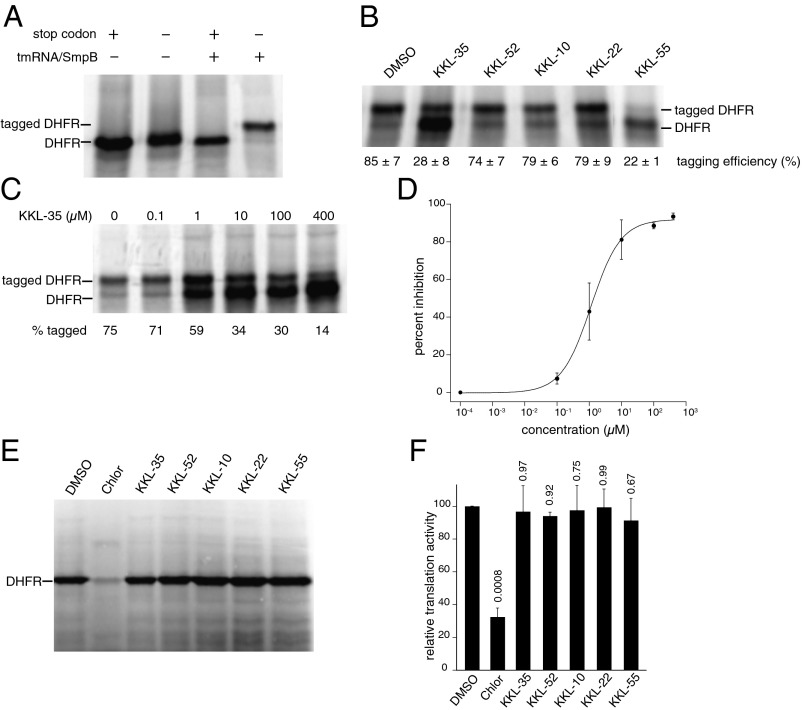
Broad-spectrum antibiotic activity is demonstrated by KKL-35. When B. anthracis and M. smegmatis grow, KKL-35 inhibits their growth with minimum inhibitory concentrations (MIC) less than 6 µM. KKL-35 prevents tagged proteins from being proteolyzed at a certain stage of trans-translation. KKL-35 prevents DHFR-ns from being tagged. Reactions containing the highest concentrations of KKL-35 yield a significant amount of untagged DHFR, suggesting that KKL-35 does not impede translation.When added to a growing culture of S. flexneri, KKL-35 stops growth and inhibits the growth of WT S. flexneri with a MIC of 6 µM. The addition of KKL-35 to a S. flexneri strain that is deleted for ssrA and expresses ArfA does not significantly affect growth rate or viability. With a minimum inhibitory concentration of 0.3 µM, KKL-35 suppresses the growth of E. coli ∆tolC, a strain that lacks small molecule efflux. |
|---|---|
| ln Vitro |
Broad-spectrum antibiotic activity is demonstrated by KKL-35. When B. anthracis and M. smegmatis grow, KKL-35 inhibits their growth with minimum inhibitory concentrations (MIC) less than 6 µM. KKL-35 prevents tagged proteins from being proteolyzed at a certain stage of trans-translation. KKL-35 prevents DHFR-ns from being tagged. Reactions containing the highest concentrations of KKL-35 yield a significant amount of untagged DHFR, suggesting that KKL-35 does not impede translation.When added to a growing culture of S. flexneri, KKL-35 stops growth and inhibits the growth of WT S. flexneri with a MIC of 6 µM. The addition of KKL-35 to a S. flexneri strain that is deleted for ssrA and expresses ArfA does not significantly affect growth rate or viability. With a minimum inhibitory concentration of 0.3 µM, KKL-35 suppresses the growth of E. coli ∆tolC, a strain that lacks small molecule efflux.
KKL-35 inhibited the in vitro trans-translation tagging reaction in a dose-dependent manner with an IC₅₀ of 0.9 μM. It did not inhibit general translation, as demonstrated by in vitro translation assays using a DHFR gene containing a stop codon. In filter-binding assays, KKL-35 (100 μM) did not significantly affect the binding affinity between tmRNA and SmpB (Kd = 1.3 ± 0.13 nM with KKL-35 vs. 1.6 ± 0.35 nM with DMSO control).[1] |
| ln Vivo |
Research points to KKL-35's inhibition of trans-translation'sreleaseof nonstop translation complexes as the source of its in vivo effects. S. flexneri strains that require trans-translation cannot grow because KKL-35 inhibits trans-translation. Genetic and pharmacological experiments demonstrating that alternative mechanisms to release nonstop translation complexes relieve the growth suppression of KKL-35 support the correlation between inhibition of trans-translation and growth[1].
KKL-35 exhibited broad-spectrum antibacterial activity in broth microdilution assays. It prevented growth of Shigella flexneri (MIC = 6 μM), Bacillus anthracis (MIC ≤ 6 μM), Mycobacterium smegmatis (MIC ≤ 6 μM), and E. coli ΔtolC (MIC = 0.3 μM). In S. flexneri, growth inhibition by KKL-35 was rescued by expression of the alternative rescue factor ArfA, confirming that its antibacterial effect is due to trans-translation inhibition. Puromycin (0.1 μg/mL) also rescued growth of E. coli ΔtolC in the presence of KKL-35, further supporting that growth inhibition results from accumulation of nonstop translation complexes.[1] |
| Enzyme Assay |
In vitro trans-translation assays were performed using a coupled transcription/translation system. A DHFR gene without a stop codon (DHFR-ns) was used as template. tmRNA and SmpB were added to 2 μM final concentration to enable tagging. KKL-35 or other compounds were added at 10 μM (or varied concentrations for dose-response). Reactions were incubated at 37°C for 1–3 hours, precipitated with acetone, separated by SDS-PAGE, and visualized. Tagging efficiency was calculated as the ratio of tagged DHFR to total DHFR.[1]
|
| Cell Assay |
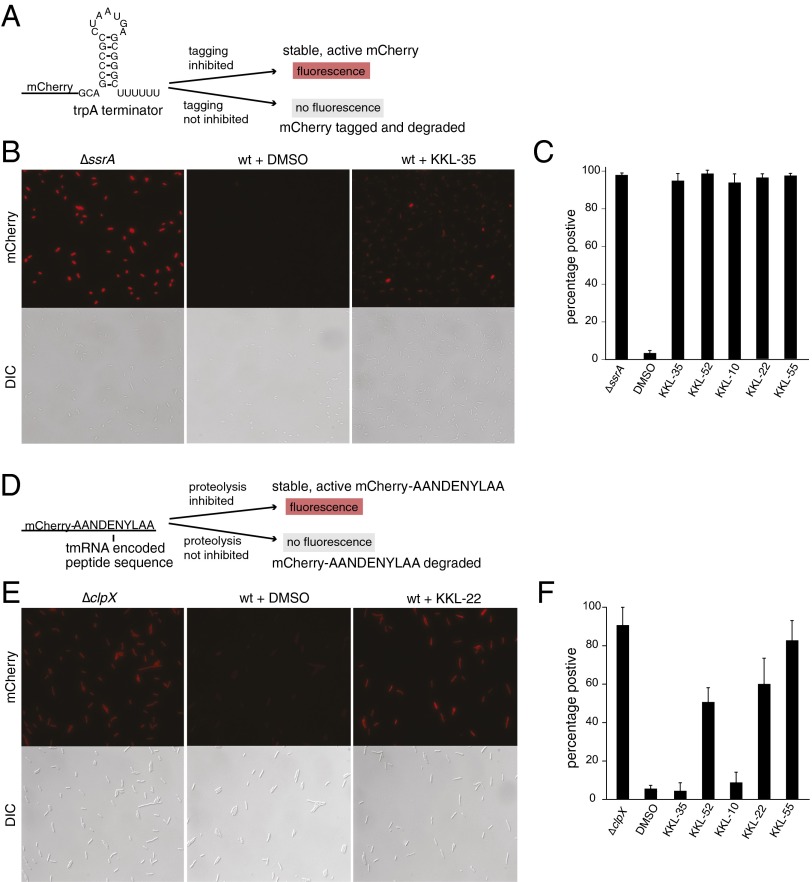
A cell-based luciferase reporter assay was used for high-throughput screening. E. coli cells expressing a nonstop luciferase mRNA (luc-trpAt) were treated with compounds. If trans-translation is inhibited, active luciferase accumulates and produces luminescence. For fluorescent reporter assays, strains expressing mCherry-trpAt or mCherry-tag were grown to OD₆₀₀ = 0.2, induced with IPTG, and treated with compounds. Fluorescence intensity was measured by microscopy, and cells with intensity >2 SD above DMSO control were scored as positive.[1]
|
| References | |
| Additional Infomation |
KKL-35 was identified through high-throughput screening of 663,000 compounds and using a cell-based translation reporter gene assay. It is a small molecule inhibitor that blocks the labeling step in the translation process. Translation is essential for bacterial survival and virulence but is absent in animals. KKL-35 has broad-spectrum antibacterial activity and is considered a promising antibiotic candidate, especially for combating drug-resistant pathogens. [1]
|
| Molecular Formula |
C15H9CLFN3O2
|
|---|---|
| Molecular Weight |
317.70
|
| Exact Mass |
317.036
|
| Elemental Analysis |
C, 49.73; H, 4.55; Cl, 13.34; N, 26.36; O, 6.02
|
| CAS # |
865285-29-6
|
| Related CAS # |
KKL-35; 865285-29-6
|
| PubChem CID |
4128171
|
| Appearance |
Solid powder
|
| Density |
1.5±0.1 g/cm3
|
| Index of Refraction |
1.639
|
| LogP |
4.13
|
| Hydrogen Bond Donor Count |
1
|
| Hydrogen Bond Acceptor Count |
5
|
| Rotatable Bond Count |
3
|
| Heavy Atom Count |
22
|
| Complexity |
385
|
| Defined Atom Stereocenter Count |
0
|
| SMILES |
O=C(C1C=CC(Cl)=CC=1)NC1OC(C2C=CC(F)=CC=2)=NN=1
|
| InChi Key |
IBRCUOMIAFDQTM-UHFFFAOYSA-N
|
| InChi Code |
InChI=1S/C11H12ClN5O/c1-2-6-17-11(14-15-16-17)13-10(18)8-4-3-5-9(12)7-8/h3-5,7H,2,6H2,1H3,(H,13,14,16,18)
|
| Chemical Name |
3-chloro-N-(1-propyl-1H-tetrazol-5-yl)benzamide
|
| Synonyms |
KKL-35; KKL 35; KKL35;
|
| HS Tariff Code |
2934.99.9001
|
| Storage |
Powder -20°C 3 years 4°C 2 years In solvent -80°C 6 months -20°C 1 month |
| Shipping Condition |
Room temperature (This product is stable at ambient temperature for a few days during ordinary shipping and time spent in Customs)
|
| Solubility (In Vitro) |
DMSO : 6.25~32 mg/mL (19.67~100.72 mM)
|
|---|---|
| Solubility (In Vivo) |
Note: Listed below are some common formulations that may be used to formulate products with low water solubility (e.g. < 1 mg/mL), you may test these formulations using a minute amount of products to avoid loss of samples.
Injection Formulations
Injection Formulation 1: DMSO : Tween 80: Saline = 10 : 5 : 85 (i.e. 100 μL DMSO stock solution → 50 μL Tween 80 → 850 μL Saline)(e.g. IP/IV/IM/SC) *Preparation of saline: Dissolve 0.9 g of sodium chloride in 100 mL ddH ₂ O to obtain a clear solution. Injection Formulation 2: DMSO : PEG300 :Tween 80 : Saline = 10 : 40 : 5 : 45 (i.e. 100 μL DMSO → 400 μLPEG300 → 50 μL Tween 80 → 450 μL Saline) Injection Formulation 3: DMSO : Corn oil = 10 : 90 (i.e. 100 μL DMSO → 900 μL Corn oil) Example: Take the Injection Formulation 3 (DMSO : Corn oil = 10 : 90) as an example, if 1 mL of 2.5 mg/mL working solution is to be prepared, you can take 100 μL 25 mg/mL DMSO stock solution and add to 900 μL corn oil, mix well to obtain a clear or suspension solution (2.5 mg/mL, ready for use in animals). View More
Injection Formulation 4: DMSO : 20% SBE-β-CD in saline = 10 : 90 [i.e. 100 μL DMSO → 900 μL (20% SBE-β-CD in saline)] Oral Formulations
Oral Formulation 1: Suspend in 0.5% CMC Na (carboxymethylcellulose sodium) Oral Formulation 2: Suspend in 0.5% Carboxymethyl cellulose Example: Take the Oral Formulation 1 (Suspend in 0.5% CMC Na) as an example, if 100 mL of 2.5 mg/mL working solution is to be prepared, you can first prepare 0.5% CMC Na solution by measuring 0.5 g CMC Na and dissolve it in 100 mL ddH2O to obtain a clear solution; then add 250 mg of the product to 100 mL 0.5% CMC Na solution, to make the suspension solution (2.5 mg/mL, ready for use in animals). View More
Oral Formulation 3: Dissolved in PEG400 (Please use freshly prepared in vivo formulations for optimal results.) |
| Preparing Stock Solutions | 1 mg | 5 mg | 10 mg | |
| 1 mM | 3.1476 mL | 15.7381 mL | 31.4762 mL | |
| 5 mM | 0.6295 mL | 3.1476 mL | 6.2952 mL | |
| 10 mM | 0.3148 mL | 1.5738 mL | 3.1476 mL |
*Note: Please select an appropriate solvent for the preparation of stock solution based on your experiment needs. For most products, DMSO can be used for preparing stock solutions (e.g. 5 mM, 10 mM, or 20 mM concentration); some products with high aqueous solubility may be dissolved in water directly. Solubility information is available at the above Solubility Data section. Once the stock solution is prepared, aliquot it to routine usage volumes and store at -20°C or -80°C. Avoid repeated freeze and thaw cycles.
Calculation results
Working concentration: mg/mL;
Method for preparing DMSO stock solution: mg drug pre-dissolved in μL DMSO (stock solution concentration mg/mL). Please contact us first if the concentration exceeds the DMSO solubility of the batch of drug.
Method for preparing in vivo formulation::Take μL DMSO stock solution, next add μL PEG300, mix and clarify, next addμL Tween 80, mix and clarify, next add μL ddH2O,mix and clarify.
(1) Please be sure that the solution is clear before the addition of next solvent. Dissolution methods like vortex, ultrasound or warming and heat may be used to aid dissolving.
(2) Be sure to add the solvent(s) in order.
Characterization of inhibitors of tagging and proteolysis.Proc Natl Acad Sci U S A. 2013 Jun 18;110(25):10282-7. |
In vitro assays for inhibition oftrans-translation and translation.Proc Natl Acad Sci U S A. 2013 Jun 18;110(25):10282-7. |
KKL-35 inhibits cell growth by preventing resolution of nonstop translation complexes.Proc Natl Acad Sci U S A. 2013 Jun 18;110(25):10282-7. |
Products are for research use only; We do not sell to patients
Copyright 2020 InvivoChem LLC | All Rights Reserved


 COA
COA