
| Size | Price | |
|---|---|---|
| Other Sizes |


| Targets |
Fmoc-β-HoAsp(OtBu)-OH is classified as a glutamic acid derivative targeting peptide synthesis applications. The β³-homoamino acid residue introduces backbone extension into peptide sequences, which can affect peptide conformation, stability, and biological activity. It is used in the synthesis of peptides and peptidomimetics for biological research. The tert-butyl protecting group on the side chain allows for selective deprotection during peptide synthesis.
|
|---|---|
| ln Vitro |
Commercial ergot supplements have been made from amino acids and their derivatives. They affect the release of anabolic hormones, the availability of fuel for activity, the ability to think clearly under pressure, and the prevention of muscular damage brought on by exertion. They are regarded as advantageous synergistic food ingredients [1].
In vitro activity of Fmoc-β-HoAsp(OtBu)-OH is primarily as a peptide synthesis building block. Amino acids and amino acid derivatives have been commercially used as ergogenic supplements. They affect the release of anabolic hormones and fuel availability. Fmoc-β-HoAsp(OtBu)-OH itself is not directly biologically active. Its utility is in preparing β³-homoaspartic acid-containing peptides for studying the effects of backbone extension on peptide bioactivity. |
| ln Vivo |
There is no specific in vivo activity data for Fmoc-β-HoAsp(OtBu)-OH. Peptides containing β³-homoaspartic acid residues synthesized using this building block may be evaluated in vivo for therapeutic applications. The backbone extension can confer proteolytic resistance and alter target binding properties of peptide drugs. Animal studies would be performed on the final peptide products. Fmoc-β-HoAsp(OtBu)-OH is a research reagent for peptide synthesis.
|
| Enzyme Assay |
In vitro enzyme/receptor binding protocols for Fmoc-β-HoAsp(OtBu)-OH involve its use in SPPS. Standard Fmoc/tBu chemistry: the compound is activated with HATU or HBTU (1 equiv) and DIPEA (2 equiv) in DMF, then coupled to resin-bound peptides. Fmoc deprotection uses 20% piperidine in DMF. The tert-butyl group on the side chain is removed with TFA during final peptide cleavage. Purity is ≥98% by HPLC. Coupling efficiency is monitored by HPLC or Kaiser test.
|
| Cell Assay |
Cell-based protocols are not directly applicable to Fmoc-β-HoAsp(OtBu)-OH as it is a synthesis building block. Peptides containing β³-homoaspartic acid residues synthesized using this reagent can be tested in cell culture. Peptides are dissolved in DMSO or appropriate buffers, sterile-filtered, and added to cells at 0.1-100 µM. Incubation is for 24-72 hours. Assays include cell viability, proliferation, and specific signaling readouts. The β³-homoamino acid residue can modulate peptide bioactivity and stability.
|
| Animal Protocol |
Animal studies with Fmoc-β-HoAsp(OtBu)-OH are not conducted directly. Peptides containing β³-homoaspartic acid residues synthesized using this building block may be evaluated in vivo. Protocols involve administration of the peptide via appropriate routes in animal models. Pharmacokinetic sampling, efficacy assessment, and toxicological evaluation follow standard preclinical study designs. The backbone extension from the β³-homoamino acid can improve peptide stability and bioavailability.
|
| ADME/Pharmacokinetics |
Pharmacokinetic data for Fmoc-β-HoAsp(OtBu)-OH is not applicable as it is a research building block. The compound has molecular weight 425.47 g/mol and formula C₂₄H₂₇NO₆. It has a purity of ≥98%. The compound features an Fmoc protecting group and a tert-butyl ester protecting group on the side chain. It is used in Fmoc/tBu SPPS. The resulting β³-homoaspartic acid-containing peptides may have altered pharmacokinetics.
|
| Toxicity/Toxicokinetics |
Toxicological data for Fmoc-β-HoAsp(OtBu)-OH is limited. The compound is for research use only. Standard safety precautions should be observed. Store as powder at -20°C. Acute toxicity is expected to be low. Proper personal protective equipment should be worn when handling. No specific toxicity studies have been reported. It is not intended for human therapeutic use.
|
| References | |
| Additional Infomation |
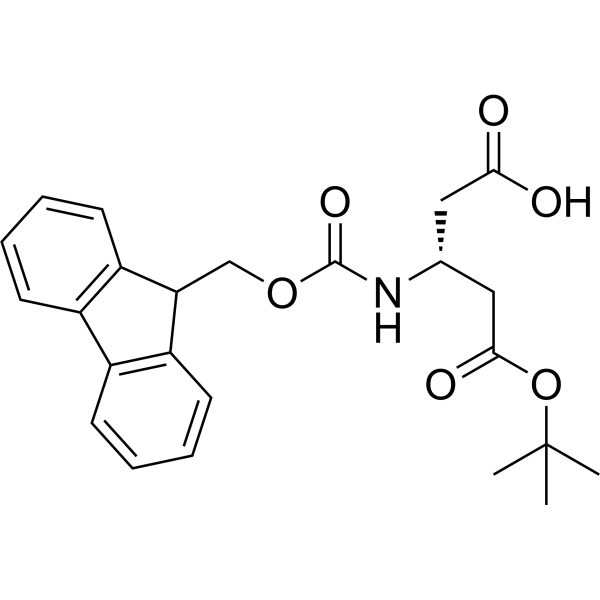
Fmoc-β-HoAsp(OtBu)-OH (CAS#: 209252-17-5) is also known as (3R)-3-(9H-fluoren-9-ylmethoxycarbonylamino)-5-[(2-methylpropan-2-yl)oxy]-5-oxopentanoic acid. Its molecular formula is C₂₄H₂₇NO₆ and molecular weight is 425.47. It is a glutamic acid derivative and a protected β³-homoamino acid building block for Fmoc/tBu SPPS. It has no approved therapeutic indications.
|
| Molecular Formula |
C24H27NO6
|
|---|---|
| Molecular Weight |
425.47428
|
| Exact Mass |
425.184
|
| CAS # |
209252-17-5
|
| PubChem CID |
2761514
|
| Appearance |
White to off-white powder
|
| Density |
1.232g/cm3
|
| Boiling Point |
637ºC at 760 mmHg
|
| Flash Point |
339.1ºC
|
| Vapour Pressure |
4.22E-17mmHg at 25°C
|
| Index of Refraction |
1.57
|
| LogP |
4.491
|
| Hydrogen Bond Donor Count |
2
|
| Hydrogen Bond Acceptor Count |
6
|
| Rotatable Bond Count |
10
|
| Heavy Atom Count |
31
|
| Complexity |
635
|
| Defined Atom Stereocenter Count |
1
|
| SMILES |
CC(C)(C)OC(=O)C[C@@H](CC(=O)O)NC(=O)OCC1C2=C(C=CC=C2)C3=C1C=CC=C3
|
| InChi Key |
XXXSUGLINJXRGT-OAHLLOKOSA-N
|
| InChi Code |
InChI=1S/C24H27NO6/c1-24(2,3)31-22(28)13-15(12-21(26)27)25-23(29)30-14-20-18-10-6-4-8-16(18)17-9-5-7-11-19(17)20/h4-11,15,20H,12-14H2,1-3H3,(H,25,29)(H,26,27)/t15-/m1/s1
|
| Chemical Name |
(3R)-3-(9H-fluoren-9-ylmethoxycarbonylamino)-5-[(2-methylpropan-2-yl)oxy]-5-oxopentanoic acid
|
| Synonyms |
Fmoc-β-HoAsp(OtBu)-OH
|
| HS Tariff Code |
2934.99.9001
|
| Storage |
Powder -20°C 3 years 4°C 2 years In solvent -80°C 6 months -20°C 1 month |
| Shipping Condition |
Room temperature (This product is stable at ambient temperature for a few days during ordinary shipping and time spent in Customs)
|
| Solubility (In Vitro) |
May dissolve in DMSO (in most cases), if not, try other solvents such as H2O, Ethanol, or DMF with a minute amount of products to avoid loss of samples
|
|---|---|
| Solubility (In Vivo) |
Note: Listed below are some common formulations that may be used to formulate products with low water solubility (e.g. < 1 mg/mL), you may test these formulations using a minute amount of products to avoid loss of samples.
Injection Formulations
Injection Formulation 1: DMSO : Tween 80: Saline = 10 : 5 : 85 (i.e. 100 μL DMSO stock solution → 50 μL Tween 80 → 850 μL Saline)(e.g. IP/IV/IM/SC) *Preparation of saline: Dissolve 0.9 g of sodium chloride in 100 mL ddH ₂ O to obtain a clear solution. Injection Formulation 2: DMSO : PEG300 :Tween 80 : Saline = 10 : 40 : 5 : 45 (i.e. 100 μL DMSO → 400 μLPEG300 → 50 μL Tween 80 → 450 μL Saline) Injection Formulation 3: DMSO : Corn oil = 10 : 90 (i.e. 100 μL DMSO → 900 μL Corn oil) Example: Take the Injection Formulation 3 (DMSO : Corn oil = 10 : 90) as an example, if 1 mL of 2.5 mg/mL working solution is to be prepared, you can take 100 μL 25 mg/mL DMSO stock solution and add to 900 μL corn oil, mix well to obtain a clear or suspension solution (2.5 mg/mL, ready for use in animals). View More
Injection Formulation 4: DMSO : 20% SBE-β-CD in saline = 10 : 90 [i.e. 100 μL DMSO → 900 μL (20% SBE-β-CD in saline)] Oral Formulations
Oral Formulation 1: Suspend in 0.5% CMC Na (carboxymethylcellulose sodium) Oral Formulation 2: Suspend in 0.5% Carboxymethyl cellulose Example: Take the Oral Formulation 1 (Suspend in 0.5% CMC Na) as an example, if 100 mL of 2.5 mg/mL working solution is to be prepared, you can first prepare 0.5% CMC Na solution by measuring 0.5 g CMC Na and dissolve it in 100 mL ddH2O to obtain a clear solution; then add 250 mg of the product to 100 mL 0.5% CMC Na solution, to make the suspension solution (2.5 mg/mL, ready for use in animals). View More
Oral Formulation 3: Dissolved in PEG400 (Please use freshly prepared in vivo formulations for optimal results.) |
| Preparing Stock Solutions | 1 mg | 5 mg | 10 mg | |
| 1 mM | 2.3503 mL | 11.7517 mL | 23.5034 mL | |
| 5 mM | 0.4701 mL | 2.3503 mL | 4.7007 mL | |
| 10 mM | 0.2350 mL | 1.1752 mL | 2.3503 mL |
*Note: Please select an appropriate solvent for the preparation of stock solution based on your experiment needs. For most products, DMSO can be used for preparing stock solutions (e.g. 5 mM, 10 mM, or 20 mM concentration); some products with high aqueous solubility may be dissolved in water directly. Solubility information is available at the above Solubility Data section. Once the stock solution is prepared, aliquot it to routine usage volumes and store at -20°C or -80°C. Avoid repeated freeze and thaw cycles.
Calculation results
Working concentration: mg/mL;
Method for preparing DMSO stock solution: mg drug pre-dissolved in μL DMSO (stock solution concentration mg/mL). Please contact us first if the concentration exceeds the DMSO solubility of the batch of drug.
Method for preparing in vivo formulation::Take μL DMSO stock solution, next add μL PEG300, mix and clarify, next addμL Tween 80, mix and clarify, next add μL ddH2O,mix and clarify.
(1) Please be sure that the solution is clear before the addition of next solvent. Dissolution methods like vortex, ultrasound or warming and heat may be used to aid dissolving.
(2) Be sure to add the solvent(s) in order.
Products are for research use only; We do not sell to patients
Copyright 2020 InvivoChem LLC | All Rights Reserved


