| Size | Price | Stock | Qty |
|---|---|---|---|
| 5mg |
|
||
| 10mg |
|
||
| 100mg | |||
| Other Sizes |


| Targets |
Creatine riboside does not have a well-defined drug target. It is a naturally occurring metabolite found in urine. Its primary significance is as a biomarker for lung cancer, where its levels in urine are associated with disease risk and prognosis.
|
|---|---|
| ln Vitro |
In vitro, creatine riboside is not typically used in cell-based assays as a drug. Its role is as a diagnostic biomarker rather than a therapeutic agent. Its levels can be measured in biological samples to assess disease status.
|
| ln Vivo |
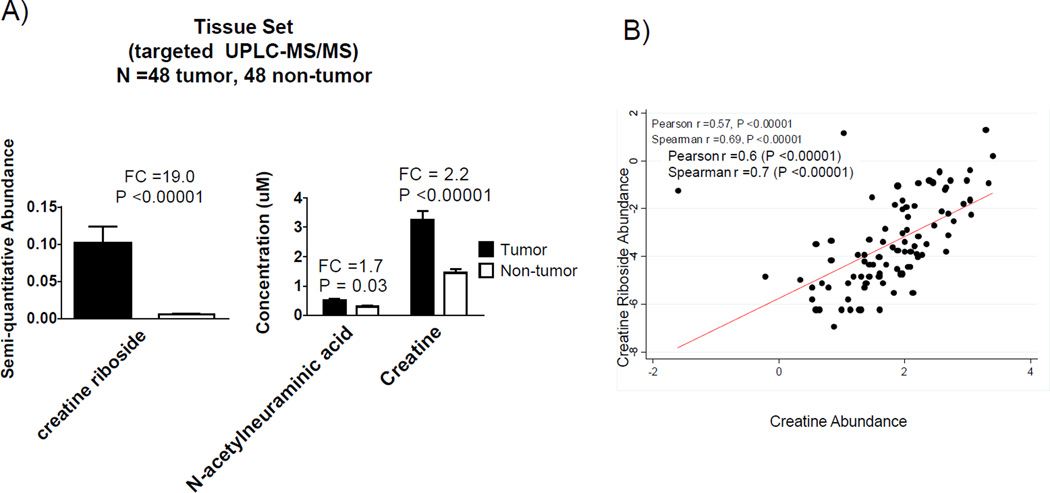
There is a considerable increase in the urine metabolites creatine nucleoside and N-acetylneuraminic acid (NANA) in patients with intrahepatic cholangiocarcinoma (ICC) [2].
In vivo, creatine riboside is a urinary metabolite. Its levels in the body are associated with lung cancer risk and prognosis. As a biomarker, its concentration in urine can be measured to aid in the diagnosis and monitoring of lung cancer. |
| Enzyme Assay |
Cell-free assays for creatine riboside are primarily analytical methods used to detect and quantify the metabolite in biological samples. These assays often involve techniques such as liquid chromatography-mass spectrometry (LC-MS) to measure its concentration in urine.
|
| Cell Assay |
In vitro cell-based assays are not typically used for creatine riboside, as it is a biomarker rather than a therapeutic agent. Its measurement is performed on biological fluids such as urine using analytical chemistry techniques.
|
| Animal Protocol |
In vivo animal experiments for creatine riboside are not typically performed, as it is a naturally occurring metabolite and a biomarker. Its association with lung cancer has been established through clinical studies in humans.
|
| ADME/Pharmacokinetics |
Pharmacokinetic (PK) data for creatine riboside is not available in the public literature, as it is a metabolite rather than a drug. Its levels in the body are determined by its production and excretion. For research use, it is typically stored as a powder.
|
| Toxicity/Toxicokinetics |
Toxicological data for creatine riboside is not available in the public literature, as it is a naturally occurring metabolite. It is not used as a therapeutic agent, so its toxicity profile is not relevant for drug development.
|
| References | |
| Additional Infomation |
Creatine riboside is a research-grade compound used as a urinary metabolite biomarker for lung cancer. It is associated with disease risk and prognosis. It has not been approved for clinical use as a therapeutic agent. All information is for research reference only.
|
| Molecular Formula |
C9H17N3O6
|
|---|---|
| Molecular Weight |
263.247782468796
|
| Exact Mass |
263.11
|
| Elemental Analysis |
C, 41.06; H, 6.51; N, 15.96; O, 36.46
|
| CAS # |
1616693-92-5
|
| PubChem CID |
124173903
|
| Appearance |
Light brown to brown solid powder
|
| LogP |
-2.7
|
| Hydrogen Bond Donor Count |
5
|
| Hydrogen Bond Acceptor Count |
7
|
| Rotatable Bond Count |
5
|
| Heavy Atom Count |
18
|
| Complexity |
336
|
| Defined Atom Stereocenter Count |
4
|
| SMILES |
CN(CC(=O)O)/C(=N/[C@H]1[C@@H]([C@@H]([C@H](O1)CO)O)O)/N
|
| InChi Key |
BGJFEKXALPJEGN-XVFCMESISA-N
|
| InChi Code |
InChI=1S/C9H17N3O6/c1-12(2-5(14)15)9(10)11-8-7(17)6(16)4(3-13)18-8/h4,6-8,13,16-17H,2-3H2,1H3,(H2,10,11)(H,14,15)/t4-,6-,7-,8-/m1/s1
|
| Chemical Name |
2-[[(E)-N'-[(2R,3R,4S,5R)-3,4-dihydroxy-5-(hydroxymethyl)oxolan-2-yl]carbamimidoyl]-methylamino]acetic acid
|
| Synonyms |
Creatine riboside;
|
| HS Tariff Code |
2934.99.9001
|
| Storage |
Powder -20°C 3 years 4°C 2 years In solvent -80°C 6 months -20°C 1 month |
| Shipping Condition |
Room temperature (This product is stable at ambient temperature for a few days during ordinary shipping and time spent in Customs)
|
| Solubility (In Vitro) |
DMSO : ~4.67 mg/mL (~17.74 mM)
|
|---|---|
| Solubility (In Vivo) |
Note: Listed below are some common formulations that may be used to formulate products with low water solubility (e.g. < 1 mg/mL), you may test these formulations using a minute amount of products to avoid loss of samples.
Injection Formulations
Injection Formulation 1: DMSO : Tween 80: Saline = 10 : 5 : 85 (i.e. 100 μL DMSO stock solution → 50 μL Tween 80 → 850 μL Saline)(e.g. IP/IV/IM/SC) *Preparation of saline: Dissolve 0.9 g of sodium chloride in 100 mL ddH ₂ O to obtain a clear solution. Injection Formulation 2: DMSO : PEG300 :Tween 80 : Saline = 10 : 40 : 5 : 45 (i.e. 100 μL DMSO → 400 μLPEG300 → 50 μL Tween 80 → 450 μL Saline) Injection Formulation 3: DMSO : Corn oil = 10 : 90 (i.e. 100 μL DMSO → 900 μL Corn oil) Example: Take the Injection Formulation 3 (DMSO : Corn oil = 10 : 90) as an example, if 1 mL of 2.5 mg/mL working solution is to be prepared, you can take 100 μL 25 mg/mL DMSO stock solution and add to 900 μL corn oil, mix well to obtain a clear or suspension solution (2.5 mg/mL, ready for use in animals). View More
Injection Formulation 4: DMSO : 20% SBE-β-CD in saline = 10 : 90 [i.e. 100 μL DMSO → 900 μL (20% SBE-β-CD in saline)] Oral Formulations
Oral Formulation 1: Suspend in 0.5% CMC Na (carboxymethylcellulose sodium) Oral Formulation 2: Suspend in 0.5% Carboxymethyl cellulose Example: Take the Oral Formulation 1 (Suspend in 0.5% CMC Na) as an example, if 100 mL of 2.5 mg/mL working solution is to be prepared, you can first prepare 0.5% CMC Na solution by measuring 0.5 g CMC Na and dissolve it in 100 mL ddH2O to obtain a clear solution; then add 250 mg of the product to 100 mL 0.5% CMC Na solution, to make the suspension solution (2.5 mg/mL, ready for use in animals). View More
Oral Formulation 3: Dissolved in PEG400 (Please use freshly prepared in vivo formulations for optimal results.) |
| Preparing Stock Solutions | 1 mg | 5 mg | 10 mg | |
| 1 mM | 3.7987 mL | 18.9934 mL | 37.9867 mL | |
| 5 mM | 0.7597 mL | 3.7987 mL | 7.5973 mL | |
| 10 mM | 0.3799 mL | 1.8993 mL | 3.7987 mL |
*Note: Please select an appropriate solvent for the preparation of stock solution based on your experiment needs. For most products, DMSO can be used for preparing stock solutions (e.g. 5 mM, 10 mM, or 20 mM concentration); some products with high aqueous solubility may be dissolved in water directly. Solubility information is available at the above Solubility Data section. Once the stock solution is prepared, aliquot it to routine usage volumes and store at -20°C or -80°C. Avoid repeated freeze and thaw cycles.
Calculation results
Working concentration: mg/mL;
Method for preparing DMSO stock solution: mg drug pre-dissolved in μL DMSO (stock solution concentration mg/mL). Please contact us first if the concentration exceeds the DMSO solubility of the batch of drug.
Method for preparing in vivo formulation::Take μL DMSO stock solution, next add μL PEG300, mix and clarify, next addμL Tween 80, mix and clarify, next add μL ddH2O,mix and clarify.
(1) Please be sure that the solution is clear before the addition of next solvent. Dissolution methods like vortex, ultrasound or warming and heat may be used to aid dissolving.
(2) Be sure to add the solvent(s) in order.
|
Products are for research use only; We do not sell to patients
Copyright 2020 InvivoChem LLC | All Rights Reserved