| Size | Price | Stock | Qty |
|---|---|---|---|
| 1mg |
|
||
| Other Sizes |


| Targets |
CMP8's primary target is the estrogen receptor (ER), specifically the mutant estrogen receptor ligand binding domain (ERLBD). It binds to the ERLBD with IC50 values of 29 nM for MGERα, 41 nM for MGRERα, 1100 nM for human ERα (hERα), and 2200 nM for human ERβ (hERβ). This selectivity profile makes it a valuable tool for studying the function of specific estrogen receptor isoforms and mutants.
|
|---|---|
| ln Vitro |
In vitro, CMP8 is a selective ligand for the estrogen receptor, binding to the mutant ERLBD with high affinity. It has IC50 values of 29 nM for MGERα and 41 nM for MGRERα, indicating potent activity against these mutant receptors. Its affinity for wild-type hERα (IC50 = 1100 nM) and hERβ (IC50 = 2200 nM) is significantly lower, demonstrating its selectivity for the mutant receptors.
|
| ln Vivo |
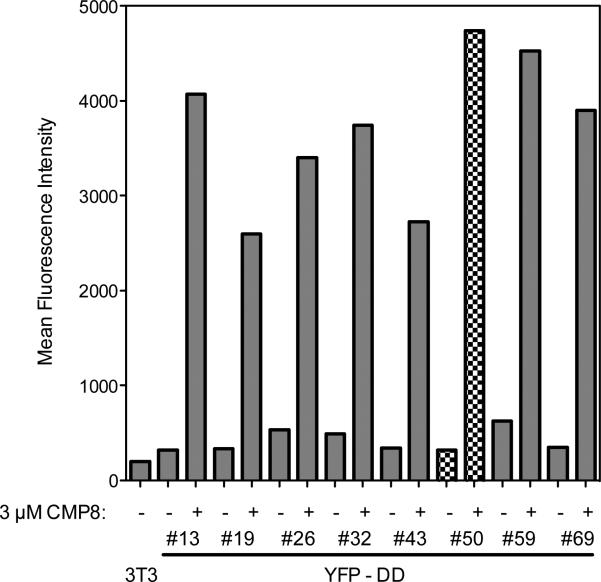
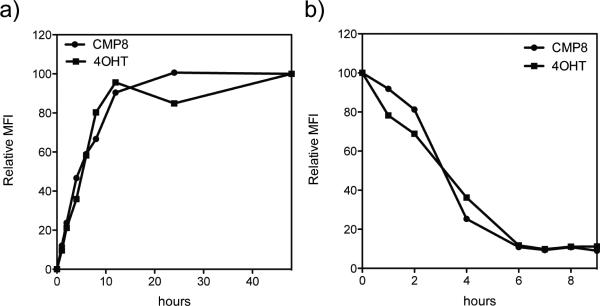
Male Balb-c mice were given 4 mg/kg of CMP8 (compound 20h) intraperitoneally. After 4 hours, the Cmax is 0.5 µM, and after 30 minutes, the plasma concentration is 1.5 times the EC50 in mammalian cells[1][2].
Specific in vivo activity data for CMP8 is not detailed in the provided search results. As a research tool for studying estrogen receptor function, its effects are primarily studied in cellular and biochemical systems. In vivo studies would likely involve administration to animal models to assess its effects on estrogen receptor signaling and its potential role in estrogen-related diseases. |
| Enzyme Assay |
The in vitro activity of CMP8 is assessed using radioligand binding assays. In these assays, the estrogen receptor ligand binding domain (ERLBD) is incubated with a radiolabeled estrogen (e.g., [3H]estradiol) in the presence of varying concentrations of CMP8. The displacement of the radiolabeled ligand is measured to calculate the inhibition constant (Ki) or IC50. The selectivity of CMP8 for different ER isoforms (e.g., MGERα, MGRERα, hERα, hERβ) is assessed by performing the binding assay with each isoform separately.
|
| Cell Assay |
For cellular assays, cell lines expressing wild-type or mutant estrogen receptors are used. Cells are cultured in estrogen-depleted media and treated with various concentrations of CMP8 (typically ranging from 0.1 nM to 10 µM) for different time periods (e.g., 24-48 hours). The activation of estrogen receptor signaling is assessed by measuring the expression of estrogen-responsive genes (e.g., pS2, progesterone receptor) using quantitative real-time PCR or by using reporter gene assays with an estrogen-responsive element (ERE)-driven luciferase reporter. The effect on cell proliferation is assessed using the MTT or cell counting assays.
|
| Animal Protocol |
In vivo studies with CMP8 are not well-documented in the provided search results. If conducted, they would likely involve administration of the compound to animal models (e.g., mice) via intraperitoneal or oral administration. The compound would be formulated in a suitable vehicle (e.g., DMSO or a mixture of DMSO and corn oil). Tissue samples (e.g., uterus, mammary gland, bone) would be collected to assess estrogen receptor signaling and the effects on estrogen-responsive tissues.
|
| ADME/Pharmacokinetics |
Specific pharmacokinetic data for CMP8 is not available in the provided search results. As a small molecule with a molecular weight of 463.99 g/mol, it is expected to have reasonable cell permeability. Its solubility and stability would require further investigation.
|
| Toxicity/Toxicokinetics |
Specific toxicity data for CMP8 is not available in the provided search results. As a research compound used at low concentrations in cell-based assays, it is generally considered to have a low toxicity profile. However, standard safety precautions should be taken when handling the compound in the laboratory.
|
| References |
[1]. Miyazaki Y, et al. Destabilizing domains derived from the human estrogen receptor. J Am Chem Soc. 2012 Mar 7;134(9):3942-5.
[2]. Kinzel O, et al. A structure-guided approach to an orthogonal estrogen-receptor-based gene switch activated by ligands suitable for in vivo studies. J Med Chem. 2006 Sep 7;49(18):5404-7. |
| Additional Infomation |
CMP8 is a research tool used to study estrogen receptor function, particularly in the context of the "bump and hole" technique. This technique allows researchers to study the function of a specific protein isoform by introducing a mutation (the "hole") into the protein that can be selectively bound by a complementary ligand (the "bump"). CMP8 is the ligand designed to bind to the mutant estrogen receptor, enabling the selective modulation of the mutant receptor's activity without affecting the wild-type receptor. It is not a pharmaceutical drug and is intended for research purposes only.
|
| Molecular Formula |
C33H34CLNO3
|
|---|---|
| Molecular Weight |
528.08
|
| Exact Mass |
527.222
|
| CAS # |
851107-28-3
|
| PubChem CID |
16082575
|
| Appearance |
Typically exists as solid at room temperature
|
| Density |
1.3±0.1 g/cm3
|
| Boiling Point |
703.5±60.0 °C at 760 mmHg
|
| Flash Point |
379.3±32.9 °C
|
| Vapour Pressure |
0.0±2.3 mmHg at 25°C
|
| Index of Refraction |
1.667
|
| LogP |
8.38
|
| Hydrogen Bond Donor Count |
1
|
| Hydrogen Bond Acceptor Count |
4
|
| Rotatable Bond Count |
7
|
| Heavy Atom Count |
38
|
| Complexity |
852
|
| Defined Atom Stereocenter Count |
0
|
| SMILES |
ClC1C=CC(=CC=1)CC12CCC(C(C3C=CC(=CC=3)OCCN3CCCCC3)=C1C1C=CC(=CC=1C2)O)=O
|
| InChi Key |
YHOXIEXEPIIKMD-UHFFFAOYSA-N
|
| InChi Code |
InChI=1S/C33H34ClNO3/c34-26-8-4-23(5-9-26)21-33-15-14-30(37)31(32(33)29-13-10-27(36)20-25(29)22-33)24-6-11-28(12-7-24)38-19-18-35-16-2-1-3-17-35/h4-13,20,36H,1-3,14-19,21-22H2
|
| Chemical Name |
9a-[(4-chlorophenyl)methyl]-7-hydroxy-4-[4-(2-piperidin-1-ylethoxy)phenyl]-2,9-dihydro-1H-fluoren-3-one
|
| Synonyms |
CMP 8 CMP-8 CMP8
|
| HS Tariff Code |
2934.99.9001
|
| Storage |
Powder -20°C 3 years 4°C 2 years In solvent -80°C 6 months -20°C 1 month |
| Shipping Condition |
Room temperature (This product is stable at ambient temperature for a few days during ordinary shipping and time spent in Customs)
|
| Solubility (In Vitro) |
May dissolve in DMSO (in most cases), if not, try other solvents such as H2O, Ethanol, or DMF with a minute amount of products to avoid loss of samples
|
|---|---|
| Solubility (In Vivo) |
Note: Listed below are some common formulations that may be used to formulate products with low water solubility (e.g. < 1 mg/mL), you may test these formulations using a minute amount of products to avoid loss of samples.
Injection Formulations
Injection Formulation 1: DMSO : Tween 80: Saline = 10 : 5 : 85 (i.e. 100 μL DMSO stock solution → 50 μL Tween 80 → 850 μL Saline)(e.g. IP/IV/IM/SC) *Preparation of saline: Dissolve 0.9 g of sodium chloride in 100 mL ddH ₂ O to obtain a clear solution. Injection Formulation 2: DMSO : PEG300 :Tween 80 : Saline = 10 : 40 : 5 : 45 (i.e. 100 μL DMSO → 400 μLPEG300 → 50 μL Tween 80 → 450 μL Saline) Injection Formulation 3: DMSO : Corn oil = 10 : 90 (i.e. 100 μL DMSO → 900 μL Corn oil) Example: Take the Injection Formulation 3 (DMSO : Corn oil = 10 : 90) as an example, if 1 mL of 2.5 mg/mL working solution is to be prepared, you can take 100 μL 25 mg/mL DMSO stock solution and add to 900 μL corn oil, mix well to obtain a clear or suspension solution (2.5 mg/mL, ready for use in animals). View More
Injection Formulation 4: DMSO : 20% SBE-β-CD in saline = 10 : 90 [i.e. 100 μL DMSO → 900 μL (20% SBE-β-CD in saline)] Oral Formulations
Oral Formulation 1: Suspend in 0.5% CMC Na (carboxymethylcellulose sodium) Oral Formulation 2: Suspend in 0.5% Carboxymethyl cellulose Example: Take the Oral Formulation 1 (Suspend in 0.5% CMC Na) as an example, if 100 mL of 2.5 mg/mL working solution is to be prepared, you can first prepare 0.5% CMC Na solution by measuring 0.5 g CMC Na and dissolve it in 100 mL ddH2O to obtain a clear solution; then add 250 mg of the product to 100 mL 0.5% CMC Na solution, to make the suspension solution (2.5 mg/mL, ready for use in animals). View More
Oral Formulation 3: Dissolved in PEG400 (Please use freshly prepared in vivo formulations for optimal results.) |
| Preparing Stock Solutions | 1 mg | 5 mg | 10 mg | |
| 1 mM | 1.8937 mL | 9.4683 mL | 18.9365 mL | |
| 5 mM | 0.3787 mL | 1.8937 mL | 3.7873 mL | |
| 10 mM | 0.1894 mL | 0.9468 mL | 1.8937 mL |
*Note: Please select an appropriate solvent for the preparation of stock solution based on your experiment needs. For most products, DMSO can be used for preparing stock solutions (e.g. 5 mM, 10 mM, or 20 mM concentration); some products with high aqueous solubility may be dissolved in water directly. Solubility information is available at the above Solubility Data section. Once the stock solution is prepared, aliquot it to routine usage volumes and store at -20°C or -80°C. Avoid repeated freeze and thaw cycles.
Calculation results
Working concentration: mg/mL;
Method for preparing DMSO stock solution: mg drug pre-dissolved in μL DMSO (stock solution concentration mg/mL). Please contact us first if the concentration exceeds the DMSO solubility of the batch of drug.
Method for preparing in vivo formulation::Take μL DMSO stock solution, next add μL PEG300, mix and clarify, next addμL Tween 80, mix and clarify, next add μL ddH2O,mix and clarify.
(1) Please be sure that the solution is clear before the addition of next solvent. Dissolution methods like vortex, ultrasound or warming and heat may be used to aid dissolving.
(2) Be sure to add the solvent(s) in order.
|
|
|
Products are for research use only; We do not sell to patients
Copyright 2020 InvivoChem LLC | All Rights Reserved