| Size | Price | Stock | Qty |
|---|---|---|---|
| 1mg |
|
||
| 5mg |
|
||
| 10mg | |||
| 25mg | |||
| 50mg | |||
| 100mg | |||
| 250mg | |||
| Other Sizes |


Purity: ≥98%
| Targets |
Hsp90α (N-terminal ATP-binding site).
Binding affinity (Kd) measured by surface plasmon resonance: 0.52 nM (reported in abstract) [1]; alternatively, Kd = 2.5 nM (reported in Table 3 for compound 16i) [1]. |
|---|---|
| ln Vitro |
CH5138303 has antifungal efficacy against azole-resistant C when administered in conjunction with FLC. albicans, as evidenced by its 0.500 FICI (fractional inhibitory concentration index)[2].
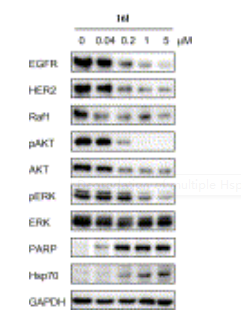
- In vitro cell growth inhibition against human cancer cell lines: HCT116 IC50 = 0.098 μM, NCI-N87 IC50 = 0.066 μM (abstract) [1]; according to Table 3 for compound 16i: HCT116 IC50 = 0.31 μM, NCI-N87 IC50 = 0.31 μM [1]. - The compound reduces the phosphorylation and protein level of multiple Hsp90 client proteins such as EGFR, HER2, Raf1, and AKT (this result is shown for compound 16l, not specifically for CH5138303/16i) [1]. |
| ln Vivo |
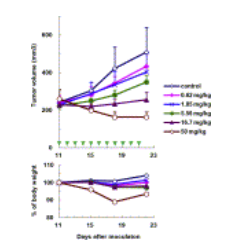
With a median effective dose (ED50) of 3.9 mg/kg and a tumor growth inhibition (TGI) of 136%, CH5138303 (SCID mice carrying NCI-N87 cells, 0-50 mg/kg, Orally, once daily for 11 days) has strong anticancer activity without causing a discernible decrease of body weight[1].
- Potent antitumor efficacy in a human NCI-N87 gastric cancer xenograft mouse model. Mice bearing NCI-N87 tumors were orally treated once daily for 11 consecutive days. At a dose of 50 mg/kg, tumor growth inhibition (TGI) was 136% (Figure 7) [1]. - The median effective dose (ED50) was 3.9 mg/kg without significant loss of body weight [1]. |
| Enzyme Assay |
Surface plasmon resonance (SPR) direct binding assay for Hsp90α. Measurements were performed on a Biacore2000 at a flow rate of 30 μL/min, 25 °C in 50 mM Tris-based saline, pH 7.6, containing 0.005% surfactant. Human N-terminal Hsp90α was immobilized. Binding affinity (Kd) was determined. For CH5138303 (16i), Kd = 2.5 nM (Table 3) [1].
|
| Cell Assay |
In vitro cell growth inhibition assay using HCT116 (colorectal cancer) and NCI-N87 (gastric cancer) cell lines. Cells were cultured according to standard conditions. Cells suspended in medium were added to solutions containing various concentrations of the test compound and incubated at 37 °C in 5% CO2. After 4 days, a cell counting kit solution was added and absorbance at 450 nm was measured. Anti-proliferative activity was calculated as (1 − T/C) × 100%, where T is absorbance of treated cells and C of untreated controls. IC50 values were calculated. For CH5138303 (16i), IC50 values are 0.31 μM against both HCT116 and NCI-N87 (Table 3) [1].
|
| Animal Protocol |
50 mg/kg; p.o.
Human NCI-N87 gastric cancer xenograft model. - Pharmacokinetic study in female athymic nu/nu mice. The test compound was dissolved in vehicle: 10% DMSO / 10% Cremophor EL / 0.025 N HCl in water. Administration routes: intravenous (iv) and oral (po). For iv dosing, blood samples were collected at 2, 15 min, 1, 2, 4, 7, and 24 h post-dose. For po dosing, samples were collected at 30 min, 1, 2, 4, 7, and 24 h post-dose. Plasma was separated by centrifugation and stored at −80 °C. Concentrations were measured by LC-MS/MS. Pharmacokinetic parameters were calculated by non-compartmental analysis [1]. - In vivo antitumor efficacy study: NCI-N87 gastric cancer xenograft model. Cancer cells (0.5–1×10^7) were implanted subcutaneously into the right flank of athymic nude (BALB/c nu/nu) mice. When tumor volume reached approximately 200–300 mm³, animals were randomized (n=4 or 5 per group) and treatment initiated. CH5138303 was dissolved in 10% DMSO / 10% Cremophor EL / 0.025 N HCl in water and orally administered once daily for 11 consecutive days at doses of 0.62, 1.85, 5.56, 16.7, and 50 mg/kg. Tumor volume was calculated as TV = a × b² / 2 (a = length, b = width). TGI was calculated as [1 − (Tt − T0) / (Ct − C0)] × 100%. Body weight and tumor volume were measured twice a week [1]. |
| ADME/Pharmacokinetics |
Pharmacokinetic parameters in nude mice (compound 16i / CH5138303):
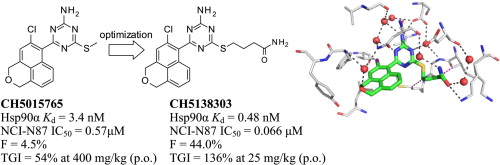
Intravenous (iv) at 1 mg/kg: t1/2 = 0.96 h, Cmax = 24.9 μg/mL, AUCinf = 40.3 μg·h/mL, CL = 24.8 mL/h/kg. Oral (po) at 5 mg/kg: t1/2 = 0.94 h, tmax = 0.75 h, Cmax = 36.7 μg/mL, AUCinf = 54.8 μg·h/mL, CL/F = 93.8 mL/h/kg, oral bioavailability (F) = 44.0%. Compared to lead compound CH5015765 (7), CH5138303 showed improved total systemic exposure (AUC), plasma clearance (CL), and oral bioavailability [1]. |
| Toxicity/Toxicokinetics |
In the NCI-N87 xenograft study, treatment with CH5138303 at doses up to 50 mg/kg (once daily for 11 days) did not cause significant loss of body weight, indicating tolerability at these doses. No other toxicity data are reported [1].
|
| References |
|
| Additional Infomation |
- CH5138303 is an orally bioavailable Hsp90 inhibitor that binds to the N-terminal ATP-binding site, preventing ATP binding and leading to degradation of multiple oncogenic client proteins involved in tumor progression [1].
- The compound was identified through structure-based drug design starting from lead CH5015765, with optimization of affinity, water solubility, liver microsomal stability, and cell growth inhibitory activity [1]. - In the X-ray cocrystal structure of a related analog (16l) with Hsp90, hydrogen bonds via water molecules and lipophilic interactions with Met98 and Ile96 contribute to improved affinity. Although not directly shown for CH5138303, the structural class shares similar binding modes [1]. |
| Molecular Formula |
C19H18CLN5O2S
|
|
|---|---|---|
| Molecular Weight |
415.9
|
|
| Exact Mass |
415.087
|
|
| CAS # |
959763-06-5
|
|
| Related CAS # |
|
|
| PubChem CID |
25066238
|
|
| Appearance |
White to off-white solid powder
|
|
| LogP |
4.596
|
|
| Hydrogen Bond Donor Count |
2
|
|
| Hydrogen Bond Acceptor Count |
7
|
|
| Rotatable Bond Count |
6
|
|
| Heavy Atom Count |
28
|
|
| Complexity |
558
|
|
| Defined Atom Stereocenter Count |
0
|
|
| SMILES |
C1C2=C3C(=CC(=C(C3=CC=C2)C4=NC(=NC(=N4)SCCCC(=O)N)N)Cl)CO1
|
|
| InChi Key |
VIGHQZSTZWNWFA-UHFFFAOYSA-N
|
|
| InChi Code |
InChI=1S/C19H18ClN5O2S/c20-13-7-11-9-27-8-10-3-1-4-12(15(10)11)16(13)17-23-18(22)25-19(24-17)28-6-2-5-14(21)26/h1,3-4,7H,2,5-6,8-9H2,(H2,21,26)(H2,22,23,24,25)
|
|
| Chemical Name |
4-((4-amino-6-(5-chloro-1,3-dihydrobenzo[de]isochromen-6-yl)-1,3,5-triazin-2-yl)thio)butanamide
|
|
| Synonyms |
|
|
| HS Tariff Code |
2934.99.9001
|
|
| Storage |
Powder -20°C 3 years 4°C 2 years In solvent -80°C 6 months -20°C 1 month Note: This product requires protection from light (avoid light exposure) during transportation and storage. |
|
| Shipping Condition |
Room temperature (This product is stable at ambient temperature for a few days during ordinary shipping and time spent in Customs)
|
| Solubility (In Vitro) |
DMSO: 83 mg/mL (199.6 mM)
Water: 1 mg/mL (Insoluble) Ethanol: 1 mg/mL |
|---|---|
| Solubility (In Vivo) |
Solubility in Formulation 1: ≥ 2.5 mg/mL (6.01 mM) (saturation unknown) in 10% DMSO + 90% (20% SBE-β-CD in Saline) (add these co-solvents sequentially from left to right, and one by one), Clear solution.
For example, if 1 mL of working solution is to be prepared, you can add 100 μL of DMSO stock solution (25.0 mg/mL) to 900 μL of 20% SBE-β-CD saline and mix well. Preparation of 20% SBE-β-CD in Saline (4°C,1 week): Dissolve 2 g SBE-β-CD in 10 mL saline to obtain a clear solution. Solubility in Formulation 2: ≥ 2.5 mg/mL (6.01 mM) (saturation unknown) in 10% DMSO + 90% Corn Oil (add these co-solvents sequentially from left to right, and one by one), Clear solution. For example, if 1 mL of working solution is to be prepared, you can add 100 μL of DMSO stock solution (25.0 mg/mL) to 900 μL of corn oil and mix well. (Please use freshly prepared in vivo formulations for optimal results.) |
| Preparing Stock Solutions | 1 mg | 5 mg | 10 mg | |
| 1 mM | 2.4044 mL | 12.0221 mL | 24.0442 mL | |
| 5 mM | 0.4809 mL | 2.4044 mL | 4.8088 mL | |
| 10 mM | 0.2404 mL | 1.2022 mL | 2.4044 mL |
*Note: Please select an appropriate solvent for the preparation of stock solution based on your experiment needs. For most products, DMSO can be used for preparing stock solutions (e.g. 5 mM, 10 mM, or 20 mM concentration); some products with high aqueous solubility may be dissolved in water directly. Solubility information is available at the above Solubility Data section. Once the stock solution is prepared, aliquot it to routine usage volumes and store at -20°C or -80°C. Avoid repeated freeze and thaw cycles.
Calculation results
Working concentration: mg/mL;
Method for preparing DMSO stock solution: mg drug pre-dissolved in μL DMSO (stock solution concentration mg/mL). Please contact us first if the concentration exceeds the DMSO solubility of the batch of drug.
Method for preparing in vivo formulation::Take μL DMSO stock solution, next add μL PEG300, mix and clarify, next addμL Tween 80, mix and clarify, next add μL ddH2O,mix and clarify.
(1) Please be sure that the solution is clear before the addition of next solvent. Dissolution methods like vortex, ultrasound or warming and heat may be used to aid dissolving.
(2) Be sure to add the solvent(s) in order.
|
|---|
|
|
Products are for research use only; We do not sell to patients
Copyright 2020 InvivoChem LLC | All Rights Reserved


 COA
COA