yingweiwo

Bis-T-23

Cat No.:V11373 Purity: ≥98%
Bis-T-23 (AG1717), a tyrphostin analogue, is an HIV-I integrase inhibitor.
Bis-T-23
Bis-T-23 Chemical Structure CAS No.: 171674-76-3
Product category: New1
This product is for research use only, not for human use. We do not sell to patients.
Size Price Stock Qty
1mg
Other Sizes
Official Supplier of:
Alternate Text
Alternate Text
Alternate Text
Alternate Text
Alternate Text
Alternate Text
Alternate Text
Alternate Text
Alternate Text
Alternate Text
Alternate Text
Alternate Text
Alternate Text
Alternate Text
Alternate Text
Alternate Text
Alternate Text
Alternate Text
Alternate Text
Alternate Text
Alternate Text
Alternate Text
Alternate Text
Alternate Text
Alternate Text
Alternate Text
Alternate Text
Alternate Text
Alternate Text
Alternate Text
Alternate Text
Alternate Text


  • Business Relationship with 5000+ Clients Globally
  • Major Universities, Research Institutions, Biotech & Pharma
  • Citations by Top Journals: Nature, Cell, Science, etc.
Top Publications Citing lnvivochem Products
Product Description
Bis-T-23 (AG1717), a tyrphostin analogue, is an HIV-I integrase inhibitor. Bis-T-23 promotes actin-dependent dynein oligomerization. Bis-T-23 may be utilized in HIV and chronic kidney disease (CKD) research.
Bis-T-23 (CAS 171674-76-3), also known as AG1717, is a tyrphostin derivative and an HIV-I integrase inhibitor. It can promote actin-dependent dynamin oligomerization. Bis-T-23 was originally discovered to inhibit phosphatidylserine-induced dynamin 1 GTPase activity with an IC50 of 1.7 µM. It can be used for the research of HIV and chronic kidney diseases (CKD).
Biological Activity I Assay Protocols (From Reference)
Targets
Bis-T-23 targets HIV-1 integrase, an enzyme essential for the replication of the HIV virus. It acts as an inhibitor of this enzyme. It also targets dynamin, a GTPase involved in endocytosis and other cellular processes. By promoting dynamin oligomerization and inhibiting its GTPase activity, Bis-T-23 modulates cellular trafficking and signaling.
ln Vitro
Via its 0.18 μM dose, Bis-T-23 (AG1717) inhibits HIV-1 integrase [2]. The binding of integrase to substrate DNA is inhibited by AG1717 (2 μM)[2].
In vitro, Bis-T-23 inhibits HIV-1 integrase activity. It also inhibits phosphatidylserine-induced dynamin 1 GTPase activity with an IC50 of 1.7 µM. It promotes actin-dependent dynamin oligomerization. These activities demonstrate its ability to modulate both viral replication and cellular trafficking processes.
ln Vivo
Bis-T-23 (1 ng) targets the oligomerization of the actin kinase dynein in podocytes to promote proper GFB activity [1]. Bis-T-23 (ip; 20, 40 mg/kg) improves proteinuria by altering actin dynamics [1]. Bis-T-23 (ip; 20, 40 mg/kg) relieves or avoids proteinuria in numerous hereditary and chronic glomerular disease models in wild animals
In vivo, Bis-T-23 has been studied for its potential in the treatment of HIV and chronic kidney diseases (CKD). By inhibiting HIV-1 integrase, it may prevent viral replication. Its effects on dynamin may be relevant to kidney disease. However, specific details of in vivo efficacy studies are not extensively detailed in the available literature.
Enzyme Assay
The in vitro enzyme assay for Bis-T-23 measures its ability to inhibit HIV-1 integrase activity. These cell-free assays use purified integrase and a DNA substrate. The compound's inhibitory potency is determined by measuring the reduction in integration activity. Its effects on dynamin GTPase activity can be assessed using similar assays with purified dynamin.
Cell Assay
In vitro cellular assays for Bis-T-23 assess its effects on HIV replication and cellular trafficking. HIV-infected cells are treated with Bis-T-23, and viral replication is measured. Its effects on dynamin-mediated endocytosis and other cellular processes can also be assessed. These assays demonstrate the compound's functional activity in a relevant cellular context.
Animal Protocol
Animal/Disease Models: zebrafish[1]
Doses: 1 ng
Route of Administration: Injection
Experimental Results:Promotes the oligomerization of zebrafish Dyn2. Increases the number of focal adhesions (FA) and stress fibers in cultured podocytes.
In vivo animal studies for Bis-T-23 have been conducted in models of HIV infection and chronic kidney disease to evaluate its efficacy. However, specific details of these studies are not extensively detailed in the available literature. It is a research compound and is not approved for clinical use.
ADME/Pharmacokinetics
Specific pharmacokinetic data for Bis-T-23 are not extensively detailed in the available literature. As a small molecule, its pharmacokinetic properties would be important for its in vivo efficacy. However, specific parameters such as half-life and bioavailability are not provided. It is intended for research use only.
Toxicity/Toxicokinetics
Specific toxicity data for Bis-T-23 are not extensively detailed in the available literature. As an HIV integrase inhibitor and dynamin modulator, its toxicity profile is likely related to its mechanism of action. However, its potential for treating HIV and CKD suggests a manageable safety profile. It is intended for research purposes only.
References

[1]. Pharmacological targeting of actin-dependent dynamin oligomerization ameliorates chronic kidney disease in diverse animal models. Nat Med. 2015;21(6):601-609.

[2]. Effects of Tyrphostins, Protein Kinase Inhibitors, on Human Immunodeficiency Virus Type 1 Integrase. Biochemistry, 1995, 34(46), 15111–15122.

Additional Infomation
Bis-T-23 (AG1717) is a tyrphostin derivative and an HIV-I integrase inhibitor. It promotes actin-dependent dynamin oligomerization and inhibits dynamin 1 GTPase activity. It can be used for the research of HIV and chronic kidney diseases (CKD). It is not approved for clinical use and is intended for research purposes only.
These protocols are for reference only. InvivoChem does not independently validate these methods.
Physicochemical Properties
Molecular Formula
C23H20N4O8
Molecular Weight
480.426905632019
Exact Mass
480.128
CAS #
171674-76-3
PubChem CID
5468833
Appearance
Light yellow to yellow solid powder
LogP
1.1
Hydrogen Bond Donor Count
8
Hydrogen Bond Acceptor Count
10
Rotatable Bond Count
8
Heavy Atom Count
35
Complexity
834
Defined Atom Stereocenter Count
0
SMILES
O=C(/C(/C#N)=C/C1C=C(C(=C(C=1)O)O)O)NCCCNC(/C(/C#N)=C/C1C=C(C(=C(C=1)O)O)O)=O
InChi Key
AAPVOSBVTLGGOU-VHUAAIQRSA-N
InChi Code
InChI=1S/C23H20N4O8/c24-10-14(4-12-6-16(28)20(32)17(29)7-12)22(34)26-2-1-3-27-23(35)15(11-25)5-13-8-18(30)21(33)19(31)9-13/h4-9,28-33H,1-3H2,(H,26,34)(H,27,35)/b14-4+,15-5+
Chemical Name
(E)-2-cyano-N-[3-[[(E)-2-cyano-3-(3,4,5-trihydroxyphenyl)prop-2-enoyl]amino]propyl]-3-(3,4,5-trihydroxyphenyl)prop-2-enamide
HS Tariff Code
2934.99.9001
Storage

Powder      -20°C    3 years

                     4°C     2 years

In solvent   -80°C    6 months

                  -20°C    1 month

Shipping Condition
Room temperature (This product is stable at ambient temperature for a few days during ordinary shipping and time spent in Customs)
Solubility Data
Solubility (In Vitro)
May dissolve in DMSO (in most cases), if not, try other solvents such as H2O, Ethanol, or DMF with a minute amount of products to avoid loss of samples
Solubility (In Vivo)
Note: Listed below are some common formulations that may be used to formulate products with low water solubility (e.g. < 1 mg/mL), you may test these formulations using a minute amount of products to avoid loss of samples.

Injection Formulations
(e.g. IP/IV/IM/SC)
Injection Formulation 1: DMSO : Tween 80: Saline = 10 : 5 : 85 (i.e. 100 μL DMSO stock solution 50 μL Tween 80 850 μL Saline)
*Preparation of saline: Dissolve 0.9 g of sodium chloride in 100 mL ddH ₂ O to obtain a clear solution.
Injection Formulation 2: DMSO : PEG300Tween 80 : Saline = 10 : 40 : 5 : 45 (i.e. 100 μL DMSO 400 μLPEG300 50 μL Tween 80 450 μL Saline)
Injection Formulation 3: DMSO : Corn oil = 10 : 90 (i.e. 100 μL DMSO 900 μL Corn oil)
Example: Take the Injection Formulation 3 (DMSO : Corn oil = 10 : 90) as an example, if 1 mL of 2.5 mg/mL working solution is to be prepared, you can take 100 μL 25 mg/mL DMSO stock solution and add to 900 μL corn oil, mix well to obtain a clear or suspension solution (2.5 mg/mL, ready for use in animals).
View More

Injection Formulation 4: DMSO : 20% SBE-β-CD in saline = 10 : 90 [i.e. 100 μL DMSO 900 μL (20% SBE-β-CD in saline)]
*Preparation of 20% SBE-β-CD in Saline (4°C,1 week): Dissolve 2 g SBE-β-CD in 10 mL saline to obtain a clear solution.
Injection Formulation 5: 2-Hydroxypropyl-β-cyclodextrin : Saline = 50 : 50 (i.e. 500 μL 2-Hydroxypropyl-β-cyclodextrin 500 μL Saline)
Injection Formulation 6: DMSO : PEG300 : castor oil : Saline = 5 : 10 : 20 : 65 (i.e. 50 μL DMSO 100 μLPEG300 200 μL castor oil 650 μL Saline)
Injection Formulation 7: Ethanol : Cremophor : Saline = 10: 10 : 80 (i.e. 100 μL Ethanol 100 μL Cremophor 800 μL Saline)
Injection Formulation 8: Dissolve in Cremophor/Ethanol (50 : 50), then diluted by Saline
Injection Formulation 9: EtOH : Corn oil = 10 : 90 (i.e. 100 μL EtOH 900 μL Corn oil)
Injection Formulation 10: EtOH : PEG300Tween 80 : Saline = 10 : 40 : 5 : 45 (i.e. 100 μL EtOH 400 μLPEG300 50 μL Tween 80 450 μL Saline)


Oral Formulations
Oral Formulation 1: Suspend in 0.5% CMC Na (carboxymethylcellulose sodium)
Oral Formulation 2: Suspend in 0.5% Carboxymethyl cellulose
Example: Take the Oral Formulation 1 (Suspend in 0.5% CMC Na) as an example, if 100 mL of 2.5 mg/mL working solution is to be prepared, you can first prepare 0.5% CMC Na solution by measuring 0.5 g CMC Na and dissolve it in 100 mL ddH2O to obtain a clear solution; then add 250 mg of the product to 100 mL 0.5% CMC Na solution, to make the suspension solution (2.5 mg/mL, ready for use in animals).
View More

Oral Formulation 3: Dissolved in PEG400
Oral Formulation 4: Suspend in 0.2% Carboxymethyl cellulose
Oral Formulation 5: Dissolve in 0.25% Tween 80 and 0.5% Carboxymethyl cellulose
Oral Formulation 6: Mixing with food powders


Note: Please be aware that the above formulations are for reference only. InvivoChem strongly recommends customers to read literature methods/protocols carefully before determining which formulation you should use for in vivo studies, as different compounds have different solubility properties and have to be formulated differently.

 (Please use freshly prepared in vivo formulations for optimal results.)
Preparing Stock Solutions 1 mg 5 mg 10 mg
1 mM 2.0815 mL 10.4073 mL 20.8147 mL
5 mM 0.4163 mL 2.0815 mL 4.1629 mL
10 mM 0.2081 mL 1.0407 mL 2.0815 mL

*Note: Please select an appropriate solvent for the preparation of stock solution based on your experiment needs. For most products, DMSO can be used for preparing stock solutions (e.g. 5 mM, 10 mM, or 20 mM concentration); some products with high aqueous solubility may be dissolved in water directly. Solubility information is available at the above Solubility Data section. Once the stock solution is prepared, aliquot it to routine usage volumes and store at -20°C or -80°C. Avoid repeated freeze and thaw cycles.

Calculator

Molarity Calculator allows you to calculate the mass, volume, and/or concentration required for a solution, as detailed below:

  • Calculate the Mass of a compound required to prepare a solution of known volume and concentration
  • Calculate the Volume of solution required to dissolve a compound of known mass to a desired concentration
  • Calculate the Concentration of a solution resulting from a known mass of compound in a specific volume
An example of molarity calculation using the molarity calculator is shown below:
What is the mass of compound required to make a 10 mM stock solution in 5 ml of DMSO given that the molecular weight of the compound is 350.26 g/mol?
  • Enter 350.26 in the Molecular Weight (MW) box
  • Enter 10 in the Concentration box and choose the correct unit (mM)
  • Enter 5 in the Volume box and choose the correct unit (mL)
  • Click the “Calculate” button
  • The answer of 17.513 mg appears in the Mass box. In a similar way, you may calculate the volume and concentration.

Dilution Calculator allows you to calculate how to dilute a stock solution of known concentrations. For example, you may Enter C1, C2 & V2 to calculate V1, as detailed below:

What volume of a given 10 mM stock solution is required to make 25 ml of a 25 μM solution?
Using the equation C1V1 = C2V2, where C1=10 mM, C2=25 μM, V2=25 ml and V1 is the unknown:
  • Enter 10 into the Concentration (Start) box and choose the correct unit (mM)
  • Enter 25 into the Concentration (End) box and select the correct unit (mM)
  • Enter 25 into the Volume (End) box and choose the correct unit (mL)
  • Click the “Calculate” button
  • The answer of 62.5 μL (0.1 ml) appears in the Volume (Start) box
g/mol

Molecular Weight Calculator allows you to calculate the molar mass and elemental composition of a compound, as detailed below:

Note: Chemical formula is case sensitive: C12H18N3O4  c12h18n3o4
Instructions to calculate molar mass (molecular weight) of a chemical compound:
  • To calculate molar mass of a chemical compound, please enter the chemical/molecular formula and click the “Calculate’ button.
Definitions of molecular mass, molecular weight, molar mass and molar weight:
  • Molecular mass (or molecular weight) is the mass of one molecule of a substance and is expressed in the unified atomic mass units (u). (1 u is equal to 1/12 the mass of one atom of carbon-12)
  • Molar mass (molar weight) is the mass of one mole of a substance and is expressed in g/mol.
/

Reconstitution Calculator allows you to calculate the volume of solvent required to reconstitute your vial.

  • Enter the mass of the reagent and the desired reconstitution concentration as well as the correct units
  • Click the “Calculate” button
  • The answer appears in the Volume (to add to vial) box
In vivo Formulation Calculator (Clear solution)
Step 1: Enter information below (Recommended: An additional animal to make allowance for loss during the experiment)
Step 2: Enter in vivo formulation (This is only a calculator, not the exact formulation for a specific product. Please contact us first if there is no in vivo formulation in the solubility section.)
+
+
+

Calculation results

Working concentration mg/mL;

Method for preparing DMSO stock solution mg drug pre-dissolved in μL DMSO (stock solution concentration mg/mL). Please contact us first if the concentration exceeds the DMSO solubility of the batch of drug.

Method for preparing in vivo formulation:Take μL DMSO stock solution, next add μL PEG300, mix and clarify, next addμL Tween 80, mix and clarify, next add μL ddH2O,mix and clarify.

(1) Please be sure that the solution is clear before the addition of next solvent. Dissolution methods like vortex, ultrasound or warming and heat may be used to aid dissolving.
             (2) Be sure to add the solvent(s) in order.

Biological Data
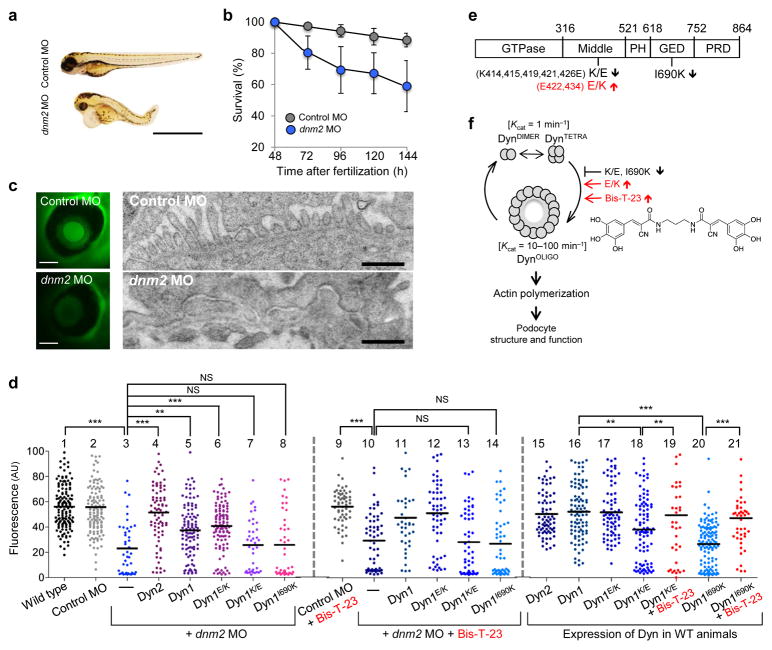
  • Dynamin oligomerization is essential for kidney function. (a) Phenotype of zebrafish larvae injected with either scrambled (Control MO) or dynamin-2-specific morpholino (dnm2 MO) 120 hours post-fertilization. Scale bars, 2 mm. (b) Survivorship curves of zebrafish larvae injected with either Control MO or dnm2 MO. Each curve represents 180 animals for Control MO and 245 animals for dnm2 MO. Error bars, mean ± SD (log-rank: P < 0.0001 for comparison of mean survival time). (c) Representative image of the fluorescence of circulating eGFP-DBP in the retinal vessel plexus of the fish eye 96 hours post-fertilization and injected with either control MO or dnm2 MO (left) (n = 128 images for control MO, and n = 94 images for dnm2 MO animals). Scale bars, 100 μm. Transmission electron micrographs of glomeruli analyzed in zebrafish larvae 120 hours post-fertilization and injected with either control MO or dnm2 MO (right). Scale bars, 0.5 μm. (d) Intensity of circulating eGFP-DBP (AU, arbitrary units) in the retinal vessel plexus of the fish eye 96 hours post-fertilization and treated with the indicated MO and/or expression construct and with Bis-T-23 (1 ng per larvae) or with DMSO as vehicle (20% per larvae). For groups 1–6, 16, and 20, n = 100–150; for all other groups n = 40–100. Black lines represent median intensity in each group (**P ≤ 0.01, ***P ≤ 0.001, unpaired t-test). (e) A schematic diagram indicating the domain structures of dynamin: GTPase, Middle, PH (Pleckstrin-Homology), GED (GTPase Effector Domain), and PRD (Proline/arginine-Rich Domain). Indicated mutations: K/E (K-to-E mutations of the indicated amino acid residues in black), E/K (E-to-K mutations of the indicated residues in red) and I690K.[1].Pharmacological targeting of actin-dependent dynamin oligomerization ameliorates chronic kidney disease in diverse animal models. Nat Med. 2015;21(6):601-609.
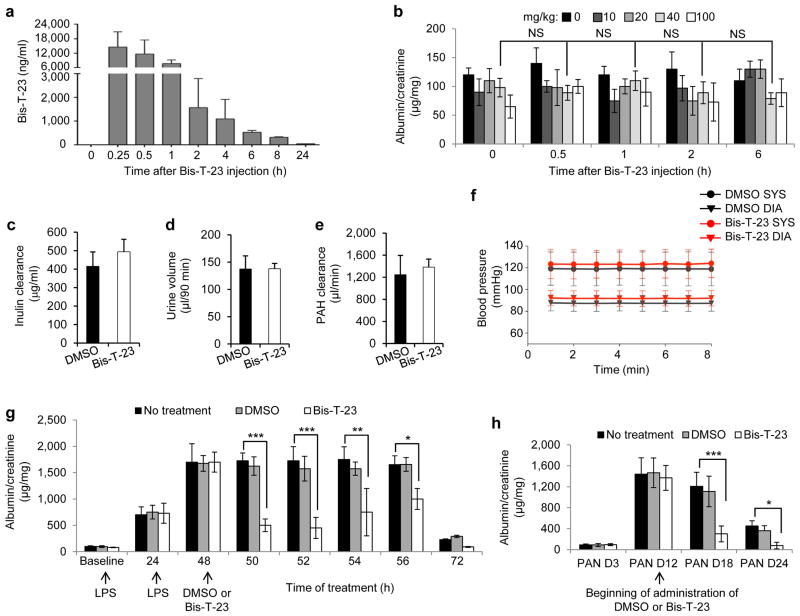
  • Dynamin oligomerization ameliorates transient proteinuria. (a) Plasma pharmacokinetics of Bis-T-23 after injection (40 mg/kg) in C57BL/6J mice (n = 3) as measured by mass spectrometry. (b) Proteinuria of C57BL/6J mice determined by spot urine test before injection (0 h) and at the indicated hours after injection of the indicated concentrations of Bis-T-23. NS, not statistically significant (unpaired t-test; n = 5 mice per concentration). (c-e) Inulin clearance (c), urine volume (d) and para-aminohippurate (PAH) clearance (e) of C57BL/6J mice determined after 8 consecutive days of treatment with DMSO (1%, vehicle) or Bis-T-23 (40 mg/kg). Error bars, mean ± SD (n = 6 mice per condition). (f) The systolic (SYS) or diastolic (DIA) blood pressure of 129X1/SvJ mice measured invasively using a carotid catheter after 8 consecutive days of treatment with DMSO (1%, vehicle) or Bis-T-23 (40 mg/kg) (n = 3 mice per condition). (g) Proteinuria of BALB/c mice determined by spot urine test at indicated times after two consecutive doses of LPS. As indicated, animals were injected with either DMSO (1%, vehicle) or Bis-T-23 (40 mg/kg) (n = 10 mice per condition). Error bars, mean ± SD (*P ≤ 0.05; **P ≤ 0.01, ***P ≤ 0.001, unpaired t-test). (h) Proteinuria of Sprague-Dawley rats treated with PAN and determined by spot urine test. Rats were treated once a day starting 12 days after PAN with DMSO (1%, vehicle) or Bis-T-23 (20 mg/kg) for 6 consecutive days (n = 6 rats per condition). Error bars, mean ± SD (*P ≤ 0.05; ***P ≤ 0.001, unpaired t-test).[1].Pharmacological targeting of actin-dependent dynamin oligomerization ameliorates chronic kidney disease in diverse animal models. Nat Med. 2015;21(6):601-609.
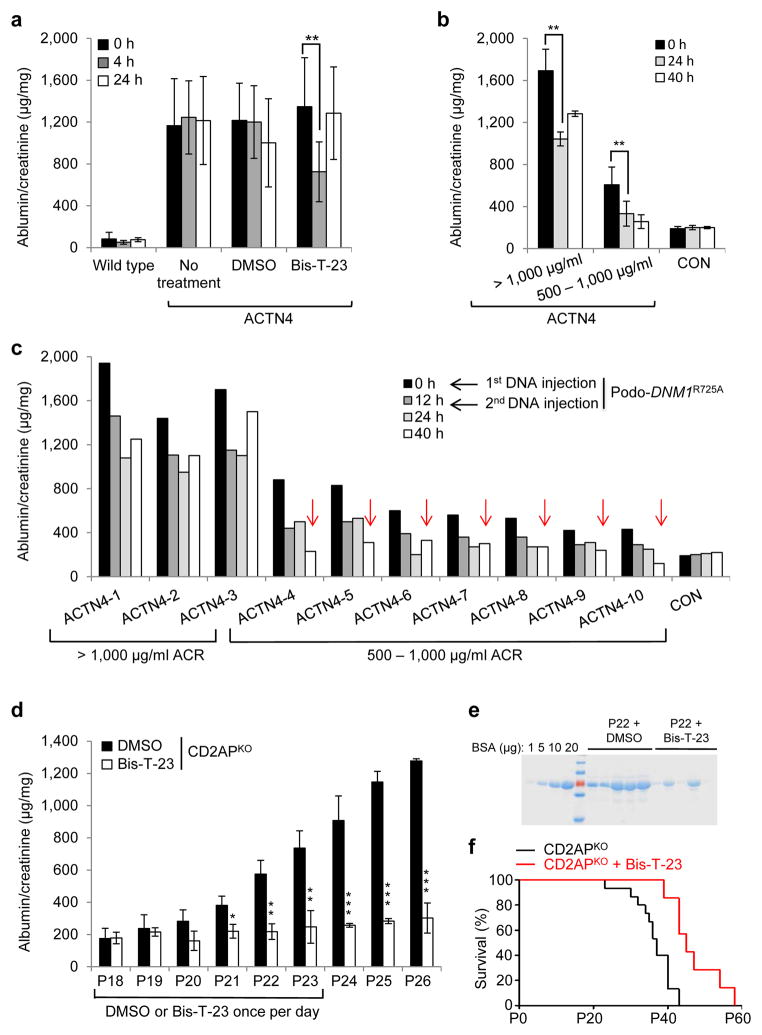
  • Dynamin oligomerization targets actin cytoskeleton in podocytes. (a) Proteinuria in wild type and ACTN4 mice (without treatment or with treatment with either DMSO (1%, vehicle) or with Bis-T-23 (40 mg/kg)) as determined by spot urine test at indicated time points. Error bars, mean ± SD (**P ≤ 0.01, unpaired t-test). (b,c) Proteinuria in ACTN4 mice determined by spot urine test prior to and after double injection of a podocin-driven expression vector encoding DNM1R725A mutant protein. Animals were grouped by protein levels before treatment (n = 3 for > 1,000 μg/ml ACR; n = 7 for 500–1,000 μg/ml ACR). Individual animals from b are shown in c. Red arrows indicate reduction of proteinuria to control levels. Error bars, mean ± SD (**P ≤ 0.01, unpaired t-test). (d) Proteinuria in CD2APKO mice determined by spot urine test over several days during which animals were treated daily with DMSO (1%, vehicle) or Bis-T-23 (40 mg/kg), starting at Postnatal Day 18 (n = 5 mice per condition). Error bars, mean ± SD (*P ≤ 0.05; **P ≤ 0.01, ***P ≤ 0.001, unpaired t-test). (e) Coomassie blue staining of SDS-PAGE gel showing protein bands from two microliters of mouse spot urine at day 22 in d. BSA was used as a standard. (f) Line graph depicting number of live CD2APKO mice (black lines, n = 20 mice) and CD2APKO mice injected daily with Bis-T-23 (40 mg/kg) (red lines, n = 7 mice) at indicated time points. Animals exhibited a statistically significant difference in survival rate (log-rank: P < 0.0163).[1].Pharmacological targeting of actin-dependent dynamin oligomerization ameliorates chronic kidney disease in diverse animal models. Nat Med. 2015;21(6):601-609.
Contact Us