| Size | Price | Stock | Qty |
|---|---|---|---|
| 5mg |
|
||
| 10mg |
|
||
| 50mg |
|
||
| 100mg | |||
| Other Sizes |


| Targets |
BIP-135 is a potent and selective ATP-competitive inhibitor of glycogen synthase kinase-3 (GSK-3). Its primary targets are the two isoforms of this enzyme: GSK-3α and GSK-3β. GSK-3 is a multifunctional serine/threonine kinase that plays a critical role in diverse signaling pathways, including those regulating glycogen metabolism, cell cycle progression, and gene expression. By competitively binding to the ATP-binding pocket of the kinase, BIP-135 inhibits its enzymatic activity, thereby modulating the phosphorylation of its downstream targets. This inhibition has been shown to be neuroprotective, suggesting that GSK-3 is a key player in pathways relevant to neuronal survival and function.
|
|---|---|
| ln Vitro |
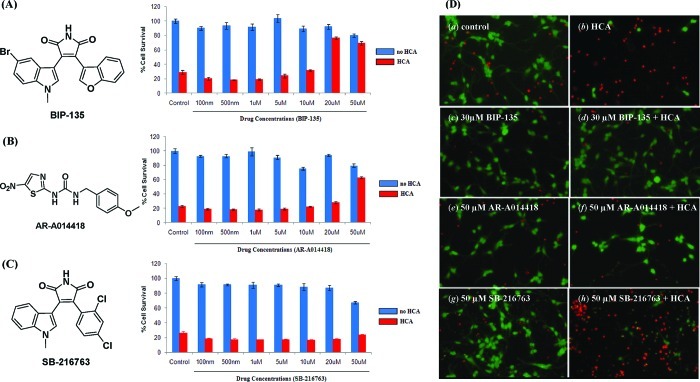
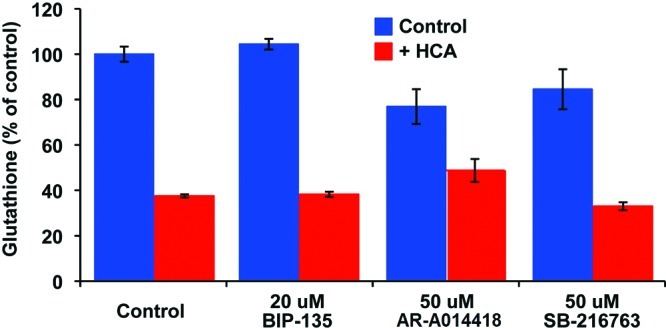
In human SMA fibroblasts, BIP-135 (20-30 μM; 72 hours) raises survival motor neuron (SMN) protein levels at the 25 μM dose. A commonly observed dose-response curve with a bell shape is caused by some toxicity at higher dosages [1]. In oxidative stress models, BIP-135 (20 μM; 48 hours) is a highly effective neuroprotective drug [1].
In vitro, BIP-135 demonstrates potent and selective inhibition of GSK-3. It is an ATP-competitive inhibitor, with IC50 values of 16 nM and 21 nM for GSK-3α and GSK-3β, respectively. Studies in human spinal muscular atrophy (SMA) fibroblasts have shown that BIP-135 (at 20-30 µM for 72 hours) can raise survival motor neuron (SMN) protein levels. In oxidative stress models, treatment with BIP-135 (20 µM) has shown protective effects. The compound's ability to inhibit GSK-3 and its neuroprotective properties make it a valuable tool for investigating the role of this kinase in various cellular processes and disease models. |
| ln Vivo |
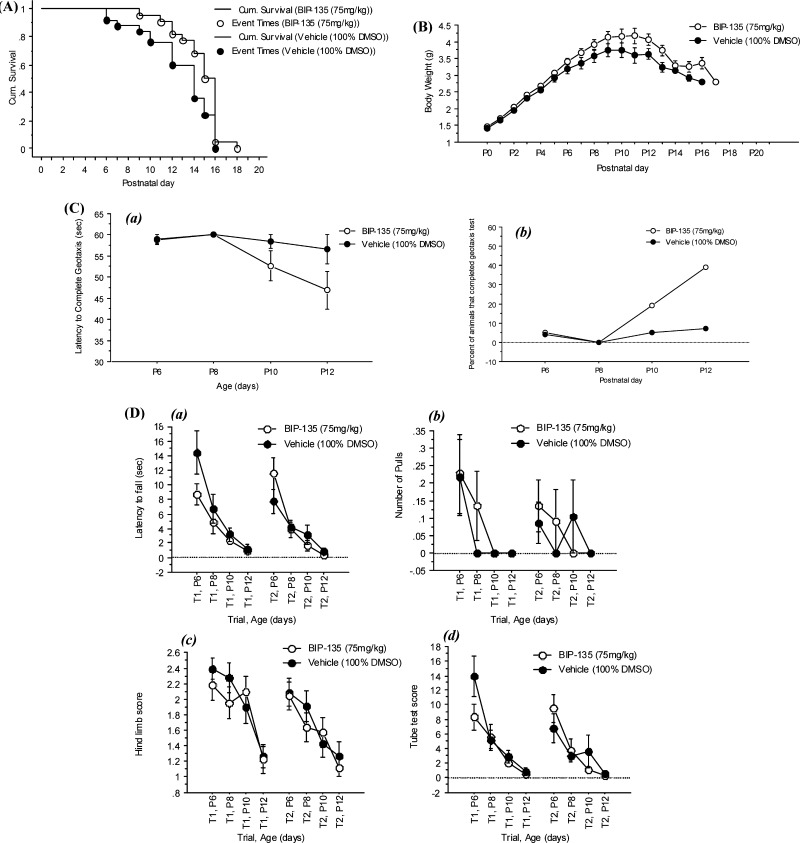
Animals seem to tolerate BIP-135 well; they do not appear to lose weight as a result [1]. BIP-135 (i.p.; 75 mg/kg; daily; from postnatal day 0 to 21) increases median survival in the spinal muscular atrophy model of the Δ7 SMA KO mouse [1].
Specific in vivo activity data for BIP-135 are not extensively detailed in the provided references. However, its neuroprotective properties and potent GSK-3 inhibition suggest potential for in vivo efficacy in models of neurological disorders. One source notes that animals seem to tolerate BIP-135 well, as they do not appear to lose weight as a result of treatment. For in vivo administration, the compound can be prepared in various formulations, such as a suspension in 0.5% CMC Na for oral use or in DMSO:Tween 80:Saline (10:5:85) for injection. These findings support the compound's potential for further in vivo evaluation in relevant disease models. |
| Enzyme Assay |
In vitro enzyme assays for BIP-135 typically involve measuring its inhibition of GSK-3 activity. As an ATP-competitive inhibitor, its potency is assessed by incubating the recombinant GSK-3α or GSK-3β enzymes with varying concentrations of the compound and a peptide substrate in the presence of ATP. The degree of substrate phosphorylation is then quantified, allowing for the determination of the IC50 values. These assays confirm its high potency and selectivity, establishing BIP-135 as a specific tool for studying GSK-3 function.
|
| Cell Assay |
Western Blot Analysis[1]
Cell Types: Human SMA fibroblasts Tested Concentrations: 20 μM, 25 μM, 30 μM Incubation Duration: 72 hrs (hours) Experimental Results: SMN levels increased 7-fold at 25 μM. In vitro cell-based assays for BIP-135 are used to evaluate its effects on GSK-3-mediated cellular processes. Studies have been conducted in human SMA fibroblasts, where the compound (20-30 µM for 72 hours) was shown to raise survival motor neuron (SMN) protein levels. Additionally, in oxidative stress models, treatment with BIP-135 at 20 µM has demonstrated protective effects. These assays help to elucidate the functional consequences of GSK-3 inhibition in a cellular context, confirming its neuroprotective potential and providing insights into its mechanism of action. |
| Animal Protocol |
Animal/Disease Models: Male and female SMN2+/+, SMN2Δ7+/+, Smn+/– mice [1]
Doses: 75 mg/kg Route of Administration: intraperitoneal (ip) injection; daily; from postnatal day 0 to day 21 Experimental Results: The median survival of SMA KO animals was modestly prolonged by two days. In vivo animal studies for BIP-135 have been conducted to evaluate its tolerability and potential efficacy. One source notes that animals seem to tolerate the compound well, as they do not appear to lose weight as a result of treatment. BIP-135 has been administered via intraperitoneal (i.p.) injection. For in vivo studies, the compound can be prepared in various formulations, such as a suspension in 0.5% CMC Na for oral administration or in DMSO:Tween 80:Saline (10:5:85) for injection. These preliminary findings suggest a favorable tolerability profile, warranting further investigation into its efficacy in disease models. |
| ADME/Pharmacokinetics |
Pharmacokinetic (PK) data for BIP-135 are limited in the provided references. For in vivo applications, the compound can be formulated in various vehicles, such as a suspension in 0.5% CMC Na for oral administration or in DMSO:Tween 80:Saline (10:5:85) for injection. These formulations are suitable for administering the compound to animal models to study its absorption, distribution, metabolism, and excretion. The compound has a molecular weight of 421.24 g/mol and is soluble in DMSO to at least 62.5 mg/mL. A full PK profile would require measuring its concentration in plasma and tissues over time to determine its half-life, bioavailability, and clearance.
|
| Toxicity/Toxicokinetics |
The toxicity profile of BIP-135 is not extensively detailed in the provided literature. However, one source notes that animals seem to tolerate BIP-135 well, as they do not appear to lose weight as a result of treatment. This suggests a potentially favorable tolerability profile in vivo. As a potent GSK-3 inhibitor, its safety would need to be carefully evaluated in comprehensive preclinical studies. The compound is intended for research use only and is not for human or veterinary use. Standard laboratory safety practices should be followed when handling this chemical.
|
| References | |
| Additional Infomation |
BIP-135 is a potent, selective, and ATP-competitive inhibitor of glycogen synthase kinase-3 (GSK-3). It demonstrates high potency against both GSK-3α and GSK-3β, with IC50 values of 16 nM and 21 nM, respectively. The compound exhibits neuroprotective properties, making it a valuable tool for studying the role of GSK-3 in neurological disorders. In vitro studies have shown that BIP-135 can raise SMN protein levels in SMA fibroblasts and provide protection in oxidative stress models. It has a molecular weight of 421.24 g/mol and a molecular formula of C21H13BrN2O3. BIP-135 is exclusively a research chemical and is not approved for clinical trials or therapeutic use.
|
| Molecular Formula |
C21H13N2O3BR
|
|---|---|
| Molecular Weight |
421.24352
|
| Exact Mass |
420.011
|
| CAS # |
941575-71-9
|
| PubChem CID |
16741475
|
| Appearance |
Light yellow to orange solid powder
|
| Density |
1.64±0.1 g/cm3 (20 °C, 760 mmHg)
|
| Boiling Point |
643.5±55.0 °C (760 mmHg)
|
| LogP |
4.583
|
| Hydrogen Bond Donor Count |
1
|
| Hydrogen Bond Acceptor Count |
3
|
| Rotatable Bond Count |
2
|
| Heavy Atom Count |
27
|
| Complexity |
693
|
| Defined Atom Stereocenter Count |
0
|
| SMILES |
O=C(C(C1=COC2=CC=CC=C12)=C3C4=CN(C)C5=C4C=C(Br)C=C5)NC3=O
|
| InChi Key |
QKQJCKAXFJBYKJ-UHFFFAOYSA-N
|
| InChi Code |
InChI=1S/C21H13BrN2O3/c1-24-9-14(13-8-11(22)6-7-16(13)24)18-19(21(26)23-20(18)25)15-10-27-17-5-3-2-4-12(15)17/h2-10H,1H3,(H,23,25,26)
|
| Chemical Name |
3-(1-benzofuran-3-yl)-4-(5-bromo-1-methylindol-3-yl)pyrrole-2,5-dione
|
| HS Tariff Code |
2934.99.9001
|
| Storage |
Powder -20°C 3 years 4°C 2 years In solvent -80°C 6 months -20°C 1 month |
| Shipping Condition |
Room temperature (This product is stable at ambient temperature for a few days during ordinary shipping and time spent in Customs)
|
| Solubility (In Vitro) |
DMSO : ~62.5 mg/mL (~148.37 mM)
|
|---|---|
| Solubility (In Vivo) |
Note: Listed below are some common formulations that may be used to formulate products with low water solubility (e.g. < 1 mg/mL), you may test these formulations using a minute amount of products to avoid loss of samples.
Injection Formulations
Injection Formulation 1: DMSO : Tween 80: Saline = 10 : 5 : 85 (i.e. 100 μL DMSO stock solution → 50 μL Tween 80 → 850 μL Saline)(e.g. IP/IV/IM/SC) *Preparation of saline: Dissolve 0.9 g of sodium chloride in 100 mL ddH ₂ O to obtain a clear solution. Injection Formulation 2: DMSO : PEG300 :Tween 80 : Saline = 10 : 40 : 5 : 45 (i.e. 100 μL DMSO → 400 μLPEG300 → 50 μL Tween 80 → 450 μL Saline) Injection Formulation 3: DMSO : Corn oil = 10 : 90 (i.e. 100 μL DMSO → 900 μL Corn oil) Example: Take the Injection Formulation 3 (DMSO : Corn oil = 10 : 90) as an example, if 1 mL of 2.5 mg/mL working solution is to be prepared, you can take 100 μL 25 mg/mL DMSO stock solution and add to 900 μL corn oil, mix well to obtain a clear or suspension solution (2.5 mg/mL, ready for use in animals). View More
Injection Formulation 4: DMSO : 20% SBE-β-CD in saline = 10 : 90 [i.e. 100 μL DMSO → 900 μL (20% SBE-β-CD in saline)] Oral Formulations
Oral Formulation 1: Suspend in 0.5% CMC Na (carboxymethylcellulose sodium) Oral Formulation 2: Suspend in 0.5% Carboxymethyl cellulose Example: Take the Oral Formulation 1 (Suspend in 0.5% CMC Na) as an example, if 100 mL of 2.5 mg/mL working solution is to be prepared, you can first prepare 0.5% CMC Na solution by measuring 0.5 g CMC Na and dissolve it in 100 mL ddH2O to obtain a clear solution; then add 250 mg of the product to 100 mL 0.5% CMC Na solution, to make the suspension solution (2.5 mg/mL, ready for use in animals). View More
Oral Formulation 3: Dissolved in PEG400 (Please use freshly prepared in vivo formulations for optimal results.) |
| Preparing Stock Solutions | 1 mg | 5 mg | 10 mg | |
| 1 mM | 2.3739 mL | 11.8697 mL | 23.7394 mL | |
| 5 mM | 0.4748 mL | 2.3739 mL | 4.7479 mL | |
| 10 mM | 0.2374 mL | 1.1870 mL | 2.3739 mL |
*Note: Please select an appropriate solvent for the preparation of stock solution based on your experiment needs. For most products, DMSO can be used for preparing stock solutions (e.g. 5 mM, 10 mM, or 20 mM concentration); some products with high aqueous solubility may be dissolved in water directly. Solubility information is available at the above Solubility Data section. Once the stock solution is prepared, aliquot it to routine usage volumes and store at -20°C or -80°C. Avoid repeated freeze and thaw cycles.
Calculation results
Working concentration: mg/mL;
Method for preparing DMSO stock solution: mg drug pre-dissolved in μL DMSO (stock solution concentration mg/mL). Please contact us first if the concentration exceeds the DMSO solubility of the batch of drug.
Method for preparing in vivo formulation::Take μL DMSO stock solution, next add μL PEG300, mix and clarify, next addμL Tween 80, mix and clarify, next add μL ddH2O,mix and clarify.
(1) Please be sure that the solution is clear before the addition of next solvent. Dissolution methods like vortex, ultrasound or warming and heat may be used to aid dissolving.
(2) Be sure to add the solvent(s) in order.
|
|
|
Products are for research use only; We do not sell to patients
Copyright 2020 InvivoChem LLC | All Rights Reserved