| Size | Price | Stock | Qty |
|---|---|---|---|
| 5mg |
|
||
| 10mg |
|
||
| 50mg |
|
||
| 100mg |
|
||
| 250mg |
|
||
| 500mg | |||
| Other Sizes |


| Targets |
AZ 13705339 targets PAK1 (p21-activated kinase 1) and PAK2. It is a potent and specific inhibitor of PAK1, with an IC50 of 0.33 nM. It also inhibits PAK2 with an IC50 of 6 nM. The compound displays 14-, 470-, 4100-, and 2600-fold selectivity over Src, FGFR1, KDR, and PAK4, respectively. PAK1 is a key kinase involved in cancer cell proliferation and survival.
|
|---|---|
| ln Vitro |
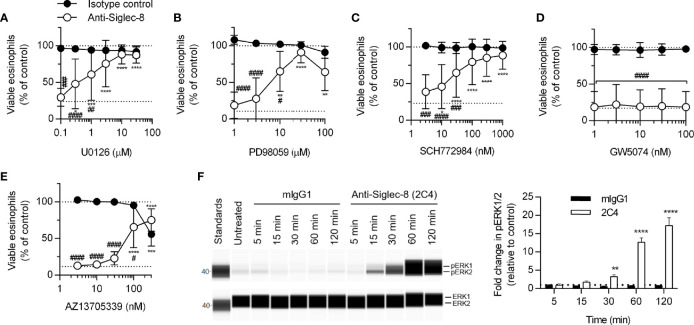
In Namalwa cells, AZ13705339 (1 μM) reduces adhesion generated by PMA but not adhesion regulated by αIgM [2]. Siglec-8 engagement-induced eosinophil death is inhibited by AZ13705339 (300 nM, 30 minutes) [3].
In vitro, AZ13705339 (1 μM) reduces adhesion generated by PMA but not adhesion regulated by αIgM in Namalwa cells. Siglec-8 engagement-induced eosinophil death is inhibited by AZ13705339 (300 nM, 30 minutes). AZ13705339 has potent anti-proliferative effects against a range of cancer cell lines. It shows growth inhibition of human A549 cells with an IC50 of 0.06 μM. In MCF-10A cells, it inhibits PAK1 phosphorylation with an IC50 of 0.059 μM. |
| ln Vivo |
Rats having an oral Cmax of 7.7 μM show moderate clearance of AZ13705339 (100 mg/kg, PO) [1].
In vivo, AZ13705339 shows moderate clearance in rats following oral administration (100 mg/kg, PO), with an oral Cmax of 7.7 μM. It has been shown to have excellent physiochemical properties and large margins against inhibition of CYP isoforms and the hERG ion channel. The compound's oral bioavailability makes it suitable for in vivo efficacy studies. |
| Enzyme Assay |
The enzymatic activity of AZ13705339 can be assessed using kinase assays with recombinant PAK1 and PAK2 proteins. The assay involves incubating the kinase with a peptide substrate and ATP in the presence of varying concentrations of the inhibitor. The extent of phosphorylation is measured using techniques such as radioactive labeling or fluorescence-based detection. The IC50 and Kd values are determined from dose-response curves.
|
| Cell Assay |
To evaluate the cellular effects of AZ13705339, cells such as A549, MCF-10A, or Namalwa are treated with the compound. Cell viability, proliferation, and adhesion are measured using standard assays. The inhibition of PAK1 phosphorylation is assessed by Western blotting using phospho-specific antibodies. The IC50 values for cell growth inhibition or PAK1 phosphorylation are determined from dose-response curves.
|
| Animal Protocol |
In vivo studies with AZ13705339 typically involve administration to tumor-bearing mice in xenograft models. The compound is given via oral or intraperitoneal routes at various doses. Tumor growth inhibition, body weight, and overall health are monitored to assess efficacy and tolerability. Pharmacokinetic parameters, such as Cmax and clearance, are measured in rats.
|
| ADME/Pharmacokinetics |
AZ13705339 has a molecular formula of C33H36FN7O3S and a molecular weight of 629.75. Its CAS number is 2016806-57-6. The compound is a white to off-white solid powder with a density of 1.4±0.1 g/cm3. It has a logP of 1.96. The purity is ≥98%. The powder should be stored at -20°C for 3 years or at 4°C for 2 years.
|
| Toxicity/Toxicokinetics |
Specific toxicology data for AZ13705339 are not detailed in the available literature. However, it has excellent physiochemical properties and large margins against inhibition of CYP isoforms and the hERG ion channel, suggesting a potentially favorable safety profile. As with all research compounds, standard safety precautions should be taken during handling.
|
| References |
|
| Additional Infomation |
AZ13705339 is a highly potent and selective PAK1 inhibitor used in cancer research. It is a valuable tool for studying PAK1 biology and for developing targeted cancer therapies. The compound's high selectivity and potency make it ideal for exploring the role of PAK1 in cancer cell proliferation and survival. It is not a clinically approved drug.
|
| Molecular Formula |
C33H36FN7O3S
|
|---|---|
| Molecular Weight |
629.747448921204
|
| Exact Mass |
629.258
|
| Elemental Analysis |
C, 62.94; H, 5.76; F, 3.02; N, 15.57; O, 7.62; S, 5.09
|
| CAS # |
2016806-57-6
|
| Related CAS # |
AZ13705339 hemihydrate
|
| PubChem CID |
129909860
|
| Appearance |
White to off-white solid powder
|
| Density |
1.4±0.1 g/cm3
|
| Boiling Point |
868.7±75.0 °C at 760 mmHg
|
| Flash Point |
479.2±37.1 °C
|
| Vapour Pressure |
0.0±0.3 mmHg at 25°C
|
| Index of Refraction |
1.682
|
| LogP |
1.96
|
| Hydrogen Bond Donor Count |
2
|
| Hydrogen Bond Acceptor Count |
11
|
| Rotatable Bond Count |
10
|
| Heavy Atom Count |
45
|
| Complexity |
1090
|
| Defined Atom Stereocenter Count |
0
|
| SMILES |
C(#N)C1=CC=CC=C1CN(C1C(F)=CN=C(NC2=CC=C(N3CCN(C)CC3)C(S(CC)(=O)=O)=C2)N=1)C1=CC(CO)=CC=C1C
|
| Synonyms |
AZ13705339; AZ-13705339; AZ 13705339
|
| HS Tariff Code |
2934.99.9001
|
| Storage |
Powder -20°C 3 years 4°C 2 years In solvent -80°C 6 months -20°C 1 month |
| Shipping Condition |
Room temperature (This product is stable at ambient temperature for a few days during ordinary shipping and time spent in Customs)
|
| Solubility (In Vitro) |
DMSO : ~250 mg/mL (~396.98 mM)
|
|---|---|
| Solubility (In Vivo) |
Note: Listed below are some common formulations that may be used to formulate products with low water solubility (e.g. < 1 mg/mL), you may test these formulations using a minute amount of products to avoid loss of samples.
Injection Formulations
Injection Formulation 1: DMSO : Tween 80: Saline = 10 : 5 : 85 (i.e. 100 μL DMSO stock solution → 50 μL Tween 80 → 850 μL Saline)(e.g. IP/IV/IM/SC) *Preparation of saline: Dissolve 0.9 g of sodium chloride in 100 mL ddH ₂ O to obtain a clear solution. Injection Formulation 2: DMSO : PEG300 :Tween 80 : Saline = 10 : 40 : 5 : 45 (i.e. 100 μL DMSO → 400 μLPEG300 → 50 μL Tween 80 → 450 μL Saline) Injection Formulation 3: DMSO : Corn oil = 10 : 90 (i.e. 100 μL DMSO → 900 μL Corn oil) Example: Take the Injection Formulation 3 (DMSO : Corn oil = 10 : 90) as an example, if 1 mL of 2.5 mg/mL working solution is to be prepared, you can take 100 μL 25 mg/mL DMSO stock solution and add to 900 μL corn oil, mix well to obtain a clear or suspension solution (2.5 mg/mL, ready for use in animals). View More
Injection Formulation 4: DMSO : 20% SBE-β-CD in saline = 10 : 90 [i.e. 100 μL DMSO → 900 μL (20% SBE-β-CD in saline)] Oral Formulations
Oral Formulation 1: Suspend in 0.5% CMC Na (carboxymethylcellulose sodium) Oral Formulation 2: Suspend in 0.5% Carboxymethyl cellulose Example: Take the Oral Formulation 1 (Suspend in 0.5% CMC Na) as an example, if 100 mL of 2.5 mg/mL working solution is to be prepared, you can first prepare 0.5% CMC Na solution by measuring 0.5 g CMC Na and dissolve it in 100 mL ddH2O to obtain a clear solution; then add 250 mg of the product to 100 mL 0.5% CMC Na solution, to make the suspension solution (2.5 mg/mL, ready for use in animals). View More
Oral Formulation 3: Dissolved in PEG400 (Please use freshly prepared in vivo formulations for optimal results.) |
| Preparing Stock Solutions | 1 mg | 5 mg | 10 mg | |
| 1 mM | 1.5879 mL | 7.9397 mL | 15.8793 mL | |
| 5 mM | 0.3176 mL | 1.5879 mL | 3.1759 mL | |
| 10 mM | 0.1588 mL | 0.7940 mL | 1.5879 mL |
*Note: Please select an appropriate solvent for the preparation of stock solution based on your experiment needs. For most products, DMSO can be used for preparing stock solutions (e.g. 5 mM, 10 mM, or 20 mM concentration); some products with high aqueous solubility may be dissolved in water directly. Solubility information is available at the above Solubility Data section. Once the stock solution is prepared, aliquot it to routine usage volumes and store at -20°C or -80°C. Avoid repeated freeze and thaw cycles.
Calculation results
Working concentration: mg/mL;
Method for preparing DMSO stock solution: mg drug pre-dissolved in μL DMSO (stock solution concentration mg/mL). Please contact us first if the concentration exceeds the DMSO solubility of the batch of drug.
Method for preparing in vivo formulation::Take μL DMSO stock solution, next add μL PEG300, mix and clarify, next addμL Tween 80, mix and clarify, next add μL ddH2O,mix and clarify.
(1) Please be sure that the solution is clear before the addition of next solvent. Dissolution methods like vortex, ultrasound or warming and heat may be used to aid dissolving.
(2) Be sure to add the solvent(s) in order.
|
Products are for research use only; We do not sell to patients
Copyright 2020 InvivoChem LLC | All Rights Reserved