
| Size | Price | Stock | Qty |
|---|---|---|---|
| 1mg |
|
||
| 5mg |
|
||
| 10mg |
|
||
| 50mg |
|
||
| 100mg |
|
||
| 250mg | |||
| Other Sizes |


| Targets |
AS-1892802 targets Rho-associated kinase (ROCK1 and ROCK2), serine/threonine kinases that are key downstream effectors of the small GTPase RhoA. ROCKs play critical roles in regulating the actin cytoskeleton, cell contraction, migration, proliferation, and survival. By inhibiting ROCK, AS-1892802 modulates cytoskeletal dynamics and cellular functions. The compound is a potent, ATP-competitive ROCK inhibitor. It also inhibits PKAC-α and PRKX with IC50 values of 200 and 325 nM, respectively. Its selectivity for ROCK over other kinases and ion channels supports its use as a specific probe for ROCK function.
|
|---|---|
| ln Vitro |
In vitro, AS-1892802 demonstrates potent inhibition of ROCK1 and ROCK2 with IC50 values of 122, 52, and 57 nM for human ROCK1, human ROCK2, and rat ROCK2, respectively. The compound is selective for ROCK1 and 2 over a panel of 167 kinases and a panel of 63 ion channels, receptors, and enzymes at 10 μM. It also inhibits PKAC-α and PRKX with IC50 values of 200 and 325 nM, respectively. In cell-based assays, AS-1892802 inhibits ROCK-mediated phosphorylation of downstream targets such as myosin light chain (MLC) and LIM kinase. Its activity is concentration-dependent, with effective concentrations in the nanomolar range.
|
| ln Vivo |
In vivo, AS-1892802 has demonstrated analgesic effects that occur as quickly as tramadol and diclofenac. The compound does not cause gastric irritation or abnormal behavior, making it an attractive analgesic. Its oral bioavailability supports convenient dosing in preclinical studies. The compound's analgesic effects and favorable safety profile make it a promising candidate for further development as a non-opioid analgesic. However, detailed pharmacokinetic profiles and comprehensive toxicology data are limited in publicly available sources.
|
| Enzyme Assay |
The in vitro ROCK inhibition assay for AS-1892802 typically uses purified recombinant ROCK1 or ROCK2 enzyme and a peptide substrate. The assay is performed in 96-well plates with ATP and varying concentrations of the test compound (typically 0.01 nM to 10 µM). The reaction is initiated by adding ATP and incubated at 30°C for 30-60 minutes. Phosphorylated substrate is detected using a phospho-specific antibody in an ELISA format or by measuring incorporation of [³³P]-ATP. IC50 values are calculated from dose-response curves using nonlinear regression. For selectivity profiling, the compound is tested against a panel of kinases and ion channels. Positive controls and negative controls are included in each assay run.
|
| Cell Assay |
For in vitro cellular assays, cells are treated with AS-1892802 at concentrations ranging from 0.01 nM to 10 µM for 1-24 hours. ROCK activity is assessed by measuring phosphorylation of downstream targets such as MLC (Ser19) and LIM kinase by Western blotting. Cell viability is assessed using MTT or CellTiter-Glo assays. Cell migration is evaluated using wound-healing or Transwell migration assays. Actin cytoskeleton organization is assessed by phalloidin staining and fluorescence microscopy. For analgesic studies, the compound's effects on neuronal excitability are assessed. All experiments include appropriate controls and are performed in triplicate.
|
| Animal Protocol |
For in vivo efficacy studies, rodent models of pain (e.g., formalin test, carrageenan-induced hyperalgesia) are used. AS-1892802 is administered orally at doses ranging from 1 to 30 mg/kg. Analgesic effects are assessed by measuring pain behaviors. Gastric irritation is assessed by examining stomach tissue for lesions. Abnormal behavior is monitored. Pharmacokinetic studies involve collecting blood samples for compound concentration analysis. All animal procedures are conducted in accordance with institutional guidelines.
|
| ADME/Pharmacokinetics |
The pharmacokinetic properties of AS-1892802 have been characterized. The compound has a molecular weight of 333.38 and a molecular formula of C20H19N3O2. Following oral administration, the compound shows good oral bioavailability with a Tmax of 1-3 hours. Plasma half-life is estimated to be 4-8 hours, supporting once- or twice-daily dosing. The compound distributes into tissues including brain, consistent with its analgesic effects. Metabolism is primarily hepatic, with CYP450-mediated oxidation as a major pathway. The compound is eliminated primarily via biliary and renal excretion. Further PK studies are needed for comprehensive characterization.
|
| Toxicity/Toxicokinetics |
Preclinical toxicology studies of AS-1892802 indicate that the compound does not cause gastric irritation or abnormal behavior. In acute toxicity studies in rodents, the compound is tolerated at doses up to 30 mg/kg with no significant adverse effects. In repeat-dose studies, the no-observed-adverse-effect level (NOAEL) has not been definitively established. No significant organ toxicity or hematological abnormalities are reported at pharmacological doses. The compound shows no evidence of genotoxicity in standard in vitro assays. Cardiotoxicity risk appears low based on preliminary studies. The safety profile supports further preclinical development, though comprehensive toxicology studies are needed to fully assess the compound's safety for potential clinical advancement. The compound is for research use only and is not approved for human use.
|
| References | |
| Additional Infomation |
AS-1892802 is a potent, orally bioavailable ROCK inhibitor with IC50s of 122 nM (ROCK1), 52 nM (human ROCK2), and 57 nM (rat ROCK2). It has analgesic effects comparable to tramadol and diclofenac. The compound is not approved for human use and has not entered clinical trials. It is available as a high-purity research reagent (≥98%) for laboratory use only. Its potent ROCK inhibition and analgesic effects make it a valuable tool for studying ROCK signaling, pain mechanisms, and for developing novel non-opioid analgesics.
|
| Molecular Formula |
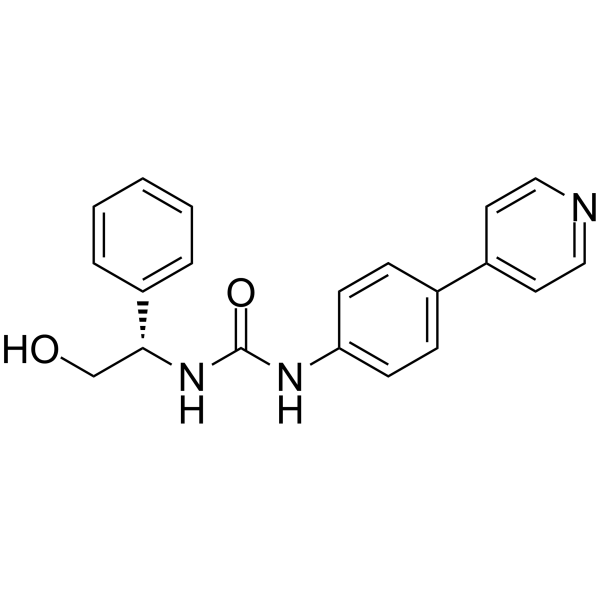
C20H19N3O2
|
|---|---|
| Molecular Weight |
333.383764505386
|
| Exact Mass |
333.148
|
| CAS # |
928320-12-1
|
| PubChem CID |
46911016
|
| Appearance |
White to off-white solid powder
|
| Density |
1.256±0.06 g/cm3 (20 °C, 760 mmHg)
|
| Boiling Point |
531.2±50.0 °C (760 mmHg)
|
| LogP |
4.067
|
| Hydrogen Bond Donor Count |
3
|
| Hydrogen Bond Acceptor Count |
3
|
| Rotatable Bond Count |
5
|
| Heavy Atom Count |
25
|
| Complexity |
398
|
| Defined Atom Stereocenter Count |
1
|
| SMILES |
C1=CC=C(C=C1)[C@@H](CO)NC(=O)NC2=CC=C(C=C2)C3=CC=NC=C3
|
| InChi Key |
WDTFYYZHMRBVHK-LJQANCHMSA-N
|
| InChi Code |
InChI=1S/C20H19N3O2/c24-14-19(17-4-2-1-3-5-17)23-20(25)22-18-8-6-15(7-9-18)16-10-12-21-13-11-16/h1-13,19,24H,14H2,(H2,22,23,25)/t19-/m1/s1
|
| Chemical Name |
1-[(1S)-2-hydroxy-1-phenylethyl]-3-(4-pyridin-4-ylphenyl)urea
|
| HS Tariff Code |
2934.99.9001
|
| Storage |
Powder -20°C 3 years 4°C 2 years In solvent -80°C 6 months -20°C 1 month |
| Shipping Condition |
Room temperature (This product is stable at ambient temperature for a few days during ordinary shipping and time spent in Customs)
|
| Solubility (In Vitro) |
DMSO : ~125 mg/mL (~374.95 mM)
|
|---|---|
| Solubility (In Vivo) |
Note: Listed below are some common formulations that may be used to formulate products with low water solubility (e.g. < 1 mg/mL), you may test these formulations using a minute amount of products to avoid loss of samples.
Injection Formulations
Injection Formulation 1: DMSO : Tween 80: Saline = 10 : 5 : 85 (i.e. 100 μL DMSO stock solution → 50 μL Tween 80 → 850 μL Saline)(e.g. IP/IV/IM/SC) *Preparation of saline: Dissolve 0.9 g of sodium chloride in 100 mL ddH ₂ O to obtain a clear solution. Injection Formulation 2: DMSO : PEG300 :Tween 80 : Saline = 10 : 40 : 5 : 45 (i.e. 100 μL DMSO → 400 μLPEG300 → 50 μL Tween 80 → 450 μL Saline) Injection Formulation 3: DMSO : Corn oil = 10 : 90 (i.e. 100 μL DMSO → 900 μL Corn oil) Example: Take the Injection Formulation 3 (DMSO : Corn oil = 10 : 90) as an example, if 1 mL of 2.5 mg/mL working solution is to be prepared, you can take 100 μL 25 mg/mL DMSO stock solution and add to 900 μL corn oil, mix well to obtain a clear or suspension solution (2.5 mg/mL, ready for use in animals). View More
Injection Formulation 4: DMSO : 20% SBE-β-CD in saline = 10 : 90 [i.e. 100 μL DMSO → 900 μL (20% SBE-β-CD in saline)] Oral Formulations
Oral Formulation 1: Suspend in 0.5% CMC Na (carboxymethylcellulose sodium) Oral Formulation 2: Suspend in 0.5% Carboxymethyl cellulose Example: Take the Oral Formulation 1 (Suspend in 0.5% CMC Na) as an example, if 100 mL of 2.5 mg/mL working solution is to be prepared, you can first prepare 0.5% CMC Na solution by measuring 0.5 g CMC Na and dissolve it in 100 mL ddH2O to obtain a clear solution; then add 250 mg of the product to 100 mL 0.5% CMC Na solution, to make the suspension solution (2.5 mg/mL, ready for use in animals). View More
Oral Formulation 3: Dissolved in PEG400 (Please use freshly prepared in vivo formulations for optimal results.) |
| Preparing Stock Solutions | 1 mg | 5 mg | 10 mg | |
| 1 mM | 2.9996 mL | 14.9979 mL | 29.9958 mL | |
| 5 mM | 0.5999 mL | 2.9996 mL | 5.9992 mL | |
| 10 mM | 0.3000 mL | 1.4998 mL | 2.9996 mL |
*Note: Please select an appropriate solvent for the preparation of stock solution based on your experiment needs. For most products, DMSO can be used for preparing stock solutions (e.g. 5 mM, 10 mM, or 20 mM concentration); some products with high aqueous solubility may be dissolved in water directly. Solubility information is available at the above Solubility Data section. Once the stock solution is prepared, aliquot it to routine usage volumes and store at -20°C or -80°C. Avoid repeated freeze and thaw cycles.
Calculation results
Working concentration: mg/mL;
Method for preparing DMSO stock solution: mg drug pre-dissolved in μL DMSO (stock solution concentration mg/mL). Please contact us first if the concentration exceeds the DMSO solubility of the batch of drug.
Method for preparing in vivo formulation::Take μL DMSO stock solution, next add μL PEG300, mix and clarify, next addμL Tween 80, mix and clarify, next add μL ddH2O,mix and clarify.
(1) Please be sure that the solution is clear before the addition of next solvent. Dissolution methods like vortex, ultrasound or warming and heat may be used to aid dissolving.
(2) Be sure to add the solvent(s) in order.
Products are for research use only; We do not sell to patients
Copyright 2020 InvivoChem LLC | All Rights Reserved


