| Size | Price | Stock | Qty |
|---|---|---|---|
| 5mg |
|
||
| 10mg |
|
||
| 50mg |
|
||
| 100mg |
|
||
| 250mg | |||
| Other Sizes |


| Targets |
The primary target of AQW051 is the α7 nicotinic acetylcholine receptor (α7 nAChR). It acts as a partial agonist at this receptor, with high selectivity (>100-fold) over other nicotinic acetylcholine receptors.
|
|---|---|
| ln Vitro |
For human α7-nACh that has been recombinantly produced, VQW-765 has a pKD value of 7.56[1]. With a pEC50 value of 7.41, VQW-765 exhibits substantial stimulation of the calcium transient state following stimulation with human α7-nACh recombinantly produced in GH3-ha7-22 cells[1].
AQW051 stimulates calcium influx in GH3–ha7-22 cells recombinantly expressing the human α7-nACh receptor with a pEC50 of 7.41. It displays a pKd of 7.56 for the recombinant human α7-nAChR. |
| ln Vivo |
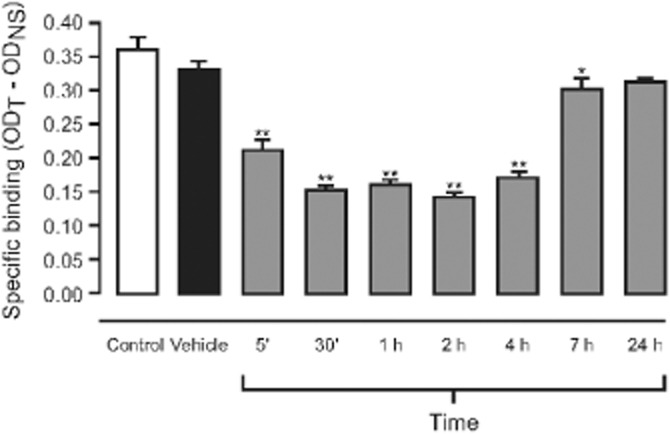
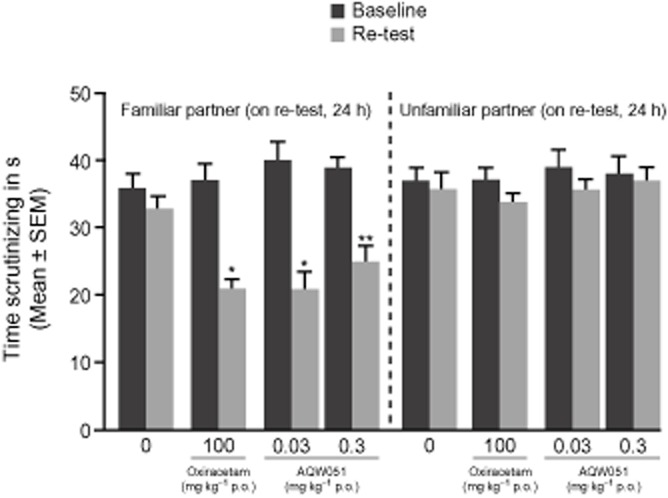
VQW-765 (0.03 and 0.3 mg/kg; oral, once) enhances cognition and learning and memory function in mice [1]. VQW-765 (1 mg/kg; bucally, once) displays anxiolytic and enhanced effects
AQW051 facilitates learning and memory performance in mice. In parkinsonian monkeys, it reduces L-Dopa-induced dyskinesias and extends the duration of L-Dopa effects. |
| Enzyme Assay |
The binding affinity (pKd) of AQW051 for the human α7 nicotinic acetylcholine receptor is determined using radioligand binding assays with membranes from cells recombinantly expressing the receptor. The pKd value of 7.56 was reported from such assays.
|
| Cell Assay |
The agonistic activity is measured by assessing calcium influx in GH3–ha7-22 cells, which recombinantly express the human α7-nACh receptor. The compound's potency is quantified by its pEC50 value of 7.41, determined from these calcium flux assays.
|
| Animal Protocol |
Animal/Disease Models: OF1/IC strain adult mice [1]
Doses: 0.03 and 0.3 mg/kg Route of Administration: Oral; Large The social exploration time of rats lasts for at least 6 hrs (hrs (hours)) [1]. 0.03 and 0.3 mg/kg primary Experimental Results: Improved learning/memory performance at 24-hour retest with more time to scrutinize new partners compared with familiar partners. Demonstrated cognitive enhancement in mice via the Object Recognition Test (ORT). In vivo efficacy was demonstrated in mouse models of learning and memory, where AQW051 facilitated cognitive performance. In a primate model, it was shown to reduce L-Dopa-induced dyskinesias and extend the duration of L-Dopa's effects in parkinsonian monkeys. |
| ADME/Pharmacokinetics |
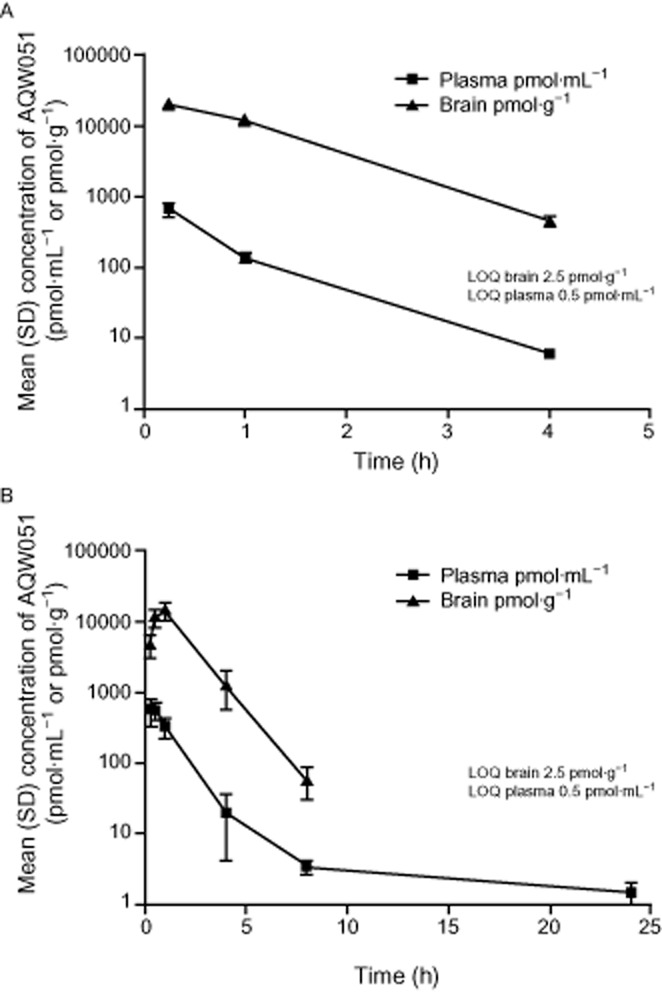
AQW051 demonstrates good oral bioavailability and rapid penetration into the brain. The geometric mean elimination half-life (t1/2) following single dosing ranged from 18.8 to 43.2 hours. Urinary excretion of unchanged drug was less than 1.5% of the dose over 24 or 48 hours.
|
| Toxicity/Toxicokinetics |
Preclinical toxicity data is not specified in the available literature. As a research compound, standard toxicological profiling would typically include assessments of safety pharmacology, genotoxicity, and repeated-dose toxicity in relevant animal models to support its clinical development for cognitive disorders.
|
| References | |
| Additional Infomation |
AQW051 (also known as VQW-765) is an α7 nAChR partial agonist that advanced to Phase 2 clinical trials for Parkinson's disease. Its development highlights the therapeutic potential of targeting the α7 nAChR for cognitive impairment associated with various neurological and neuropsychiatric conditions.
|
| Molecular Formula |
C19H22N2O
|
|---|---|
| Molecular Weight |
294.391
|
| Exact Mass |
294.173
|
| CAS # |
669770-29-0
|
| Related CAS # |
(S)-VQW-765
|
| PubChem CID |
50914822
|
| Appearance |
White to off-white solid powder
|
| Density |
1.2±0.1 g/cm3
|
| Boiling Point |
443.8±45.0 °C at 760 mmHg
|
| Flash Point |
222.2±28.7 °C
|
| Vapour Pressure |
0.0±1.1 mmHg at 25°C
|
| Index of Refraction |
1.622
|
| LogP |
3.69
|
| Hydrogen Bond Donor Count |
0
|
| Hydrogen Bond Acceptor Count |
3
|
| Rotatable Bond Count |
3
|
| Heavy Atom Count |
22
|
| Complexity |
358
|
| Defined Atom Stereocenter Count |
1
|
| SMILES |
CC1=CC=C(C=C1)C2=NC=C(C=C2)O[C@H]3CN4CCC3CC4
|
| InChi Key |
NPDLTEZXGWRMLQ-IBGZPJMESA-N
|
| InChi Code |
InChI=1S/C19H22N2O/c1-14-2-4-15(5-3-14)18-7-6-17(12-20-18)22-19-13-21-10-8-16(19)9-11-21/h2-7,12,16,19H,8-11,13H2,1H3/t19-/m0/s1
|
| Chemical Name |
(3R)-3-[6-(4-methylphenyl)pyridin-3-yl]oxy-1-azabicyclo[2.2.2]octane
|
| HS Tariff Code |
2934.99.9001
|
| Storage |
Powder -20°C 3 years 4°C 2 years In solvent -80°C 6 months -20°C 1 month Note: Please store this product in a sealed and protected environment, avoid exposure to moisture. |
| Shipping Condition |
Room temperature (This product is stable at ambient temperature for a few days during ordinary shipping and time spent in Customs)
|
| Solubility (In Vitro) |
DMSO : ~16.67 mg/mL (~56.63 mM)
|
|---|---|
| Solubility (In Vivo) |
Note: Listed below are some common formulations that may be used to formulate products with low water solubility (e.g. < 1 mg/mL), you may test these formulations using a minute amount of products to avoid loss of samples.
Injection Formulations
Injection Formulation 1: DMSO : Tween 80: Saline = 10 : 5 : 85 (i.e. 100 μL DMSO stock solution → 50 μL Tween 80 → 850 μL Saline)(e.g. IP/IV/IM/SC) *Preparation of saline: Dissolve 0.9 g of sodium chloride in 100 mL ddH ₂ O to obtain a clear solution. Injection Formulation 2: DMSO : PEG300 :Tween 80 : Saline = 10 : 40 : 5 : 45 (i.e. 100 μL DMSO → 400 μLPEG300 → 50 μL Tween 80 → 450 μL Saline) Injection Formulation 3: DMSO : Corn oil = 10 : 90 (i.e. 100 μL DMSO → 900 μL Corn oil) Example: Take the Injection Formulation 3 (DMSO : Corn oil = 10 : 90) as an example, if 1 mL of 2.5 mg/mL working solution is to be prepared, you can take 100 μL 25 mg/mL DMSO stock solution and add to 900 μL corn oil, mix well to obtain a clear or suspension solution (2.5 mg/mL, ready for use in animals). View More
Injection Formulation 4: DMSO : 20% SBE-β-CD in saline = 10 : 90 [i.e. 100 μL DMSO → 900 μL (20% SBE-β-CD in saline)] Oral Formulations
Oral Formulation 1: Suspend in 0.5% CMC Na (carboxymethylcellulose sodium) Oral Formulation 2: Suspend in 0.5% Carboxymethyl cellulose Example: Take the Oral Formulation 1 (Suspend in 0.5% CMC Na) as an example, if 100 mL of 2.5 mg/mL working solution is to be prepared, you can first prepare 0.5% CMC Na solution by measuring 0.5 g CMC Na and dissolve it in 100 mL ddH2O to obtain a clear solution; then add 250 mg of the product to 100 mL 0.5% CMC Na solution, to make the suspension solution (2.5 mg/mL, ready for use in animals). View More
Oral Formulation 3: Dissolved in PEG400 (Please use freshly prepared in vivo formulations for optimal results.) |
| Preparing Stock Solutions | 1 mg | 5 mg | 10 mg | |
| 1 mM | 3.3969 mL | 16.9843 mL | 33.9685 mL | |
| 5 mM | 0.6794 mL | 3.3969 mL | 6.7937 mL | |
| 10 mM | 0.3397 mL | 1.6984 mL | 3.3969 mL |
*Note: Please select an appropriate solvent for the preparation of stock solution based on your experiment needs. For most products, DMSO can be used for preparing stock solutions (e.g. 5 mM, 10 mM, or 20 mM concentration); some products with high aqueous solubility may be dissolved in water directly. Solubility information is available at the above Solubility Data section. Once the stock solution is prepared, aliquot it to routine usage volumes and store at -20°C or -80°C. Avoid repeated freeze and thaw cycles.
Calculation results
Working concentration: mg/mL;
Method for preparing DMSO stock solution: mg drug pre-dissolved in μL DMSO (stock solution concentration mg/mL). Please contact us first if the concentration exceeds the DMSO solubility of the batch of drug.
Method for preparing in vivo formulation::Take μL DMSO stock solution, next add μL PEG300, mix and clarify, next addμL Tween 80, mix and clarify, next add μL ddH2O,mix and clarify.
(1) Please be sure that the solution is clear before the addition of next solvent. Dissolution methods like vortex, ultrasound or warming and heat may be used to aid dissolving.
(2) Be sure to add the solvent(s) in order.
| NCT Number | Recruitment | interventions | Conditions | Sponsor/Collaborators | Start Date | Phases |
| NCT00409500 | Completed | Drug: AQW051 | Healthy | Novartis | 2006-10 | Phase 1 |
| NCT01474421 | Completed | Drug: AQW051 Drug: AQW051 Drug: Placebo |
Drug-induced Dyskinesias |
Novartis Pharmaceuticals | 2011-09-15 | Phase 2 |
| NCT00418002 | Completed | Drug: AQW051 | Healthy | Novartis | 2006-05 | Phase 1 |
| NCT01730768 | Completed | Drug: AQW051 Drug: Placebo |
Schizophrenia | Novartis Pharmaceuticals | 2012-09 | Phase 2 |
| NCT00582855 | Terminated | Drug: AQW051 Drug: Placebo |
Amnestic Mild Cognitive Impairment Mild Alzheimer's Disease |
Novartis Pharmaceuticals | 2007-12 | Phase 2 |
|
|
|
Products are for research use only; We do not sell to patients
Copyright 2020 InvivoChem LLC | All Rights Reserved