| Size | Price | Stock | Qty |
|---|---|---|---|
| 1mg |
|
||
| 5mg | |||
| Other Sizes |


| Targets |
The primary target of AP 811 is the atrial natriuretic peptide clearance receptor (ANP-CR, NPR3). AP 811 binds to NPR3 with a Ki of 0.48 nM and displays >20,000-fold selectivity for NPR3 over NPR1. NPR3 is a clearance receptor for natriuretic peptides that regulates the extracellular levels of atrial natriuretic peptide (ANP) and other natriuretic peptides. By antagonizing NPR3, AP 811 prevents the clearance of ANP, leading to increased ANP levels and enhanced natriuretic peptide signaling through NPR1 and NPR2. The compound has been found to restrain Na⁺/K⁺ pump activity in rabbit ventricular cardiomyocytes and eliminates ANP-induced pump stimulation.
|
|---|---|
| ln Vitro |
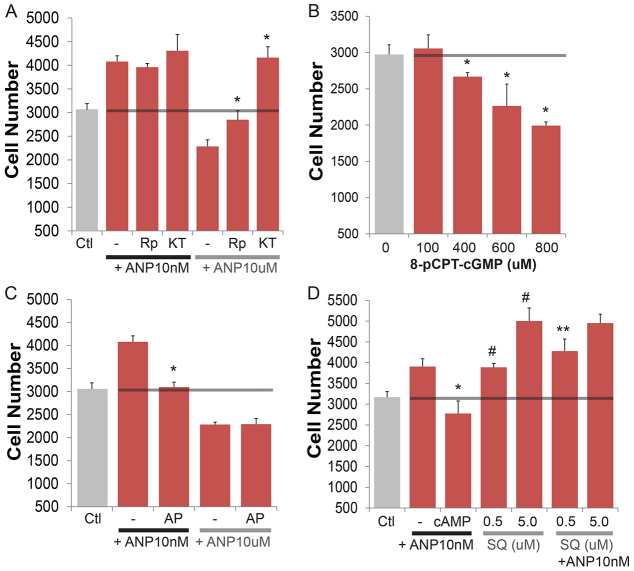
The increased cardiomyocyte proliferation observed at low concentrations of ANP (10 nM) was totally eliminated by AP 811 (10-500 nM) [3].
In vitro, AP 811 demonstrates potent and selective NPR3 antagonism. The compound binds to NPR3 with a Ki of 0.48 nM and displays >20,000-fold selectivity for NPR3 over NPR1. AP 811 eliminates ANP-induced pump stimulation in rabbit ventricular cardiomyocytes. The compound has been found to restrain Na⁺/K⁺ pump activity. These in vitro studies demonstrate the compound's utility as a tool for studying NPR3 function and natriuretic peptide signaling. The compound's high selectivity makes it a valuable tool for dissecting the roles of NPR3 versus NPR1 in various physiological processes. |
| ln Vivo |
In vivo, AP 811 has been used to study the role of NPR3 in cardiovascular physiology. By antagonizing NPR3, the compound prevents ANP clearance, leading to increased ANP levels and enhanced natriuretic peptide signaling. This can result in increased natriuresis, diuresis, and vasodilation. The compound's effects on Na⁺/K⁺ pump activity in cardiomyocytes suggest potential roles in cardiac function regulation. Further in vivo studies are needed to fully characterize its physiological and therapeutic effects. The compound is a valuable research tool for studying the natriuretic peptide system.
|
| Enzyme Assay |
In vitro enzyme/receptor binding studies for AP 811 focus on its interaction with NPR3. Binding affinity to NPR3 can be assessed using radioligand competition assays with [¹²⁵I]-ANP or other labeled natriuretic peptides. A Ki of 0.48 nM has been determined for NPR3 binding. Selectivity for NPR3 over NPR1 (>20,000-fold) is assessed by comparing binding affinities to the two receptors. The compound's ability to antagonize NPR3-mediated ANP clearance can be evaluated using cell-based assays measuring ANP degradation or receptor internalization. These methods are for research purposes only.
|
| Cell Assay |
In vitro cell-based assays for AP 811 evaluate its effects on NPR3-mediated functions. Cells expressing NPR3 (e.g., rabbit ventricular cardiomyocytes, endothelial cells, or fibroblasts) are treated with AP 811 at various concentrations (typically 0.1 nM to 10 µM). ANP-induced signaling or cellular responses are measured. Na⁺/K⁺ pump activity can be assessed by measuring ouabain-sensitive rubidium uptake or by electrophysiological techniques. ANP clearance can be measured by tracking the disappearance of labeled ANP from the medium. Cell viability is assessed using standard assays. Standard cell culture conditions are used with appropriate media and supplementation.
|
| Animal Protocol |
In vivo animal studies for AP 811 would typically involve rodent models to study cardiovascular physiology. Rats or mice are treated with AP 811 via intravenous or intraperitoneal administration at various doses. Blood pressure, heart rate, and urine output are measured. Plasma ANP levels are measured by ELISA or radioimmunoassay. Renal function parameters (glomerular filtration rate, sodium excretion) are assessed. Cardiac function can be evaluated by echocardiography or hemodynamic measurements. All procedures must comply with institutional animal care guidelines.
|
| ADME/Pharmacokinetics |
The pharmacokinetic properties of AP 811 are not fully characterized in publicly available literature. The compound is a peptide derivative with a molecular formula of C₄₆H₆₆N₁₂O₈. As a peptide, it may be susceptible to proteolytic degradation in biological fluids. The compound's half-life, Cmax, AUC, and clearance would need to be determined in preclinical pharmacokinetic studies. The compound is for research use only and is not approved for clinical use. Further studies are needed to fully characterize its pharmacokinetic properties.
|
| Toxicity/Toxicokinetics |
The toxicity profile of AP 811 is not fully characterized in publicly available literature. The compound is classified for research use only and not for human consumption. Standard safety precautions for handling peptides apply, including the use of personal protective equipment and working in a chemical fume hood. Preclinical toxicology studies would be required for clinical development. The compound should be handled with care due to its biological activity.
|
| References |
[1]. Veale CA, et al. The discovery of non-basic atrial natriuretic peptide clearance receptor antagonists. Part 1. Bioorg Med Chem Lett. 2000;10(17):1949-1952.
[2]. William M, et al. Natriuretic peptides stimulate the cardiac sodium pump via NPR-C-coupled NOS activation. Am J Physiol Cell Physiol. 2008;294(4):C1067-C1073. [3]. Jason R Becker, et al. Differential activation of natriuretic peptide receptors modulates cardiomyocyte proliferation during development. Development. 2014 Jan;141(2):335-45. |
| Additional Infomation |
Additional information: AP 811 has the CAS number 124833-45-0 and the molecular formula C₄₆H₆₆N₁₂O₈. The compound is a selective antagonist of the atrial natriuretic peptide clearance receptor (NPR3) with a Ki of 0.48 nM. AP 811 displays >20,000-fold selectivity for NPR3 over NPR1. The compound is a derivative of the Phe⁸-Ile¹⁵ region of atrial natriuretic peptide (ANP). AP 811 has been found to restrain Na⁺/K⁺ pump activity in rabbit ventricular cardiomyocytes and eliminates ANP-induced pump stimulation. This product is for research use only and is not approved for clinical or therapeutic applications.
|
| Molecular Formula |
C46H66N12O8
|
|---|---|
| Molecular Weight |
915.091840000001
|
| Exact Mass |
914.513
|
| CAS # |
124833-45-0
|
| Related CAS # |
AP 811 acetate
|
| PubChem CID |
44301714
|
| Appearance |
White to off-white solid powder
|
| Density |
1.33g/cm3
|
| Index of Refraction |
1.635
|
| LogP |
7.99
|
| Hydrogen Bond Donor Count |
11
|
| Hydrogen Bond Acceptor Count |
10
|
| Rotatable Bond Count |
27
|
| Heavy Atom Count |
66
|
| Complexity |
1660
|
| Defined Atom Stereocenter Count |
6
|
| SMILES |
N/C(=N/CCC[C@@H](C(NC([C@@H](NC([C@@H](NC([C@@H](NC(CC1C=CC(NC(C2C=CC3=CC=CC=C3C=2)=O)=CC=1)=O)CCC/N=C(\N)/N)=O)[C@H](CC)C)=O)CC(=O)O)=O)=O)NC[C@H](CC)C)/N
|
| InChi Key |
UNMJSSQZDQBGDS-OCFLPWLCSA-N
|
| InChi Code |
InChI=1S/C46H66N12O8/c1-5-27(3)26-53-41(63)34(13-9-21-51-45(47)48)56-43(65)36(25-38(60)61)57-44(66)39(28(4)6-2)58-42(64)35(14-10-22-52-46(49)50)55-37(59)23-29-15-19-33(20-16-29)54-40(62)32-18-17-30-11-7-8-12-31(30)24-32/h7-8,11-12,15-20,24,27-28,34-36,39H,5-6,9-10,13-14,21-23,25-26H2,1-4H3,(H,53,63)(H,54,62)(H,55,59)(H,56,65)(H,57,66)(H,58,64)(H,60,61)(H4,47,48,51)(H4,49,50,52)/t27-,28-,34-,35-,36-,39-/m0/s1
|
| Chemical Name |
(3S)-4-[[(2S)-5-(diaminomethylideneamino)-1-[[(2S)-2-methylbutyl]amino]-1-oxopentan-2-yl]amino]-3-[[(2S,3S)-2-[[(2S)-5-(diaminomethylideneamino)-2-[[2-[4-(naphthalene-2-carbonylamino)phenyl]acetyl]amino]pentanoyl]amino]-3-methylpentanoyl]amino]-4-oxobutanoic acid
|
| HS Tariff Code |
2934.99.9001
|
| Storage |
Powder -20°C 3 years 4°C 2 years In solvent -80°C 6 months -20°C 1 month Note: Please store this product in a sealed and protected environment, avoid exposure to moisture. |
| Shipping Condition |
Room temperature (This product is stable at ambient temperature for a few days during ordinary shipping and time spent in Customs)
|
| Solubility (In Vitro) |
H2O : ~1.67 mg/mL (~1.82 mM)
|
|---|---|
| Solubility (In Vivo) |
Note: Listed below are some common formulations that may be used to formulate products with low water solubility (e.g. < 1 mg/mL), you may test these formulations using a minute amount of products to avoid loss of samples.
Injection Formulations
Injection Formulation 1: DMSO : Tween 80: Saline = 10 : 5 : 85 (i.e. 100 μL DMSO stock solution → 50 μL Tween 80 → 850 μL Saline)(e.g. IP/IV/IM/SC) *Preparation of saline: Dissolve 0.9 g of sodium chloride in 100 mL ddH ₂ O to obtain a clear solution. Injection Formulation 2: DMSO : PEG300 :Tween 80 : Saline = 10 : 40 : 5 : 45 (i.e. 100 μL DMSO → 400 μLPEG300 → 50 μL Tween 80 → 450 μL Saline) Injection Formulation 3: DMSO : Corn oil = 10 : 90 (i.e. 100 μL DMSO → 900 μL Corn oil) Example: Take the Injection Formulation 3 (DMSO : Corn oil = 10 : 90) as an example, if 1 mL of 2.5 mg/mL working solution is to be prepared, you can take 100 μL 25 mg/mL DMSO stock solution and add to 900 μL corn oil, mix well to obtain a clear or suspension solution (2.5 mg/mL, ready for use in animals). View More
Injection Formulation 4: DMSO : 20% SBE-β-CD in saline = 10 : 90 [i.e. 100 μL DMSO → 900 μL (20% SBE-β-CD in saline)] Oral Formulations
Oral Formulation 1: Suspend in 0.5% CMC Na (carboxymethylcellulose sodium) Oral Formulation 2: Suspend in 0.5% Carboxymethyl cellulose Example: Take the Oral Formulation 1 (Suspend in 0.5% CMC Na) as an example, if 100 mL of 2.5 mg/mL working solution is to be prepared, you can first prepare 0.5% CMC Na solution by measuring 0.5 g CMC Na and dissolve it in 100 mL ddH2O to obtain a clear solution; then add 250 mg of the product to 100 mL 0.5% CMC Na solution, to make the suspension solution (2.5 mg/mL, ready for use in animals). View More
Oral Formulation 3: Dissolved in PEG400 (Please use freshly prepared in vivo formulations for optimal results.) |
| Preparing Stock Solutions | 1 mg | 5 mg | 10 mg | |
| 1 mM | 1.0928 mL | 5.4639 mL | 10.9279 mL | |
| 5 mM | 0.2186 mL | 1.0928 mL | 2.1856 mL | |
| 10 mM | 0.1093 mL | 0.5464 mL | 1.0928 mL |
*Note: Please select an appropriate solvent for the preparation of stock solution based on your experiment needs. For most products, DMSO can be used for preparing stock solutions (e.g. 5 mM, 10 mM, or 20 mM concentration); some products with high aqueous solubility may be dissolved in water directly. Solubility information is available at the above Solubility Data section. Once the stock solution is prepared, aliquot it to routine usage volumes and store at -20°C or -80°C. Avoid repeated freeze and thaw cycles.
Calculation results
Working concentration: mg/mL;
Method for preparing DMSO stock solution: mg drug pre-dissolved in μL DMSO (stock solution concentration mg/mL). Please contact us first if the concentration exceeds the DMSO solubility of the batch of drug.
Method for preparing in vivo formulation::Take μL DMSO stock solution, next add μL PEG300, mix and clarify, next addμL Tween 80, mix and clarify, next add μL ddH2O,mix and clarify.
(1) Please be sure that the solution is clear before the addition of next solvent. Dissolution methods like vortex, ultrasound or warming and heat may be used to aid dissolving.
(2) Be sure to add the solvent(s) in order.
|
Products are for research use only; We do not sell to patients
Copyright 2020 InvivoChem LLC | All Rights Reserved