| Size | Price | |
|---|---|---|
| 1mg | ||
| Other Sizes |


| Targets |
Alstonine primarily targets the 5-HT2C receptor. It exhibits antipsychotic-like effects attributed in part to 5-HT2C receptor agonism. Unlike typical antipsychotics, it shows no direct D1/D2 receptor binding, and extrapyramidal side effects are absent in preclinical studies.
|
|---|---|
| ln Vitro |
When DNA from various cancer tissues or cells is used as a template, alstonine can distinguish between DNA from cancer and DNA from healthy tissues. It also suppresses DNA synthesis in vitro. Almost negligible impact on healthy tissue's DNA [1].
In vitro, Alstonine shows activity at the 5-HT2C receptor. It has antipsychotic-like effects in preclinical models. Specific IC50 or EC50 values are not detailed in the available literature. It is a potential fluorescent marker for tiny tumor detection and imaging. |
| ln Vivo |
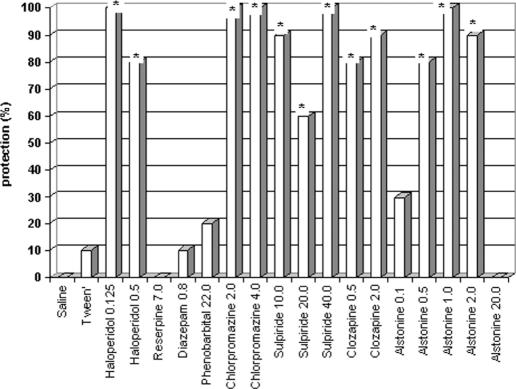
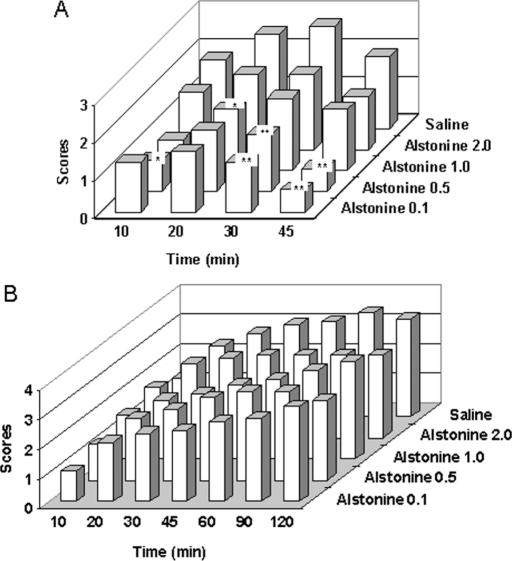
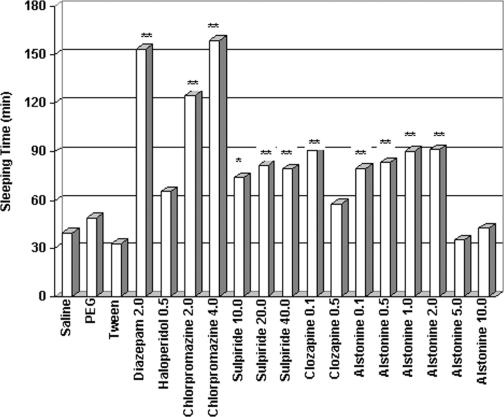
In mice models, Alston exhibited strong, dose-dependent, and powerful antipsychotic effects. Alstonine (ip) can prevent amphetamine-induced death at efficacious dosages in the range of 0.5-2.0 mg/kg [1]. Alstonine (0.1, 0.5, and 1.0 mg/kg) inhibits MK-801-induced hyperkinesis. Because Alstonine partially reverses the MK-801-induced increase in movement of the well plate and locomotor activity cage [1]. Alstonine successfully cured a relatively considerable proportion of BALB/C mice infected with transplantable YC8 lymphoma ascites cells and Swiss mice carrying Ehrlich ascites cancer cells [1].
In vivo, Alstonine attenuates MK-801-induced hyperlocomotion, working memory deficit, and social withdrawal. It prevents amphetamine-induced lethality at doses of 0.5-2.0 mg/kg (ip). It has antipsychotic, anxiolytic, anticancer, and antimalarial properties. |
| Enzyme Assay |
5-HT2C receptor binding affinity is assessed using radioligand binding assays with [³H]-mesulergine or [³H]-5-HT as tracers. Membrane preparations from cells expressing the human 5-HT2C receptor are incubated with Alstonine and a fixed concentration of radioligand. Non-specific binding is determined using mianserin. Ki values are calculated from competition curves.
|
| Cell Assay |
For functional assays, cells expressing 5-HT2C receptors are treated with Alstonine at varying concentrations. Receptor activation is measured by monitoring intracellular calcium mobilization using fluorescent calcium indicators (e.g., Fluo-4) or by measuring inositol phosphate accumulation. EC50 values for receptor activation are calculated from dose-response curves.
|
| Animal Protocol |
For in vivo efficacy studies, rodents are administered Alstonine intraperitoneally at doses of 0.5-2.0 mg/kg. MK-801-induced hyperlocomotion, working memory deficit, and social withdrawal are assessed. For anticancer activity, tumor xenograft models are used. For pharmacokinetic studies, blood and brain samples are collected and compound concentrations are measured by LC-MS/MS.
|
| References | |
| Additional Infomation |
Alstonine is an indole alkaloid with the molecular formula C21H20N2O3, isolated from various Rauvolfia species, and possesses antipsychotic activity. It is an antipsychotic drug. Alstonine is a methyl ester, belonging to the organic heteropentaneous compound family, exhibiting zwitterionic and indole alkaloid properties. It is the conjugate base of Alstonine (1+). Alstonine has been reported to exist in Rauvolfia species, Rauvolfia serpentina, and other organisms with relevant data.
|
| Molecular Formula |
C21H21N2O3+
|
|---|---|
| Molecular Weight |
349.40304
|
| Exact Mass |
348.147
|
| CAS # |
642-18-2
|
| Related CAS # |
47485-83-6;642-18-2;
|
| PubChem CID |
441979
|
| Appearance |
White to yellow solid powder
|
| Density |
0.9±0.1 g/cm3
|
| Boiling Point |
189.9±0.0 °C at 760 mmHg
|
| Flash Point |
65.0±8.0 °C
|
| Vapour Pressure |
0.8±0.3 mmHg at 25°C
|
| Index of Refraction |
1.488
|
| Source |
Originated from plants: Apocynaceae Alstonia scholaris (L.) R. Br.
|
| LogP |
3.2
|
| tPSA |
53.4
|
| Hydrogen Bond Donor Count |
0
|
| Hydrogen Bond Acceptor Count |
4
|
| Rotatable Bond Count |
2
|
| Heavy Atom Count |
26
|
| Complexity |
606
|
| Defined Atom Stereocenter Count |
3
|
| SMILES |
C[C@H]1[C@@H]2CN3C=CC4=C5C=CC=CC5=NC4=C3C[C@@H]2C(=CO1)C(=O)OC
|
| InChi Key |
WYTGDNHDOZPMIW-RCBQFDQVSA-N
|
| InChi Code |
InChI=1S/C21H20N2O3/c1-12-16-10-23-8-7-14-13-5-3-4-6-18(13)22-20(14)19(23)9-15(16)17(11-26-12)21(24)25-2/h3-8,11-12,15-16H,9-10H2,1-2H3/t12-,15-,16-/m0/s1
|
| Chemical Name |
methyl (15S,16S,20S)-16-methyl-17-oxa-3,13-diazapentacyclo[11.8.0.02,10.04,9.015,20]henicosa-1,3,5,7,9,11,18-heptaene-19-carboxylate
|
| HS Tariff Code |
2934.99.9001
|
| Storage |
Powder -20°C 3 years 4°C 2 years In solvent -80°C 6 months -20°C 1 month Note: This product requires protection from light (avoid light exposure) during transportation and storage. |
| Shipping Condition |
Room temperature (This product is stable at ambient temperature for a few days during ordinary shipping and time spent in Customs)
|
| Solubility (In Vitro) |
May dissolve in DMSO (in most cases), if not, try other solvents such as H2O, Ethanol, or DMF with a minute amount of products to avoid loss of samples
|
|---|---|
| Solubility (In Vivo) |
Note: Listed below are some common formulations that may be used to formulate products with low water solubility (e.g. < 1 mg/mL), you may test these formulations using a minute amount of products to avoid loss of samples.
Injection Formulations
Injection Formulation 1: DMSO : Tween 80: Saline = 10 : 5 : 85 (i.e. 100 μL DMSO stock solution → 50 μL Tween 80 → 850 μL Saline)(e.g. IP/IV/IM/SC) *Preparation of saline: Dissolve 0.9 g of sodium chloride in 100 mL ddH ₂ O to obtain a clear solution. Injection Formulation 2: DMSO : PEG300 :Tween 80 : Saline = 10 : 40 : 5 : 45 (i.e. 100 μL DMSO → 400 μLPEG300 → 50 μL Tween 80 → 450 μL Saline) Injection Formulation 3: DMSO : Corn oil = 10 : 90 (i.e. 100 μL DMSO → 900 μL Corn oil) Example: Take the Injection Formulation 3 (DMSO : Corn oil = 10 : 90) as an example, if 1 mL of 2.5 mg/mL working solution is to be prepared, you can take 100 μL 25 mg/mL DMSO stock solution and add to 900 μL corn oil, mix well to obtain a clear or suspension solution (2.5 mg/mL, ready for use in animals). View More
Injection Formulation 4: DMSO : 20% SBE-β-CD in saline = 10 : 90 [i.e. 100 μL DMSO → 900 μL (20% SBE-β-CD in saline)] Oral Formulations
Oral Formulation 1: Suspend in 0.5% CMC Na (carboxymethylcellulose sodium) Oral Formulation 2: Suspend in 0.5% Carboxymethyl cellulose Example: Take the Oral Formulation 1 (Suspend in 0.5% CMC Na) as an example, if 100 mL of 2.5 mg/mL working solution is to be prepared, you can first prepare 0.5% CMC Na solution by measuring 0.5 g CMC Na and dissolve it in 100 mL ddH2O to obtain a clear solution; then add 250 mg of the product to 100 mL 0.5% CMC Na solution, to make the suspension solution (2.5 mg/mL, ready for use in animals). View More
Oral Formulation 3: Dissolved in PEG400 (Please use freshly prepared in vivo formulations for optimal results.) |
| Preparing Stock Solutions | 1 mg | 5 mg | 10 mg | |
| 1 mM | 2.8620 mL | 14.3102 mL | 28.6205 mL | |
| 5 mM | 0.5724 mL | 2.8620 mL | 5.7241 mL | |
| 10 mM | 0.2862 mL | 1.4310 mL | 2.8620 mL |
*Note: Please select an appropriate solvent for the preparation of stock solution based on your experiment needs. For most products, DMSO can be used for preparing stock solutions (e.g. 5 mM, 10 mM, or 20 mM concentration); some products with high aqueous solubility may be dissolved in water directly. Solubility information is available at the above Solubility Data section. Once the stock solution is prepared, aliquot it to routine usage volumes and store at -20°C or -80°C. Avoid repeated freeze and thaw cycles.
Calculation results
Working concentration: mg/mL;
Method for preparing DMSO stock solution: mg drug pre-dissolved in μL DMSO (stock solution concentration mg/mL). Please contact us first if the concentration exceeds the DMSO solubility of the batch of drug.
Method for preparing in vivo formulation::Take μL DMSO stock solution, next add μL PEG300, mix and clarify, next addμL Tween 80, mix and clarify, next add μL ddH2O,mix and clarify.
(1) Please be sure that the solution is clear before the addition of next solvent. Dissolution methods like vortex, ultrasound or warming and heat may be used to aid dissolving.
(2) Be sure to add the solvent(s) in order.
|
|
|
Products are for research use only; We do not sell to patients
Copyright 2020 InvivoChem LLC | All Rights Reserved