
| Size | Price | Stock | Qty |
|---|---|---|---|
| 5mg |
|
||
| 10mg |
|
||
| 25mg |
|
||
| 100mg |
|
||
| 500mg | |||
| 1g | |||
| Other Sizes |


| Targets |
CHK1 (Checkpoint Kinase 1) and CHK2 (Checkpoint Kinase 2). WAY-230563 targets these key kinases in the DNA damage response (DDR) pathway. By inhibiting CHK1/CHK2, it prevents the activation of cell cycle checkpoints (particularly the G2/M checkpoint), forcing cancer cells with genomic instability to enter mitosis prematurely, which leads to mitotic catastrophe and apoptosis. It is a potent and selective inhibitor within the serine/threonin kinase class.
|
|---|---|
| ln Vitro |
WAY-230563 is a serine/threonine kinase inhibitor. It blocks CHK1/CHK2-mediated cell cycle checkpoints, leading to G2/M phase arrest in tumour cells following DNA damage. It is used in vitro to study checkpoint biology and potential chemosensitization in cancer research. The compound is a potent and selective inhibitor, but specific IC50 values were not provided in the search results.
|
| ln Vivo |
No specific in vivo activity data has been reported. However, based on its mechanism, WAY-230563 is expected to act as a chemosensitizer. In vivo, it would be administered in combination with DNA-damaging chemotherapies (e.g., irinotecan, cisplatin, PARP inhibitors) to enhance their efficacy. It is expected to abrogate cell cycle checkpoints in tumors, leading to increased DNA damage accumulation and tumor regression.
|
| Enzyme Assay |
WAY-230563 is a potent and selective CHK1/CHK2 kinase inhibitor. A typical enzyme inhibition assay is performed using recombinant human CHK1 or CHK2 protein (e.g., 10 nM). The enzyme is incubated with various concentrations of WAY-230563 (0.1 nM-100 uM) in a reaction buffer (50 mM Tris-HCl, pH 7.5, 10 mM MgCl2, 1 mM EGTA, 2 mM DTT) for 10-30 minutes. The reaction is initiated by adding a peptide substrate (e.g., P38-tide for CHK2) and ATP (10 uM-1 mM). After 30-60 minutes at 30degC, the reaction is stopped with EDTA. The amount of phosphorylated peptide is quantified by a FRET-based assay or by using a 33P-ATP filter-binding assay. IC50 values are calculated.
|
| Cell Assay |
For in vitro cellular studies, p53-deficient cancer cell lines (e.g., HeLa or MCF-7) are seeded in 96-well plates (5×10³ cells/well). Cells are treated with DNA damaging agents (e.g., doxorubicin, cisplatin) to activate the checkpoint. WAY-230563 is then added at concentrations ranging from 0.1-50 uM. After 24-48 hours, cell cycle distribution is analyzed by flow cytometry (PI staining), and the percentage of cells in G2/M phase is calculated. Apoptosis is measured by caspase-3/7 activity. Chemosensitization is determined by comparing the IC50 of the chemotherapy agent with and without a sub-toxic dose of WAY-230563.
|
| Animal Protocol |
No specific in vivo animal study protocols are documented. A typical protocol would involve using immunodeficient mice (e.g., SCID or BALB/c nude) bearing subcutaneous tumor xenografts (e.g., pancreatic, lung, or colon cancer). Once tumors reach a palpable size (100-200 mm3), mice would be randomized into treatment groups. The groups would include vehicle, WAY-230563 alone (e.g., 20-50 mg/kg, i.p. or oral), a DNA-damaging agent alone (e.g., irinotecan 50 mg/kg, i.v.), and the combination of WAY-230563 with the DNA-damaging agent. Treatment would last for 2-3 weeks, with tumor volume and body weight measured twice weekly. The primary endpoint is the enhancement of tumor growth inhibition in the combination group (i.e., a reduction in tumor volume and/or a delay in tumor growth) compared to the chemotherapy alone group. The secondary endpoint is tolerability (body weight loss).
|
| ADME/Pharmacokinetics |
No pharmacokinetic data has been reported. As a small molecule with a molecular weight of 308.35 g/mol, it likely has moderate to good oral bioavailability. The compound is likely to be distributed in tissues and may cross the blood-brain barrier. It is anticipated to be metabolized in the liver. Specific ADME parameters must be determined experimentally.
|
| Toxicity/Toxicokinetics |
No specific toxicity data has been reported. As a CHK1/2 inhibitor, there is a risk of significant on-target toxicity in normal dividing tissues (e.g., bone marrow, GI tract). These enzymes are critical for normal cells to recover from DNA damage; their inhibition can cause significant myelosuppression (low blood cell counts) and gastrointestinal toxicity. This is the primary dose-limiting toxicity for this class of drug. The compound is for research use only.
|
| Additional Infomation |
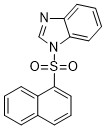
WAY-230563 is a chemical probe for studying the DNA damage response (DDR) and cell cycle checkpoints. By blocking CHK1/CHK2-mediated cell cycle checkpoints, it leads to G2/M phase arrest in tumour cells following DNA damage. It is a valuable tool for discovering and validating new combination therapies for cancer. Its molecular weight is 308.35 g/mol, and its molecular formula is C17H12N2O2S. It is also known as 1-(Naphthalen-1-ylsulfonyl)-1H-benzo[d]imidazole.
|
| Molecular Formula |
C17H12N2O2S
|
|---|---|
| Molecular Weight |
308.354382514954
|
| Exact Mass |
308.06
|
| Elemental Analysis |
C, 66.22; H, 3.92; N, 9.08; O, 10.38; S, 10.40
|
| CAS # |
93326-70-6
|
| PubChem CID |
581689
|
| Appearance |
Typically exists as solid at room temperature
|
| LogP |
3.9
|
| Hydrogen Bond Donor Count |
0
|
| Hydrogen Bond Acceptor Count |
3
|
| Rotatable Bond Count |
2
|
| Heavy Atom Count |
22
|
| Complexity |
501
|
| Defined Atom Stereocenter Count |
0
|
| SMILES |
C1=CC=C2C(=C1)C=CC=C2S(=O)(=O)N3C=NC4=CC=CC=C43
|
| InChi Key |
OWLBJCZHBXHQPQ-UHFFFAOYSA-N
|
| InChi Code |
InChI=1S/C17H12N2O2S/c20-22(21,19-12-18-15-9-3-4-10-16(15)19)17-11-5-7-13-6-1-2-8-14(13)17/h1-12H
|
| Chemical Name |
1-(naphthalen-1-ylsulfonyl)-1H-benzo[d]imidazole
|
| Synonyms |
Benzimidazole, 1-(1-naphthylsulfonyl)-; CBMicro_008038; Oprea1_826310; Oprea1_852430; WAY230563; WAY-230563; WAY 230563
|
| HS Tariff Code |
2934.99.9001
|
| Storage |
Powder -20°C 3 years 4°C 2 years In solvent -80°C 6 months -20°C 1 month |
| Shipping Condition |
Room temperature (This product is stable at ambient temperature for a few days during ordinary shipping and time spent in Customs)
|
| Solubility (In Vitro) |
May dissolve in DMSO (in most cases), if not, try other solvents such as H2O, Ethanol, or DMF with a minute amount of products to avoid loss of samples
|
|---|---|
| Solubility (In Vivo) |
Note: Listed below are some common formulations that may be used to formulate products with low water solubility (e.g. < 1 mg/mL), you may test these formulations using a minute amount of products to avoid loss of samples.
Injection Formulations
Injection Formulation 1: DMSO : Tween 80: Saline = 10 : 5 : 85 (i.e. 100 μL DMSO stock solution → 50 μL Tween 80 → 850 μL Saline)(e.g. IP/IV/IM/SC) *Preparation of saline: Dissolve 0.9 g of sodium chloride in 100 mL ddH ₂ O to obtain a clear solution. Injection Formulation 2: DMSO : PEG300 :Tween 80 : Saline = 10 : 40 : 5 : 45 (i.e. 100 μL DMSO → 400 μLPEG300 → 50 μL Tween 80 → 450 μL Saline) Injection Formulation 3: DMSO : Corn oil = 10 : 90 (i.e. 100 μL DMSO → 900 μL Corn oil) Example: Take the Injection Formulation 3 (DMSO : Corn oil = 10 : 90) as an example, if 1 mL of 2.5 mg/mL working solution is to be prepared, you can take 100 μL 25 mg/mL DMSO stock solution and add to 900 μL corn oil, mix well to obtain a clear or suspension solution (2.5 mg/mL, ready for use in animals). View More
Injection Formulation 4: DMSO : 20% SBE-β-CD in saline = 10 : 90 [i.e. 100 μL DMSO → 900 μL (20% SBE-β-CD in saline)] Oral Formulations
Oral Formulation 1: Suspend in 0.5% CMC Na (carboxymethylcellulose sodium) Oral Formulation 2: Suspend in 0.5% Carboxymethyl cellulose Example: Take the Oral Formulation 1 (Suspend in 0.5% CMC Na) as an example, if 100 mL of 2.5 mg/mL working solution is to be prepared, you can first prepare 0.5% CMC Na solution by measuring 0.5 g CMC Na and dissolve it in 100 mL ddH2O to obtain a clear solution; then add 250 mg of the product to 100 mL 0.5% CMC Na solution, to make the suspension solution (2.5 mg/mL, ready for use in animals). View More
Oral Formulation 3: Dissolved in PEG400 (Please use freshly prepared in vivo formulations for optimal results.) |
| Preparing Stock Solutions | 1 mg | 5 mg | 10 mg | |
| 1 mM | 3.2431 mL | 16.2153 mL | 32.4307 mL | |
| 5 mM | 0.6486 mL | 3.2431 mL | 6.4861 mL | |
| 10 mM | 0.3243 mL | 1.6215 mL | 3.2431 mL |
*Note: Please select an appropriate solvent for the preparation of stock solution based on your experiment needs. For most products, DMSO can be used for preparing stock solutions (e.g. 5 mM, 10 mM, or 20 mM concentration); some products with high aqueous solubility may be dissolved in water directly. Solubility information is available at the above Solubility Data section. Once the stock solution is prepared, aliquot it to routine usage volumes and store at -20°C or -80°C. Avoid repeated freeze and thaw cycles.
Calculation results
Working concentration: mg/mL;
Method for preparing DMSO stock solution: mg drug pre-dissolved in μL DMSO (stock solution concentration mg/mL). Please contact us first if the concentration exceeds the DMSO solubility of the batch of drug.
Method for preparing in vivo formulation::Take μL DMSO stock solution, next add μL PEG300, mix and clarify, next addμL Tween 80, mix and clarify, next add μL ddH2O,mix and clarify.
(1) Please be sure that the solution is clear before the addition of next solvent. Dissolution methods like vortex, ultrasound or warming and heat may be used to aid dissolving.
(2) Be sure to add the solvent(s) in order.
Products are for research use only; We do not sell to patients
Copyright 2020 InvivoChem LLC | All Rights Reserved


