
| Size | Price | |
|---|---|---|
| 10mg | ||
| Other Sizes |


| Targets |
Antibiotic
|
|---|---|
| ln Vitro |
Gramicidin C exhibits inhibitory activity against Gram-positive bacteria but is ineffective against Gram-negative bacteria. Its mechanism involves forming pores and channels in the bacterial cell membrane, increasing permeability to monovalent cations and disrupting transmembrane ion gradients. NMR structural studies in sodium dodecyl sulfate micelles have demonstrated that Gramicidin C adopts a double helix structure similar to Gramicidin A.
|
| ln Vivo |
In 1942, Soviet scientists G. F. Gause and M. G. Brazhnikova successfully developed Gramicidin C, which was used in frontline hospitals the same year to treat wound infections, saving hundreds of thousands of soldiers' lives. As Gramicidin C is typically used as part of the Gramicidin D mixture, its individual in vivo activity data are limited, with clinical applications primarily involving the mixture.
|
| ADME/Pharmacokinetics |
Due to its effects on both bacterial and mammalian cell membranes, Gramicidin (including Gramicidin C) has significant clinical limitations and is restricted to topical or local administration. Currently, there is no domestic production of Gramicidin C in China, nor are there imported products available. Systemic pharmacokinetic parameters (such as oral bioavailability and half-life) are not available.
|
| Toxicity/Toxicokinetics |
Gramicidin C exhibits nephrotoxicity and affects mammalian cell membranes, which significantly limits its clinical use to topical applications only. The pregnancy safety classification is Category C, with routes of administration including ocular, parenteral, or topical. Due to its toxicity to eukaryotic cells, Gramicidin C cannot be used systemically and is clinically formulated only in topical preparations for treating localized Gram-positive bacterial infections.
|
| References | |
| Additional Infomation |
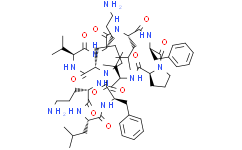
Gram-S is a homocyclic peptide. Gram-ins are a class of peptide antibiotics derived from brevibacteria. Gram-C or S is a cyclic ten-amino acid polypeptide, while Gram-A, B, and D are linear. Gram-ins are one of the two main components of casein.
|
| Molecular Formula |
C60H92N12O10
|
|---|---|
| Molecular Weight |
1141.44689464569
|
| Exact Mass |
1140.705
|
| CAS # |
9062-61-7
|
| PubChem CID |
73357
|
| Appearance |
Typically exists as solid at room temperature
|
| LogP |
4.6
|
| Hydrogen Bond Donor Count |
10
|
| Hydrogen Bond Acceptor Count |
12
|
| Rotatable Bond Count |
16
|
| Heavy Atom Count |
82
|
| Complexity |
2020
|
| Defined Atom Stereocenter Count |
10
|
| SMILES |
O=C1[C@@H](CC2C=CC=CC=2)NC([C@H](CC(C)C)NC([C@H](CCCN)NC([C@@H](C(C)C)NC([C@@H]2CCCN2C([C@@H](CC2C=CC=CC=2)NC([C@H](CC(C)C)NC([C@H](CCCN)NC([C@H](C(C)C)NC([C@@H]2CCCN21)=O)=O)=O)=O)=O)=O)=O)=O)=O
|
| InChi Key |
IUAYMJGZBVDSGL-XNNAEKOYSA-N
|
| InChi Code |
InChI=1S/C60H92N12O10/c1-35(2)31-43-53(75)67-45(33-39-19-11-9-12-20-39)59(81)71-29-17-25-47(71)55(77)70-50(38(7)8)58(80)64-42(24-16-28-62)52(74)66-44(32-36(3)4)54(76)68-46(34-40-21-13-10-14-22-40)60(82)72-30-18-26-48(72)56(78)69-49(37(5)6)57(79)63-41(23-15-27-61)51(73)65-43/h9-14,19-22,35-38,41-50H,15-18,23-34,61-62H2,1-8H3,(H,63,79)(H,64,80)(H,65,73)(H,66,74)(H,67,75)(H,68,76)(H,69,78)(H,70,77)/t41-,42-,43-,44-,45+,46+,47-,48-,49-,50-/m0/s1
|
| Chemical Name |
(3R,6S,9S,12S,15S,21R,24S,27S,30S,33S)-9,27-bis(3-aminopropyl)-3,21-dibenzyl-6,24-bis(2-methylpropyl)-12,30-di(propan-2-yl)-1,4,7,10,13,19,22,25,28,31-decazatricyclo[31.3.0.015,19]hexatriacontane-2,5,8,11,14,20,23,26,29,32-decone
|
| HS Tariff Code |
2934.99.9001
|
| Storage |
Powder -20°C 3 years 4°C 2 years In solvent -80°C 6 months -20°C 1 month |
| Shipping Condition |
Room temperature (This product is stable at ambient temperature for a few days during ordinary shipping and time spent in Customs)
|
| Solubility (In Vitro) |
May dissolve in DMSO (in most cases), if not, try other solvents such as H2O, Ethanol, or DMF with a minute amount of products to avoid loss of samples
|
|---|---|
| Solubility (In Vivo) |
Note: Listed below are some common formulations that may be used to formulate products with low water solubility (e.g. < 1 mg/mL), you may test these formulations using a minute amount of products to avoid loss of samples.
Injection Formulations
Injection Formulation 1: DMSO : Tween 80: Saline = 10 : 5 : 85 (i.e. 100 μL DMSO stock solution → 50 μL Tween 80 → 850 μL Saline)(e.g. IP/IV/IM/SC) *Preparation of saline: Dissolve 0.9 g of sodium chloride in 100 mL ddH ₂ O to obtain a clear solution. Injection Formulation 2: DMSO : PEG300 :Tween 80 : Saline = 10 : 40 : 5 : 45 (i.e. 100 μL DMSO → 400 μLPEG300 → 50 μL Tween 80 → 450 μL Saline) Injection Formulation 3: DMSO : Corn oil = 10 : 90 (i.e. 100 μL DMSO → 900 μL Corn oil) Example: Take the Injection Formulation 3 (DMSO : Corn oil = 10 : 90) as an example, if 1 mL of 2.5 mg/mL working solution is to be prepared, you can take 100 μL 25 mg/mL DMSO stock solution and add to 900 μL corn oil, mix well to obtain a clear or suspension solution (2.5 mg/mL, ready for use in animals). View More
Injection Formulation 4: DMSO : 20% SBE-β-CD in saline = 10 : 90 [i.e. 100 μL DMSO → 900 μL (20% SBE-β-CD in saline)] Oral Formulations
Oral Formulation 1: Suspend in 0.5% CMC Na (carboxymethylcellulose sodium) Oral Formulation 2: Suspend in 0.5% Carboxymethyl cellulose Example: Take the Oral Formulation 1 (Suspend in 0.5% CMC Na) as an example, if 100 mL of 2.5 mg/mL working solution is to be prepared, you can first prepare 0.5% CMC Na solution by measuring 0.5 g CMC Na and dissolve it in 100 mL ddH2O to obtain a clear solution; then add 250 mg of the product to 100 mL 0.5% CMC Na solution, to make the suspension solution (2.5 mg/mL, ready for use in animals). View More
Oral Formulation 3: Dissolved in PEG400 (Please use freshly prepared in vivo formulations for optimal results.) |
| Preparing Stock Solutions | 1 mg | 5 mg | 10 mg | |
| 1 mM | 0.8761 mL | 4.3804 mL | 8.7608 mL | |
| 5 mM | 0.1752 mL | 0.8761 mL | 1.7522 mL | |
| 10 mM | 0.0876 mL | 0.4380 mL | 0.8761 mL |
*Note: Please select an appropriate solvent for the preparation of stock solution based on your experiment needs. For most products, DMSO can be used for preparing stock solutions (e.g. 5 mM, 10 mM, or 20 mM concentration); some products with high aqueous solubility may be dissolved in water directly. Solubility information is available at the above Solubility Data section. Once the stock solution is prepared, aliquot it to routine usage volumes and store at -20°C or -80°C. Avoid repeated freeze and thaw cycles.
Calculation results
Working concentration: mg/mL;
Method for preparing DMSO stock solution: mg drug pre-dissolved in μL DMSO (stock solution concentration mg/mL). Please contact us first if the concentration exceeds the DMSO solubility of the batch of drug.
Method for preparing in vivo formulation::Take μL DMSO stock solution, next add μL PEG300, mix and clarify, next addμL Tween 80, mix and clarify, next add μL ddH2O,mix and clarify.
(1) Please be sure that the solution is clear before the addition of next solvent. Dissolution methods like vortex, ultrasound or warming and heat may be used to aid dissolving.
(2) Be sure to add the solvent(s) in order.
Products are for research use only; We do not sell to patients
Copyright 2020 InvivoChem LLC | All Rights Reserved


