| Size | Price | Stock | Qty |
|---|---|---|---|
| 50mg |
|
||
| 100mg |
|
||
| 250mg |
|
||
| 500mg | |||
| Other Sizes |


Purity: ≥98%
| Targets |
PDE10A (IC50 = 0.37 nM)
|
|---|---|
| ln Vitro |
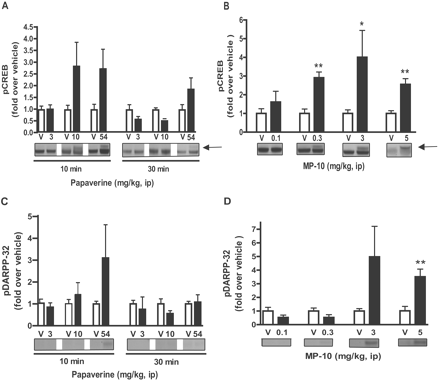
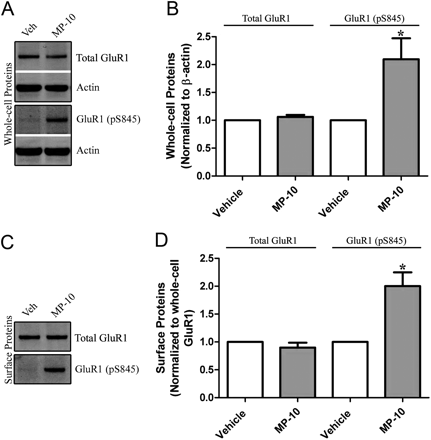
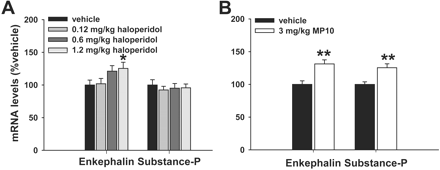
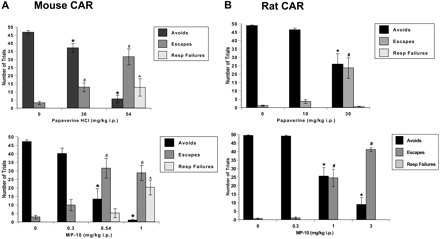
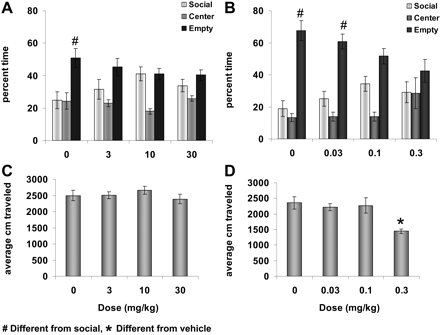
PF-2545920 intraperitoneally administrated at dose of 0.3, 3, and 5 mg/kg in male CF-1 mice causes striking increases in GluR1 phosphorylation levels of 3-, 5.4-, and 4.1-fold , respectively. MP-10 at concentration of 1 μM treats Rat striatal slices for 30 min, the level of GluR1S845 phosphorylation at the cell surface is significantly increased 2-fold, without change the level of total GluR1 on the cell surface. MP-10 intraperitoneally administrated at dose of 0.3, 3, and 5 mg/kg in male CF-1 mice results in robust, statistically significant increases in CREBS133 phosphorylation of 3-, 4-, and 2.6-fold, respectively. MP-10 intraperitoneally administrated at dose of 3 mg/kg increases both enkephalin and substance-P mRNA levels in striatum of CF-1 mice. MP-10 intraperitoneally administrated at dose of 0.3-1 mg/kg decreases avoidance responding with a significant treatment effect in the mouse CAR model. Mice treated with MP-10 at dose of 0.03 mg/kg spents more time in the empty than social side in the mice, MP-10 also dose-dependently decreased locomotor activity.
Kinase Assay: PF-2545920 (Also known asMardepodect, MP-10) is a potent and selective PDE10A (phosphodiesterase)inhibitor with IC50 of 0.37 nM, and with >1000-fold selectivity overthe PDE. Mardepodect shows excellent potency against PDE10A with an IC50 of 0.37 nM and >1000-fold selectivity over other phosphodiesterase family members. In rat striatal slices, MP-10 at 1 µM for 30 minutes significantly increases cell surface GluR1S845 phosphorylation by 2-fold without changing total GluR1 levels. In male CF-1 mice, intraperitoneal administration at 0.3, 3, and 5 mg/kg causes striking increases in GluR1 phosphorylation (3-, 5.4-, and 4.1-fold) and CREBS133 phosphorylation (3-, 4-, and 2.6-fold). The compound's ability to inhibit PDE10A leads to elevation of cyclic nucleotides, which in turn modulates striatal signaling pathways involved in motor control and cognition. |
| ln Vivo |
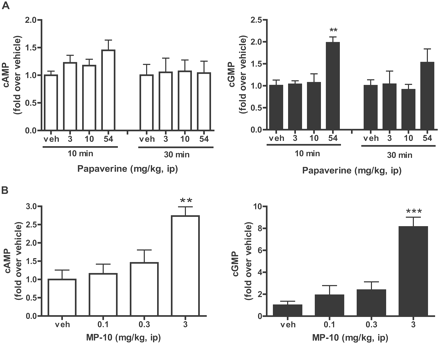
With an ED50 of 1 mg/kg, mardepodect (PF-2545920) is active in the conditioned avoidance response (CAR). The striatal cGMP assay in mice administered Mardepodect (PF-2545920) increases in a dose-dependent manner[2].
Mardepodect is active in a range of antipsychotic models with an ED50 of 1 mg/kg in the conditioned avoidance response (CAR) assay. It antagonizes apomorphine-induced climbing in mice, inhibits conditioned avoidance responding in rats and mice, and blocks NMDA antagonist-induced deficits in prepulse inhibition. The compound induces dose-dependent increases in striatal cGMP in mice and can cross the blood-brain barrier. PDE10A inhibitors like PF-2545920 have been shown to have anti-tumor efficacy at concentrations that significantly elevate cyclic nucleotides without immediately activating PI3K/AKT feedback loops in responsive tumors. The compound produces greater induction of c-Fos in D2 neurons than in D1 neurons in the neostriatum. |
| Enzyme Assay |
PDE10A enzyme activity is measured using scintillation proximity assays or fluorescence polarization methods with cAMP or cGMP as substrates. IC50 values are determined from dose-response curves. Selectivity profiling is conducted against all other PDE family members to establish the selectivity ratio of >1000-fold. Kinase assays assess the compound's effects on downstream signaling pathways including GluR1 and CREB phosphorylation.
|
| Cell Assay |
Rat striatal slices are treated with MP-10 at 1 µM for 30 minutes, and cell surface GluR1 phosphorylation is measured by Western blot. In cell-based assays, PDE10A inhibition is assessed by measuring cGMP accumulation in striatal neurons or recombinant cell lines expressing PDE10A. Effects on downstream signaling markers including phospho-GluR1 and phospho-CREB are evaluated. The compound's effects on c-Fos induction in D1 and D2 neurons are also assessed.
|
| Animal Protocol |
Dissolved in 5:5:90 DMSO:1N HCl:saline; 0.1 mg/kg; i.v. injection
Jugular vein-cannulated male Sprague-Dawley rats In male CF-1 mice, Mardepodect is administered intraperitoneally at 0.3, 3, and 5 mg/kg. Striatal tissue is collected for analysis of GluR1 and CREB phosphorylation, cGMP levels, and enkephalin and substance-P mRNA expression. In the CAR model, mice are treated with MP-10 at 0.3–1 mg/kg. For in vivo formulation, the compound is dissolved in 5:5:90 DMSO:1N HCl:saline and administered intravenously at 0.1 mg/kg in jugular vein-cannulated male Sprague-Dawley rats. Formulations containing PF-2545920 are under clinical investigation for the treatment of schizophrenia and Huntington's disease. |
| ADME/Pharmacokinetics |
Mardepodect demonstrates excellent pharmacokinetic properties in preclinical species, supporting successful oral human dosing. The compound shows brain penetration with validated human PET occupancy data establishing a direct exposure-target engagement relationship. It is soluble in DMSO (25 mg/mL, 58.29 mM) and can be formulated for in vivo administration. Detailed PK parameters such as half-life, clearance, and bioavailability are available from preclinical and clinical studies. The compound is a substrate for relevant metabolic enzymes and shows acceptable clearance and volume of distribution.
|
| Toxicity/Toxicokinetics |
Mardepodect has been evaluated in Phase 1 and Phase 2 clinical trials for schizophrenia and Huntington's disease (NCT01103726, NCT01806896, NCT02342548). The compound demonstrates CNS target engagement and has been characterized for safety and tolerability. Some Phase 2 trials in Huntington's disease were terminated. Comprehensive toxicology data are available from clinical development programs, including assessments of genotoxicity, cardiotoxicity, and repeated-dose toxicity. The compound is generally well-tolerated at studied doses.
|
| References |
|
| Additional Infomation |
Mardepodect was developed by Pfizer as a PDE10A inhibitor for schizophrenia and Huntington's disease. It is the first potent and selective PDE10A inhibitor to enter human clinical trials. The compound demonstrates efficacy at 1 mg/kg in the CAR assay and dose-dependent increases in striatal cGMP. It has been characterized with validated human PET occupancy data and Phase II efficacy/safety results. The compound has also been investigated for its anti-tumor effects, with studies showing that PDE10A inhibitors like PF-2545920 can restore cyclic nucleotide levels and inhibit oncogenic signaling in preclinical models of colorectal cancer and non-small cell lung cancer.
|
| Molecular Formula |
C25H21CLN4O
|
|
|---|---|---|
| Molecular Weight |
428.9134
|
|
| Exact Mass |
428.14
|
|
| CAS # |
2070014-78-5
|
|
| Related CAS # |
898562-94-2
|
|
| PubChem CID |
122412737
|
|
| Appearance |
Light brown to brown solid powder
|
|
| LogP |
0
|
|
| Hydrogen Bond Donor Count |
1
|
|
| Hydrogen Bond Acceptor Count |
4
|
|
| Rotatable Bond Count |
5
|
|
| Heavy Atom Count |
31
|
|
| Complexity |
531
|
|
| Defined Atom Stereocenter Count |
0
|
|
| SMILES |
Cl[H].O(C([H])([H])C1C([H])=C([H])C2=C([H])C([H])=C([H])C([H])=C2N=1)C1C([H])=C([H])C(=C([H])C=1[H])C1C(C2C([H])=C([H])N=C([H])C=2[H])=C([H])N(C([H])([H])[H])N=1
|
|
| InChi Key |
BDHTXAXWOXYUDG-UHFFFAOYSA-N
|
|
| InChi Code |
InChI=1S/C25H20N4O.ClH/c1-29-16-23(18-12-14-26-15-13-18)25(28-29)20-7-10-22(11-8-20)30-17-21-9-6-19-4-2-3-5-24(19)27-21;/h2-16H,17H2,1H3;1H
|
|
| Chemical Name |
2-[[4-(1-methyl-4-pyridin-4-ylpyrazol-3-yl)phenoxy]methyl]quinoline;hydrochloride
|
|
| Synonyms |
|
|
| HS Tariff Code |
2934.99.9001
|
|
| Storage |
Powder -20°C 3 years 4°C 2 years In solvent -80°C 6 months -20°C 1 month Note: Please store this product in a sealed and protected environment, avoid exposure to moisture. |
|
| Shipping Condition |
Room temperature (This product is stable at ambient temperature for a few days during ordinary shipping and time spent in Customs)
|
| Solubility (In Vitro) |
|
|||
|---|---|---|---|---|
| Solubility (In Vivo) |
Solubility in Formulation 1: ≥ 3.25 mg/mL (7.58 mM) (saturation unknown) in 10% DMSO + 40% PEG300 + 5% Tween80 + 45% Saline (add these co-solvents sequentially from left to right, and one by one), clear solution.
For example, if 1 mL of working solution is to be prepared, you can add 100 μL of 32.5 mg/mL clear DMSO stock solution to 400 μL of PEG300 and mix evenly; then add 50 μL of Tween-80 to the above solution and mix evenly; then add 450 μL of normal saline to adjust the volume to 1 mL. Preparation of saline: Dissolve 0.9 g of sodium chloride in 100 mL ddH₂ O to obtain a clear solution. Solubility in Formulation 2: ≥ 3.25 mg/mL (7.58 mM) (saturation unknown) in 10% DMSO + 90% (20% SBE-β-CD in Saline) (add these co-solvents sequentially from left to right, and one by one), clear solution. For example, if 1 mL of working solution is to be prepared, you can add 100 μL of 32.5 mg/mL clear DMSO stock solution to 900 μL of 20% SBE-β-CD physiological saline solution and mix evenly. Preparation of 20% SBE-β-CD in Saline (4°C,1 week): Dissolve 2 g SBE-β-CD in 10 mL saline to obtain a clear solution. (Please use freshly prepared in vivo formulations for optimal results.) |
| Preparing Stock Solutions | 1 mg | 5 mg | 10 mg | |
| 1 mM | 2.3315 mL | 11.6575 mL | 23.3149 mL | |
| 5 mM | 0.4663 mL | 2.3315 mL | 4.6630 mL | |
| 10 mM | 0.2331 mL | 1.1657 mL | 2.3315 mL |
*Note: Please select an appropriate solvent for the preparation of stock solution based on your experiment needs. For most products, DMSO can be used for preparing stock solutions (e.g. 5 mM, 10 mM, or 20 mM concentration); some products with high aqueous solubility may be dissolved in water directly. Solubility information is available at the above Solubility Data section. Once the stock solution is prepared, aliquot it to routine usage volumes and store at -20°C or -80°C. Avoid repeated freeze and thaw cycles.
Calculation results
Working concentration: mg/mL;
Method for preparing DMSO stock solution: mg drug pre-dissolved in μL DMSO (stock solution concentration mg/mL). Please contact us first if the concentration exceeds the DMSO solubility of the batch of drug.
Method for preparing in vivo formulation::Take μL DMSO stock solution, next add μL PEG300, mix and clarify, next addμL Tween 80, mix and clarify, next add μL ddH2O,mix and clarify.
(1) Please be sure that the solution is clear before the addition of next solvent. Dissolution methods like vortex, ultrasound or warming and heat may be used to aid dissolving.
(2) Be sure to add the solvent(s) in order.
|
|---|
|
|
|
|---|
|
|
Products are for research use only; We do not sell to patients
Copyright 2020 InvivoChem LLC | All Rights Reserved


 COA
COA