| Size | Price | Stock | Qty |
|---|---|---|---|
| 5mg |
|
||
| 10mg |
|
||
| 25mg |
|
||
| 50mg |
|
||
| 100mg |
|
||
| 250mg | |||
| 500mg | |||
| Other Sizes |


Purity: ≥98%
| Targets |
IL-15; IL-17
Mainly exerts effects by regulating immunoinflammatory pathways and ribosome biogenesis-related pathways [1][2][3] |
|---|---|
| ln Vitro |
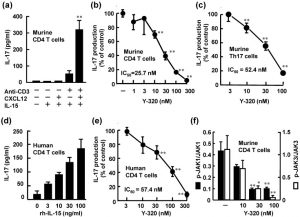
Y-320 also prevents mouse CD4 T cells stimulated with IL-15, CXCL12, and anti-CD3 mAb from producing IFN-γ and TNF-α. [1]
In in vitro culture of human peripheral blood T cells, treatment with Y-320 at 1-10 μM dose-dependently inhibited anti-CD3/CD28-induced IL-17 secretion (maximum inhibition rate of 72%), while reducing IL-17A mRNA expression level, with no obvious effect on IFN-γ and IL-4 secretion [1] - In mouse splenocytes, treatment with Y-320 (5 μM, 48 hours) inhibited Th17 cell differentiation (Th17 cell proportion decreased from 18% to 7%), upregulated the proportion of regulatory T cells (Treg) (from 5% to 12%), and did not affect overall T cell proliferation [1] - In human synovial fibroblasts, Y-320 inhibited IL-1β-induced IL-6 and IL-8 secretion (decreased by 65% and 58%, respectively) and reduced the mRNA expressions of matrix metalloproteinases (MMP-3, MMP-9) [1] - In human cervical cancer cells (HeLa) and fibroblasts (IMR-90), treatment with Y-320 at 0.1-10 μM significantly promoted ribosome biogenesis, with rRNA synthesis rate increased by 45% and protein synthesis rate increased by 38%. It also dose-dependently enhanced gentamicin-induced premature termination codon (PTC) readthrough efficiency (maximum readthrough efficiency increased by 3.2 times) [2] - In various multidrug-resistant (MDR) tumor cell lines (A549/ADR, MCF-7/ADR, HepG2/ADR), combination of Y-320 (2.5 μM) with doxorubicin or paclitaxel significantly enhanced the antiproliferative activity of chemotherapeutic drugs. The IC50 of doxorubicin against A549/ADR decreased from 12.8 μM to 3.2 μM, and the IC50 of paclitaxel against MCF-7/ADR decreased from 8.5 μM to 2.1 μM [3] - In MDR tumor cells, Y-320 treatment downregulated the mRNA and protein expressions of multidrug resistance genes (MDR1, MRP1) (decreased by 55% and 48%, respectively), increased intracellular chemotherapeutic drug accumulation (doxorubicin accumulation increased by 62%), and activated the caspase-3/9-dependent apoptotic pathway [3] |
| ln Vivo |
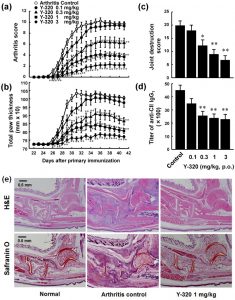
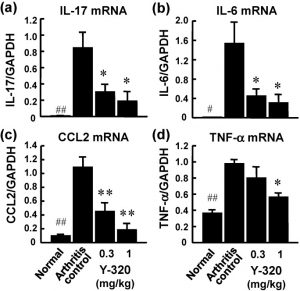
Y-320 (0.3–3 mg/kg p.o.) shows therapeutic effects on collagen-induced arthritis (CIA) in cynomolgus monkeys as well as mice with a reduction in IL-17 mRNA in arthritic joints. Additionally, when combined with an anti-TNF mAb, Y-320 has a synergistic effect on mice with chronically worsening CIA. [1]
In the DBA/1 mouse collagen-induced arthritis (CIA) model, oral administration of Y-320 at 30 mg/kg once daily for 21 days significantly alleviated joint swelling (swelling index decreased from 4.2 to 1.5), reduced serum IL-17 and TNF-α concentrations (decreased by 68% and 52%, respectively), and reduced synovial inflammatory infiltration and cartilage damage in joints [1] - In the cynomolgus monkey CIA model, oral administration of Y-320 at 10 mg/kg twice a week for 8 weeks reduced the joint inflammation score from 3.8 to 1.2. X-ray films of joints showed significantly reduced bone erosion and no obvious progression of joint deformity [1] - In the nude mouse A549/ADR drug-resistant lung cancer xenograft model, combination of Y-320 (15 mg/kg, oral, once daily) and doxorubicin (5 mg/kg, intraperitoneal injection, once a week) for 3 consecutive weeks reduced tumor volume by 65% and tumor weight by 62% compared with the doxorubicin monotherapy group. The proportion of apoptotic cells in tumor tissues increased (TUNEL positive rate increased from 12% to 45%) [3] - In the drug-resistant tumor model, MDR1 protein expression in tumor tissues of the combination group decreased by 58%, caspase-3 activation level increased by 2.8 times, and no enhanced toxicity related to chemotherapeutic drugs (such as weight loss, myelosuppression) was observed [3] |
| Enzyme Assay |
IL-17 secretion detection: Human peripheral blood T cells were activated with anti-CD3/CD28 antibodies, then gradient concentrations (0.1-20 μM) of Y-320 were added. After culturing for 72 hours, the supernatant was collected to detect IL-17A concentration by ELISA, and the inhibition rate was calculated [1]
- Ribosome biogenesis detection: After HeLa cells were treated with Y-320, radioactive-labeled uridine was added. After culturing for 4 hours, total cellular RNA was extracted, and the radioactive incorporation was detected to evaluate the rRNA synthesis rate [2] - Protein synthesis rate detection: After IMR-90 cells were treated with Y-320, radioactive-labeled leucine was added. After culturing for 2 hours, the radioactivity intensity of radioactive proteins in cells was detected to calculate the protein synthesis rate [2] - Multidrug resistance gene expression detection: After MDR tumor cells were treated with Y-320, cellular RNA and protein were extracted, and the mRNA and protein expression levels of MDR1 and MRP1 were detected by RT-PCR and Western blot [3] |
| Cell Assay |
Y-320 inhibited IL-17 production by CD4 T cells induced by IL-15 with IC50 values of 20-60 NM.
T cell differentiation and cytokine detection: Human peripheral blood or mouse splenic T cells were isolated and seeded in culture plates coated with anti-CD3/CD28 antibodies. Gradient concentrations (1-10 μM) of Y-320 were added. After culturing for 72 hours, the proportions of Th17 and Treg cells were detected by flow cytometry; the concentrations of IL-17, IFN-γ, and IL-4 in the supernatant were detected by ELISA [1] - Ribosome function-related detection: HeLa cells were seeded and treated with 0.1-10 μM Y-320 for 24 hours. The expression of ribosomal proteins (RPS6, RPL11) was detected by Western blot; the transcription levels of 18S and 28S rRNA were detected by RT-PCR; the nucleolar morphology (ribosome biogenesis site) was observed by immunofluorescence staining [2] - MDR tumor cell drug sensitivity assay: MDR cell lines (A549/ADR, MCF-7/ADR, etc.) were seeded in 96-well plates. Y-320 (2.5 μM) and gradient concentrations of chemotherapeutic drugs (doxorubicin, paclitaxel) were added. After culturing for 72 hours, cell viability was detected by MTT assay to calculate IC50 values [3] - Tumor cell apoptosis and drug accumulation detection: After MDR tumor cells were treated with the combination of Y-320 and doxorubicin, the apoptosis rate was detected by flow cytometry with Annexin V/PI double staining; the intracellular doxorubicin accumulation was detected by high-performance liquid chromatography [3] - Synovial fibroblast inflammatory factor detection: Human synovial fibroblasts were induced by IL-1β, then treated with Y-320 (5 μM) for 48 hours. The mRNA expressions of IL-6, IL-8, and MMP-3 were detected by RT-PCR; the IL-6 concentration in the supernatant was detected by ELISA [1] |
| Animal Protocol |
Suspended in a 0.5% hydroxypropylmethylcellulose (HPMC); 3 mg/kg; p.o.
DBA/1J mice with type II collagen-induced arthritis (CIA) Mouse collagen-induced arthritis experiment: 6-week-old DBA/1 mice were immunized with bovine type Ⅱ collagen emulsion via subcutaneous injection at the base of the tail to establish the model. Seven days after modeling, the treatment group was given oral Y-320 (30 mg/kg, dissolved in 0.5% sodium carboxymethylcellulose) once daily for 21 consecutive days; the control group was given an equal volume of vehicle. The joint swelling index was monitored weekly, and serum and joint tissues were collected at the end of the experiment to detect inflammatory factors and pathological damage [1] - Cynomolgus monkey collagen-induced arthritis experiment: Adult cynomolgus monkeys were modeled by intra-articular injection of bovine type Ⅱ collagen. Fourteen days after modeling, the treatment group was given oral Y-320 (10 mg/kg, dissolved in normal saline + a small amount of ethanol) twice a week for 8 consecutive weeks; the control group was given an equal volume of vehicle. The joint inflammation score and serum cytokine concentration were detected regularly, and bone erosion was evaluated by X-ray films [1] - MDR tumor xenograft experiment: 6-8 week-old nude mice were subcutaneously inoculated with A549/ADR cells (5×10^6 cells/mouse) on the right back. Seven days after inoculation, mice were randomly divided into a control group, a doxorubicin monotherapy group, and a combination group (8 mice per group). The combination group received oral Y-320 (15 mg/kg, once daily) + intraperitoneal injection of doxorubicin (5 mg/kg, once a week) for 3 consecutive weeks; other groups received corresponding drugs or vehicle. Tumor volume was measured every 3 days, and tumors were stripped at the end of the experiment to detect apoptosis-related indicators and drug resistance gene expression [3] |
| Toxicity/Toxicokinetics |
In mouse and cynomolgus monkey arthritis models, the animals were administered 30 mg/kg (mice) and 10 mg/kg (cynomolgus monkeys) for 8-21 weeks, respectively, and no significant weight loss was observed (weight change rate ≤5%). Serum ALT, AST, creatinine and urea nitrogen levels were not significantly different from those in the control group, and no damage was observed in the pathological sections of the major organs (liver, kidney and spleen) [1]. In nude mouse tumor models, no toxic synergistic effect was observed when Y-320 was used in combination with chemotherapy drugs. Mice did not show obvious symptoms such as diarrhea, hair loss or bone marrow suppression, and the peripheral blood leukocyte count was not significantly different from that in the control group [3].
|
| References |
|
| Additional Infomation |
Y-320 is a novel phenylpyrazole aniline compound with multiple activities, including immunomodulation, regulation of ribosome biosynthesis, and sensitization of tumor chemotherapy [1][2][3]. Its anti-inflammatory mechanism is related to the inhibition of Th17 cell differentiation and IL-17 secretion, and it can regulate the Treg/Th17 balance without affecting the function of other Th cell subsets, showing immunomodulatory specificity [1]. In terms of regulation of ribosome biosynthesis, Y-320 can promote rRNA synthesis and ribosome assembly, improve protein translation efficiency, and improve peptide end capping (PTC) readout induced by aminoglycoside drugs, providing potential therapeutic value for the treatment of hereditary diseases (such as cystic fibrosis) [2]. Its sensitization effect on multidrug-resistant (MDR) tumors depends on downregulating the expression of drug resistance genes such as MDR1 and MRP1, increasing the accumulation of chemotherapeutic drugs in cells, and without increasing the toxicity of chemotherapeutic drugs to normal tissues, showing good safety. [3]
- The drug showed significant efficacy in autoimmune arthritis and multidrug-resistant tumor models, and was well tolerated in non-human primates, indicating its potential for clinical translation.[1][3] |
| Molecular Formula |
C27H29CLN6O2
|
|
|---|---|---|
| Molecular Weight |
505.01
|
|
| Exact Mass |
504.204
|
|
| Elemental Analysis |
C, 64.21; H, 5.79; Cl, 7.02; N, 16.64; O, 6.34
|
|
| CAS # |
288250-47-5
|
|
| Related CAS # |
|
|
| PubChem CID |
22227931
|
|
| Appearance |
Off-white to pink solid powder
|
|
| Density |
1.3±0.1 g/cm3
|
|
| Boiling Point |
631.2±55.0 °C at 760 mmHg
|
|
| Flash Point |
335.6±31.5 °C
|
|
| Vapour Pressure |
0.0±1.8 mmHg at 25°C
|
|
| Index of Refraction |
1.675
|
|
| LogP |
3.58
|
|
| Hydrogen Bond Donor Count |
1
|
|
| Hydrogen Bond Acceptor Count |
6
|
|
| Rotatable Bond Count |
5
|
|
| Heavy Atom Count |
36
|
|
| Complexity |
784
|
|
| Defined Atom Stereocenter Count |
0
|
|
| SMILES |
ClC1C([H])=C([H])C(=C([H])C=1[H])N1C(C([H])([H])[H])=C(C([H])=N1)C(N([H])C1C([H])=C([H])C(=C(C#N)C=1[H])N1C([H])([H])C([H])([H])C([H])(C([H])([H])C1([H])[H])N1C([H])([H])C([H])([H])OC([H])([H])C1([H])[H])=O
|
|
| InChi Key |
BWZNJVZTAWBIFG-UHFFFAOYSA-N
|
|
| InChi Code |
InChI=1S/C27H29ClN6O2/c1-19-25(18-30-34(19)24-5-2-21(28)3-6-24)27(35)31-22-4-7-26(20(16-22)17-29)33-10-8-23(9-11-33)32-12-14-36-15-13-32/h2-7,16,18,23H,8-15H2,1H3,(H,31,35)
|
|
| Chemical Name |
1-(4-chlorophenyl)-N-[3-cyano-4-(4-morpholin-4-ylpiperidin-1-yl)phenyl]-5-methylpyrazole-4-carboxamide
|
|
| Synonyms |
|
|
| HS Tariff Code |
2934.99.9001
|
|
| Storage |
Powder -20°C 3 years 4°C 2 years In solvent -80°C 6 months -20°C 1 month |
|
| Shipping Condition |
Room temperature (This product is stable at ambient temperature for a few days during ordinary shipping and time spent in Customs)
|
| Solubility (In Vitro) |
DMSO: ~11 mg/mL (~21.8 mM)
Water: 1 mg/mL (Insoluble) Ethanol: 1 mg/mL |
|---|---|
| Solubility (In Vivo) |
Solubility in Formulation 1: ≥ 0.5 mg/mL (0.99 mM) (saturation unknown) in 10% DMSO + 40% PEG300 + 5% Tween80 + 45% Saline (add these co-solvents sequentially from left to right, and one by one), clear solution.
For example, if 1 mL of working solution is to be prepared, you can add 100 μL of 5.0 mg/mL clear DMSO stock solution to 400 μL PEG300 and mix evenly; then add 50 μL Tween-80 to the above solution and mix evenly; then add 450 μL normal saline to adjust the volume to 1 mL. Preparation of saline: Dissolve 0.9 g of sodium chloride in 100 mL ddH₂ O to obtain a clear solution. Solubility in Formulation 2: ≥ 0.5 mg/mL (0.99 mM) (saturation unknown) in 10% DMSO + 90% (20% SBE-β-CD in Saline) (add these co-solvents sequentially from left to right, and one by one), clear solution. For example, if 1 mL of working solution is to be prepared, you can add 100 μL of 5.0 mg/mL clear DMSO stock solution to 900 μL of 20% SBE-β-CD physiological saline solution and mix evenly. Preparation of 20% SBE-β-CD in Saline (4°C,1 week): Dissolve 2 g SBE-β-CD in 10 mL saline to obtain a clear solution. View More
Solubility in Formulation 3: ≥ 0.5 mg/mL (0.99 mM) (saturation unknown) in 10% DMSO + 90% Corn Oil (add these co-solvents sequentially from left to right, and one by one), clear solution. |
| Preparing Stock Solutions | 1 mg | 5 mg | 10 mg | |
| 1 mM | 1.9802 mL | 9.9008 mL | 19.8016 mL | |
| 5 mM | 0.3960 mL | 1.9802 mL | 3.9603 mL | |
| 10 mM | 0.1980 mL | 0.9901 mL | 1.9802 mL |
*Note: Please select an appropriate solvent for the preparation of stock solution based on your experiment needs. For most products, DMSO can be used for preparing stock solutions (e.g. 5 mM, 10 mM, or 20 mM concentration); some products with high aqueous solubility may be dissolved in water directly. Solubility information is available at the above Solubility Data section. Once the stock solution is prepared, aliquot it to routine usage volumes and store at -20°C or -80°C. Avoid repeated freeze and thaw cycles.
Calculation results
Working concentration: mg/mL;
Method for preparing DMSO stock solution: mg drug pre-dissolved in μL DMSO (stock solution concentration mg/mL). Please contact us first if the concentration exceeds the DMSO solubility of the batch of drug.
Method for preparing in vivo formulation::Take μL DMSO stock solution, next add μL PEG300, mix and clarify, next addμL Tween 80, mix and clarify, next add μL ddH2O,mix and clarify.
(1) Please be sure that the solution is clear before the addition of next solvent. Dissolution methods like vortex, ultrasound or warming and heat may be used to aid dissolving.
(2) Be sure to add the solvent(s) in order.
|
|---|
|
|
Products are for research use only; We do not sell to patients
Copyright 2020 InvivoChem LLC | All Rights Reserved


 COA
COA