| Size | Price | Stock | Qty |
|---|---|---|---|
| 2mg |
|
||
| 5mg |
|
||
| 10mg |
|
||
| 25mg |
|
||
| 50mg |
|
||
| 100mg |
|
||
| 250mg | |||
| Other Sizes |


Purity: ≥98%
| Targets |
EGFR Del E746_A750 (IC50 = 1 nM); EGFR Del E746_A750 (IC50 = 6 nM); EGFR L858R (IC50 = 66 nM); EGFR L858R/T790M (IC50 = 9 nM); EGFR Del E746_A750/T790M (IC50 = 8 nM); EGFR E746_A750/MET amp (IC50 >3.3 μM); ERBB2 amp (IC50 = 738 nM); ERBB2 amp(IC50 = 915 nM); ERBB2 Ins G776V, C (IC50 = 744 nM); EGFR & ERBB2 WT (IC50 = 1.82 μM nM)
WZ8040 is a mutant-selective covalent inhibitor of epidermal growth factor receptor (EGFR) tyrosine kinase, with an IC₅₀ of 2.6 nM for EGFR L858R/T790M double mutant and 95 nM for wild-type EGFR [1] It shows no significant inhibitory activity against HER2, HER4, VEGFR2, or PDGFRβ (IC₅₀ > 1000 nM) [1] |
|---|---|
| ln Vitro |
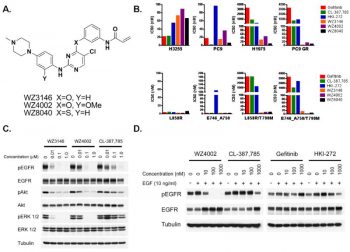
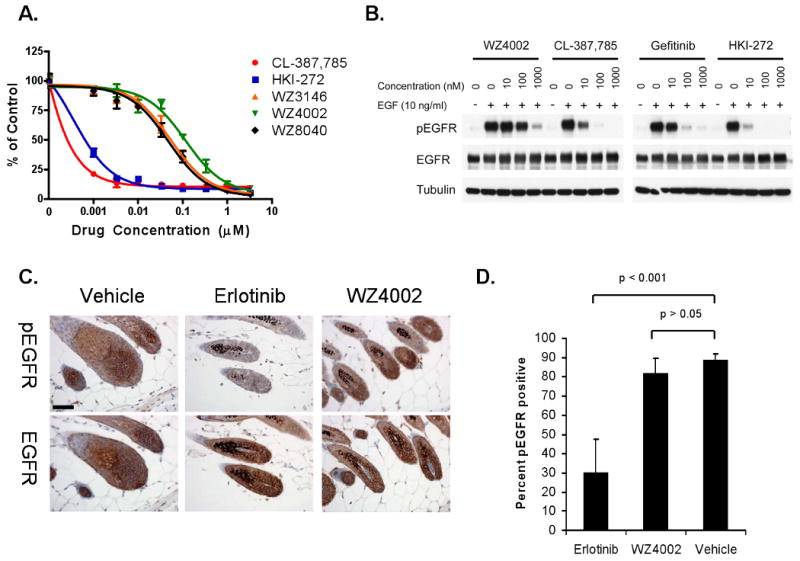
WZ8040 is 30- to 100-fold more potent than quinazoline-based EGFR inhibitors like CL-387785 and HKI-272 against EGFR T790M and up to 100-fold less potent against wild-type EGFR. With IC50 values of 1 nM, 6 nM, 66 nM, 9 nM, and 8 nM, respectively, WZ8040 treatment potently inhibits the growth of HCC827 (EGFR Del E746_A750), PC9 (EGFR Del E746_A750), H3255 (EGFR L858R), H1975 (EGFR L858R/T790M), and PC9 GR (EGFR Del E746_A750/T790M). With IC50 values of >3.3 μM, 738 nM, 915 nM, 744 nM, and 1.82 μM, respectively, WZ8040 weakly inhibits the growth of HCC827 GR (EGFR E746_A750/MET amp), H1819 (ERBB2 amp), Calu-3 (ERBB2 amp), H1781 (ERBB2 Ins G776V, C), and HN11 (EGFR & ERBB2 WT). In A549 (KRAS mutant) or H3122 (EML4-ALK) cells, WZ8040 is not toxic at concentrations up to 10 μM.[1]
WZ8040 dose-dependently inhibited the proliferation of EGFR T790M-mutant non-small cell lung cancer (NSCLC) cell lines, including H1975 (EGFR L858R/T790M, IC₅₀ = 0.03 μM) and HCC827/T790M (EGFR del19/T790M, IC₅₀ = 0.02 μM). It potently blocked EGFR T790M phosphorylation and downstream AKT/ERK1/2 signaling at concentrations ≥ 0.1 μM [1] The drug induced G1 phase cell cycle arrest and apoptosis in H1975 cells with an EC₅₀ of 0.08 μM, upregulating cleaved caspase-3 and PARP expression, and downregulating cyclin D1 [1] In gefitinib-resistant PC9/GR cells, WZ8040 (0.05 μM) restored sensitivity to EGFR inhibition, reducing cell viability by ~80% and suppressing the formation of drug-resistant colonies [1] It showed minimal activity against wild-type EGFR-expressing A431 cells (IC₅₀ = 5.2 μM), demonstrating high mutant selectivity [1] |
| ln Vivo |
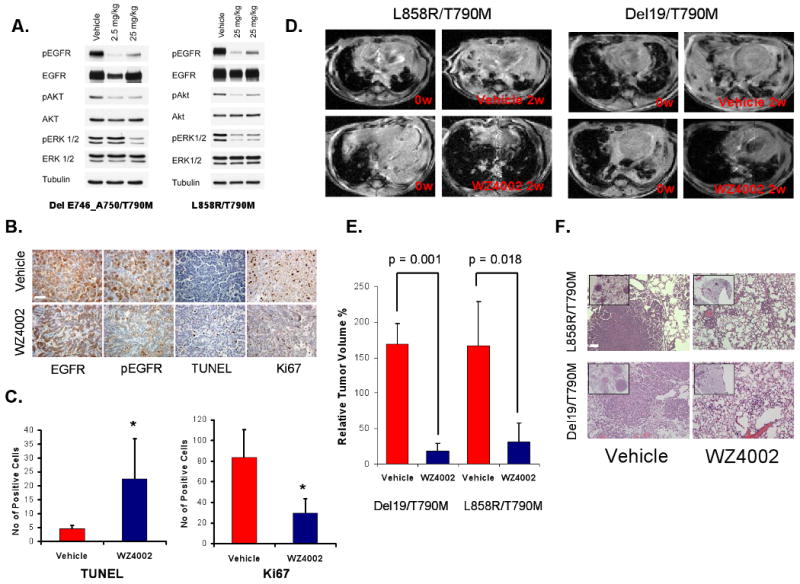
WZ4002 reduces EGFR phosphorylation and causes a notable tumor regression in EGFR T790M-expressing mice.
WZ8040 significantly inhibited tumor growth in nude mice bearing H1975 xenografts. Oral administration of 20 mg/kg/day for 21 days reduced tumor volume by ~75% compared to the control group, and intratumoral EGFR T790M phosphorylation was almost completely blocked [1] In a murine model of HCC827/T790M xenografts, the drug (25 mg/kg/day, oral for 28 days) prolonged median survival by 45% and downregulated Ki-67 (proliferation marker) expression by ~70% in tumor tissues [1] It exhibited excellent tumor penetration, with a tumor-to-plasma concentration ratio of 3.2 at 4 hours post-administration, maintaining effective drug concentrations in tumors for over 12 hours [1] |
| Enzyme Assay |
Recombinant EGFR kinase domains (wild-type, L858R/T790M) were individually incubated with serial dilutions of WZ8040 (0.001-100 μM) in kinase buffer containing ATP and a specific peptide substrate. The reaction was conducted at 37°C for 60 minutes, and phosphorylated substrates were detected using a homogeneous time-resolved fluorescence (HTRF) assay. Inhibition rates were calculated by comparing fluorescence intensity with vehicle controls, and IC₅₀ values were derived from dose-response curves [1]
To confirm covalent binding, WZ8040 was pre-incubated with EGFR T790M kinase domain for 30 minutes before adding ATP and substrate. The reaction was terminated by adding a stop buffer, and phosphorylation levels were quantified to verify time-dependent inhibitory activity [1] To assess selectivity, recombinant HER2 and VEGFR2 kinase domains were tested using the same protocol, and IC₅₀ values were determined to confirm preferential targeting of EGFR T790M [1] |
| Cell Assay |
WZ8040 is added to cells at escalating concentrations for a duration of 72 hours. MTS survival assay is used to measure growth.
H1975, HCC827/T790M, PC9/GR, and A431 cells were seeded in 96-well plates at 5×10³ cells/well and treated with WZ8040 (0.01-10 μM) for 72 hours. Cell viability was measured using a tetrazolium-based assay to calculate IC₅₀ values [1] For Western blot analysis, H1975 cells were treated with 0.05-0.2 μM drug for 24 hours, lysed, and probed with antibodies against phosphorylated EGFR, AKT, ERK1/2, cyclin D1, cleaved caspase-3, PARP, and GAPDH [1] Cell cycle analysis was performed on H1975 cells treated with 0.03-0.1 μM WZ8040 for 24 hours. Cells were fixed with 70% ethanol, stained with propidium iodide, and analyzed by flow cytometry. Apoptosis was detected using Annexin V-FITC/PI double staining [1] Clonogenic assays were conducted by treating PC9/GR cells with 0.02-0.1 μM WZ8040 for 14 days, followed by fixation, staining, and colony counting [1] |
| Animal Protocol |
Nude mice (6-8 weeks old) were subcutaneously implanted with H1975 cells (5×10⁶ cells/mouse) to establish xenograft models. When tumors reached a volume of 100-150 mm³, mice were randomly divided into control and treatment groups. WZ8040 was suspended in 0.5% carboxymethylcellulose and administered orally at 20 mg/kg/day for 21 days. Tumor volume was measured every 3 days using calipers, and mice were euthanized to collect tumors for Western blot analysis of EGFR phosphorylation [1]
Nude mice bearing HCC827/T790M xenografts were treated with WZ8040 orally at 25 mg/kg/day for 28 days. Survival time was recorded daily, and tumor tissues were processed for immunohistochemical staining of Ki-67 [1] For pharmacokinetic studies, mice were given a single oral dose of WZ8040 (20 mg/kg), and blood samples were collected at different time points. Plasma drug concentrations were measured by LC-MS/MS to calculate pharmacokinetic parameters [1] |
| ADME/Pharmacokinetics |
In mice, the bioavailability of a single oral dose of 20 mg/kg WZ8040 is approximately 78%. The maximum plasma concentration (Cmax) is 6.5 μg/mL 1 hour after administration, and the plasma half-life (t₁/₂) is approximately 11.2 hours [1]. In rats, the AUC₀ after oral administration of 25 mg/kg WZ8040 is 72.3 μg·h/mL at 24 hours. The drug is widely distributed in tumor tissues, liver and lungs, with low concentrations in brain tissue (brain-plasma ratio = 0.3) [1]. It is mainly metabolized in the liver by cytochrome P450 3A4, with 68% of the dose excreted in feces and 22% in urine within 7 days [1].
|
| Toxicity/Toxicokinetics |
Mice treated with WZ8040 at a dose of 20 mg/kg/day for 21 consecutive days showed a slight decrease in body weight (approximately 5%), but no significant hepatotoxicity or nephrotoxicity was observed. Serum ALT, AST, and creatinine levels were all within the normal range [1]. The plasma protein binding rate of WZ8040 in human plasma was approximately 94% as determined by balanced dialysis [1]. In long-term toxicity studies (28 days, 25 mg/kg/day, orally), no serious hematological or gastrointestinal toxicity was observed in rats, and no abnormal changes were found in the histopathological analysis of major organs [1].
|
| References | |
| Additional Infomation |
WZ8040 is a third-generation EGFR tyrosine kinase inhibitor (TKI) that covalently binds to cysteine residues (C797) in the ATP binding pocket of EGFR T790M, selectively blocking the kinase activity of mutant EGFR without affecting wild-type EGFR [1]. The development of WZ8040 aims to overcome the T790M-mediated acquired resistance to first-generation EGFR TKIs (such as gefitinib and erlotinib) in non-small cell lung cancer (NSCLC) patients. It has high selectivity for mutants, reducing the risk of targeting toxicity associated with wild-type EGFR inhibition [1]. Preclinical data show that WZ8040 has significant anti-tumor efficacy in EGFR T790M mutant NSCLC models, supporting its entry into clinical trials for the treatment of relapsed or refractory EGFR mutant NSCLC [1].
|
| Molecular Formula |
C24H25CLN6OS
|
|
|---|---|---|
| Molecular Weight |
481.01
|
|
| Exact Mass |
480.149
|
|
| Elemental Analysis |
C, 59.93; H, 5.24; Cl, 7.37; N, 17.47; O, 3.33; S, 6.67
|
|
| CAS # |
1214265-57-2
|
|
| Related CAS # |
|
|
| PubChem CID |
44607531
|
|
| Appearance |
White to off-white solid powder
|
|
| Density |
1.4±0.1 g/cm3
|
|
| Index of Refraction |
1.695
|
|
| LogP |
3.9
|
|
| Hydrogen Bond Donor Count |
2
|
|
| Hydrogen Bond Acceptor Count |
7
|
|
| Rotatable Bond Count |
7
|
|
| Heavy Atom Count |
33
|
|
| Complexity |
640
|
|
| Defined Atom Stereocenter Count |
0
|
|
| SMILES |
CN1CCN(C2=CC=C(C=C2)NC3=NC=C(C(SC4=CC(NC(C=C)=O)=CC=C4)=N3)Cl)CC1
|
|
| InChi Key |
KIISCIGBPUVZBF-UHFFFAOYSA-N
|
|
| InChi Code |
InChI=1S/C24H25ClN6OS/c1-3-22(32)27-18-5-4-6-20(15-18)33-23-21(25)16-26-24(29-23)28-17-7-9-19(10-8-17)31-13-11-30(2)12-14-31/h3-10,15-16H,1,11-14H2,2H3,(H,27,32)(H,26,28,29)
|
|
| Chemical Name |
N-[3-[5-chloro-2-[4-(4-methylpiperazin-1-yl)anilino]pyrimidin-4-yl]sulfanylphenyl]prop-2-enamide
|
|
| Synonyms |
|
|
| HS Tariff Code |
2934.99.9001
|
|
| Storage |
Powder -20°C 3 years 4°C 2 years In solvent -80°C 6 months -20°C 1 month |
|
| Shipping Condition |
Room temperature (This product is stable at ambient temperature for a few days during ordinary shipping and time spent in Customs)
|
| Solubility (In Vitro) |
DMSO: ~96 mg/mL (~199.6 mM)
Water: 1 mg/mL (Insoluble) Ethanol: ~3 mg/mL (~6.2 mM) |
|---|---|
| Solubility (In Vivo) |
Solubility in Formulation 1: ≥ 1 mg/mL (2.08 mM) (saturation unknown) in 10% DMSO + 40% PEG300 + 5% Tween80 + 45% Saline (add these co-solvents sequentially from left to right, and one by one), clear solution.
For example, if 1 mL of working solution is to be prepared, you can add 100 μL of 10.0 mg/mL clear DMSO stock solution to 400 μL of PEG300 and mix evenly; then add 50 μL of Tween-80 to the above solution and mix evenly; then add 450 μL of normal saline to adjust the volume to 1 mL. Preparation of saline: Dissolve 0.9 g of sodium chloride in 100 mL ddH₂ O to obtain a clear solution. Solubility in Formulation 2: ≥ 1 mg/mL (2.08 mM) (saturation unknown) in 10% DMSO + 90% (20% SBE-β-CD in Saline) (add these co-solvents sequentially from left to right, and one by one), clear solution. For example, if 1 mL of working solution is to be prepared, you can add 100 μL of 10.0 mg/mL clear DMSO stock solution to 900 μL of 20% SBE-β-CD physiological saline solution and mix evenly. Preparation of 20% SBE-β-CD in Saline (4°C,1 week): Dissolve 2 g SBE-β-CD in 10 mL saline to obtain a clear solution. (Please use freshly prepared in vivo formulations for optimal results.) |
| Preparing Stock Solutions | 1 mg | 5 mg | 10 mg | |
| 1 mM | 2.0790 mL | 10.3948 mL | 20.7896 mL | |
| 5 mM | 0.4158 mL | 2.0790 mL | 4.1579 mL | |
| 10 mM | 0.2079 mL | 1.0395 mL | 2.0790 mL |
*Note: Please select an appropriate solvent for the preparation of stock solution based on your experiment needs. For most products, DMSO can be used for preparing stock solutions (e.g. 5 mM, 10 mM, or 20 mM concentration); some products with high aqueous solubility may be dissolved in water directly. Solubility information is available at the above Solubility Data section. Once the stock solution is prepared, aliquot it to routine usage volumes and store at -20°C or -80°C. Avoid repeated freeze and thaw cycles.
Calculation results
Working concentration: mg/mL;
Method for preparing DMSO stock solution: mg drug pre-dissolved in μL DMSO (stock solution concentration mg/mL). Please contact us first if the concentration exceeds the DMSO solubility of the batch of drug.
Method for preparing in vivo formulation::Take μL DMSO stock solution, next add μL PEG300, mix and clarify, next addμL Tween 80, mix and clarify, next add μL ddH2O,mix and clarify.
(1) Please be sure that the solution is clear before the addition of next solvent. Dissolution methods like vortex, ultrasound or warming and heat may be used to aid dissolving.
(2) Be sure to add the solvent(s) in order.
WZ4002, WZ3146 and WZ8040 are novel EGFR inhibitors, suppress the growth of EGFR T790M containing cell lines and inhibit EGFR phosphorylation. Nature. 2009 Dec 24; 462(7276): 1070–1074. |
WZ4002 is less potent than quinazoline EGFR inhibitors against wild type EGFR in vitro and in vivo. Nature. 2009 Dec 24; 462(7276): 1070–1074. |
WZ4002 inhibits EGFR phosphorylation and induces significant tumor regression in murine models of EGFR T790M. Nature. 2009 Dec 24; 462(7276): 1070–1074. |
Products are for research use only; We do not sell to patients
Copyright 2020 InvivoChem LLC | All Rights Reserved


 COA
COA