| Size | Price | Stock | Qty |
|---|---|---|---|
| 50mg |
|
||
| 100mg |
|
||
| 250mg |
|
||
| 500mg | |||
| Other Sizes |
Purity: ≥98%
| Targets |
W-7 HCl primarily targets calmodulin (CaM), a calcium-binding messenger protein that mediates many calcium-dependent signaling pathways. By binding to calmodulin, W-7 HCl inhibits calmodulin-dependent enzymes, including Ca2+-calmodulin-dependent phosphodiesterase and myosin light chain kinase. It has IC50 values of 28 μM and 51 μM for these enzymes, respectively.
|
|---|---|
| ln Vitro |
W-7 is mostly found in the cytoplasm and prevents Chinese hamster ovary K1 (CHO-K1) cells from proliferating. W-7 acts in a specific manner to selectively block the G1/S border phase of the cell cycle. Cell growth at the G1/S border phase of the cell cycle can be inhibited by 25 μM W-7 [1]. The degree of antagonism between the contractile responses to KCl and carbachol is similar in W-7 (100 μM). Ten micrograms of carbachol stimulates myosin light chain (P-LC) phosphate level for one minute, while W-7 blocks this increase. By preventing the early rise in P-LC phosphorylation, W-7 inhibits smooth muscle contraction [2]. Multiple human multiple myeloma cell lines exhibit a dose-dependent reduction of cell growth upon treatment with W-7. W-7 upregulates p21cip1 and downregulates cyclins to cause G1 phase cell cycle arrest. W-7 activates caspase to cause apoptosis; this is partially achieved by raising intracellular calcium levels, depolarizing the mitochondrial membrane potential, inhibiting STAT3 phosphorylation, and subsequently downregulating the Mcl-1 protein [3]. With a Ki value of 300 μM, W-7 competitively inhibits phosphodiesterase that is dependent on Ca2+ and calmodulin [4].
In vitro, W-7 HCl is a selective calmodulin antagonist. It inhibits Ca2+-calmodulin-dependent phosphodiesterase and myosin light chain kinase with IC50 values of 28 μM and 51 μM, respectively. It induces apoptosis and has antitumor activity. Its activity is characterized by its ability to inhibit calmodulin-dependent signaling pathways. |
| ln Vivo |
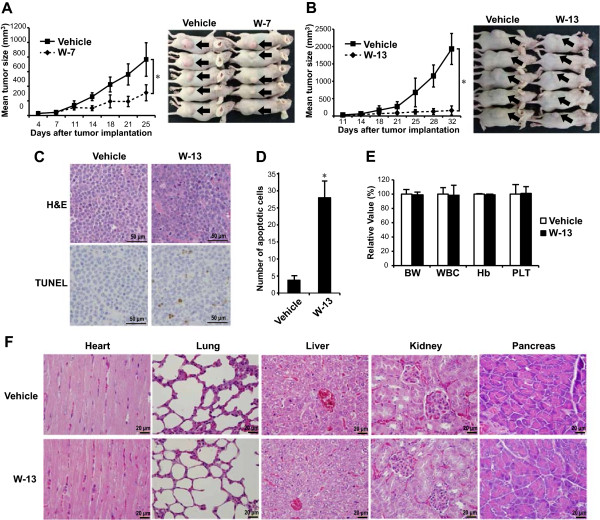
In the mouse model of multiple myeloma, W-7 (3 mg/kg; intraperitoneal injection; 5 consecutive days per week; female BALB/c nu mice) therapy dramatically inhibited tumor growth [3].
Specific in vivo activity data for W-7 HCl is not detailed in the provided search results. As a calmodulin antagonist, it has antitumor activity. By inhibiting calmodulin-dependent signaling pathways, it may inhibit tumor cell growth and induce apoptosis. Further studies are needed to characterize its in vivo efficacy and safety in animal models of cancer. |
| Enzyme Assay |
The in vitro activity of W-7 HCl is assessed using cell-free enzyme activity assays. Calmodulin-dependent phosphodiesterase or myosin light chain kinase is incubated with its substrate and calmodulin in the presence of varying concentrations of W-7 HCl. The enzyme activity is measured, and the IC50 is determined from dose-response curves. For apoptosis studies, cancer cells are treated with W-7 HCl.
|
| Cell Assay |
For cellular assays, cancer cell lines or other relevant cell types are cultured in appropriate media. Cells are treated with various concentrations of W-7 HCl (typically 1-100 µM) for defined periods. Cell viability is assessed using MTT or CellTiter-Glo assays. Apoptosis is evaluated by flow cytometry using Annexin V/PI staining or by measuring caspase-3/7 activity. Calmodulin-dependent signaling is assessed by measuring downstream targets.
|
| Animal Protocol |
Animal/Disease Models: Female BALB/c nu (nude) mice (6 weeks old) were injected with RPMI 8226 cells [3]
Doses: 3 mg/kg Route of Administration: intraperitoneal (ip) injection; 5 days per week Experimental Results: significant in mouse MM model Reduce tumor growth. In vivo, W-7 HCl would be administered to animal models of cancer. The compound is formulated in a suitable vehicle and administered at various doses via intraperitoneal or oral routes. Tumor growth is monitored by measuring tumor volume. At the end of the study, tumors are excised and analyzed for apoptosis and calmodulin-dependent signaling. Pharmacokinetic studies involve measuring W-7 HCl levels in plasma. |
| ADME/Pharmacokinetics |
W-7 HCl has a molecular weight of 377.33 g/mol and a molecular formula of C16H22Cl2N2O2S. It is a selective calmodulin antagonist. The compound is soluble in DMF (20 mg/mL), DMSO (14 mg/mL), and DMSO:PBS (1:1) (0.5 mg/mL). It should be stored as a powder at -20°C under desiccated conditions. Specific pharmacokinetic parameters are not detailed.
|
| Toxicity/Toxicokinetics |
Specific toxicity data for W-7 HCl is not available in the provided search results. As a calmodulin antagonist, it may affect various calcium-dependent cellular processes. The compound is intended for research purposes only and is not approved for human or veterinary use. Standard laboratory safety precautions should be followed when handling the compound. Comprehensive toxicological studies are required.
|
| References |
|
| Additional Infomation |
W-7 HCl is a selective calmodulin antagonist. It inhibits Ca2+-calmodulin-dependent phosphodiesterase and myosin light chain kinase with IC50 values of 28 μM and 51 μM, respectively. W-7 HCl induces apoptosis and has antitumor activity. The compound is not approved for clinical use and is intended for research purposes only.
|
| Molecular Formula |
C16H22CL2N2O2S
|
|---|---|
| Molecular Weight |
377.3291
|
| Exact Mass |
376.077
|
| CAS # |
61714-27-0
|
| Related CAS # |
W-7 isomer hydrochloride;69762-85-2
|
| PubChem CID |
124887
|
| Appearance |
Off-white to yellow solid powder
|
| Boiling Point |
518.8ºC at 760 mmHg
|
| Melting Point |
220-222 °C
|
| Flash Point |
267.6ºC
|
| LogP |
6.264
|
| Hydrogen Bond Donor Count |
3
|
| Hydrogen Bond Acceptor Count |
4
|
| Rotatable Bond Count |
8
|
| Heavy Atom Count |
23
|
| Complexity |
424
|
| Defined Atom Stereocenter Count |
0
|
| SMILES |
O=S(C1=C2C=CC=C(Cl)C2=CC=C1)(NCCCCCCN)=O.[H]Cl
|
| InChi Key |
OMMOSRLIFSCDBL-UHFFFAOYSA-N
|
| InChi Code |
InChI=1S/C16H21ClN2O2S.ClH/c17-15-9-5-8-14-13(15)7-6-10-16(14)22(20,21)19-12-4-2-1-3-11-18/h5-10,19H,1-4,11-12,18H21H
|
| Chemical Name |
N-(6-Aminohexyl)-5-chloro-1-naphthalenesulfonamide hydrochloride
|
| Synonyms |
W-7 HCl W 7 HCl W7 HCl W-7 hydrochloride
|
| HS Tariff Code |
2934.99.9001
|
| Storage |
Powder -20°C 3 years 4°C 2 years In solvent -80°C 6 months -20°C 1 month Note: Please store this product in a sealed and protected environment, avoid exposure to moisture. |
| Shipping Condition |
Room temperature (This product is stable at ambient temperature for a few days during ordinary shipping and time spent in Customs)
|
| Solubility (In Vitro) |
DMSO : ~250 mg/mL (~662.55 mM)
H2O : ~1.43 mg/mL (~3.79 mM) |
|---|---|
| Solubility (In Vivo) |
Solubility in Formulation 1: ≥ 2.08 mg/mL (5.51 mM) (saturation unknown) in 10% DMSO + 40% PEG300 + 5% Tween80 + 45% Saline (add these co-solvents sequentially from left to right, and one by one), clear solution.
For example, if 1 mL of working solution is to be prepared, you can add 100 μL of 20.8 mg/mL clear DMSO stock solution to 400 μL PEG300 and mix evenly; then add 50 μL Tween-80 to the above solution and mix evenly; then add 450 μL normal saline to adjust the volume to 1 mL. Preparation of saline: Dissolve 0.9 g of sodium chloride in 100 mL ddH₂ O to obtain a clear solution. Solubility in Formulation 2: ≥ 2.08 mg/mL (5.51 mM) (saturation unknown) in 10% DMSO + 90% (20% SBE-β-CD in Saline) (add these co-solvents sequentially from left to right, and one by one), clear solution. For example, if 1 mL of working solution is to be prepared, you can add 100 μL of 20.8 mg/mL clear DMSO stock solution to 900 μL of 20% SBE-β-CD physiological saline solution and mix evenly. Preparation of 20% SBE-β-CD in Saline (4°C,1 week): Dissolve 2 g SBE-β-CD in 10 mL saline to obtain a clear solution. View More
Solubility in Formulation 3: ≥ 2.08 mg/mL (5.51 mM) (saturation unknown) in 10% DMSO + 90% Corn Oil (add these co-solvents sequentially from left to right, and one by one), clear solution. |
| Preparing Stock Solutions | 1 mg | 5 mg | 10 mg | |
| 1 mM | 2.6502 mL | 13.2510 mL | 26.5020 mL | |
| 5 mM | 0.5300 mL | 2.6502 mL | 5.3004 mL | |
| 10 mM | 0.2650 mL | 1.3251 mL | 2.6502 mL |
*Note: Please select an appropriate solvent for the preparation of stock solution based on your experiment needs. For most products, DMSO can be used for preparing stock solutions (e.g. 5 mM, 10 mM, or 20 mM concentration); some products with high aqueous solubility may be dissolved in water directly. Solubility information is available at the above Solubility Data section. Once the stock solution is prepared, aliquot it to routine usage volumes and store at -20°C or -80°C. Avoid repeated freeze and thaw cycles.
Calculation results
Working concentration: mg/mL;
Method for preparing DMSO stock solution: mg drug pre-dissolved in μL DMSO (stock solution concentration mg/mL). Please contact us first if the concentration exceeds the DMSO solubility of the batch of drug.
Method for preparing in vivo formulation::Take μL DMSO stock solution, next add μL PEG300, mix and clarify, next addμL Tween 80, mix and clarify, next add μL ddH2O,mix and clarify.
(1) Please be sure that the solution is clear before the addition of next solvent. Dissolution methods like vortex, ultrasound or warming and heat may be used to aid dissolving.
(2) Be sure to add the solvent(s) in order.
|
Products are for research use only; We do not sell to patients
Copyright 2020 InvivoChem LLC | All Rights Reserved


 COA
COA