| Size | Price | Stock | Qty |
|---|---|---|---|
| 5mg |
|
||
| 10mg |
|
||
| 25mg |
|
||
| 50mg |
|
||
| 100mg |
|
||
| 250mg |
|
||
| 500mg | |||
| Other Sizes |


Purity: ≥98%
| Targets |
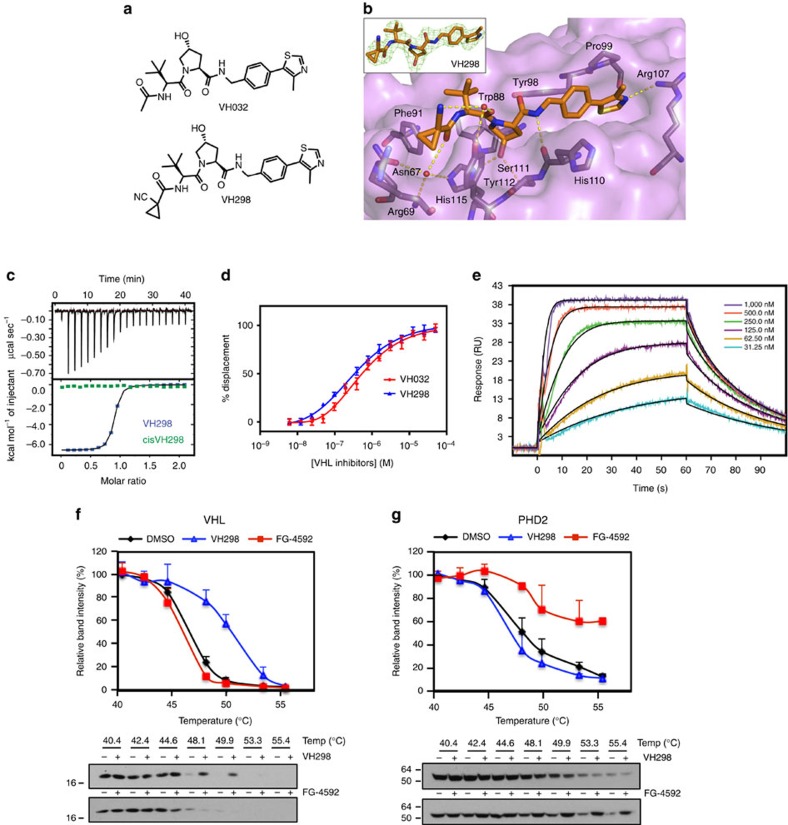
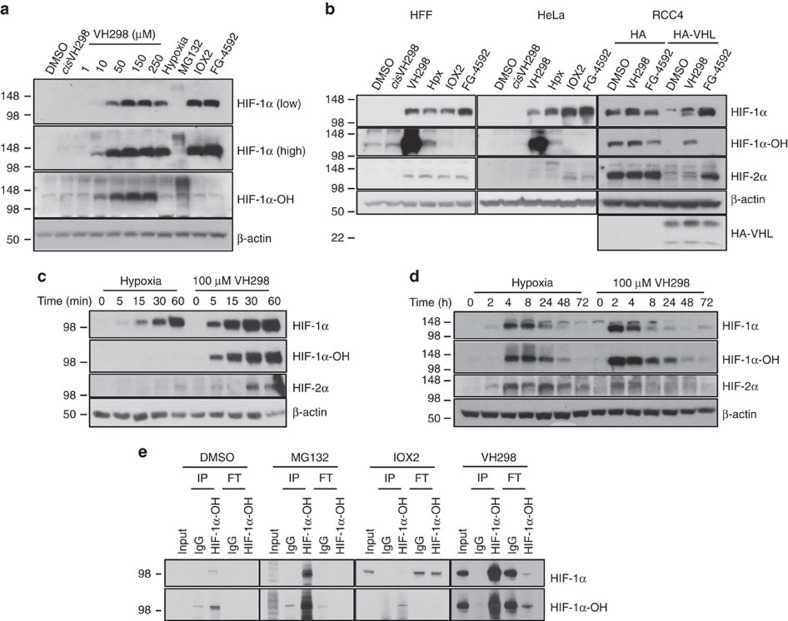
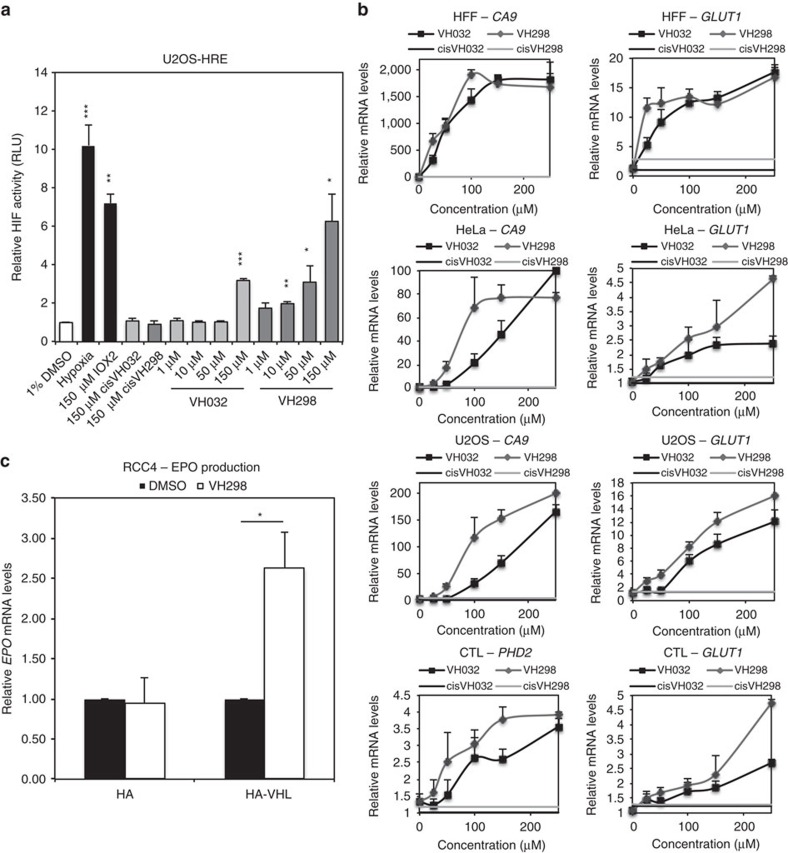
By obstructing the VHL, the powerful, non-toxic, and cell-permeable chemical probe VH-298 causes the hypoxic response. With Kd values of 90 and 80 nM in isothermal titration calorimetry and competitive fluorescence polarization assay, VH-298 is a highly powerful inhibitor of the VHL:HIF-α interaction. VH-298 quickly binds to the VHL complex and takes time to disassociate. When VH-298 is used at a 50 μM concentration, it barely affects more than 100 evaluated cellular kinases, GPCRs, and ion channels in vitro. Cells can pass through VH-298 and it is not hazardous to them. VH-298's permeability is determined to be 19.4 nm s -1 through measurement. VH-298 causes hydroxylated HIF-α to accumulate on-target in a concentration- and time-dependent manner in human cell lines, such as HeLa cancer cells and renal cell carcinoma 4 (RCC4) cells. VH-298 raises EPO mRNA levels by 2.5 times in RCC4-HA-VHL but not in VHL-null RCC4-HA, suggesting that endogenous EPO synthesis can be stimulated by pharmacological inhibition of VHL. While VH-298 and hypoxia both work well to raise PHD2 and HK2 protein levels, in HFF, VH-298 therapy causes a greater increase in BNIP3 protein levels than hypoxia treatment[1].
|
|---|---|
| ln Vitro |
By obstructing the VHL, the powerful, non-toxic, and cell-permeable chemical probe VH-298 causes the hypoxic response. With Kd values of 90 and 80 nM in isothermal titration calorimetry and competitive fluorescence polarization assay, VH-298 is a highly powerful inhibitor of the VHL:HIF-α interaction. VH-298 quickly binds to the VHL complex and takes time to disassociate. When VH-298 is used at a 50 μM concentration, it barely affects more than 100 evaluated cellular kinases, GPCRs, and ion channels in vitro. Cells can pass through VH-298 and it is not hazardous to them. VH-298's permeability is determined to be 19.4 nm s -1 through measurement. VH-298 causes hydroxylated HIF-α to accumulate on-target in a concentration- and time-dependent manner in human cell lines, such as HeLa cancer cells and renal cell carcinoma 4 (RCC4) cells. VH-298 raises EPO mRNA levels by 2.5 times in RCC4-HA-VHL but not in VHL-null RCC4-HA, suggesting that endogenous EPO synthesis can be stimulated by pharmacological inhibition of VHL. While VH-298 and hypoxia both work well to raise PHD2 and HK2 protein levels, in HFF, VH-298 therapy causes a greater increase in BNIP3 protein levels than hypoxia treatment[1].
VH298 stabilizes hydroxylated HIF-α subunits (HIF-1α and HIF-2α) in a concentration- and time-dependent manner in various cell lines (e.g., HeLa, HFF, U2OS, RCC4), leading to the upregulation of HIF-target genes (e.g., CA9, GLUT1, PHD2, PHD3, BNIP3, HK2, EPO) at both mRNA and protein levels. [1] Cellular thermal shift assay (CETSA) demonstrated direct target engagement, showing a significant thermal stabilization of VHL, but not PHD2, in HeLa cell lysates treated with VH298. [1] Chemoproteomic mass spectrometry confirmed selective capture and displacement of the CRL2VHL complex by a linkable VH298 analogue, supporting its on-target specificity. [1] VH298 induces HIF-dependent transcriptional activity, as shown by a dose-dependent increase in HRE-luciferase reporter activity and qRT-PCR analysis of HIF-target genes. It is more potent and cell-permeable than its predecessor VH032. [1] VH298 (up to 150-500 µM) showed negligible cytotoxicity in a range of fibroblast, tumoral, and non-tumoral cell lines, as assessed by CellTiter-Glo viability assays. Its inactive cis-epimer (cisVH298) also showed no toxicity, indicating that potential toxicity is not due to VHL inhibition. [1] |
| Enzyme Assay |
Isothermal Titration Calorimetry (ITC): Experiments were conducted using an ITC200 micro-calorimeter. A solution of VH298 (300 µM) was titrated into a solution containing the VHL-ElonginB:ElonginC (VBC) complex (30 µM). The dissociation constant (Kd) was determined from the binding isotherm. [1]
Competitive Fluorescence Polarization (FP) Assay: Assays were performed in 384-well plates. Each well contained VBC protein (15 nM), a FAM-labeled HIF-1α peptide (10 nM, Kd = 3 nM), and decreasing concentrations of VH298 (two-fold dilutions from 50 µM). Fluorescence polarization was measured (excitation 485 nm, emission 520 nm). IC50 values were determined and Kd values were back-calculated using a displacement binding model. [1] Surface Plasmon Resonance (SPR): VH298 was dissolved in DMSO and diluted in SPR buffer (20 mM HEPES, 150 mM NaCl, 1 mM DTT, 0.005% Tween 20, pH 7.0) to create a concentration series (31.25 nM to 1 µM, 2% final DMSO). Solutions were injected over a sensor chip with immobilized VBC protein at 10°C. Association (kon) and dissociation (koff) rate constants were determined by fitting the sensorgrams to a 1:1 binding model. [1] |
| Cell Assay |
Cell Culture & Treatment: Human cell lines (HFF, HeLa, U2OS, RCC4) were cultured in DMEM supplemented with fetal bovine serum, L-glutamine, and antibiotics. For hypoxia induction, cells were incubated at 1% O2. Cells were treated with VH298 or control compounds (e.g., DMSO, PHD inhibitors IOX2/FG-4592) for specified durations. [1]
Immunoblotting: Cells were lysed in RIPA or Tris lysis buffer containing protease and phosphatase inhibitors. Proteins were resolved by SDS-PAGE, transferred to membranes, and probed with primary antibodies against HIF-1α, HIF-1α-OH (Pro564), HIF-2α, CA9, GLUT1, PHD2, PHD3, BNIP3, HK2, VHL, and β-actin (or SMC1 for CTLs). Detection was performed using HRP-conjugated secondary antibodies and chemiluminescence. [1] Quantitative Real-Time PCR (qRT-PCR): RNA was extracted from treated cells, reverse transcribed, and analyzed by qRT-PCR using SYBR Green. mRNA levels of HIF-target genes (CA9, GLUT1, PHD2, EPO) were normalized to β-actin or TATA-binding protein (TBP) mRNA. [1] Cellular Thermal Shift Assay (CETSA): HeLa cell lysates were treated with VH298 (100 µM) or vehicle for 10-30 min at room temperature. Aliquots were heated at different temperatures (40.4-55.4°C) for 3 min, cooled, and centrifuged. Soluble fractions were analyzed by immunoblotting for VHL and PHD2. Band intensities were quantified relative to the lowest temperature control. [1] Co-immunoprecipitation: HeLa cell lysates (in 1% Triton X-100 buffer) were incubated overnight with an antibody specific for hydroxylated HIF-1α (Pro564) or control IgG. Protein-G-sepharose beads were added to capture immune complexes. After washing, bound proteins were eluted and analyzed by immunoblotting for total HIF-1α. [1] Parallel Artificial Membrane Permeability Assay (PAMPA): Permeability of VH298 was measured using a pre-coated PAMPA plate. A solution of the compound (10 µM in PBS, pH 7.4) was added to the donor chamber, and PBS was added to the acceptor chamber. After 5 hours at room temperature, compound concentration in both chambers was quantified by UPLC-MS/MS. Effective permeability (Pe) was calculated based on the compound's distribution. [1] Cytotoxicity Assay: Cells were seeded in 384-well plates and treated with VH298 or its inactive cis-epimer for 24 hours. Cell viability was assessed using the CellTiter-Glo Luminescent Cell Viability Assay, which measures ATP content. Luminescence was measured using a plate reader. For cytotoxic T lymphocytes (CTLs), cell death was assessed by DAPI staining and flow cytometry after 24-hour treatment. [1] |
| References | |
| Additional Infomation |
VH298 is a high-quality chemical probe that can be used to study the hypoxia signaling pathway by selectively inhibiting the VHL:HIF-α interaction downstream of HIF-α hydroxylation, a mechanism different from that of PHD enzyme inhibitors. It provides a starting point for developing therapies targeting the hypoxia signaling pathway, such as for the treatment of anemia or ischemic diseases. [1] The compound also has potential use as a VHL ligand for the design of PROTAC (proteolytic-targeted chimeras), where its HIF stabilizing activity can be separated from its E3 ligase recruitment function at lower concentrations. [1]
|
| Molecular Formula |
C27H33N5O4S
|
|
|---|---|---|
| Molecular Weight |
523.6470
|
|
| Exact Mass |
523.225
|
|
| CAS # |
2097381-85-4
|
|
| Related CAS # |
|
|
| PubChem CID |
122199236
|
|
| Appearance |
Off-white to pink solid powder
|
|
| LogP |
2.5
|
|
| Hydrogen Bond Donor Count |
3
|
|
| Hydrogen Bond Acceptor Count |
7
|
|
| Rotatable Bond Count |
8
|
|
| Heavy Atom Count |
37
|
|
| Complexity |
931
|
|
| Defined Atom Stereocenter Count |
3
|
|
| SMILES |
S1C([H])=NC(C([H])([H])[H])=C1C1C([H])=C([H])C(=C([H])C=1[H])C([H])([H])N([H])C([C@]1([H])C([H])([H])[C@]([H])(C([H])([H])N1C([C@]([H])(C(C([H])([H])[H])(C([H])([H])[H])C([H])([H])[H])N([H])C(C1(C#N)C([H])([H])C1([H])[H])=O)=O)O[H])=O
|
|
| InChi Key |
NDVQUNZCNAMROD-RZUBCFFCSA-N
|
|
| InChi Code |
InChI=1S/C27H33N5O4S/c1-16-21(37-15-30-16)18-7-5-17(6-8-18)12-29-23(34)20-11-19(33)13-32(20)24(35)22(26(2,3)4)31-25(36)27(14-28)9-10-27/h5-8,15,19-20,22,33H,9-13H2,1-4H3,(H,29,34)(H,31,36)/t19-,20+,22-/m1/s1
|
|
| Chemical Name |
|
|
| Synonyms |
|
|
| HS Tariff Code |
2934.99.9001
|
|
| Storage |
Powder -20°C 3 years 4°C 2 years In solvent -80°C 6 months -20°C 1 month |
|
| Shipping Condition |
Room temperature (This product is stable at ambient temperature for a few days during ordinary shipping and time spent in Customs)
|
| Solubility (In Vitro) |
|
|||
|---|---|---|---|---|
| Solubility (In Vivo) |
Solubility in Formulation 1: ≥ 2.5 mg/mL (4.77 mM) (saturation unknown) in 10% DMSO + 40% PEG300 + 5% Tween80 + 45% Saline (add these co-solvents sequentially from left to right, and one by one), clear solution.
For example, if 1 mL of working solution is to be prepared, you can add 100 μL of 25.0 mg/mL clear DMSO stock solution to 400 μL PEG300 and mix evenly; then add 50 μL Tween-80 to the above solution and mix evenly; then add 450 μL normal saline to adjust the volume to 1 mL. Preparation of saline: Dissolve 0.9 g of sodium chloride in 100 mL ddH₂ O to obtain a clear solution. Solubility in Formulation 2: ≥ 2.5 mg/mL (4.77 mM) (saturation unknown) in 10% DMSO + 90% (20% SBE-β-CD in Saline) (add these co-solvents sequentially from left to right, and one by one), clear solution. For example, if 1 mL of working solution is to be prepared, you can add 100 μL of 25.0 mg/mL clear DMSO stock solution to 900 μL of 20% SBE-β-CD physiological saline solution and mix evenly. Preparation of 20% SBE-β-CD in Saline (4°C,1 week): Dissolve 2 g SBE-β-CD in 10 mL saline to obtain a clear solution. View More
Solubility in Formulation 3: ≥ 2.5 mg/mL (4.77 mM) (saturation unknown) in 10% DMSO + 90% Corn Oil (add these co-solvents sequentially from left to right, and one by one), clear solution. |
| Preparing Stock Solutions | 1 mg | 5 mg | 10 mg | |
| 1 mM | 1.9097 mL | 9.5484 mL | 19.0967 mL | |
| 5 mM | 0.3819 mL | 1.9097 mL | 3.8193 mL | |
| 10 mM | 0.1910 mL | 0.9548 mL | 1.9097 mL |
*Note: Please select an appropriate solvent for the preparation of stock solution based on your experiment needs. For most products, DMSO can be used for preparing stock solutions (e.g. 5 mM, 10 mM, or 20 mM concentration); some products with high aqueous solubility may be dissolved in water directly. Solubility information is available at the above Solubility Data section. Once the stock solution is prepared, aliquot it to routine usage volumes and store at -20°C or -80°C. Avoid repeated freeze and thaw cycles.
Calculation results
Working concentration: mg/mL;
Method for preparing DMSO stock solution: mg drug pre-dissolved in μL DMSO (stock solution concentration mg/mL). Please contact us first if the concentration exceeds the DMSO solubility of the batch of drug.
Method for preparing in vivo formulation::Take μL DMSO stock solution, next add μL PEG300, mix and clarify, next addμL Tween 80, mix and clarify, next add μL ddH2O,mix and clarify.
(1) Please be sure that the solution is clear before the addition of next solvent. Dissolution methods like vortex, ultrasound or warming and heat may be used to aid dissolving.
(2) Be sure to add the solvent(s) in order.
Biophysical and structural characterization of VH298, a new potent VHL inhibitor.. From: Potent and selective chemical probe of hypoxic signalling downstream of HIF-α hydroxylation via VHL inhibition.Nat Commun.2016 Nov 4;7:13312. |
VH298 induces concentration- and time-dependent on-target specific accumulation of hydroxylated HIF-α in human cell lines.. From: Potent and selective chemical probe of hypoxic signalling downstream of HIF-α hydroxylation via VHL inhibition.Nat Commun.2016 Nov 4;7:13312. |
VHL inhibitors induce HIF-α transcriptional activity in various cell lines.. From: Potent and selective chemical probe of hypoxic signalling downstream of HIF-α hydroxylation via VHL inhibition.Nat Commun.2016 Nov 4;7:13312. |
Products are for research use only; We do not sell to patients
Copyright 2020 InvivoChem LLC | All Rights Reserved


 COA
COA