| Size | Price | Stock | Qty |
|---|---|---|---|
| 2mg |
|
||
| 5mg |
|
||
| 10mg |
|
||
| 25mg |
|
||
| 50mg |
|
||
| 100mg |
|
||
| 250mg |
|
||
| Other Sizes |


Purity: ≥98%
| Targets |
Src family kinases: Src (IC₅₀ ≈ 280 nM), Lck (IC₅₀ ≈ 110 nM), Fyn (IC₅₀ ≈ 160 nM), Yes (IC₅₀ ≈ 240 nM); non-Src kinases: EGFR (IC₅₀ > 1000 nM), Abl (IC₅₀ > 1000 nM), PKCα (IC₅₀ > 1000 nM), PLCγ (IC₅₀ > 1000 nM), showing high selectivity for Src family kinases [1]
SU6656 was used as a selective Src family kinase inhibitor to block Src-mediated signaling in respective cell/tissue models [2][4][5][6] |
|---|---|
| ln Vitro |
In HNSCC cells, SU6656 lowers the phosphorylation of Src family kinase (SFK) [2].
In NIH3T3 fibroblasts (Src-transformed) and A431 epidermoid carcinoma cells: SU6656 (1 μM–10 μM) concentration-dependently inhibited Src phosphorylation at Tyr416 (Western blot). At 5 μM, p-Src levels decreased by ~70% (NIH3T3) and ~65% (A431) vs. control. It also suppressed downstream Src signaling: p-ERK1/2 (Thr202/Tyr204) and p-AKT (Ser473) levels reduced by ~55% and ~50% (5 μM, A431), respectively. Additionally, SU6656 (10 μM) inhibited EGF-induced cell proliferation (MTT assay) by ~40% in A431 cells [1] - In human head and neck squamous cell carcinoma (HNSCC) cell lines (SCC-25, FaDu): SU6656 (2.5 μM–10 μM) reduced Src kinase activity (p-Src Tyr416 down by ~60% at 5 μM, Western blot). This inhibition destabilized E-cadherin-based adherens junctions: E-cadherin expression at cell membranes decreased by ~50% (immunofluorescence), and collective cell migration (scratch assay) was inhibited by ~45% (5 μM, 24 h) [2] - In human melanoma cell lines (A375, SK-MEL-28): SU6656 (5 μM–20 μM) concentration-dependently inhibited mTORC1 activity: p-p70S6K (Thr389) and p-4E-BP1 (Thr37/46) levels decreased by ~70% and ~65% (10 μM, 24 h), respectively (Western blot). Notably, it did not activate Akt/PKB (p-Akt Ser473 unchanged vs. control) [4] - In human acute myeloid leukemia (AML) cell lines (HL-60, U937): SU6656 (1 μM–5 μM) enhanced the antitumor effect of anti-CD33 immunotoxin (IT). At 3 μM, SU6656 + IT reduced cell viability (MTT assay) by ~65%, compared to ~30% with IT alone. This synergy was associated with reduced Src-mediated IT resistance (p-Src Tyr416 down by ~55% at 3 μM) [6] |
| ln Vivo |
Fall time increase caused by ischemia postconditioning (IPoCo) is greatly reduced by SU6656 (2-4 mg/kg; i.p.; once) [5].
In ICR mouse model of cerebral ischemia-reperfusion (ischemic postconditioning, IPC): Mice were divided into sham, ischemia-reperfusion (I/R), I/R + IPC, and I/R + IPC + SU6656 groups. SU6656 was administered via intraperitoneal injection (10 mg/kg) 30 minutes before IPC. Compared to I/R + IPC group: (1) Neurological deficit score (0–5 scale) increased from 1.2 to 2.8 (worse function), indicating reversed neuroprotection; (2) Cerebral infarct volume (TTC staining) increased by ~40%; (3) Western blot of brain tissues showed reduced p-Src Tyr416 levels (by ~50%) in I/R + IPC group, which was restored by SU6656 [5] |
| Enzyme Assay |
Recombinant Src family kinase activity assay: Recombinant human Src, Lck, Fyn, Yes, and non-Src kinases (EGFR, Abl) were expressed in E. coli and purified via affinity chromatography. The reaction was conducted in 50 μL buffer containing 50 mM Tris-HCl (pH 7.5), 10 mM MgCl₂, 1 mM DTT, 10 μM ATP (including [γ-³²P]ATP), 20 μM Src-specific peptide substrate (KKEEEEYMMMM), and SU6656 (0.1 μM–1000 μM, solvent as control). Incubation at 30°C for 60 minutes, then terminated by adding 25 μL 0.5 M EDTA. Phosphorylated substrate was spotted onto phosphocellulose filters, washed with 0.75% phosphoric acid, and radioactivity was measured via scintillation counting. Inhibition rates were calculated, and IC₅₀ values were determined by fitting to a dose-response curve [1]
|
| Cell Assay |
Src phosphorylation and signaling assay (NIH3T3/A431): Cells were seeded in 6-well plates, serum-starved (0.5% FBS) overnight, then treated with SU6656 (0 μM–10 μM) for 2 hours (NIH3T3) or pretreated with SU6656 for 1 hour followed by EGF (100 ng/mL) stimulation for 15 minutes (A431). Cells were lysed with RIPA buffer (含 protease/phosphatase inhibitors), 30 μg protein separated by SDS-PAGE, transferred to PVDF membranes. Membranes were probed with antibodies against p-Src Tyr416, total Src, p-ERK1/2, p-AKT, and β-actin. Signals were detected via ECL, quantified with ImageJ [1]
- HNSCC cell migration and E-cadherin assay (SCC-25/FaDu): (1) Migration: Scratch wounds were made in confluent cells, treated with SU6656 (0 μM–10 μM). Wound closure was imaged at 0 and 24 hours, and closure rate was calculated; (2) E-cadherin: Cells were fixed with 4% paraformaldehyde, permeabilized with 0.1% Triton X-100, stained with anti-E-cadherin antibody and DAPI. Fluorescence intensity at cell junctions was quantified via confocal microscopy [2] - Melanoma mTORC1 assay (A375/SK-MEL-28): Cells were treated with SU6656 (0 μM–20 μM) for 24 hours, lysed, and Western blot was performed to detect p-p70S6K Thr389, p-4E-BP1 Thr37/46, total p70S6K, total 4E-BP1, p-AKT Ser473, and total AKT [4] - AML cell viability assay (HL-60/U937): Cells were seeded in 96-well plates (5×10³ cells/well), treated with SU6656 (0 μM–5 μM) alone or combined with anti-CD33 immunotoxin (0.1 μg/mL) for 72 hours. MTT reagent was added, absorbance at 570 nm measured, and viability was calculated as (drug group absorbance/control absorbance) × 100% [6] |
| Animal Protocol |
Animal/Disease Models: Swiss albino male mice[5]
Doses: 2, 4 mg/kg Route of Administration: intraperitoneal (ip)injection; once Experimental Results: Dramatically diminished IPoCo mediated increase in fall down time. Mouse cerebral ischemia-reperfusion model: Male ICR mice (8–10 weeks old, 25–30 g) were housed in SPF facilities (22–25°C, 12 h light/dark cycle). Ischemia was induced by transient middle cerebral artery occlusion (MCAO) using a nylon suture (60 minutes), followed by reperfusion. Groups: (1) Sham: No MCAO; (2) I/R: MCAO + reperfusion; (3) I/R + IPC: MCAO + 3 cycles of 10s reperfusion/10s ischemia before full reperfusion; (4) I/R + IPC + SU6656: SU6656 dissolved in 5% DMSO + 10% Cremophor EL + 85% normal saline, administered intraperitoneally (10 mg/kg, 10 μL/g body weight) 30 minutes before IPC. At 24 hours after reperfusion: (1) Neurological deficit score was evaluated (0 = normal, 5 = death); (2) Brains were harvested, sliced, stained with TTC to measure infarct volume; (3) Cortical tissues were lysed for Western blot (p-Src Tyr416, total Src) [5] |
| Toxicity/Toxicokinetics |
In ICR mice treated with SU6656 (10 mg/kg, intraperitoneal injection, single dose): no significant weight loss (<5% vs. baseline) or death was observed within 24 hours. Serum ALT, AST, creatinine, and BUN levels were not measured. [5]
|
| References |
|
| Additional Infomation |
SU6656 is a selective small molecule Src family kinase inhibitor that is widely used as a tool to study Src-mediated signaling pathways such as growth factor signaling and cell adhesion/migration. SU6656’s high selectivity for non-Src kinases minimizes off-target effects in experimental models [1] - In head and neck squamous cell carcinoma (HNSCC), SU6656 revealed the role of Src in stabilizing E-cadherin junctions and regulating collective cell migration, suggesting that Src could be a target for inhibiting HNSCC metastasis [2] - In melanoma, SU6656 inhibited mTORC1 independently of Akt activation, providing insights into the Src-mTORC1 interaction and potential combination therapies for melanoma [4] - SU6656 eliminated the neuroprotective effect of ischemic posttreatment in mice by blocking Src activation, indicating that Src is a key mediator of IPC-induced neuroprotection [5] - In acute myeloid leukemia (AML), SU6656 enhanced the efficacy of anti-CD33 immunotoxins by overcoming Src-mediated resistance, supporting the anti-CD33 immunotoxin effect of Src. Src inhibitors as adjuvants to immunotoxin-based cancer therapy [6]
|
| Molecular Formula |
C19H21N3O3S
|
|
|---|---|---|
| Molecular Weight |
371.45
|
|
| Exact Mass |
371.13
|
|
| CAS # |
330161-87-0
|
|
| Related CAS # |
|
|
| PubChem CID |
5312137
|
|
| Appearance |
Yellow to orange solid powder
|
|
| Density |
1.4±0.1 g/cm3
|
|
| Index of Refraction |
1.657
|
|
| LogP |
3.46
|
|
| Hydrogen Bond Donor Count |
2
|
|
| Hydrogen Bond Acceptor Count |
4
|
|
| Rotatable Bond Count |
3
|
|
| Heavy Atom Count |
26
|
|
| Complexity |
697
|
|
| Defined Atom Stereocenter Count |
0
|
|
| SMILES |
CN(C)S(=O)(=O)C1=CC\2=C(C=C1)NC(=O)/C2=C\C3=CC4=C(N3)CCCC4
|
|
| InChi Key |
LOGJQOUIVKBFGH-YBEGLDIGSA-N
|
|
| InChi Code |
InChI=1S/C19H21N3O3S/c1-22(2)26(24,25)14-7-8-18-15(11-14)16(19(23)21-18)10-13-9-12-5-3-4-6-17(12)20-13/h7-11,20H,3-6H2,1-2H3,(H,21,23)/b16-10-
|
|
| Chemical Name |
(Z)-N,N-dimethyl-2-oxo-3-((4,5,6,7-tetrahydro-1H-indol-2-yl)methylene)indoline-5-sulfonamide
|
|
| Synonyms |
SU 6656; SU-6656; SU6656;
|
|
| HS Tariff Code |
2934.99.9001
|
|
| Storage |
Powder -20°C 3 years 4°C 2 years In solvent -80°C 6 months -20°C 1 month |
|
| Shipping Condition |
Room temperature (This product is stable at ambient temperature for a few days during ordinary shipping and time spent in Customs)
|
| Solubility (In Vitro) |
DMSO: 74 mg/mL (199.2 mM)
Water: 1 mg/mL (Insoluble) Ethanol: 1 mg/mL |
|---|---|
| Solubility (In Vivo) |
Solubility in Formulation 1: ≥ 2 mg/mL (5.38 mM) (saturation unknown) in 10% DMSO + 40% PEG300 + 5% Tween80 + 45% Saline (add these co-solvents sequentially from left to right, and one by one), clear solution.
For example, if 1 mL of working solution is to be prepared, you can add 100 μL of 20.0 mg/mL clear DMSO stock solution to 400 μL PEG300 and mix evenly; then add 50 μL Tween-80 to the above solution and mix evenly; then add 450 μL normal saline to adjust the volume to 1 mL. Preparation of saline: Dissolve 0.9 g of sodium chloride in 100 mL ddH₂ O to obtain a clear solution. Solubility in Formulation 2: 10% DMSO+dd H2O: 16mg/mL (Please use freshly prepared in vivo formulations for optimal results.) |
| Preparing Stock Solutions | 1 mg | 5 mg | 10 mg | |
| 1 mM | 2.6922 mL | 13.4608 mL | 26.9215 mL | |
| 5 mM | 0.5384 mL | 2.6922 mL | 5.3843 mL | |
| 10 mM | 0.2692 mL | 1.3461 mL | 2.6922 mL |
*Note: Please select an appropriate solvent for the preparation of stock solution based on your experiment needs. For most products, DMSO can be used for preparing stock solutions (e.g. 5 mM, 10 mM, or 20 mM concentration); some products with high aqueous solubility may be dissolved in water directly. Solubility information is available at the above Solubility Data section. Once the stock solution is prepared, aliquot it to routine usage volumes and store at -20°C or -80°C. Avoid repeated freeze and thaw cycles.
Calculation results
Working concentration: mg/mL;
Method for preparing DMSO stock solution: mg drug pre-dissolved in μL DMSO (stock solution concentration mg/mL). Please contact us first if the concentration exceeds the DMSO solubility of the batch of drug.
Method for preparing in vivo formulation::Take μL DMSO stock solution, next add μL PEG300, mix and clarify, next addμL Tween 80, mix and clarify, next add μL ddH2O,mix and clarify.
(1) Please be sure that the solution is clear before the addition of next solvent. Dissolution methods like vortex, ultrasound or warming and heat may be used to aid dissolving.
(2) Be sure to add the solvent(s) in order.
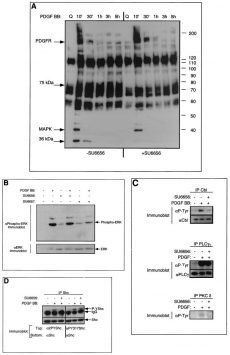
Effect of SU6656 on tyrosine phosphorylation.Mol Cell Biol.2000 Dec;20(23):9018-27. |
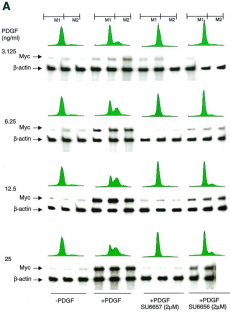
SU6656 inhibits PDGF-stimulated c-Myc induction.Mol Cell Biol.2000 Dec;20(23):9018-27. |
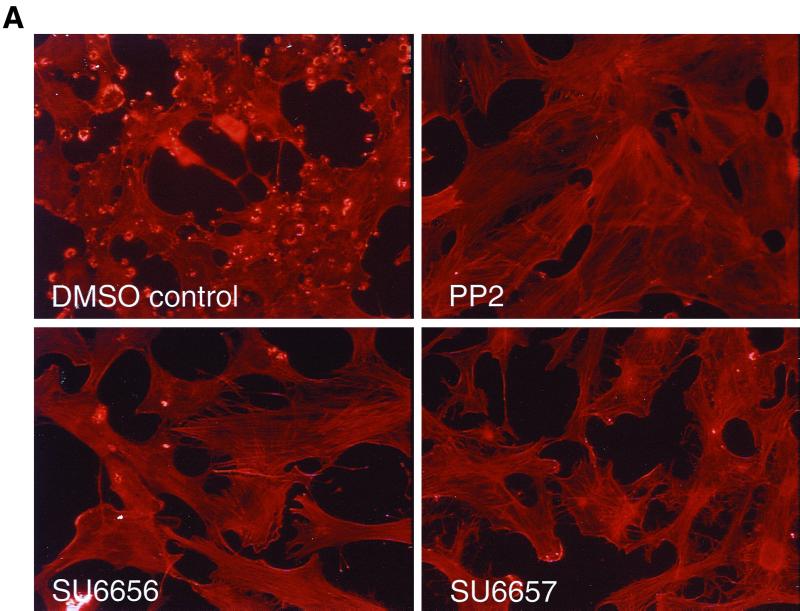
Effects of PP2, SU6656, and SU6657.
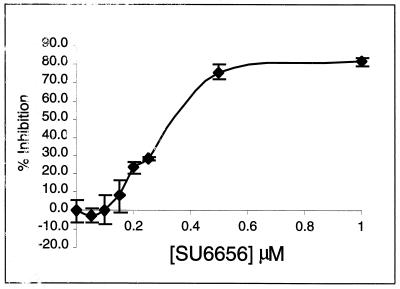
Inhibition of PDGF-stimulated NIH 3T3 cell DNA synthesis.Mol Cell Biol.2000 Dec;20(23):9018-27. |
Products are for research use only; We do not sell to patients
Copyright 2020 InvivoChem LLC | All Rights Reserved


 COA
COA